Fermentation Rootbeer


FERMENTATION – MAKING ROOT BEER
David Fankhauser’s Main Page


Introduction:

Fermentation has been used by mankind for thousands of years for raising bread, fermenting wine and brewing beer. The products of the fermentation of sugar by baker’s yeast Saccharomyces cerevisiae (a fungus) are ethyl alcohol and carbon dioxide. Carbon dioxide causes bread to rise and gives effervescent drinks their bubbles. This action of yeast on sugar is used to ‘carbonate’ beverages, as in the addition of bubbles to champagne).

We will set up a fermentation in a closed system and capture the generated carbon dioxide to carbonate root beer. You may of course adjust the quantities of sugar and/or extract  (Zatarain’s) to taste. 

EQUIPMENT
SUPPLIES
  • clean 2 liter plastic soft drink bottle with cap
  • funnel
  • 1 cup measuring cup
  • 1/4 tsp measuring spoon
  • 1 Tbl measuring spoon
  • Cane (table) sugar [sucrose] (1 cup)
  • Zatarain’s Root Beer Extract (1 tablespoon)
  • (When I could not find it locally, I ordered a case of 12 bottles for $18 from Zatarain’s, New Orleans, LA 70114
  • powdered baker’s yeast (1/4 teaspoon)  (Yeast for brewing would certainly work at least as well as baking yeast.)
  • cold fresh water


INSTRUCTIONS:

1) Assemble the necessary equipment and supplies
2) With a dry funnel, add in sequence:

1 level cup of table sugar (cane sugar) (You can adjust the amount to achieve the desired sweetness.)

3) Add: 1/4 teaspoon powdered baker’s yeast ( fresh and active)

(Fleischmann’s or other brand)

4) You can see the yeast granules on top of the sugar.
5) Shake to distribute the yeast grains into the sugar.
6) Swirl the sugar/yeast mixture in the bottom to make it concave (to catch the extract).
7) Add with funnel:

1 Tbl of root beer extract (I prefer Zatarain’s, but Hires, etc. will work.)

on top of the dry sugar

8) The extract sticks to the sugar which will help dissolve the extract in the next steps.
9) Half fill the bottle with fresh cool tap water (the less chlorine, the better).

Rinse in the extract which sticks to the tablespoon and funnel. Swirl to dissolve the ingredients.

10) Q.s. [fill up] to the neck of the bottle with fresh cool tap water, leaving about an inch of head space, securely screw cap down to seal. Invert repeatedly to thoroughly dissolve.

If you leave it in a warm temperature longer than two weeks, you risk an explosion…

11) Place at room temperature about three to four days until the bottle feels hard to a forceful squeeze. Move to a cool place (below 65 F). refrigerate overnight to thoroughly chill before serving. Crack the lid of the thoroughly chilled root beer just a little to release the pressure slowly.

NOTE: Do not leave the finished root beer in a warm place once the bottle feels hard. After a couple weeks or so at room temperature, especially in the summer when the temperature is high, enough pressure may build up to explode the bottle! There is no danger of this if the finished root beer is refrigerated.

12) Move to a refrigerator overnight before opening.


NOTE: There will be a sediment of yeast at the bottom of the bottle, so that the last bit of root beer will be turbid. Decant carefully if you wish to avoid this sediment.

A WORD ABOUT THE ALCOHOL IN HOME MADE ROOT BEER: The alcoholic content which results from the fermentation of this root beer and found it to be between 0.35 and 0.5 %. Comparing this to the 6% in many beers, it would require a person to drink about a gallon and a half of this root beer to be equivalent to one 12 ounce beer. I would call this amount of alcohol negligible, but for persons with metabolic problems who cannot metabolize alcohol properly, or religious prohibition against any alcohol,  consumption should be limited or avoided.


Food Chemistry


Food Chemistry

Introduction:

All living things are made up of one or more cells, and the cells in turn contain many kinds of molecules.  In this lab we will be looking at several different macromolecules (large molecules): proteins, carbohydrates, and lipids (specifically fats).  Various chemicals will be used in this laboratory to test for the presence of these molecules.  Most often, you will be looking for a particular color change.  If the change is observed, the test is said to be positive because it indicates that a particular molecule is present.  If the color change is not observed, the test is said to be negative because it indicates that a particular molecule is not present.

You will be using these tests to determine which of the macromolecules are present in various samples of food.

In all of the procedures, you will need to include a distilled water sample as a control.  Usually, a control goes through all the steps of the experiment but lacks one essential factor (the experimental variable).  This missing factor allows you to observe the difference between a positive result and a negative result.  If the control sample tests positive, you know your test is invalid.  Some tests may also contain other controls to make sure certain additives are not contaminated with the substance for which you are testing.

Proteins:

Protein molecules are long chains of amino acids joined by peptide bonds.

Biuret reagent, which is a blue color, contains a strong solution of sodium or potassium hydroxide (NaOH or KOH) and a very small amount of very dilute copper sulfate (CuSO4) solution.  The reagent changes color in the presence of proteins or peptides because the amino group (H2N-) of the protein or peptide chemically combines with the copper ions in biuret reagent.

Carbohydrates:

Carbohydrates include sugars and molecules that are chains of sugars.  Glucose is a simple sugar, also known as a monosaccharide.  Sucrose, or table sugar is a disaccharide, two sugar units bonded together.  Starch is a polysaccharide, a long chain of glucose units.

Benedict’s reagent reacts with many sugars (both mono- and disaccharides) after being heated in a boiling water bath.  Increasing concentrations of sugar give a continuum of colored products ranging from green through yellow and orange to orange red.

Iodine solution reacts with starch to produce colors ranging from a brownish to blue black.

Lipids:

Lipids are hydrophobic molecules which are insoluble in water and soluble in solvents such as alcohol and ether.  Lipids include fats, oils, and cholesterol.

Lipids do not evaporate from brown paper, instead leaving an oily spot.  Lipids also do not mix with water, forming a separate layer, usually on top of the water.  However, some molecules mix with both water and lipids, and can be used to mix the two.  These molecules are known as emulsifiers.  The liver produces bile salts which act as emulsifiers in the digestive tract.  Soaps and detergents also act as emulsifiers.

Summary of tests:


Biuret Reagent
Benedict’s Reagent
Iodine Solution
Brown Paper
Reacts with proteins or peptides, turns purple (protein) or pink (peptides) Reacts with sugars, turns green through yellow to orange (green, less sugar, orange, more sugar) Reacts with starch, turns dark brown to black Lipids leave oily spot

Procedure:

Take some time to plan with your lab partner what tests you will do, and in what order before beginning the procedures.

There are available in the lab a variety of different types of common food.  Choose at least 3 foods and test each for the presence of protein, carbohydrate (both starch and simple sugars), and fats.  Be sure to plan your experiments before starting.

Form a hypothesis for each sample you have chosen to test.

Samples will need to be suspended in water for most tests.  Using a mortar and pestle if necessary, break each sample to be tested into small pieces and suspend the pieces in a small amount of distilled water.

Also available are samples of each of the types of molecules for which you will be testing.  Use these samples to try out the tests so that you will know what a positive result looks like.

Be sure to include a blank control (distilled water) with each test so you know what a negative result looks like.  You may also include a positive control, a sample which you know contains the substance for which you are testing.

The procedures for testing for each type of molecule are given below.

Proteins and Peptides

Proteins:

  1. Use a separate test tube for each sample to be tested, as well as one for a control.
  2. Label each test tube.
  3. Place about 1 mL of each sample (and control) in its test tube.
  4. Add 5 drops of copper sulfate solution to each tube.
  5. Add 10 drops of potassium hydroxide solution to each tube and mix.
  6. Record the tube contents and final color in a data table.
  7. Conclusions: which tubes contained protein?

Carbohydrates: Sugars and starch

Starch

  1. Use a separate test tube for each sample to be tested, as well as one (or two) for a control.
  2. Label each test tube.
  3. Place about 1 mL of each sample (and control) in its test tube.
  4. Add 5 drops of iodine solution to each tube and mix.
  5. Record the tube contents and final color in a data table.
  6. Conclusions: which tubes contained starch?

Sugar

  1. Use a separate test tube for each sample to be tested, as well as one (or two) for a control.
  2. Label each test tube.
  3. Place about 1 mL of each sample (and control) in its test tube.
  4. Add about 2 mL of Benedict’s reagent to each tube and mix.
  5. Heat the tubes in a boiling water bath for 5-10 minutes.
  6. Record the tube contents and final color in a data table.
  7. Conclusions: which tubes contained sugar?

Lipids

  1. Place a small sample of the material to be tested on a square of brown paper.
  2. Place a small drop of water on the square of brown paper.
  3. Compare the drop of water to the sample.
  4. Wait at least 5 minutes.  Evaluate which substance impregnates the paper and which is subject to evaporation.  Record your results.
  5. Conclusions: which sample contained lipids?

Conclusion Questions:

  1. Why do experimental procedures include control samples?
  2. How would you test an unknown solution for each of the following:
    1. Sugars
    2. Fat
    3. Starch
    4. Protein
  3. Assume that you have tested an unknown sample with both biuret solution and Benedict’s solution and that both tests result in a blue color.  What have you learned?
  4. What purpose is served when a test is done using water instead of a sample substance?
  5. Compare your results.

Lab report:

Lab reports must include the following:

  1. A Title to the lab.  A Purpose: What was studied in this lab, and why did we study it?
  2. Procedure: a brief description of each type of test, what constitutes a positive test and what constitutes a negative test.
  3. All data tables.
  4. For each food sample, state your hypothesis and your conclusions.  Did your results confirm or refute your hypothesis?
  5. Answers to questions.
  6. A brief analysis of what worked in this lab and what didn’t work, and why.


Food Testing


Chemical Tests for Nutrients in Food

INTRODUCTION:

Cells are made up of small molecules like water; ions such as sodium and magnesium, and large organic molecules. There are four important types of large organic molecule in living organisms — proteins, carbohydrates (sugars & starches), lipids (fats), and nucleic acids. Proteins, carbohydrates, and fats serve as nutrients in the food that we eat.

In this experiment you will evaluate the nutrient content of unidentified food samples. You will use chemical reagents to test the unknown for specific nutrients. By comparing the color change a reagent produces in the unknown with the change it produces in the known nutrient, you can estimate the amount of that nutrient. Use small samples.

MATERIALS:

400-ml beaker
Hot plate
8 test tubes
Test tube rack
4 medicine droppers
Glass stirring rod
Tongs
Several unknown food substances
Glucose
Cornstarch
Non-fat dry milk
Lard
Distilled water
Benedict’s solution
Iodine-potassium iodide solution
10% aqueous sodium hydroxide solution
0.5% Copper sulfate solution
Sudan III solution

PROCEDURE:

Monosaccharide (simple sugar) test

1. Fill a 400-ml beaker to about 300 ml with water and heat on the hot plate.

Be sure to label all test tubes.

2. Place pea-sized portions of glucose and the unknown substance you are testing in separate test tubes. Add about 2.5 ml of distilled water and 10 drops of Benedict’s solution to each test tube. Mix with a stirring rod, or holding the tube between the thumb and index finger of one hand, thump it with the middle finger of the other hand to mix.

REMEMBER: If you use a stirring rod, wash it after every use, so you won’t contaminate one solution with another.

3. When the water boils, use tongs to place the test tubes in the water bath. Leave the test tubes in the water bath for 10 minutes.

Do not let the water bath boil hard. Control the boiling by turning the hot plate on and off as needed.

4. Remove the test tubes with tongs and place the tubes in a test tube rack. Unplug the hot plate to cool. When the tubes cool, an orange or red precipitate will form if large amounts of glucose are present. Small amounts of glucose will form a yellow or green precipitate. Record your observations in the DATA TABLE.

Polysaccharide complex sugar) test

5. Place cornstarch in a clean test tube and some of the unknown substance in another. Use a clean dropper to add 10 drops of iodine-potassium iodide solution to each test tube. Observe the results and record in the DATA TABLE.

Protein test

6. Place non-fat dry milk in a clean test tube and some of the unknown in another. With a clean dropper slowly add an amount of sodium hydroxide solution about equal to the amount of the milk sample, and mix carefully. Then add 10 drops of copper sulfate solution one drop at a time. Mix gently between drops. Observe the results and record in the DATA TABLE.

7. Repeat step 6 with the unknown substance.

Lipid test

8. Place a small piece of lard in a clean test tube and some of the unknown in another. Use a clean dropper to add 10 drops of Sudan III solution to each test tube. Mix well, observe and record your results in the DATA TABLE.

DATA TABLE:

Mark your results in the appropriate boxes. Indicate relative amount by H for high, M for medium, L for low, or 0 for none.

Monosaccharide test Polysaccharide test
SUBSTANCE: RELATIVE
AMOUNT:
SUBSTANCE: RELATIVE
AMOUNT:
Unknown Unknown
Glucose Corn starch


Protein test Lipid test
SUBSTANCE: RELATIVE
AMOUNT:
SUBSTANCE: RELATIVE
AMOUNT:
Unknown Unknown
Non-fat dry milk Lard

CONCLUSIONS:

Question 1 . What is the main nutrient in the unknown?

Question 2. What are the controls in this investigation?


Evolution & Phylogeny AP Study Guide


Unit 6  Evolution & Phylogeny Study Guide
  • Be able to give an example of an idea that Charles Darwin borrowed from Thomas Malthus
  • Know some anatomical structures that would be homologous to the wing of a bat
  • Know what important information was unavailable to Darwin in the mid-nineteenth century when he formulated his theory of evolution
  • Know the name of Darwin’s 1859 publication
  • Be able to explain all parts of the Darwin-Wallace theory of natural selection
  • Be able to explain how phylogenetic relationships are determined for closely related species
  • Be able to differentiate between analogous & homolgous structures
  • Know the requirements for the maintenance of  Hardy-Weinberg equilibrium
  • Be able to use the Hardy-Weinberg equation to determine allele frequencies and genotypic frequencies
  • Be able to describe and give an example of a cline
  • Be able to explain the bottleneck effect
  • Know what process creates new alleles and serves to balance natural selection
  • Be able to explain & give an example of genetic drift
  • Know what is meant by the “gene pool”
  • Know the major divisions of geologic time
  • Be able to give several examples of fossil types
  • Be able to explain binomial nomenclature
  • Be able to list in order the major taxonomic categories
  • Know what individuals in a population would most often carry copies of harmful recessive alleles
  • Be able to explain & give an example of hybrid sterility
  • Be able to explain & give an example of ecological isolation of species
  • Know what polyploidy is & how it can cause rapid speciation
  • Know the effect of mitosis & meiosis on allelic frequencies in nature
  • Be able to explain the effect on alleles when new members move into a population
  • Know the difference in prezygotic & postzygotic barriers
  • Be able to name & and give examples of prezygotic and postzygotic barriers
  • Be able to explain & give examples of mechanical and behavioral isolation
  • Know the difference between sympatric isolation and allopatric isolation
  • Be able to explain why such a great diversity of life exists on the Hawaiian & Galapagos Islands
  • Be able to tell the difference between anagenesis & cladogenesis
  • Know what taxonomic level can exist as a discrete unit in nature
  • Know what taxonomic unit would show the most genetic variation
  • Be able to explain & give an example of adaptive radiation
  • Be able to determine the age of a fossil using the half-life of carbon-14
  • Know what major evolutionary episode occurred closely with the formation of Pangaea
  • Be able to explain phylogeny
  • Know the significance of the asteroid hypothesis
  • Be able to explain & give examples of divergent & convergent evolution


Evolution Answers


Evolution Answers
    1. In biological terms, what is a species? a group of organisms that are similar in form and structure
      a group of organisms that can interbreed
      a group of organisms that share common features
      a group of organisms that have live in the same habitat
    2. What is the Scala Naturae? an idea proposed by Darwin that suggests that all organisms share a common ancestor
      an idea proposed by Plato that suggests organisms are all evolving toward an ideal form
      an idea proposed by Aristotle that suggests that all organisms fit into an orderly scheme
      an idea proposed by Wallace that suggests that organisms change over time
    3. Creationism is not accepted as a valid scientific theory because: it violates the scientific principle of natural causality
      it doesn’t offer a model to explain the diversity of life on earth
      it cannot be disproven
      all of these

birds

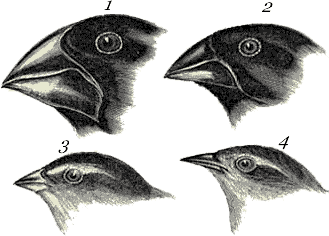
    1. The picture of the finches is used to illustrate: phylogeny of finches
      change over time
      specialization of beaks for different diets
      natural selection
    2. Which of the following was not an observation made by Darwin on his voyages: penguins use wings to paddle instead of fly
      snakes have rudimentary hind limbs
      the earth is very old
      islands had species that did not exist on the mainland

bones

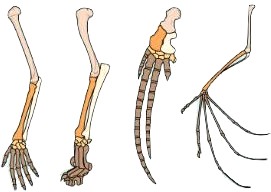
    1. The image illustrates: vestigial structures
      homologous structures
      the fossil record
      natural selection
    2. Which of the following is an example of artificial selection: a panda’s thumb
      the breeding of dogs
      the galapagos finches
      a giraffe’s neck
    3. According to the theory of evolution by natural selection, which of the following is true: random mating is necessary for evolution to occur
      variation does not exist between members of the same species
      populations will change to better fit their environment
      individuals will adapt to their environment
    4. Which of the following are assumptions made with regards to the Theory of Evolution by Natural selection organisms compete with each other to survive
      variations exist among organisms
      not all organisms that are born survive to reproduce
      all of these

whale

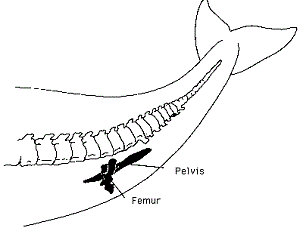
    1. The image illustrates which of the following: artificial selection
      acquired characteristics
      homologous structures
      vestigial structures
    2. A panda’s thumb is considered an evolutionary contrivance because: it is assembled from wrist bones, and imperfect
      it is perfectly structured to grab leaves
      it is an structure that has no use
      none of these
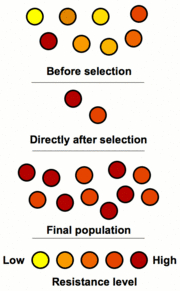
    3. Which of the following outcomes would you predict for a population of bacteria exposed to a new antibiotic. over many generations, the bacteria would become resistant to the antibiotic
      over a few generations, the bacteria would evolve into Archaebacteria
      over a few generations, the bacteria would become extinct
      over many generations, the bacteria would become more susceptible to the antibiotic
    4. Which of the following is an example of convergent evolution: whales and sharks have similar body designs
      bees and hummingbirds have similar body designs
      bats and birds have similar body designs
      all of these
    5. Why is evolution called the “unifying theory of biology” because it explains the diversity of life on the planet
      because it serves as a model to predict how organisms will change
      it serves as a model to interpret relationships between organisms on the planet
      all of these

moths

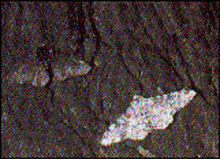
  1. The image illustrates how peppered moths are related to other moths
    how peppered moths adapted to a changing environment
    how peppered moths became extinct
    how peppered moths became two species