Chapter 10 Protein Synthesis PPT Questions


Protein Synthesis
ppt Questions

DNA and Genes

1. What are genes and what do they code for?


2. Proteins are made of chains of _______________.

3. How do cells use proteins?


4. The subunits making up polypeptides are called _________________.

5. How many amino acids exist?

6. Sketch and label the basic structure of an amino acid.


7. The group that makes amino acids different from each other & gives the amino acid its unique properties is called the ___________ group.

8. DNA is found in the ____________ of a cell and begins the process of making a _______________.

9. Where are proteins made?

10. Describe the two types of ribosomes.


11. The first step in making a protein is to make a copy of ___________ in the nucleus.

RNA

12. What nucleic acid contains the master code for making proteins?

13. What nucleic acids acts as a blueprint in copying the master code?

14. Compare and contrast the sugars on DNA and RNA.


15. Compare and contrast the nitrogen bases on DNA and RNA.


16. RNA is made of a ____________ strand, while DNA is a ___________ stranded molecule.

17. What base replaces thymine on RNA?

18. Name the 3 types of RNA molecules.


19. What is the function of mRNA?


20. What is the function of rRNA?


21. What is the function of tRNA?


22. Describe the shape of mRNA.

23. How does mRNA get out of the nucleus once it has copied DNA’s instructions?

24. What bases pair together on RNA?

25. How long is mRNA?

26. What is a codon?


27. Methionine is called the __________ codon & is represented by the bases ________.

28. Name the 3 stop codons.

29. How long in rRNA?

30. What is the shape of rRNA?

31. What two things make up ribosomes?

32. What process occurs at the ribosomes?

33. Each codon stands for an _______________.

34. Can amino acids have more than one codon?

35. There are ______ amino acids and ______ possible codons.

36. How do you read the circular genetic codon table?


37. Use the genetic codon table and name these amino acids:

GGG?
UCA?
CAU?
GCA?
AAA?

38. Name the complementary bases on DNA.


39. Name the complementary bases on RNA.


40. What is the shape of tRNA?

41. What can attach to one end of a tRNA molecule for transport?

42. Opposite the attachment site on tRNA are 3 nucleotide bases called the ______________.

43. Make a sketch of a tRNA molecule with its attachment site and anticodon labeled.


44. A codon on mRNA is complementary to an _____________ on tRNA.

45. What anticodon is complementary to the codon – ACU?

Transcription and Translation

46. Sketch the pathway to making a protein.


47. define protein synthesis.


48. Name the 2 phases of protein synthesis.

49. Before mRNA can leave the nucleus it must be _______________ in order to correctly make proteins.

50. Define transcription and tell where it occurs.


51. What RNA copies DNA?

52. Are both strands of DNA copied?

53. What enzyme is required to copy DNA?

54. The DNA strand that is copied is called the _____________ strand.

55. What would be the complementary RNA sequence for the DNA sequence- 5′- GCGTATG-3′?

56. What enzyme separates the DNA strands in transcription?

57. RNA polymerase adds complementary ____________ to the DNA template strand.

58. ___________ are regions on DNA where RNA polymerase binds to start transcription.

59. The promoter contains a sequence called the _________ box.

60. Other sequences on DNA called __________ signals tell the RNA polymerase when to stop transcribing.

61. Newly made mRNA must be _________ to make the nucleic acid functional.

62. What are introns & what happens to them during mRNA processing?


63. What are exons and what happens to them during mRNA processing?


64. Describe the cap that is added to the new mRNA transcript.


65. What type of tail is added to the mRNA transcript?

66. The new mRNA transcripts is made of _____________ with a 5′ _________ and a 3′ ____________ tail.

67. What happens next to the newly made mRNA?

68. Define translation & tell where it occurs?


69. How do ribosomes read mRNA?

70. Describe the structure of a ribosome.


71. Ribosomes are composed of ________ rRNA and ________ protein.

72. Ribosomes have 2 tRNA sites called _______ and ______ along with an exit site.

73. The first part of translation is called ____________.

74. The small ribosomal subunit attaches to what codon on mRNA?

75. Once the mRNA and small subunit attach, what happens next?

76. Sketch an label a ribosome with both its subunits, its 2 tRNA sites, and the attached mRNA transcript.


77. The ______________ moves along the mRNA strand ________ codon at a time.

78. How many tRNA’s will fit into a ribosome at one time?

79. What happens to the two amino acids carried by the 2 tRNA’s inside a ribosome?

80. The joining of amino acids by ___________ bonds is the second part of translation called ______________.

81. Once an amino acid is joined to the growing polypeptide chain, the tRNA leaves the _______________ to pick up another ________________.

82. When a tRNA leaves the ribosome, the ribosome moves down the _________ strand allowing another ________ and its amino acid to enter.

83. each time the ribosome moves, it moves over _________ codon.

84. The last stage of translation is called _______________.

85. Name the 3 termination codons.

86. The sequence of amino acids in the polypeptide chain is called the ____________ protein structure.


Cell Size

THE SURFACE AREA TO VOLUME RATIO OF A CELL
INTRODUCTION:

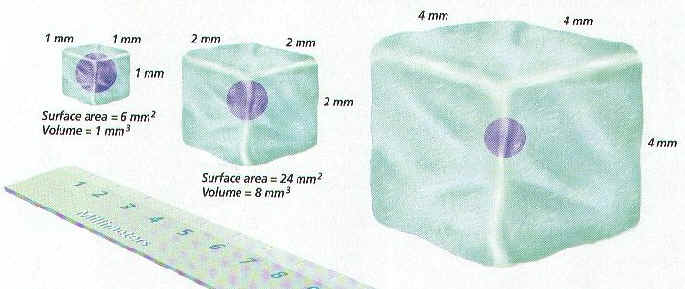
Cells are limited in how large they can be. This is because the surface area and volume ratio does not stay the same as their size increases. Because of this, it is harder for a large cell to pass materials in and out of the membrane, and to move materials through the cell.
In this lab, you will make cube shaped models to represent cells. The dimension along one side will be doubled with each model. You will then calculate the surface area, volume, and the ratio between the two.

MATERIALS:

Scissors
Construction paper
Tape
Metric ruler

PROCEDURE:

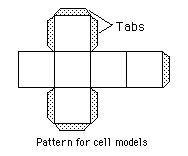
1. Construct three cell models like the pattern shown. The dimensions of a side will double each time, with the sides being 2 cm, 4 cm, and 8 cm. Fold and tape into cubes with the tabs to the inside. Record the dimensions in the DATA TABLE (the first one is done for you in the table).


DATA TABLE: Cell Size Comparison

Cell Dimensions
(cm)
Surface Area
(cm2)
Volume
(cm3)
Ratio
Surface area to Volume
1 2 X 2 X 2
2
3


CALCULATIONS:

2. Calculate the total surface area for each cell model by the following formula:

surface area = (Length X Width) X 6 sides


Record the surface areas in the DATA TABLE.

3. Calculate the volumes for each cell model by the following formula:

volume = length X width X height


Record the volumes in the DATA TABLE.

4. Calculate the surface area-to-volume ratio for each cell model by the following formula:

ratio = surface area
volume


Record the ratio values in the DATA TABLE.
These ratios show how many times larger the surface area is as compared to the volume. Notice that it becomes less than one very quickly.

QUESTIONS:

1. Which model has the largest surface area?

2. Which model has the largest volume?

3. Which model has the largest ratio?

4. To maintain life, and carry-out cellular functions, materials must be able to move into and out of the cell. Also, material needs to be able to move within the cell. What might be the advantage of having a large surface area?


5. What might be the disadvantage of having a large volume?


Chapter 10 Questions PPT

DNA & Replication
ppt Questions

History of DNA

1. Early scientists believed that _________ was the genetic material of the cell. Explain why.


2. Proteins are made of 20 different ________________.

3. Long chains of amino acids make up _________________.

4. Fred Griffith worked with what type of bacteria?

5. What did he find to be true after his experiments with the S and R strains of bacteria?


6. This process of picking up DNA from the environment is called ____________________.

7. Did Griffith’s experiment prove DNA was the genetic material?

8. What 2 main things make up chromosomes?

9. What did Hershey and Chase use in their experiments to prove DNA was the cell’s genetic material?

10. Hershey and Chase radioactively tagged the viral DNA with _______________ and the protein capsid with ______________.

11. Which radioactive substance was injected into and took over the host cell’s DNA?

12. What scientists showed the amount of the 4 nitrogen bases present in DNA?

13. Name the bases and their amounts found in somatic or body cells of humans.


14. What bases are complementary (pair with each other) on DNA?

15. What type of bonds join base pairs on DNA?

16. Are these strong or weak bonds?

17. What was Rosalind Franklin’s contribution to finding DNA’s structure?


18. Who built the first model of DNA and what did they use to help get the correct measurements for the molecule?

DNA Structure 

19. DNA is two coiled strands known as a ___________________.

20. What makes up the sides of a DNA molecule?

21. What bonds the deoxyribose sugars to the phosphate groups?

22. Where are the nitrogen bases found on DNA & how are they bonded?

23. Most DNA has a ______________ twist with ________ base pairs in a complete turn.

24. DNA stands for ___________________________.

25. ______________ are the subunits making up DNA.

26. Name the 3 parts of a nucleotide.


27. Why is deoxyribose called a pentose sugar?

28. Sketch a pentose sugar and include the carbons correctly numbered.


29. The sugars on one DNA strand of DNA are from 5′ to _________, while the sugars on the other strand are antiparallel running from _________ to ___________.

30. Double ring nitrogen bases are called ____________, while single ring nitrogen bases are called ________________.

31. Name the purines.

32. Name the pyrimidines.

33. Purines will only pair with ________________.

34. __________ hydrogen bonds are required to join guanine to cytosine, while only ________ bonds join adenine to thymine.

35. If there is 30% adenine, how much cytosine is present?

DNA Replication 

36. Cells must copy their DNA before they do what? Explain why.


37. During what part of the cell cycle is DNA copied?

38. In eukaryotes, where are the copies of DNA made?

39. The process of copying DNA is known as DNA ________________.

40. Replication of DNA begins at points called __________________________.

41. The two DNA strands ______________ at origins of replication forming Y-shaped areas called _______________________.

42. New DNA strands grow at the _____________.

43. As the two strands open at the origins of replication, replication _____________ form.

44. Prokaryotic chromosomes have a ___________ replication bubble, while eukaryotic cells have ___________ bubbles.

45. What enzyme uncoils DNA so it can be replicated or copied?

46. What other job does this enzyme perform?

47. What is the job of single-strand binding proteins?


48. What enzyme relieves stress on the DNA strands at the replication forks?

49. An RNA __________ must be present to start the addition of new nucleotides.

50. What enzyme makes the RNA primer?

51. DNA ______________ is the enzyme that adds new complementary base pairs.

52. DNA polymerase can only add nucleotides to what end of the DNA molecule?

53. Which DNA strand is synthesized continuously as a single strand?

54. The leading strand is made from the ______________ toward the _________________ as it opens.

55. The ____________ strand is synthesized ____________ the overall direction of replication.

56. The lagging strand is made in __________ short segments from the _____________ fork toward the _____________ of replication.

57. The short segments of the lagging strand are called ______________ fragments.

58. What enzyme joins Okazaki fragments together into one strand?

59. Sketch half of a replication bubble. Label the point of origin and the replication fork. Draw two arrows showing the leading strand and the lagging strand.


60. DNA polymerase initially makes how many errors?

61. Proofreading enzymes correct mistakes in DNA to a one in ______________ base pairing errors?

62. Explain the semiconservative model for DNA replication.


63. Who developed this idea about replication?

64. Chemicals and _____________ radiation can damage DNA in our body cells so it must be ________________ repaired.

65. What is excision repair?


66. What 2 enzymes replace damaged sections of DNA and rebind the molecule?

67. What is the complementary DNA strand for: 5′ -CGTATG -3′ ?


Cell Respiration


Cellular Respiration
All Materials © Cmassengale


C6H12O6 + 6O2 —–> 6CO2 + 6H20 + energy (heat and ATP)

Energy

  • Capacity to move or change matter
  • Forms of energy are important to life include Chemical, radiant (heat & light), mechanical, and electrical
  • Energy can be transformed from one form to another
  • Chemical energy is the energy contained in the chemical bonds of molecules
  • Radiant energy travels in waves and is sometimes called electromagnetic energy. An example is visible light
  • Photosynthesis converts light energy to chemical energy
  • Energy that is stored is called potential energy

Laws of Thermodynamics

  • 1st law- Energy cannot be created or destroyed.

    Energy can be converted from one form to another. The sum of the energy before the conversion is equal to the sum of the energy after the conversion.

  • 2nd law- Some usable energy is lost during transformations.

    During changes from one form of energy to another, some usable energy is lost, usually as heat. The amount of usable energy therefore decreases.


Adenosine triphosphate (ATP)

  • Energy carrying molecule used by cells to fuel their cellular processes
  • ATP is composed of an adenine base, ribose sugar, & 3 phosphate (PO4) groups


  • The PO4 bonds are high-energy bonds that require energy to be made & release energy when broken


  • ATP is made & used continuously by cells
  • Every minute all of an organism’s ATP is recycled
  • Phosphorylation refers to the chemical reactions that make ATP by adding Pi to ADP ADP + Pi + energy «  ATP + H2O
  • Enzymes  (ATP synthetase& ATPase) help break & reform these high energy PO4 bonds in a process called substrate-level phosphorylation
  • When the high-energy phosphate bond is broken, it releases energy, a free phosphate group, & adenosine diphosphate (ADP)


Enzymes in Metabolic Pathways:

  • Biological catalysts
  • Speeds up chemical reactions
  • Lowers the amount of activation energy needed by weakening existing bonds in substrates

  • Highly specific protein molecules
  • Have an area called the active site where substrates temporarily join
  • Form an enzyme-substrate complex to stress bonds
  • Enzyme usable

enzyme substrate complex

 
Energy Carriers During Respiration:

NADH: A second energy carrying molecule in the mitochondria; produces 3 ATP


FADH2: A third energy carrying molecule in the mitochondria; produces 2 ATP


Mitochondria:

  • Has outer smooth, outer membrane & folded inner membrane
  • Folds are called cristae
  • Space inside cristae is called the matrix & contains DNA & ribosomes
  • Site of aerobic respiration
  • Krebs cycle takes place in matrix
  • Electron Transport Chain takes place in cristae 

Cellular Respiration Overview:

C6H12O6 + 6O2 —–> 6CO2 + 6H20 + energy (heat and ATP)

  • Controlled release of energy from organic molecules (most often glucose)
  • Glucose is oxidized (loses e-) & oxygen is reduced (gains e-)
  • The carbon atoms of glucose (C6H12O6) are released as CO2
  • Generates ATP (adenosine triphosphate)


  • The energy in one glucose molecule may be used to produce 36 ATP
  • Involves a series of 3 reactions — Glycolysis, Kreb’s Cycle, & Electron Transport Chain

Glycolysis:

  • Occurs in the cytoplasm
  • Summary of the steps of Glycolysis:

    a. 2 ATP added to glucose (6C) to energize it.

    b. Glucose split to 2 PGAL (3C). (PGAL = phosphoglyceraldehyde)

    c. H+ and e- (e- = electron) taken from each PGAL & given to make 2 NADH.

    d. NADH is energy and e- carrier.

    e. Each PGAL rearranged into pyruvate (3C), with energy transferred to make 4 ATP (substrate phosphorylation).

    f. Although glycolysis makes 4 ATP, the net ATP production by this step is 2 ATP (because 2 ATP were used to start glycolysis). The 2 net ATP are available for cell use.

    g. If oxygen is available to the cell, the pyruvate will move into the mitochondria & aerobic respiration will begin.


    Net Yield from Glycolysis
    4 NADH2
    2 CO2
    4 ATP ( 2 used to start reaction)


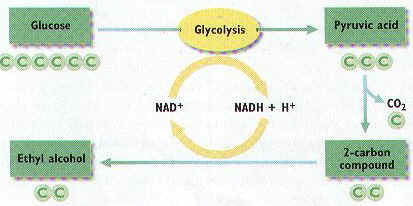
h. If no oxygen is available to the cell (anaerobic), the pyruvate will be fermented by addition of 2 H from the NADH (to alcohol + CO2 in yeast or lactic acid in muscle cells). This changes NADH back to NAD+ so it is available for step c above. This keeps glycolysis going!


Alcoholic Fermentation


Lactic Acid Fermentation


Aerobic Respiration:

  • Occurs in the mitochondria
  • Includes the Krebs Cycle & the Electron Transport Chain
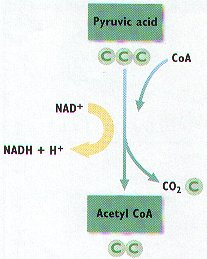
  • Pyruvic acid from glycolysis diffuses into matrix of mitochondria & reacts with coenzyme A to for acetyl-CoA (2-carbon compound)
  • CO2 and NADH are also produced

Kreb’s Cycle:

  • Named for biochemist Hans Krebs
  • Metabolic pathway that indirectly requires O2 
  • Kreb’s Cycle is also known as the Citric acid Cycle
  • Requires 2 cycles to metabolize glucose
  • Acetyl Co-A (2C) enters the Kreb’s Cycle & joins with Oxaloacetic Acid (4C) to make Citric Acid (6C)
  • Citric acid is oxidized releasing CO2 , free H+, & e- and forming ketoglutaric acid (5C)
  • Free e- reduce the energy carriers NAD+ to NADH2 and FAD+ to FADH2
  • Ketoglutaric acid is also oxidized releasing more CO2 , free H+, & e-
  • The cycle continues oxidizing the carbon compounds formed (succinic acid, fumaric acid, malic acid, etc.) producing more CO2, NADH2, FADH2, & ATP
  • H2O is added to supply more H+
  • CO2 is a waste product that diffuses out of cells
  • Oxaloacetic acid is regenerated to start the cycle again
  • NADH2 and FADH2 produced migrate to the Electron Transport Chain (ETC)


Net Yield from Kreb’s Cycle (2 turns)
6 NADH2
2 FADH2
4 CO2
2 ATP


Electron Transport Chain:

  • Found in the inner mitochondrial membrane or cristae
  • Contains 4 protein-based complexes that work in sequence moving H+ from the matrix across the inner membrane (proton pumps)
  • A concentration gradient of H+ between the inner & outer mitochondrial membrane occurs
  • H+ concentration gradient causes the synthesis of ATP by chemiosmosis
  • Energized e- & H+ from the 10 NADH2 and 2 FADH2 (produced during glycolysis & Krebs cycle) are transferred to O2 to produce H2O (redox reaction)

O2  +  4e-  +  4H+  2H2O


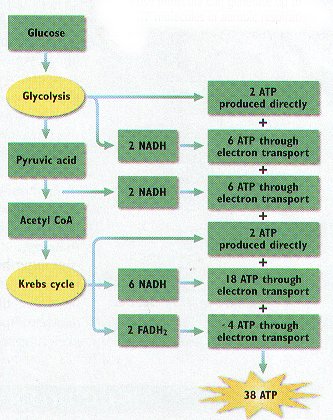
Energy Yield from Aerobic Respiration
Glycolysis Kreb’s Cycle Total
4 NADH2 6 NADH2 10 NADH2 x 3 = 30 ATP
0 FADH2 2 FADH2 2 FADH2 x 2 = 4 ATP
2 ATP 2 ATP                          4 ATP
38 ATP


  • Most cells produce 36- 38 molecules of ATP per glucose (66% efficient)
  • Actual number of ATP’s produced by aerobic respiration varies among cells


Cell Structure and Function Assi


Cell Structure and Function Assignment


Project Due – Tuesday, June 28

Instructions:

  1. Draw and color EACH CELL or CELL ORGANELLE on a separate sheet of unlined paper. BE SURE TO CENTER YOUR DRAWING ON THE PAGE!
  2. At the top of each page, CENTER and WRITE THE NAME of the cell or organelle that you are drawing.
  3. LABEL all parts of the cell and/or organelle.
  4. WRITE the function of EACH LABELED PART (FUNCTION MUST BE WRITTEN NEXT TO THE LABEL).
DRAWINGS:

  1. Prokaryote diagram
  2. Animal Cell Diagram
  3. Plant Cell Diagram
  4. Nucleus & Nucleolus Diagram
  5. Rough and Smooth Endoplasmic Reticulum Diagram
  6. Golgi Diagram
  7. Chloroplast Diagram
  8. Mitochondria Diagram
  9. Lysosome Diagram
  10. Cell Membrane Diagram