Biomes of the World Solution

Biomes of the World Solution
T + + + C D A R + R L + T + + + S + + E I E B E + A + U + + + + E S + M T T I + D E N + + + + E R U E A O + O I M D H + + R + S O W R + I + T O R E R T + N + H F C O + B R I A R E + O + S + + N A V + E B C B C C + E + + + + I R I T + + I U + R S A V A N N A N N + + V D F E N I R A M + + R I M + O O G R A S S L A N D + A V O R R S U O U D I C E D G + + O E P + + + + + + + + I + + + + R + + + + + + + + A + + + + + + E + + + + + + T + + + + + + + + (Over,Down,Direction) ABIOTIC(7,1,SE) BIOME(12,7,N) BIOTIC(10,6,NW) CARNIVORE(7,6,SE) CONSUMER(1,8,NE) DECIDUOUS(9,12,W) DESERT(6,1,SW) FRESHWATER(1,10,NE) GRASSLAND(1,11,E) HERBIVORE(14,4,S) INTERTIDAL(11,10,N) MARINE(7,10,W) OMNIVORE(13,11,NW) PRODUCER(15,12,N) RAINFOREST(10,10,NW) SAVANNA(3,9,E) TAIGA(7,15,NE) TUNDRA(13,1,S)


Biotechnology Notes Bi


DNA Technology
All Materials © Cmassengale

Introduction:

  • Biotechnology refers to technology used to manipulate DNA
  • The procedures are often referred to as genetic engineering
  • DNA is the genetic material of all living organisms
  • All organisms use the same genetic code
  • Genes from one kind of organism can be transcribed and translated when put into another kind of organism
  • For example, human and other genes are routinely put into bacteria in order to synthesize products for medical treatment and commercial use
  • Human insulin, human growth hormone, and vaccines are produced by bacteria
  • Recombinant DNA refers to DNA from two different source
  • Individuals that receive genes from other species are transgenic

Viruses & their Structure:

  • Viruses contain genetic material but are not living
  • Host cells are required for their reproduction
  • Viruses are composed of an inner nucleic acid core (genetic material) and an outer protein coat (capsid)
  • Viruses that infect animals have an outer envelope (membrane) that is derived from the cell membrane of the host cell may surround the capsid
  • The genetic material in some viruses is DNA; in others it is RNA


Viral Reproduction:

  • When viral genetic material enters a cell, it is replicated, transcribed (mRNA is produced) and translated (proteins are produced from the mRNA) by the host cell
  • By this process, the host cell uses the genetic instructions in the virus to make more viruses

Viral DNA ® mRNA ® protein

  • If the viral genetic material is RNA, a DNA copy must first be made before transcription and translation can occur
  • The DNA copy of the viral RNA is called cDNA.

viral RNA ® cDNA ® mRNA ® protein

Bacteriophages:

  • Bacteriophages are viruses that infect bacteria
  • Not surrounded by a membrane as the animal-infecting viruses
  • Virus attaches to the bacteria cell, a viral enzyme digests away a part of the wall, and its viral DNA enters the host cell
  • Inside the host cell, the viral DNA is transcribed, translated, and replicated
  • Translation produces protein coats and the enzymes needed in the construction of new virus particles
  • Viral DNA is replicated
  • The protein coats and DNA are assembled into new viral particles
  • The host cell wall to ruptures releasing the newly formed viruses

  • Upon entering the cell, the viral DNA may instead, become integrated into the bacterial DNA
  • It is replicated along with the host DNA when the host reproduces
  • Eventually, it will become transcribed and translated

Retroviruses:

  • Contain RNA & the enzyme reverse transcriptase
  • Reverse transcriptase can make a DNA copy of the viral RNA
  • The new DNA produced from the RNA template is called cDNA
  • DNA synthesis follows the production of cDNA to produce a double-helix
  • cDNA then becomes incorporated into the host DNA (called a prophage)
  • The new viruses escape the host cell by budding
  • The AIDS virus (HIV) is an example of a retrovirus


Vectors

  • Vectors are used to transfer genes into a host cell
  • Plasmids & viruses are the most commonly used vectors
  • A vector must be capable of self-replicating inside a cell
  • Viruses are the vectors of choice for animal cells
  • Marker genes can be used to determine if the gene has been taken up

Plasmids:

  • Small rings of DNA in bacterial cells
  • Used to transfer genes to other organisms
  • Host bacterium takes up the plasmid, which includes the foreign gene
  • When bacteria reproduce, plasmids with the new gene are also reproduced 
  • This clones (copies) the gene each time the bacteria reproduces

Viruses:

  • Can accept larger amounts of DNA than plasmids
  • Once the virus enters the host cell, it also reproduces the foreign gene it carries
  • The copied gene is “cloned”


Restriction enzymes:

  • Restriction enzymes were discovered in bacteria
  • Bacteria use them as a defense mechanism to cut up the DNA of viruses or other bacteria
  • Hundreds of different restriction enzymes have been isolated
  • Each restriction enzyme or RE cuts DNA at a specific base sequence
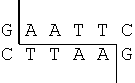
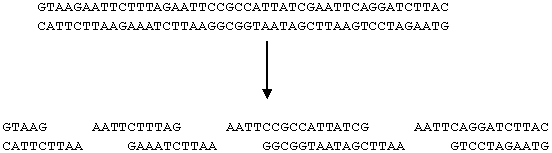
  • For example, EcoRI always cuts DNA at GAATTC as indicated below

  • The sequence GAATTC appears three times in the DNA strand below. As a result, the strand is cut into four pieces

  • Other restriction enzymes cut at different sites, some examples are listed below


Enzyme Cutting Site
Bam HI GGATCC
Hae III GGCC
Pst I CTGCAG
Hind I GANTC


Sticky Ends & Recombinant DNA:

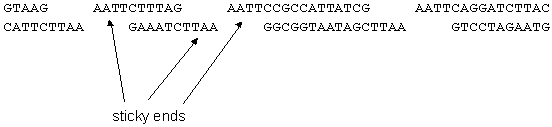
  • Fragments of DNA that has been cut with restriction enzymes have unpaired nucleotides at the ends called sticky ends

  • Sticky ends have complimentary bases, so they could rejoin
  • If the vector and the gene to be cloned are both cut with the same restriction enzyme, they will both have complimentary sticky ends
  • After cutting, the 2 DNA samples are mixed
  • Fragments with complementary sticky ends join together forming recombinant DNA (contains gene from vector & the gene to be cloned)
  • Enzyme DNA ligase seals the fragments together
  • Bacteria such as Escherichia coli are capable of taking up DNA from their environment
  • This process is called transformation
  • CaCl2 and a procedure called heat shock are used to make E. coli cells more permeable so that they take up the modified plasmids more readily

Genomic Libraries:

  • A genome is all of the genes in a particular organism
  • Bacteria or virus vectors can be used to store fragments of the DNA from another species
  • The DNA is cut up into fragments, and the different fragments are inserted into bacteria or viruses
  • The collection of bacteria or viruses is called a genomic library

Polymerase Chain Reaction (PCR):

  • Used to make many copies of small pieces of DNA
  • Procedure requires primers, DNA polymerase, and nucleotides
  • Primers are short chains of about 20 nucleotides that are complimentary to a region in the DNA to be amplified
  • DNA polymerase cannot continue the process unless it has already been started by primers
  • Nucleotides are needed because DNA is composed of nucleotide “building blocks”

  • The DNA is heated to approximately 95o C to separate the two strands of the double helix

  • After the strands are separated, the DNA is cooled to about 50o C, and the primers attach
  • The temperature is raised to approximately 70o C so the polymerase will attach to & copy the strand

  • The DNA replication process repeats itself as the solution is then heated and cooled at regular intervals


DNA Fingerprinting (RFLP Analysis):

  • In RFLP analysis, the DNA of an organism is cut up into fragments using restriction enzymes producing a large number of short fragments of DNA
  • Because no two individuals have identical DNA, no two individuals will have the same length fragments
  • Gel electrophoresis is a technique used to separate the DNA fragments according to their size
  • The fragments are placed in wells on a sheet of gelatin, and an electric current is applied to the sheet
  • DNA is negatively charged and will move in an electric field toward the positive pole

  • The smallest fragments will move the fastest because they are able to move through the pores in the gelatin faster
  • Bands will be produced on the gelatin where the fragments accumulate
  • Shortest fragments will accumulate near one end of the gelatin (furthest from the wells), and the longer, slower-moving ones will remain near the other end
  • DNA bands must be stained to make them visible


Gene Products & Uses of Genetic Engineering:

  • E. coli is used to produce proteins such as insulin by genetic engineering because it is easily grown
  • To recover the product, E. coli must be lysed or the gene must be linked to a gene that produces a naturally secreted protein
  • Yeasts can be genetically engineered and are likely to secrete the gene product continuously
  • Mammalian cells can be engineered to produce proteins such as hormones for medical use
  • Plant cells take up a plasmid from Agrobacterium
  • Plant cells can be engineered and used to produce plants with new properties such as Roundup Ready soybeans
  • Pseudomonas bacteria has been engineered to produce Bacillus thuringiensis or BT
  • BT bacteria make a toxin against insects, thus producing a natural insecticide   (example – B.T. cotton)
  • Animal viruses can be engineered to carry a gene for a pathogen’s surface protein so the virus can be used as a vaccine 
  • Genetic engineering techniques are being used to map the human genome through the Human Genome Project
  • Could provide tools for diagnosis and possible repair of genetic disease
  • Recombinant DNA techniques can be used for genetic fingerprinting
  • Gene therapy can be used to cure genetic diseases by replacing the defective or missing gene
  • Bovine growth hormone (BGH) increases milk production in cows by about 10%

Safety and Ethical Issues:

  • Harmful organisms may be accidentally produced
  • Organisms that are intended to be released in the environment may be engineered with genes that will eventually kill them
  • There is little legislation on the use of genetic screening and information produced by screening
  • The technology is increasing the ability to diagnose genetic diseases pre-natally, adding new complexity to the abortion controversy
  • Ethical questions have been raised over whether we should modify the genes of humans
  • Genetic screening and gene therapy are expensive and may be unavailable to the poor
  • Biological weapons could be created using biotechnology

Bioenergetics Powerpoint Worksheet

Bioenergetics
ppt Questions

Energy

1. What is bioenergetics?


2. All organisms require ____________ to perform their functions.

3. Name the 2 main kinds of energy.

4. What is kinetic energy?


5. Give 2 examples of kinetic energy.


6. What is potential energy?


7. Potential energy is stored in ____________ __________.

Two Types of Energy Reactions

8. What is an endergonic reaction?


9. Give an example of an endergonic reaction.


10. What serves as the energy for photosynthesis?

11. During photosynthesis, the light energy is stored in the chemical bonds of what sugar?

12. What are the two raw materials (reactants) for photosynthesis?

13. What is an exergonic reaction?


14. Give an example of an exergonic reaction.

15. Where does the energy for cellular respiration come from?


16. Energy released during cellular respiration that can be used by cells is called _________.

Metabolic Reactions of Cells

17. Define metabolism of cells.


18. From what compound do animals get their energy (ATP) to do cellular work?

19. Name the 2 types of metabolism.


20. Explain anabolic pathways and give an example.


21. Explain catabolic pathways and give an example.


22. The energy that drives catabolic pathways in organisms comes from breaking _____________ ___________ and producing the energy molecule ___________.
Cellular Energy – ATP

23. Name the 3 components that make up ATP.

     a.

     b.

     c.

24. How many phosphate groups are in ATP?

25. The last two phosphate groups on ATP are bonded with ___________ ___________ bonds.
26. Which phosphate bond contains the MOST energy?

27. Give the formula for a phosphate group.

28. Name the process that breaks the bonds of ATP to release energy.

29. How often does phosphorylation occur in cells?


30. What enzyme weakens the last phosphate bond so it can be broken?

31. Organisms use ___________ to break down energy-rich __________ to release the potential  energy stored in its bonds.
32. Energy released from the chemical bonds of glucose are trapped & stored in ________ until a cell needs energy.

33. What does ATP stand for?

34. How much ATP do cells use?


35. What coupled reactions make ATP and then release its energy.


36. Is hydrolysis exergonic or endergonic?

37. Is energy stored or released during hydrolysis?

38. Is dehydration exergonic or endergonic?

39. Is energy stored or released in dehydration?

40. When ATP is broken down to release energy, what two things form?


41. During hydrolysis of ATP, a molecule of ___________ is added to split the ________ phosphate bond.

42. What happens to the energy released from the hydrolysis of ATP?


43. During dehydration of ATP, a molecule of ___________ is removed to join a free phosphate and __________ making more ATP again.

44. Where is the energy stored in the dehydration process to form ATP?


Review

45. How many high-energy phosphate bonds does ATP have?

46. Is photosynthesis anabolic or catabolic?

47. Is photosynthesis exergonic or endergonic?

48. The breakdown of ATP is due to hydrolysis or dehydration?

49. Water is added or removed in the breakdown of ATP?

50. Which of the following are coupled reactions in organisms:

     a. hydrolysis – dehydration?

     b. Anabolism – Catabolism?

     c. Endergonic – Exergonic?


Biology Class Notes – Graphing Practice


C. Massengale
Textbook: Modern Biology by HRW

VENN DIAGRAM TEMPLATE 

All Materials © Cmassengale
The Notes on this website may be USED in class, but may NOT be MODIFIED, or SAVED, or POSTED to ANOTHER WEBSITE! 

Introduction
Safety
Safety Worksheet
Safety Quiz
Equipment
Safety Board Game
Safety Contract
Safety Contract (Espanol)
Scientific prefixes/suffixes (BI)
Scientific prefixes/suffixes (PreAP)
Worksheet
Scientific Method
Scientific Method Steps & vocabulary
Krusty Krab & Other Bikini Bottom Experiments
Designing an Experiment
Sponge Bob Science variables
Theories, Laws, & Hypotheses
Microscopes
How to use a Microscope
Microscope activity
Microscope Lab
Parts of a Light Microscope
Label a Light Microscope
Microscope Coloring Worksheet
Microscope lab BI

Metrics
Online Calculator Biology Career Brochure
Graphing Practice
Graphing Examples
Understanding Graphs & Tables
Graphing Examples Quiz
Graph Paper
Create a Graph
Bar Graph Problems
How to Make a Line Graph on Paper
Practice Making Line Graphs
Chemical Aspect of Life
Introduction – Study of Life
MRS Nerg
Characteristics of Life Worksheet
Study of Life Worksheet
Levels of organization
Review

Chemistry
Periodic Table
Knowing Elements Activity
Water Properties Handout
Biochemistry
Examples of Organic Models
BioChem Quiz
Handout: Macromolecule Chart
Handout: Macromolecule Chart (blank)
Handout: Enzyme Properties
Cells & Metabolic Processes
Structure & Function of Cells
Edible Cells Project
Cell Organelles
Photos of Cells
Review of Cell Organelles
Generalized Cell
Cell Quiz
Cell Size Limits
Homeostasis & Transport
Effect of Solutions on Cells
Web Tutorial Passive Transport
Web Tutorial Active Transport

Photosynthesis
Web Tutorial Photosynthesis
Web Tutorial Electron Transport Chain
Illuminating Photosynthesis web Tutorial
Calvin Cycle web Tutorial
Citric acid Cycle Web Tutorial
Problem Set 1
Problem set 2
Photosynthesis Quiz
Cell Respiration
Do you understand Cellular Respiration?
Web Tutorial Glycolysis
Cell Respiration Quiz
Nucleic Acids & Protein Synthesis
Do you understand nucleic acids & protein synthesis?
DNA Animation
mRNA Codon Table Codon Table worksheet

Cell Growth & Division 
Cell Growth & Division Lecture Guide
Mitosis Activity
Animal Mitosis (whitefish)
Plant Cell Mitosis (onion)
Cell Division PowerPoint
Labeling Meiosis Stages (web)
Labeling Meiosis (Word)
Phases of Meiosis Worksheet

Fundamentals  of Genetics
Genetics Tutorial
Mendel Quiz
Dihybrid Cross Quiz
Probability
Practice Test
SpongeBob Crosses
Genetic Cross template
Alien Genetics
Chromosomes & Human Genetics DNA Technology
Evolution, Taxonomy, & Organisms

Darwin & Natural selection
Population Genetics
Evolution Myths
Hardy Weinberg Problems
Classification
Dichotomous Keying
Keying activity
Animal Cladogram Practice
Bacteria
Aseptic Techniques
Viruses
Examples of Virus Models
Protozoans
Protist Key
Online Protist Quiz

Algal & Fungal like Protists
Six Divisions of Algae

Fungi
More Notes on Fungi
Online Fungi Identification
Mosses & Ferns Classification of Seed Plants
Structure & Function of Seed Plants
Leaf Cross section
Leaf Coloring worksheet
Reproduction of seed Plants
Flower Coloring Worksheet Flowering Plants Online

Introduction to Animals
General Notes on Animals Animal Symmetry Worksheet
Introduction to Animals Worksheet

Invertebrate Notes
Invertebrate Worksheet Chordates
Sponges & Cnidarians
Sponge Coloring Worksheet

Flatworms, Roundworms, & Rotifers
Practice Test

Mollusks
Annelids
Earthworm Coloring Worksheet

Arthropods (non-insects)
Arthropods (Notebook Copy)
Insects
Insect (Notebook Copy)
Insect Key
Pictorial Order Key
Echinoderms
Chordates
Vertebrate Notes
Fish
Fish & Amphibian Review
Amphibians Reptiles Birds
Bird Orders
Mammals

Orders of mammals Table

Vertebrates
Vertebrate Traits
Vertebrate Worksheet

Ecology
Ecology Quiz
Biomes of the World


Pre AP        Biology I