Simple Plants PowerPoint Questions

Simple Seedless Nonvascular & Vascular Plants
PowerPoint Worksheet

Seedless Nonvascular plants

1. Name the 3 divisions of seedless vascular plants and a member of each division.

     a.

     b.

     c.

Division Bryophyta

2. What is the common name for mosses, liverworts, and hornworts?

3. Bryophytes lack what type of tissue?

4. Name the 2 vascular tissues lacking in bryophytes and tell their function.


5. What is the 2 stage life cycle of plants called?

6. Name the 2 life cycle stages.

7. which stage is DOMINANT in bryophytes (mosses, liverworts, & hornworts)?

8. How do bryophytes reproduce?

9. Which stage of the moss looks like a lush green carpet?

10. Name the division for moss.

11. Why are moss small plants?

12. Do moss have TRUE roots, stems, or leaves?

13. In what type of area do moss grow?  Give several examples.


14.Moss gametophytes must grow close together in moist areas. Give 2 reasons why this is so.

     a.

     b.

15. What covers the outside of a moss plant to prevent water loss?

16. What anchors moss plants?

17. Can rhizoids absorb water like true roots?

18. Where does the sporophyte generation occur on moss plants?


19. What is at  the top of the sporophyte?

20. Label the following moss plant.
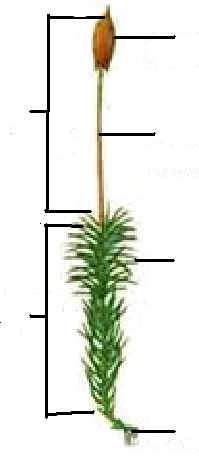
21. ___________ moss is used by florist. What characteristic makes it useful?


22. Because moss will grow on bare ground, it is called a _________ plant.

23. How is peat moss used?


24. Give 4 other uses for moss.


25. Moss are capable of asexual reproduction. Name and describe 2 types of this vegetative reproduction.

     a.

     b.

26. What are gemmae?


27. How are gemmae separate from the parent plant & dispersed?


28. Which stage of the moss is haploid and which is diploid?

29. The gametophyte generation produces what 2 cells? 

30. Why do these cells have half the chromosome number?

31. ____________ have a ________ set of chromosomes and reproduce ___________.

32. the sporophyte grows attached to the top of the ______________.

33. Since sporophytes lack chlorophyll, what cellular process are they incapable of doing?

34. How does the sporophyte get its food?

35. What is the setae on a moss plant?

36. How are the moss gametes protected?


37. Name the female gametangia & tell what it produces.

38. Eggs of moss are _____________ & ___________.

39. Label the female gametangia.
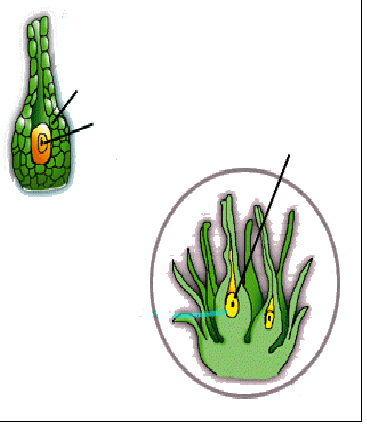
40.  Name the male gametangia & tell what it produces.

41.How does the sperm cell know the direction in which to swim to the egg?


42. Label the male gametangia.
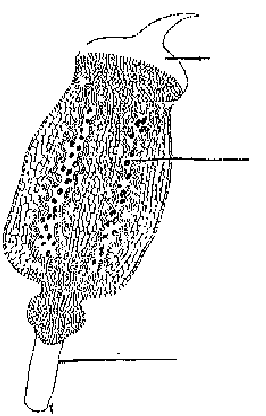
43. The moss ___________ or fertilized egg develops into the ____________.

44. Spores of the sporophyte capsule germinate into young plants called ______________.

45. Protonema develop into the _____________ stage

46. Label the protonema & developing gametophyte in this picture.
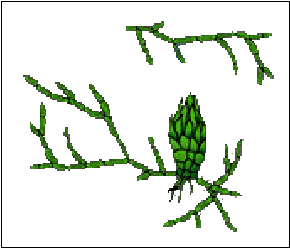
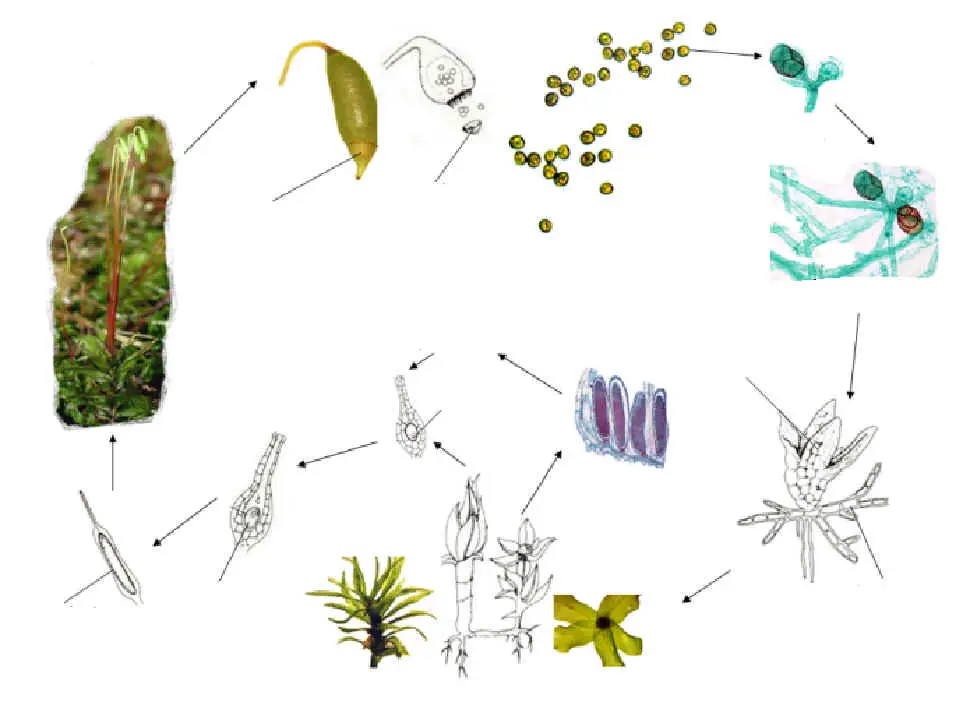
47. Label the life cycle of the moss.
Division Hepatophyta

48. ___________ are nonvascular, _________ producing bryophytes.

49. What stage is dominant in liverwort’s life cycle?

50. Describe the liverwort gametophyte.


51.Liverworts are found growing where?


52. Liverworts need lots of water for ____________.

53. How do liverworts reproduce asexually?

54. How do liverworts reproduce sexually?

Division Anthocerophyta

55._____________ are small, nonvascular ____________ with a dominant, leafy ____________ like liverworts.

56. Where are the antheridia & archegonia in hornworts?

57. Zygotes develop into ______________ sporophytes.

58. Is the horn-shaped sporophyte capable of photosynthesis?

59. Is the horn-shaped sporophyte attached to or separate from the gametophyte?

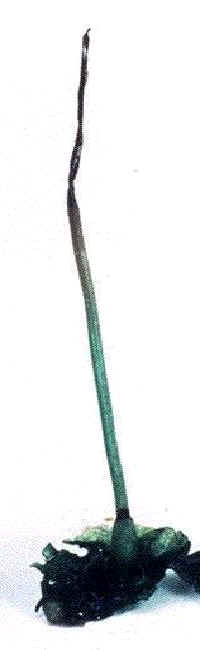
60. Label the parts of the hornwort.
Seedless Vascular Plants

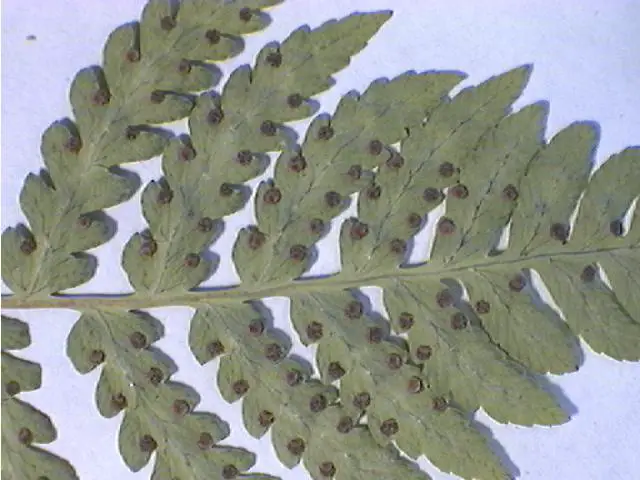
61.Label these structures on the back of this fern.
62. Name and give an example of a plant in the 4 divisions of seedless vascular plants.

     a.

     b.

     c.

     d.

63. Name the vascular tissues.

64. Do seedless vascular plants go through alternation of generations?

65. Which stage is dominant?

66. How do they reproduce?

Division Psilophyta

67.Describe whisk ferns.


68. Do they have true roots, stems, or leaves?

69.How many extant genera are there?

70. Name the root like structures of whisk ferns and tell whether they can or can’t absorb water.

71. How do whisk ferns reproduce asexually?

72. How do whisk ferns reproduce sexually?

73. Make and label a sketch of an aerial branch of whisk with sporangia.


74. What is the purpose of sporangia?

Division Lycophyta

75. The division Lycophyta contains the ______________ living vascular plants.

76. Club moss are commonly called ______________ ____________.  Explain why this is true.


77.Club moss have ________ growing root like ___________.

78. Describe the habitat needed by club moss.

79. Describe the leaves of club moss.


80. Are these TRUE leaves? Explain why.


81. What is found in the axils of the leaves & what is their purpose?

82. What are strobili?

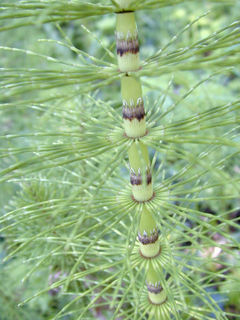
83. Some club moss are homosporous while others are heterosporous.  Explain what each of these terms means.

     a. homosporous-

     b. heteroporous-

84. Give an example of a homosporous club moss.

85. Lycopodium is used in fireworks. Explain the reason for this.


86. What do the spores of Lycopodium look like?


87.What is the purpose of each of these structures.
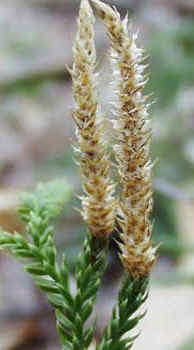
   

88. Give 3 other uses for club mosses.

     a.

     b.

     c.

Division Sphenophyta

89. How many extant species of horsetails are there?

90. Name the living genera of horsetails.

91. What is another name for horsetails?

92. Why are they called this?

93. Describe the stems of horsetails.


94. Where does photosynthesis take place in horsetails?

95. How are horsetails anchored?

96. How do horsetails reproduce?

97. Where are their spores found?

98. In prehistoric times, what was true of the size of horsetails?

99. Describe the habitat of horsetails.

100. How do horsetails prevent water loss from the parts of the plant above ground?

101. What special spore dispersing structures are found on the spores of horsetails?

102. Describe how elaters work.


103. Label the stem, node, and leaves on this horsetail.
104. Give 3 other uses for  horsetails.

     a.

     b.

     c.

104. Can animals eat horsetails? Why or why not?


Division Pterophyta

105. Ferns are in the ____________ group of extant vascular plants.

106. Describe the habitats for ferns.


107. How do ferns reproduce asexually?

108. What stage is dominant in the life cycle of the fern?

109. What is the only part of the fern plant that appears above ground?  What parts are found below ground?

110. Fern leaves are called ______________ and are attached to the plant by short stems called ______________.

111. Describe the appearance of newly forming fern fronds and tell what they are called.


112. What are sori and where are they found?

113. How are fern spores spread?

114. What forms when a fern spore lands on moist ground and germinates (starts growing)?

115. The prothallus starts what stage in the life cycle?

116. What is the shape of the gametophyte and does it live long?

117. What 2 structures grow ON the gametophyte?

118. Label the gametophyte and the male and female gametangia.
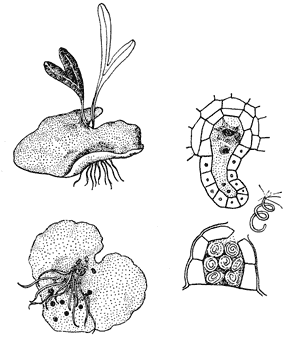
119. Label the parts of a fern.
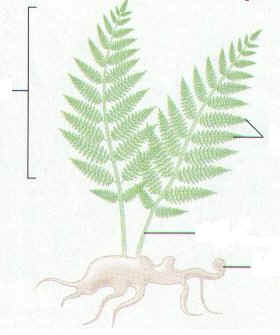
120. Label the life cycle of the fern.
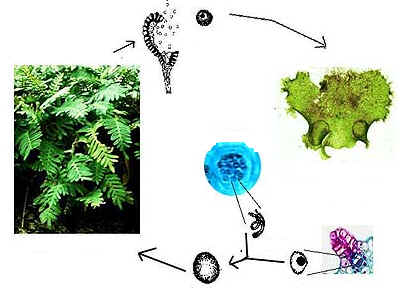
121. Give 4 uses for ferns.     a.

     b.

     c.

     d.

 

Semester Test Study Guide 2004 BI

Study Guide Semester Test 2004
Taxonomy, Plants, Invertebrates, & Vertebrates 

1.     Fruits of cereal plants are called __________________.

2.     Viral DNA becomes integrated into the host cell’s DNA during the ________________ cycle.

3.     Viruses only reproduce in ___________________.

4.      ____________________ use reverse transcriptase to transcribe DNA from RNA.

5.     Prions are composed only of __________________.

6.      RNA or DNA covered by a protein coat makes up a _______________.

7.     Classifying living things is called ______________________.

8.     From the kingdom to the species level organisms become more ___________________ in appearance.

9.     The system of classifying organisms by assigning genus & species names was developed by _________________.

10.    Which word in a scientific name is the genus?

11.   Noncellular structures that can’t make proteins or use energy, but can reproduce inside living cells would be ____________________.

12.  Scientists all over the world use the _______________, scientific name for an organism.

13.  Scientific names are written in ________________, a dead language.

14. The taxonomic hierarchy is kingdom, phylum, _________________, order, ______________, genus and _______________.

15. A waxy ________________ on the outside of plants prevents evaporation of fluids from the plant.

16. An internal system of connected tubes and vessels in some plants is called ______________________ tissue.

17.   __________________ tissue in plants transports water and minerals.

18. All seed plants have a seed containing an _________________, a ________________ supply, and a protective __________________.

19. Pines, cedars, spruce, and fir are examples of ____________________.

20. Monocot leaves have __________________ venation.

21. Plants grow in regions of active cell division called ________________.

22. Leaves connect to stems at areas called __________________.

23. ____________________ is the loss of water by the leaves & stem of a plant.

24. ____________________ tissue in plants transports sugars.

25. Multicellular heterotrophic organisms without cell walls would be in the kingdom _______________________.

26. Most animals have a head at the _________________ end and a tail located at the _______________ end.

27. Name a freshwater cnidarian closely related to the jellyfish.

28. The concentration of sensory organs on the anterior end of an animal is known as ________________________.

29. The sea anemone has ______________________ symmetry.

30.  The head of a fish would be located on the _______________ end.

31.   _________________ are animals whose cells are specialized but aren’t organized into tissues.

32.  The absence of a vertebral column or backbone is characteristic of all ______________________.

33. ________________ cells help draw water into a sponge.

34. Hard needle-like structures in the wall of a sponge are called __________________.

35. Sponges obtain food by _________________ feeding.

36. _________________ in sponges are cells that move throughout the sponge’s body wall to deliver food to the organism’s cells.

37. _____________________ organisms can produce both eggs and sperm.

38.  A sea anemone captures its prey using ___________________ in its tentacles.

39.  _________________ and _________________ are the two distinct life stages of cnidarians.

40. Name 3 cnidarians.

41. Sea anemones exist as _____________ in the adult stage.

42.                         Housed in chambers on each side of the head are the ______________ of bony fish.

43.                         __________________ mammals keep their offspring inside the mother until their development ids complete.

44. The ____________________ of fish helps them be buoyant in the water.

45. Amphibians breathe through lungs and their _______________.

46. The skin of reptiles is dry and ___________________.

47. Bird’s bones are _________________ and ________________.

48. Amphibian skin is thin and ______________ for __________ exchange.

49. The _______________ is a sheet of muscle below the rib cage in mammals to help them breathe.

50.  The _______________ egg allowed reptiles to adapt to life on land.

Sponges & Cnidarian

Sponges, Cnidarians, & Ctenophores

Phylum Porifera
Characteristics

  • Includes marine & freshwater sponges
  • Found in the kingdom Animalia & subkingdom Parazoa
  • Sessile as adults
  • Simplest of all animals

  • Contain specialized cells, but no tissue
  • Asymmetrical
  • Bodies filled with holes or pores for water circulation
  • Marine sponges are larger & more colorful than freshwater sponges
  • Range in size from 2 centimeters to 2 meters
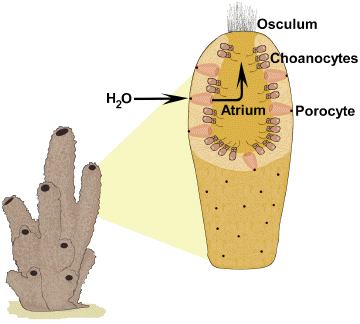
  • Osculum is single, large body opening at the top for water & wastes to leave
  • Spongocoel is the body cavity of sponges
  • Have only 2 cell layers (ectoderm & endoderm) separated by jellylike material
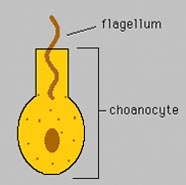
  • Flagellated cells called choanocytes or collar cells line their internal body cavity
  • Flagella of choanocytes beat & pull in water containing food which the collar traps


  • Spongin is a network of flexible, protein fibers making up the sponge’s skeleton
  • Spicules are tiny, hard particles shaped like spikes or stars in the  skeleton of some sponges
  • Spicules are made of calcium carbonate or silica

Feeding

  • Sponges are filter feeders that remove plankton (food) from the water that is brought in through pores lined with collar cells
  •  Flagella pull in bacteria, protozoans, & algae that sticks to collar of choanocytes where it is digested
  • Amebocytes are specialized cells in sponges that can roam to pick up food from choanocytes & distribute it to all other parts of the sponge
  • Amebocytes also transport carbon dioxide & wastes away from sponge cells
  • Excess water & food leaves through the excurrent osculum

Reproduction

  • Sponges can reproduce asexually by external buds that break off & form new sponges or stay attached to form sponge colonies
  • Gemmules are specialized, internal buds formed by sponges during cold or dry weather that can survive harsh conditions
  • Gemmules consist of a food-filled ball of amebocytes surrounded by a protective coat with spicules & released when adult sponge dies
  • Gemmules break open when conditions improve & the cells form new sponges

  • Sponge can also asexually regenerate missing parts or a new sponge from a small piece of sponge
  • Sponges are hermaphrodites (produce both eggs & sperm), but they exchange sperm & cross-fertilize eggs during sexual reproduction
  • Planula is the flagellated, free-swimming larva that forms from the zygote
  • Planula larva eventually settles to the bottom & attaches to develop into an adult, sessile sponge

Classes of Sponges

  • Calcarea are chalky sponges with calcium carbonate spicules
  • Hexactinella includes glass sponges & the Venus flower basket with silica spicules
  • Demospongiae include horny & bath sponges with only spongin or spongin & silica spicules
  • Sclerospongiae are coral sponges & have spongin & silica and calcium carbonate spicules

Phylum Cnidaria
Characteristics

  • Includes marine organisms such as jelllyfish, Portuguese man-of-war, coral, sea anemone, & sea fans
  • Hydra is a freshwater cnidarian

  • All carnivorous
  • Have 2 cell layers (epidermis -outer & gastrodermis-inner) with a hollow body called gastrovascular cavity
  • Contain a jelly-like layer between epidermis 7 gastrodermis  called mesoglea
  • Single opening (mouth/anus) to gastrovascular cavity where food & water enter & wastes leave; called two-way digestive system
  • Have tentacles around mouth to pull in water & capture food

  • Have a simple nerve net with to help with movement & senses
  • Sessile members include corals, sea anemones, & sea fans
  • Have radial symmetry as adults

  • Contain stinging cells called cnidocytes in their tentacles that contain coiled stingers called nematocysts that can shoot out & paralyze prey 

Body Forms

  • Have 2 basic body forms —polyp & medusa


MEDUSA

POLYP


  • Polyp forms are usually sessile with upright tentacles arranged around the mouth at the top and with a thin layer of mesoglea
  • Polyps are the asexual stage
  • Corals, hydra, & sea anemones exist in the polyp form as adults 


CORAL POLYPS

  • Medusa forms are usually free-swimming, bell-shaped animals with tentacles that hang down around the mouth and with a thick layer of mesoglea for support
  • Medusa are the sexual stage
  • Jellyfish & Portuguese man-of-war are medusa form as adults
  • Some cnidarians are dimorphic or go through both polyp & medusa stages in their life cycle

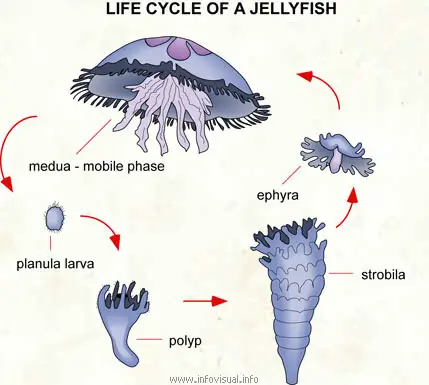
Life cycle of a jellyfish
JELLYFISH LIFE CYCLE

  • Some are solitary (Hydra) others are colonial (corals)
  • Three classes include Hydrozoa (hydra), Scyphozoa (jellyfish), & Anthozoa (sea anemones & corals)

Hydrozoa

  • Includes freshwater, sessile hydra (exists only as polyps) 
  • Portuguese man-of-war (exists as colony of polyps & medusa)
  • Group of cells called basal disk produces sticky secretion for attachment & can secrete gas bubbles to unattach & let hydra float
  • Hydra also move by somersaulting (tentacles bend over to bottom as basal disk pulls free)
  • Tentacles pull food into gastrovascular cavity where enzymes digest it
  • Reproduce asexually by budding during warm weather & sexually in the fall
  • Hermaphrodites that release sperm into water to fertilize eggs of another hydra


HYDRA

Scyphozoa

  • Includes bell-shaped jellyfish
  • Medusa stage is dominant in the life cycle
  • Tentacles may be meters in length & carry poisons that cause severe pain or death
  • Have both asexual polyps & sexual medusa stages in their life cycles
  • Adult medusa stage releases eggs & sperm into water
  • Fertilization produces ciliated planula larva that settles to the bottom, attaches, & forms tentacles 
  • New medusa bud off of reproductive polyps & form adult jellyfish

jellyfish life cycle photo
JELLYFISH

Anthozoa

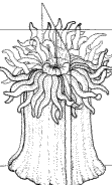
  • Include corals in a limestone case & sea anemones
  • Called “flower animals”
  • All marine
  • Sea anemone is a sessile, polyp-form that uses its tentacles to paralyze fish
  • Some anemones in the Pacific Ocean live symbiotically with the clownfish sharing food & protecting each other

#22A

  • Corals are small, colonial polyps living in limestone cases
  • Coral reefs form as polyps die & provide a home and protection for other marine animals
  • Reefs form in warm, shallow water & only the top layer has living polyps
  • Algae may live symbiotically with coral supplying them with oxygen

Phylum Ctenophora

Characteristics

  • All marine
  • Includes comb jellies

  • Have eight rows of fused cilia called “comb rows”
  • Largest animal to move by cilia
  • Move by beating cilia
  • Lack cnidocytes but have cells sticky cells called colloblasts that bind to prey
  • Colloblasts located on two ribbon-like tentacles
  • Have sensory structure called apical organ to detect direction in the water
  • Most are hermaphrodites (make eggs & sperm)
  • Produce light by bioluminescence
BACK


Biology Study Guides Summary of Links

Biology Study Guides
All Materials © Cmassengale

Safety & Equipment Chromosomes Flat & Round Worms Unsegmented Worm Review
Study of Life
Intro to Biology Review
Chapter 1 Introduction
Taxonomy
Taxonomy Review

Cladogram Practice
Mollusks
Mollusk Review
Chemistry

Chemistry Review

Evolution
Evolution Review
Annelids
Annelid Review
Biochemistry
Biochemistry Review
Viruses

Virus Review

Arthropods
Arthropod Review  
Cells
Cells – Units of Life
Cells & Their Functions
Cell Review

Cell Study Guide
Bacteria & Viruses
Bacteria & Viruses
Bacteria Review
Insects

Insect Review


Homeostasis & Transport

Handout – TRANSPORT
Cell Membrane Review
Transport Study Guide
Fungi
Fungi Review
Echinoderms
Echinoderm Review 
Photosynthesis
Photosynthesis Review
Protists
Protist Review
Fish
Fish Review  
Photosynthesis & Respiration

Photosynthesis & Cell Respiration

Mosses & Ferns Amphibians
Amphibian Review  
Cellular Respiration
Cell Respiration Review
Seed Plants Reptiles
Reptile Review  
Nucleic Acids
Nucleic Acid Review
Plant Structure & Function Birds
Birds Review 
Cell Growth & Division
Cell Cycle & Mitosis
Cell Reproduction Review
Introduction to Animals
Intro to Animals Review
Invertebrate Table
Mammals

Mammal Review  

Genetics
Genetics flashcards
Genetics Review
Sponges & Cnidarians
Review Worksheet
Ecology
Ecology Review

Cycles Worksheet  
Biogeochemical worksheet 
1st Semester 2003
2nd Semester  2003
1st Semester 2004
2nd Semester  2004
1st Semester 2006
1st Semester
2012


Biology I                


PreAP Biology


Strawberry DNA


Strawberry DNA Extraction


Adapted from a lab by C. Sheldon

Introduction:

DNA is found in cells from Animals and Plants.  DNA is a double stranded macromolecule composed of nucleotide bases pairing Adenine with Thymine and Guanine with Cytosine.  DNA can be extracted from cells by a simple technique with household chemicals, enabling students to see strands of DNA with the naked eye.

Purpose:

To extract DNA from the fruit of a strawberry plant

Safety Precautions:

  • Do not eat or drink in the laboratory.
  • Wear Apron & Safety Goggles.

Materials / Equipment (per student group):

1. heavy duty zip-lock baggie

2.  1 strawberry (fresh or frozen and thawed)

3.  cheesecloth

4.  funnel

5.  100 ml beaker

6.  test tube

7.  wooden coffee stirrer

8. DNA Extraction Buffer (One liter: mix 100 ml of shampoo (without conditioner), 15 g NaCl, 900 ml water OR 50 ml liquid dishwashing detergent, 15 g NaCl and 950 ml water)

9.  Ice-cold 95% ethanol or 95% isopropyl alcohol

Procedure:

1.  Place one strawberry in a zip lock baggie and carefully press out all of the air and seal the bag.

2.  Smash the strawberry with your fist for 2 minutes.

3.  Add 10 ml extraction buffer to the bag and carefully press out all of the air and seal the bag.

4.  Mush again for one minute.

5.  Filter through cheesecloth in a funnel into beaker. Support the test tube in a test tube rack.

6.  Discard the extra mashed strawberry.

7.  Pour filtrate into test tube so that it is 1/8 full.

8.  Slowly pour the ice-cold alcohol into the tube until the tube is half full and forms a layer over the top of the strawberry extract.

9.  At the interface, you will see the DNA precipitate out of solution and float to the top. You may spool the DNA on your glass rod or pipette tip.

10.                    Spool the DNA by dipping a pipette tip or glass rod into the tube right where the extract layer & alcohol are in contact with each other. With your tube at eye level, twirl the rod & watch as DNA strands collect.

Prelab:

Take a look at the sketch of the plant cell below. The chromosomes (which are made of DNA) are in the nucleus. This is the only place where DNA is located.


Now match the procedure with what it is doing to help isolate the DNA from the other materials in the cell.


_____1. Break open the cell A. Squish the fruit to a slush


_____2. Dissolve cell membranes B. Filter your extract through cheesecloth
_____3. Precipitate the DNA (clump the DNA together C. Mix in a detergent solution
_____4. Separate organelles, broken cell wall, and membranes from proteins, carbohydrates, and DNA D. Layer cold alcohol over the extract


DNA Extraction Table

AMOUNT ADDED OR OBTAINED INITIAL COLOR PURPOSE
BUFFER
(soap-salt mixture)
STRAWBERRY
COLD ALCOHOL
DNA

SKETCH OF TEST TUBE WITH CONTENTS


Questions:

1.  Where can DNA be found in the cell?

2.  Discuss the action of the soap (detergent) on the cell.  What is the purpose of the soap in this activity?

3.  What was the purpose of the Sodium Chloride? Include a discussion of polarity and charged particles.

4.  Why was the cold ethanol added to the soap and salt mixture?

5.  Describe the appearance of your final product?

6.  Draw a diagram of DNA containing 5 sets of nucleotide bases labeling the hydrogen bonds between the bases.