Second Semester Study Guide Bl


Second Semester Review 


Are animals autotrophs or heterotrophs? Explain.
What type of symmetry does a sea anemone have?
At which end of an animal is the tail located?
What supportive rod along the back do all chordates have at some time during their life?
How do sponges differ from all other animals?
How does a sponge obtain its food?
What hard, needle like structures are found in the walls of sponges?
Do all animal cells have cell walls? Explain.
In what phylum are squid & octopus found?
Name 4 animals that are classified as cnidarians.
What is the function of collar cells in sponges?
Are animals unicellular or multicellular organisms?
At which end of an animal is the head located?
What kind of symmetry do insects have?
Flatworms use what method to asexually reproduce?
Why do flatworms NOT need circulatory & respiratory systems?
What group of worms has a pseudocoelom?
What is the function of the radula in mollusks?
Which class of mollusks uses “jet propulsion” to move?
Describe torsion in gastropod mollusks.
Give several examples of appendages in arthropods.
Describe the body of all arthropods.
Describe the appendages of all arthropods.
In what group are clamworms found?
Name 3 main classes of mollusks.
What muscles open & close bivalve mollusks?
What makes up the exoskeleton of arthropods?
Name 4 members of the class Crustacea.
What group of animals has 3 body regions & 6 legs?
How do insects benefit agricultural crops?
Name 4 characteristics of all chordates.
In what order are amphibians without tails found?
From what structure in fish did jaws probably arise?
List 4 examples of echinoderms.
What structure in fish filters wastes from blood?
The urinary bladder & kidneys in fish make up what system?
Where are shark eggs fertilized?
What does “Agnatha” mean?
What does “Chondrichthyes” mean?
Describe caecilians.
Name 4 things used by sharks to detect their prey.
What type of symmetry do echinoderms have?
Why do most amphibians have thin, moist skin?
What does “amphibian” mean?
Describe development in placental mammals.
Where is the diaphragm found in mammals?
Name a reptilian characteristic found in birds.
What covers the body of birds?
What covers the body of reptiles?
Describe a reptile’s skin.
Are reptiles ectotherms or endotherms? Explain.
Where are the chorion & amnion found?
How many chambers does a bird’s heart have?
What adaptation of reptiles allowed them to live & reproduce on land?
How many chambers does the heart of most reptiles have?
How many chambers does the heart of mammals have?
Which group of vertebrates has a diaphragm & what is its function?
Are mammals endotherms or ectotherms?
Name 3 groups of ectothermic vertebrates.
BACK


Safety Guidelines

Safety Guidelines
All Materials © Cmassengale


  1. Safety goggles/glasses & aprons must be worn at all times in the laboratory.
  2. Tie back long hair & secure lose clothing.  
  3. No horseplay is allowed in the lab.
  4. No food or drink is allowed in the laboratory.  
  5. Practice good “housekeeping” techniques.  Return items to proper places in good condition.  Avoid cluttering your work area.
  6. Never use chemicals from unlabeled containers.  Check each label before dispensing a chemical, & do not return a chemical to a bottle without the teacher’s permission.
  7. Unless told otherwise, treat all chemicals as poisonous or corrosive.  Wash hands immediately with plenty of water if chemical gets on them and always wash your hands before leaving lab.  
  8. No unauthorized lab work may be done, & a teacher must be present to do lab work.  
  9. Read & study each lab assignment before coming to lab.  Pay attention to safety notes in the lab manual and from the instructor.  Some common lab concerns:
    * Never pipette by mouth
    * Never use chipped or cracked glassware
    * Do not heat a closed system
    * Do not point heated containers at yourself or another person
    * Use a fume hood for noxious fumes
    * Place heated glass on wire gauze until cool
    * Do not use flammable material near open flame
    * Wear gloves when dispensing irritating chemicals
    * Dilute concentrated acids by adding acid to water
    * Turn off burners and water faucets when not in use & before leaving lab
    * Only heat glassware marked Kimex or Pyrex
    * Use glycerin and a twisting motion to insert glass tubing into stoppers
    * Use tongs, test tube holders, or heat-resistant gloves to handle hot glassware
    * Use pins to secure dissecting organisms to the dissecting tray before cutting with a scalpel
    * Wash hands before and after dissecting and keep hands away from your face
  10. Report all accidents immediately to the teacher.
  11. Know the location and proper use of all safety equipment in the lab.
  12. Know where all exits are from the lab.


PRINT SAFETY RULES & LAB CONTRACT HOME      PRINT SAFETY WORKSHEET


Seed Germination & Detergents


Detergent & Seed Germination

Introduction:

Seeds come in different sizes, shapes, and colors. Some are edible and some are not. Some seeds germinate readily while others need specific conditions to be met before they will germinate. Within every seed lives a tiny plant or embryo.The outer covering of a seed is called the seed coat. Seed coasts help protect the embryo from injury and also from drying out. Seed coats can be quite thin and soft as in beans or very thick and hard as in locust or coconut seeds. Endosperm, which is a temporary food supply, is packed around the embryo in the form of special leaves called cotyledons or seed leaves. These generally are the first parts visible when the seed germinates. Plants are classified based upon the number of seed leaves (cotyledons) in the seed. Plants such as grasses and grass relatives can be monocots, containing one cotyledon. Dicots are plants that have two cotyledons.

 Seeds remain dormant or inactive until conditions are right for germination. All seeds need water, oxygen, and proper temperature in order to germinate. Some seeds require proper light also. Some germinate better in full light while other require darkness to germinate.When a seed is exposed to the proper conditions, water and oxygen are taken in through the seed coat. The embryo’s cells start to enlarge and the seed coat breaks open and root or radicle emerges first, followed by the shoot or plumule which contains the leaves and stem.

Many factors contribute to poor germination. Over-watering results in a lack of proper oxygen levels. Planting seeds to too deep results in the seed using up all of its stored energy before reaching the soil surface, and dry conditions result in the lack of sufficient moisture to start and sustain the germination process.

Objective:

The students will be able to describe how some environmental factors affect seed germination.

Materials:

Masking tape, Scissors, 3 ziplock bags, Marker, Forceps, Paper Towels, Metric Ruler, 3 colored pencils, 25 seeds, distilled water, 50 ml graduated, 1% detergent solution, 10% detergent solution, graph paper

Procedure:

  1. Label the 3 zip lock bags: Control, 1% Solution and, 10% Solution.
  2. Cut 6 square pieces of paper toweling to fit each bag.
  3. Place 2 squares in each bag.
  4. Distribute 6 seeds on each side of the paper towel between the plastic and towel.
  5. In the control bag add 25 ml of distilled water completely moistening the paper towel.
  6. In the 1% solution bag add 25 ml of 1% detergent solution making sure to completely moisten the towel.
  7. Do the same to the 10% solution bag by adding 25 ml of 10% detergent solution.
  8. Make sure all bags are sealed tightly.
  9. Place the bags in a dark warm place designated by the instructor.
  10. Write a hypothesis predicting the results of the experiment.
  11. Examine the bags daily for 5 days. Record any changes that might have occurred. If the roots is visible the seed is considered germinated.
  12. Record your date in the table below.
  13. Do not allow your towels to dry out. Moisten each bag with the appropriate solutions in equal amounts.
  14. Measure the root growth of each seed daily from the time it appeared.
  15. Graph the data from the table using the colored pencils to represent each of the zip lock bags.

Number of Seeds Germinated


Day Control 1% Detergent Solution 10% Detergent Solution
1
2
3
4
5


Average Growth of Germinating Seeds(mm)

Day Control 1% Detergent Solution 10% Detergent Solution
1
2
3
4
5

Graph Title: ________________________________________

Analysis:

1. How many of the seeds germinated after 5 days in distilled water? ________. In 1% solution? _______ in 10% solution? ________.

2. Was there a difference in the number of seeds germinated?

3. In which of the three bags did seeds germinate faster?

4. What was the purpose of the control?

5. Did the detergent strength have an effect on the seed’s germination? If so What was it?

6. Was your hypothesis correct? Why or why not?

7. If it was not, what will you do now?

 

Scientific Equipment


Scientific Equipment

All Materials © Cmassengale

Click HERE for Notebook Copy

Compound Light Microscope (LM)-used to enlarge an image Graduated Cylinder – used to measure the volume of liquids
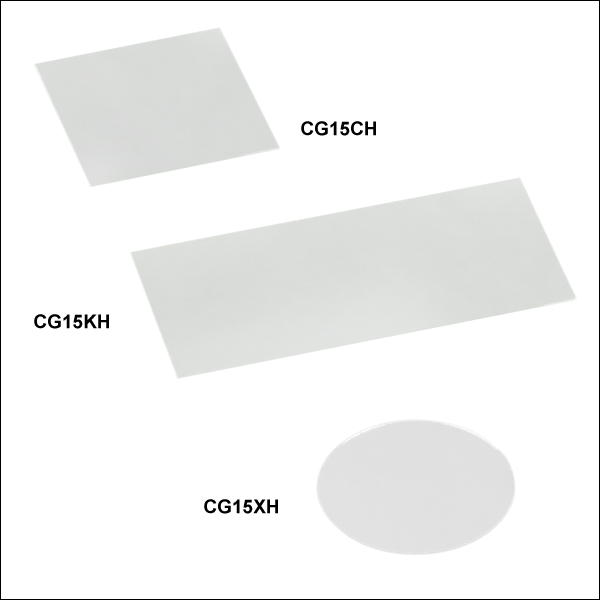
Microscope Slide – supports an item being examined under the microscope Image result for cover slip Cover slip – covers specimen on a slide
Beaker, Glass, Cup, Chemistry, Flask, Laboratory Beaker – holds liquids while they are being stirred or heated Test Tube Brush – used to clean test tubes
Image result for evaporating dish Evaporating Dish – used for heating solids Image result for pinch clamps Pinch Clamps – used to control the flow of liquids through tubing
Image result for funnel Funnel – assists in transferring liquids to containers with smaller openings Striker – used to ignite a burner
Test Tubes – holds liquids for observation or testing Safety goggles – protects the eyes from damaging substances
Pipet pump – dispenses known volumes of liquids Eyedropper – used to transfer small amounts of liquids
Image result for forceps Forceps – used to hold or lift specimens Magnifying glass – enlarges the image of an object
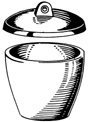
Related image Crucible – containers used for “strong” heating Test Tube Rack – holds test tubes during observation or testing
Wash Bottle – used for rinsing solids out of a container Pipet – used for exact measurements of liquids
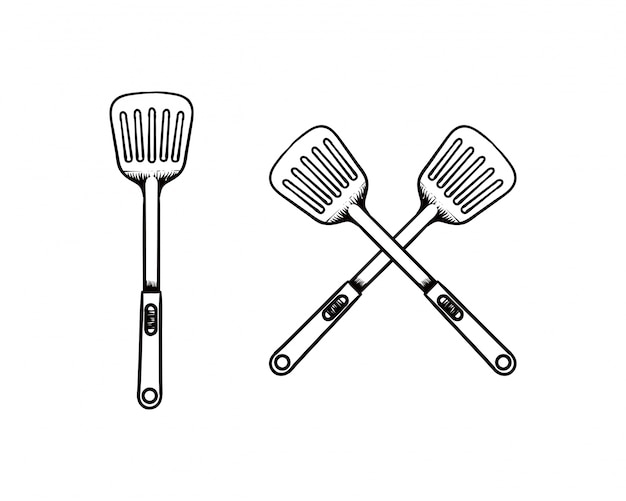
Image result for spatula drawing Spatula – chemical spoons used to transfer solids from their original container to a scale for weighing Image result for wire gauze Wire Gauze – adds additional support for containers held on tripods or O-rings
Crucible Tongs – used for picking up crucibles & crucible covers only Mortar & Pestle – used to grind solids into powders
Florence Flask – used to store liquids Erlenmeyer Flask -used to store solutions
Dissecting Pan – holds specimen being dissected test tube holder Test Tube Holder – holds test tubes while heating
an electronic balance Electronic Balance – used for weighing substances a proper lab burner flame Bunsen Burner – heat source
Thermometer – used to measure temperature Stopper – used to cap flasks containing liquids
Scalpel – used for cutting specimens being dissected Tubing – hose used for connecting glassware
Image result for petri dish Petri Dish – plate used to culture microorganisms a triple-beam balance Triple Beam Balance – used for weighing substances
O-Ring – used with ring stands to support heated vessels Volumetric Flask – used to mix precise volumes of liquids
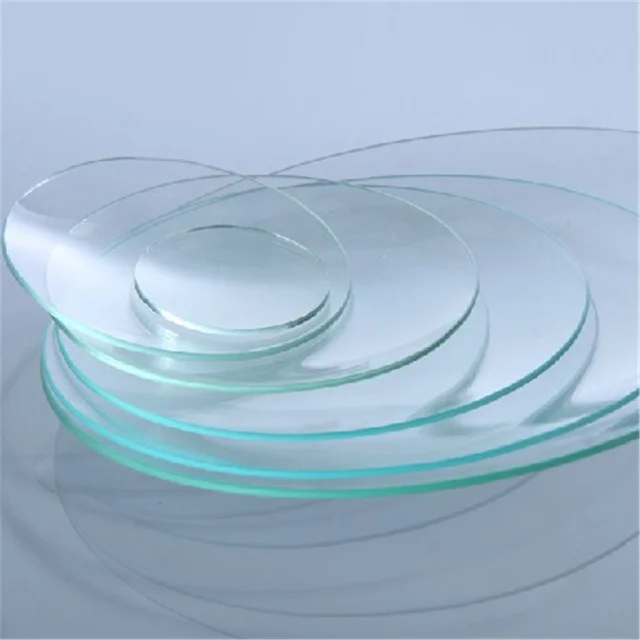
Related image Watch Glass – used on top of beakers when heating Desiccators – used to remove moisture from substances
PRINT EQUIPMENT SHEET FOR NOTEBOOK      BACK

Seed Plants Bi

For the Angiosperms the two variation of this basic design are seen in the two Classes (Monocots versus Dicots) (see fig. 23-2).


MONOCOTS
DICOTS
Flower structure arranged in group of three arranged in groups of four or five
Leaves narrow with parallel veins wider with branching netlike veins
Vascular tissue scattered vascular bundles Ring of vascular bundles
Roots Many smaller roots One main taproot
Seed One cotyledon Two cotyledons