Protist Study Guide B1

Protist Study Guide 

  1. What type of environment are slime molds found?
  2. Describe the body of a slime mold.
  3. What is so unusual about a euglena?
  4. Give main characteristics of Chlorophyta.
  5. How is quinine used?
  6. What plasmodium stage do mosquitoes inject into humans?
  7. Where are Autotrophic protists found?
  8. Where can algae be found?
  9. What are zoospores?
  10. Why are Bacillariophytes so important?
  11. List some specializations of algae.
  12. How do algae differ from other protists?
  13. Which type of algae is most like plants?
  14.  In what phylum are these algae placed?
  15. How do the sporophyte & gametophyte generations of protists differ?
  16. Name several characteristics used to identify algae.
  17. Name characteristics of all protozoa.
  18. Which type of protozoan serves as an energy source for other organisms in its environment?
  19. What insect spreads African sleeping sickness?
  20. What causes malaria?
  21. How do micronuclei & macronuclei differ genetically from each other?
  22. List human diseases caused by protists.
  23. What is conjugation?
  24. What protist uses pseudopodia & how are they used?
  25. What are cysts & why are they formed?

Protozoan


Protozoa
Animal like Protists

All Materials © Cmassengale

Characteristics:

  • Eukaryotes
  • Found in kingdom Protista
  • Most are unicellular
  • Heterotrophs that ingest small food particles & digest it inside food vacuoles containing digestive enzymes
  • Classified by the way they move (cilia, flagella, pseudopodia…)

  • Microscopic in size
  • 65,000 identified species with almost half extinct
  • Found in freshwater, marine, and moist terrestrial habitats
  • Make up part of the zooplankton & serve as food for animals in marine & freshwater systems
  • First seen by Leeuwenhoek in 1675
  • Many species are free living
  • Some species are parasitic living in the bloodstream of their host & cause malaria, amebic dysentery, or giardiasis
  • Many serve as food for other organisms in aquatic habitats; called zooplankton

Reproduction:

  • All reproduce asexually by binary fission (single protozoan divides into two individuals)
  • Some species reproduce by multiple fission producing more than two individuals
  • Some species reproduce sexually by conjugation (opposite mating strains join & exchange genetic material)

Adaptations:

  • Eyespots in some protozoans can detect changes in light

  • Many can form harden covering called cyst when conditions become unfavorable (no water, pH or temperature changes, nutrient deficiency, decreased oxygen supplies…)
  • Metabolic activity of protozoans resumes when conditions become favorable again
  • Some protozoans can detect & avoid obstacles and harmful chemicals in their environment
  • Freshwater protozoa have contractile vacuoles to pump out excess water

Classification:

  • Divided into 4 phyla based on their method of movement — Sarcodina, Ciliophora, Zoomastigina, & Sporozoa
  • Found in the kingdom Protista along with algae, slime molds, & water molds
  • Sarcodinians move by extending their cytoplasm or pseudopodia (fingerlike projections of the cytoplasm)
  • Zooflagellates move by whip like flagella
  • Ciliophorans or ciliates move by hair like cilia move
  • Sporozoans are nonmotile


Phylum Common Name Locomotion Type of Nutrition Examples
Sarcodina sarcodines pseudopodia heterotrophic;
some parasitic
Amoeba
Radiolaria
Naegleria
Ciliophora ciliates cilia heterotrophic;
some parasitic
Paramecium
Tetrahymena
Balantidium
Zoomastigina zooflagellates flagella heterotrophic;
some parasitic
Trypanosoma
Leishmania
Giardia
Trichonympha
Sporozoa sporozoans (None in Adults) heterotrophic;
some parasitic
Plasmodium
Toxoplasma


Protozoan Evolution:

  • First eukaryotic organism thought to have evolved about 1.5 billion years ago
  • Protozoans possible evolved from the 1st eukaryotes by Endosymbiosis 
  •  Endosymbiosis – process where one prokaryote lives inside another becoming dependent upon each other

Phylum Sarcodina:

  • Includes hundreds of species of amebas
  • Found in freshwater, marine, & moist soil habitats
  •  Usually reproduce asexually
  • Their cytoplasm consists of clear, outer ectoplasm and granular, inner endoplasm
  • Move by extending cytoplasm (cytoplasmic streaming)
  • Cytoplasm extensions are called “false foot” or pseudopods
  • Pseudopods form when the inner cytoplasm or endoplasm pushes the outer cytoplasm or ectoplasm forward to make a blunt, armlike extension
  • Ameba move by cytoplasmic streaming to produce pseudopods; process called ameboid movement

  • Sarcodines also use their pseudopods for feeding by surrounding & engulfing food particles & other protists; called phagocytosis
  • Food is surrounded by a pseudopod & then this part of the cell membrane pinches together forming a food vacuole; called endocytosis
  • Cytoplasmic enzymes enter the food vacuole & digest the food
  • Undigested food & wastes leave by exocytosis

  • Most Sarcodinians have contractile vacuoles to pump out excess water

  • Oxygen & carbon dioxide diffuse through the cell membrane
  • Sarcodinians may form hard, protective, inactive cysts when conditions become unfavorable (drought, lack of nutrients, heat…)
  • React to stimuli such as light
  •  Some Sarcodinians have hard shells called the test made of silica or calcium carbonate
  • Radiolarians found in warm, marine waters have a test made of silica & have sticky pseudopodia to trap food

  • Marine Foraminiferans have a test made of calcium carbonate with holes through which pseudopodia extend

  • Foraminiferan tests build up and form limestone or chalk (e.g. White Cliffs of Dover)
  • Important food source in marine habitats
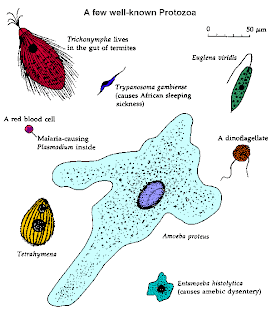
  • Entameba histolytica cysts in untreated water supplies cause amebic dysentery which can be fatal

Phylum Ciliophora:

  • Called ciliates because they move by short, hairlike cilia lining the cell membrane
  • Cilia may be modified into teeth, paddles, or feet

  • Largest group of protozoans
  • Most found in freshwater, but some are marine
  •  Called plankton & serve as a food source
  •  Form protective cysts to survive unfavorable conditions
  • Members include the Paramecium, Vorticella,  & Stentor
  • Have 2 types of nuclei — smaller micronuclei & larger macronuclei
  • Macronucleus controls asexual reproduction by mitosis
  • Can reproduce sexually by conjugation (two paramecia join together & exchange DNA)
  • Gases diffuse across cell membrane

Stentor:

  • Trumpet shaped protozoan with cilia around the top
  • Attaches to feed & then detaches to swim around

Vorticella:

  • Cup shaped protozoan with cilia at the top
  •   Has a coiled stalk to raise & lower the organism
  • Can attach to surfaces

Paramecium caudatum:

  •  Slipper shaped protozoan found in freshwater

  • Clear, elastic covering of cell membrane called pellicle
  • Pellicle made of protein for protection
  • Use cilia to swim & obtain food (algae & bacteria)
  • Have 2 contractile vacuoles to pump out excess water
  •  Cilia sweep food into oral groove where mouth located at the bottom
  •  Food enters short tube called gullet into food vacuoles where it’s digested
  • Wastes leave through anal pore

  • Have trichocysts (tiny, toxic darts to help capture prey or anchor to a surface)
  •  Respond to light & learn by trial & error
  • Reproduce asexually by mitosis & sexually by conjugation

Phylum Zoomastigina:

  • Called Zooflagellates because have one or more whiplike flagella to move
  • Flagella made of bundles of microtubules

  • May be freshwater or marine
  • Some are parasites such as Trypanosoma that destroy red blood cells & causes fatal African sleeping sickness

  • Trichonympha lives symbiotically inside termites & digests cellulose

Phylum Sporozoa:

  • Adult sporozoans have no structures for movement
  • Form spores

  • Most are parasitic using one or more hosts
  • Immature sporozoans are called sporozoites & live in body fluids of hosts
  • Plasmodium is transmitted by mosquitoes & causes malaria
  • Plasmodium sporozoites enter the bloodstream, travel to the liver, divide & form spores called merozoites
  • Merozoites attack red blood cells & later form eggs & sperm that fertilize
  •  New sporozoites migrate to the salivary glands of mosquitoes where they can be passed on to another person
  • Malaria can be controlled by controlling mosquito populations & it is treated with a drug called quinine derived from the Cinchona Tree


Preap Cellular Respiration Study Guide


Cellular Respiration Review  


1. Most eukaryotic cells produce only about ___________  ATP Molecules per Glucose Molecule.

2. What is the process by which glucose is converted to pyruvic acid? ________________________________________

3. At the beginning of aerobic respiration, pyruvic acid bonds to a molecule called ______________________________________ to form Acetyl CoA.

4. The breakdown of pyruvic acid in the presence of oxygen is called ______________________________  _______________________.

5. With every completion of the Krebs Cycle, how many ATP Molecules are made? ________________

6. What is the waste product of the Krebs Cycle? _____________________________________________.

7. The conversion of pyruvic acid to carbon dioxide and ethanol is called ___________________________________   _____________________________________________.

8. The release of energy from food molecules in the absence of oxygen is ______________________________________     _________________________________________________________.

9. What is the byproduct of the electron transport Chain?_______________________________________________.

10. How efficient is Anaerobic Respiration? __________%  Aerobic Respiration? ____________%

11. What is the first pathway of cellular respiration called? ________________________________________________

12.What is the location of Glycolysis? _______________________________________________________

13. What is the scientific unit of Energy? ________________________________________________

14. What do you call cellular respiration in the presence of oxygen? _______________________________________  _________________________________________________________.

15. Yeast produces ______________________________ and _______________________________ in the process known as ____________________________________  ___________________________________________.

16. In cellular respiration, glycolysis proceeds the _______________________________  ___________________________.

17. In cellular respiration, more energy is transferred in the ___________________________  ________________________  _________________________________ than in any other step.

18. Glucose molecules are converted into _______________________________  _______________________ molecules in the process of glycolysis.

19. What is the location of the electron transport chain in prokaryotes? ________________  _______________________.

20. The processes of glycolysis and the anaerobic pathways is called ___________________________________.

21. What is the product of acetyl CoA and oxaloacetic acid? _________________  ___________________

22. What molecule is the electron acceptor of glycolysis? _________________________________________

23. The breakdown of organic compounds to produce ATP is known as ____________________________________  ________________________-_______________________________.

24. Glycolysis begins with glucose and produces ______________________________  _________________________.

25. An important molecule generated by both lactic acid and alcoholic fermentation is ______________________________.

26.  In the first step of aerobic respiration, pyruvic acid from glycolysis produces CO2, NADH, H+, and _________________________________  _____________________________________.

27. The electron transport chain is driven by two products of the Krebs Cycle – ______________________  and  ___________________________.

28. What happens to electrons as they are transported along the electron transport chain? _________________________________________________________________

29. The energy efficiency of aerobic respiration (including glycolysis) is approximately ______________  __________________________________________________.

30. Where in the mitochondria do the reactions of the Krebs cycle occur? _____________________________   ___________________________________________________________

31. Where in the mitochondria is the electron transport chain located? _____________________________          __________________________________________________

32. In alcoholic fermentation, ethyl alcohol is produced from _______________________________  ______________________________________.

33.  ____________________________________, and _______________________________ supply electrons and protons to the electron transport chain.

34. Cellular respiration takes place in Two Stages: _______________________________________, then ________________________________________  ________________________________.

35. Water is an end product in the ________________________________________________________________
___________________________________________________________________.

36. In cellular respiration, a two-carbon molecule combines with a four-carbon molecule to form citric acid as part of the _____________________________________________________________________________________.

37. When glycolysis occurs, a molecule of glucose is ___________________________________________.

38. The name of the process that takes place when organic compounds are broken down in the absence of oxygen is _____________________________________________ or _______________________________________.

39. Energetic electrons that provide the energy for the production of most of a cell’s ATP are carried to the electron transport chain by _______________________________ and __________________________________________.

40. _______________________________________ is a biochemical pathway of cellular respiration that is anaerobic.

41. Glucose is split into smaller molecules during the biochemical pathway called __________________________________.

42. In the absence of oxygen, instead of oxidative respiration following glycolysis, glycolysis is followed by ______________________________________________________.

43. During fermentation, either ethyl alcohol and carbon dioxide or _______________________________________ is formed.

DIRECTIONS: Answer the questions below as completely and as thoroughly as possible. Answer the question in essay form (not outline form), using complete sentences. You may use diagrams to supplement your answers, but a diagram alone without appropriate discussion is inadequate.

1. How does aerobic respiration ultimately depend on photosynthesis?

2. Explain the role of oxaloacetic acid with respect to the cyclical nature of the Krebs cycle.

3. Glycolysis produces only 3.5% of the energy that would be produced if an equal quantity of glucose were completely oxidized.  What has happened to the remaining energy in the glucose?

4. Why do most cells produce fewer than 38 ATP molecules for every glucose molecule that is oxidized through aerobic respiration?

5. What happens to electrons that accumulate at the end of the electron transport chain?

6. What role does chemiosmosis play in aerobic respiration?

7. What condition must exist in a cell for the cell to engage in fermentation?

8. How is the synthesis of ATP in the electron transport chain of mitochondria similar to the synthesis of ATP in chloroplasts?

9. The fourth step of glycolysis yields four ATP molecules, but the net yield is only two ATP molecules.  Explain this discrepancy.

10. Under what conditions would cells in your body undergo lactic-acid fermentation?

11. What role does oxygen play in aerobic respiration? What molecule does oxygen become a part of as a result of aerobic respiration?

12. Where in the mitochondrion do protons accumulate, and what is the source of the protons?

Plant Structure Study Guide

PLANT STRUCTURE AND FUNCTION

1. Cells that support the non-growing parts of plants are called ____________________.

2. Sugars are transported in vascular plants through what tissue?

3. The tissue in a vascular plant that is used to transport water and minerals is __________.
4. Which plant cells are the most abundant and least structurally specialized?
5. Long, narrow cells of xylem with thin separations between them are known as _______.
6. Short, wide cells of xylem with NO end walls function in water transport when the cells are __________.

7. Cells of phloem that help the sieve tube elements to function are called _________________.

8. Growth that makes a plant stem thicker is known as ____________________  ____________.

9. In the meristem regions of plants you would expect to find _____________________ cells.

10. Collenchyma cells would help support which parts of a celery plant?

11. The epidermis on the stems and leaves of young plants prevents ______________________.

12. The vascular cylinder of a root is surrounded by the __________________________.

13.  A plant absorbs water and minerals through  _____________________.

14.  Which type of plant cells function in metabolic activities such as photosynthesis, storage, and healing?

15. Grasses usually have which type of roots?

16. In stems, vascular tissue is arranged to form ________________________.

17. What are the pores in the epidermis of leaves that control water evaporation called?

18.Primary growth in roots results in _________________________ of roots, and secondary growth results in _________________________ of roots.

19. What is the process of the evaporation of water from the leaves of a plant called?

20. The movement of sugars in a plant can be explained by the __________-
_____________  _____________.

21. What causes water molecules to stick together and pull each other up a plant stem?

22. Sugars made in photosynthesis in transported by being pumped into the ___________________________   _______________________________.

23. The function of the endodermis in roots is to _____________________ movement of substances into the ________________________  ___________________ of the root.

24. _______________________________ tissue forms the skin of a plant.

25.  ______________________________ tissue consists of everything that is Not dermal or vascular tissue.

26. The growing regions of plants are called ________________________________________.

27. Meristematic tissue is the only type of plant tissue that produces new cells by _______________.

28. The elongation of stems and roots is called _____________  _______________.

29. Most seed plants have Three basic organs, _________________, ___________________ and
_______________________________.

30. Lateral roots form from the _______________________ inside the root, while lateral stems form from _____________________________ on the surface of stems.

31. Plant cells that are even, thick-walled, rigid cells _____________________________.

32.  The name of the meristem between xylem and phloem  _______________________.

33. The roots that branch off a primary root ________________________  _________________.

34. Plant cells that are irregular, thick-walled cells ______________________________.

35. A root system with an enlarged primary root  _________________________.

36.  Type of meristems found only in monocots  _________________________.

37. Type of root system with many branch roots  _______________________.

38. Type of plants cells that are thin-walled cells that can be cube-shaped or elongated _______________.

39. In Dicots primary growth occurs in _______________________  ________________________ and in monocots it occurs in _______________________ ______________________ and may also occur in _________________________  _________________________.

40. Primary growth results in the ________________________ of plant structures, and secondary growth results in the _____________________ of plant structures.

41. Monocots stems lack ____________________  ____________________ and therefore cannot produce _________________________  growth.

42. Annual rings in woody plants form as a result of the production of _____________________  ___________________, which contain cells of different sizes that were produced during different times of the growing season.

43. Water is transported from the roots to the leaves of a plant by the process of ___________.

Short Answer:
Answer the questions below as completely and as thoroughly as possible. Answer the question in essay
form (not outline form), using complete sentences. You may use diagrams to supplement your answers.

 What are the TWO different types of vascular tissue in plants?  Briefly describe each kind.

2. How are carbohydrates transported throughout a plant? (Explain the pressure-flow hypothesis).

3. Describe tracheids and explain their function.

4. What are the lateral meristems of plants, and what is their function?

5. What is the difference between primary growth and secondary growth?

6. Explain the main functions of stems, roots and leaves.

7. What adaptations of root maximize water and mineral absorption?

8. Identify the structures that a water molecule would move through on its way from the soil into the xylem of a plant root.

9. What is the relationship between stomata and guard cells? Describe how they function and Describe their role in the activities conducted by leaves.

10. What is transpiration?  How is it related to the movement of water in plants?

11. What is the relationship between the Source and the Sink in the transport of sugars?

12. What are the Four types of tissue found in plants?

13. What are the Three basic types of plant cells?  What are the functions of each?

14. Explain the cohesion-tension theory.

15. List five differences and five similarities between the structure of roots and the structure of stems.


Potato Osmosis Bi Lab


Potato Osmosis


Introduction:

A shipwrecked sailor is stranded on a small desert island with no fresh water to drink. She knows she could last without food for up to a month, but if she didn’t have water to drink she would be dead within a week. Hoping to postpone the inevitable, her thirst drove her to drink the salty seawater. She was dead in two days. Why do you think drinking seawater killed the sailor faster than not drinking any water at all? Today we explore the cause of the sailor’s death. We’ll prepare solutions of salt water to represent the sea, and we’ll cut up slices of potato to represent the sailor. Potatoes are made of cells, as is the sailor!

Objective:

The concentration of solute in a solution will affect the movement of water across potato cell membranes.

Materials:

potato, corer, 3 plastic cups, marker, salt, sugar, distilled water, paper, pencil, electronic balance, clock with second hand or timer, metric ruler, small ziplock plastic bag, foil or plastic wrap

Procedure:

Day 1

  1. Use a knife to square off the ends of your potato. Your potato’s cells will act like the sailor’s cells.
  2. Stand your potato on end & use your cork borers to bore 3 vertical holes.

  1. Remove the potato cylinders from the cork borer & measure their length in centimeters.
  2. Cut the 3 potato cylinders to the same length (about 4 -5 centimeters long).
  3. Record the length & turgidity of the potato cylinders in your data table (day 1).
  4. Place the 3 potato cylinders in a small ziplock bag to prevent them from dehydrating before they’re used.
  5. Take 3 plastic cups and label them with the solution that will be placed in each one — sugar, salt, distilled water.
  6. Prepare a saturated solution of salt by mixing as much salt as you can with water.
  7. Repeat this step by making a saturated sugar solution.
  8. Now fill each cup 2/3’s full of the correct solution —- sugar water, salt water, or distilled water.
  9. Mass each of the potato cylinders & record this mass in grams on your data table.
  10. Place one of your potato cylinders into each cup and cover the top of the cup with foil or plastic.
  11. Leave the potato cylinders in the solution for 24 hours.

Day 2

  1. Carefully remove the potato cylinder from the distilled water solution & pat it dry on a paper towel.
  2. Measure the length of the potato cylinder & record this length & the appearance of the cylinder on your data table. (day 2)
  3. Measure & record the mass of this cylinder.
  4. Repeat steps 13-15 for the potato cylinders in the salt solution & the sugar solution.
  5. Clean up your equipment & area and return materials to their proper place.

Data:


Results of Osmosis in Potato Cells
Solution Initial length
cm
(day1)
Final length
cm
(day2)
Change in length
cm
Initial Mass
g
(day1)
Final Mass
g
(day2)
Change in mass
g
Initial Turgidity
(flaccid or crisp)
Final Turgidity
(flaccid or crisp)
Tonicity of Solution
(iso-, hypo-, or hpertonic)
Distilled water
Salt Solution
Sugar Solution


Results & Conclusions:

1. Did any of the potato cylinders change in their turgidity (flexibility), and if so, which ones changed?


2. Explain why the flexibility of the potato slices changed.


3. Define isotonic, hypotonic, & hypertonic solutions.


4. If potato slices changed in length or turgidity, what process was responsible for this?


5. Make a sketch of your potato cylinder in the distilled water and use arrows to show the direction of water movement across the potato cell membranes.


6. What type of solutions were the salt & sugar solutions. Explain how you know this.


7. Which solution served as the control for this experiment & why?


8. In which solutions was their a greater solute concentration outside of the cells?


9. In which direction did water move through these cell membranes?


10. In what type of solution do plant cells do best & why?


11. Using the information you’ve discovered from this experiment, explain why the sailor died that drank saltwater.


BACK