SECTION 31-1, PLANT CELLS AND TISSUES
Plants have adapted to a range of environments over the course of their evolution. As plants grow, their cells become specialized for particular functions. The patterns of specialized tissue vary in each plant organs-the root, the stem, and the leaf. They also vary depending on the plant’s stage of growth and taxonomic group.
OBJECTIVES: Describe the three kinds of plant cells. Explain the difference between the three plant tissue systems. Describe the main types of meristems. Differentiate between monocot and dicot meristems. Differentiate between primary growth and secondary growth.
SPECIALIZED PLANT CELLS
1. All organisms are composed of Cells.
2. Pine Trees, Marigolds, and Palms all LOOK Different from one another, but they are made of similar CELLS AND TISSUES.
3. Plant Cells have unique structures, including a Central Vacuole, Plastids, and a Thick Cell Wall that surrounds the Cell Membrane. These common Features are found in the THREE TYPES of specialized Plant Cells.
4. PLANTS ARE MADE OF THREE TYPES OF CELLS AND FOUR TYPES OF TISSUES.
5. THE THREE BASIC TYPES OF PLANT CELLS ARE PARENCHYMA (puh-REHN-kih-muh), COLLENCHYMA (kuh-LEN-kih-muh), and SCLERENCHYMA (skleh-REN-kih-muh). (Figure 31-1)
 6. PARENCHYMA CELLS: (Figure 31-1 (a))
A. The most Abundant and Least Structurally Specialized Cells.
B. Parenchyma Cells are usually loosely packed cubed-shaped or elongated cells that contain a large central vacuole and have thin, flexible cell walls.
C. Cells occur throughout the plant and have MANY Functions, INCLUDING PHOTOSYNTHESIS, FOOD STORAGE, AND GENERAL METABOLISM (photosynthesis, storage of water and nutrients, and healing).
D. AN IMPORTANT CHARACTERISTICS OF PARENCHYMA CELLS IS THAT THEY CAN DIVIDE AND BECOME SPECIALIZED FOR VARIOUS FUNCTION.
E. These cells usually form the bulk of non-woody plants. For example, the fleshy part of an apple is made mostly of parenchyma cells.
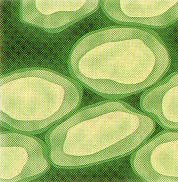 7. COLLENCHYMA CELLS: (Figure 31-1 (b))
A. Plant Cells that SUPPORT the Growing Parts of Plants.
B. The cell walls of Collenchyma Cells are thicker than those of Parenchyma CellS. Collenchyma cell walls are also irregular in shape. The thicker cell walls provide more support for the plant.
C. They have THICK Walls, STRETCHABLE Cell Walls that provide FLEXIBILITY SUPPORT.
D. Collenchyma cells are usually grouped in Strands. They are specialized for supporting regions of the Plant that are Still Lengthening. The Tough String of a Celery Stalk (Stems) are made of Collenchyma Cells.
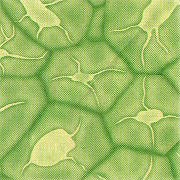 8. SCLERENCHYMA CELLS: (Figure 31-1(c))
A. Support the NON-Growing Parts of plants.
B. Sclerenchyma cells have thick, even rigid cell walls. They support and strengthen the plant in areas where growth is No Longer Occurring.
C. They Have THICK, NONSTRECHABLE Cell Walls.
D. The Cells Walls are so THICK that the Cell USUALLY DIES at maturity, providing a frame to support the plant.
E. WHEN THEY MATURE, MOST SCLERENCHYMA CELLS ARE EMPTY CHAMBERS SURROUNDED BY THICK WALLS.
9. THERE ARE TWO TYPES OF SCLERENCHYMA CELLS:
A. FIBERS – CELLS UP TO 50 cm LONG THAT USUALLY OCCUR IN STRANDS. FABRIC SUCH AS LINEN AND FLAX ARE MADE OF THESE FIBERS.
B. SCLEREIDS – HAVE THICKER CELLS WALLS THAN FIBERS, HAVE MANY SHAPES, AND CAN OCCUR SINGLY OR IN SMALL GROUPS. The gritty texture of a pear is from Sclereids it contains. Sclereids also cause the Hardness of a peach pit and a walnut shell.
PLANT TISSUES AND SYSTEMS
1. Cells that work together to perform a specific function form a Tissue.
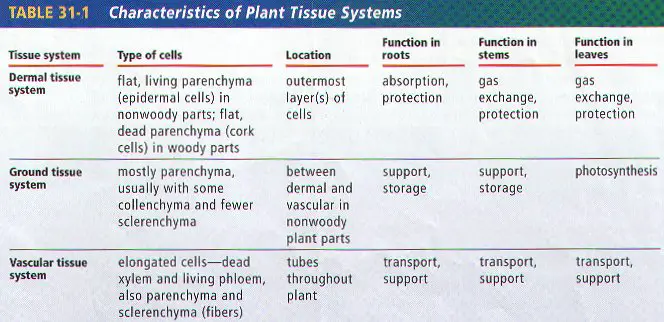
2. Tissues are arranged into Systems in Plants, including the Dermal System, Ground System, and Vascular System. (Table 31-1)
3. These Systems are further organized into the Three Major Plant Organs – THE ROOTS, STEMS AND LEAVES.
4. THE FOUR BASIC PLANT TISSUES ARE VASCULAR TISSUE, DERMAL TISSUE, GROUND TISSUE, AND MERISTEMATIC TISSUE.
DERMAL TISSUE SYSTEM
1. DERMAL TISSUE forms the SKIN (the outside covering) of a Plant, Covering all parts of the ROOTS, STEMS, AND LEAVES.
2. One kind of Dermal tissue is the EPIDERMIS, made of Parenchyma Cells, which is usually only one cell thick, and is the outer protective tissue of young plants and mature Non-woody Plants.
3. Dermal Tissue has different functions, depending on its LOCATION on the plant.
4. ABOVE the Ground, Dermal Tissue prevents the plant from drying out by reducing water loss from evaporation (Transpiration). This Dermis Tissue also Secrets a Waxy Layer called CUTICLE.
5. BELOW the Ground, Dermal Tissue ABSORBS Water. On the underground parts of a plant, the Epidermis FORMS ROOT HAIRS that ABSORB Water and Nutrients.
6. On leaves and stems openings in the epidermis are called Stomata. Stomata regulate the passage of gases and moisture into and out of the plant.
7. In woody stems and roots, the Epidermis is replaced by Dead Cork Cells.
GROUND TISSUE SYSTEM
1. Dermal Tissue surrounds the Ground Tissue System, which consists of all three types of Plant Cells.
2. Ground Tissue consists of everything that is not Dermal Tissue or Vascular Tissue. Parenchyma, a simple tissue, makes up most Ground Tissue.
3. Ground Tissue has many metabolic functions, including PHOTOSYNTHESIS, FOOD STORAGE AND SUPPORT.
4. Non-woody roots, stems, and leaves are made up primarily of Ground Tissue.
VASCULAR TISSUE SYSTEM
1. Vascular plants have specialized Tissue called Vascular Tissue. Vascular Tissue carries WATER and Nutrients THROUGHOUT THE PLANT AND HELPS SUPPORT THE PLANT.
2. There are TWO Kinds of Vascular Tissue; both Kinds of Vascular Tissue contain SPECIALIZED CONDUCTING CELLS:
 A. XYLEM (ZY-lum) – MOVES WATER AND MINERALS UPWARD FROM ROOTS TO LEAVES.
(1) When Water and Minerals are absorbed by the Roots of a Plant, These substances must be transported up to the Plant’s Stems and Leaves.
(2) XYLEM is the Tissue THAT CARRIES WATER AND DISSOLVED SUBSTANCES UPWARD IN THE PLANT.
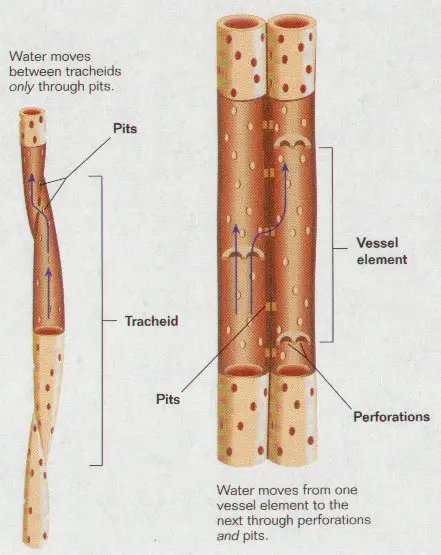
(3) Two Kinds of Conducting Cells are present in Xylem of ANGIOSPERMS: TRACHEIDS and VESSEL ELEMENTS. Both types of cells DO NOT conduct Water until they are DEAD and EMPTY. (Figure 31-2)
(4) TRACHEIDS (TRAY-kee-idz) ARE LONG, THICK WALLED SCLERENCHYMA, NARROW CELLS OF XYLEM WITH THIN SEPARATIONS BETWEEN THEM. WATER MOVES FROM ONE TRACHEID TO ANOTHER THROUGH PITS, WHICH ARE THIN, POROUS AREAS OF THE CELL WALL.
(5) VESSEL ELEMENTS ARE SHORT, SCLERENCHYMA, WIDE CELLS OF XYLEM WITH NO END WALLS. Vessel Elements DO NOT have separations between them; they are arranged end to end liked stacked barrels stack on top of each other. These Vessels are wider than Tracheids, and more water moves through them.
(6) Angiosperms, or Flowering Plants, contain Tracheids and Vessel Elements.
(7) Gymnosperms, or cone bearing seed plants, contain Only Tracheids.
 B. PHLOEM (FLOH-um) MOVES SUGARS OR SAPS IN BOTH DIRECTIONS THROUGHOUT THE PLANT ORIGINATING IN THE LEAVES.
(1) Sugars made in the leaves of a plant by photosynthesis must be transported throughout the plant.
(2) Phloem Tissue CONDUCTS SUGARS UPWARD AND DOWNWARD IN A PLANT.
(3) The sugars move as Sugary Sap.
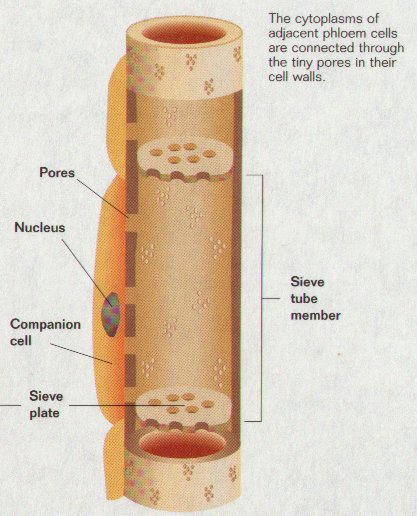
(4) TWO Kinds of Cells are present in Phloem: SIEVE TUBE MEMBER AND COMPANION CELLS.
(5) SIEVE TUBES MEMBERS ARE CELLS OF PHLOEM THAT CONDUCT SAP. Sieve Tube members are stacked to form long SIEVE TUBES. Compounds move from Cell to Cell through End Walls called SIEVE PLATES.
(6) COMPANION CELLS ARE PARENCHYMA CELLS OF PHLOEM THAT ENABLE (ASSIST) THE SIEVE TUBE ELEMENTS TO FUNCTION.
(7) Each Sieve Tube Element has a Companion Cell. Companion Cells CONTROL the movement of substances through the sieve tubes.
(8) The partnership between these two cells is vital; Neither Cell can Live without the other.
GROWTH IN MERISTEMS
1. Plants grow differently from Animals. Instead of Growing only for a limited time, Plants grow as long as the plant is alive.
2. Instead of occurring throughout the organism, Plant Growth occurs only in Specific Growing Regions.
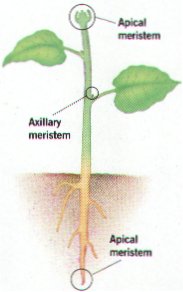 3. THE GROWING REGIONS OF PLANTS ARE CALLED MERISTEMS, regions where cells continuously divide.
4. MERISTEMS ARE LOCATED AT THE TIPS OF STEMS AND BRANCHES, AT THE TIPS OF ROOTS (APICAL), AND IN JOINTS WHERE LEAVES ATTACH TO STEMS (AXILLARY). (Table 31-2)
5. IN WOODY PLANTS (TREES), THERE ARE MERISTEMS BETWEEN THE XYLEM AND PHLOEM.
6. The type of Tissue found in Meristems is called MERISTEMATIC TISSUE.
7. MERISTEMATIC TISSUE IS THE ONLY TYPE OF PLANT TISSUE THAT PRODUCES NEW CELLS BY MITOSIS.
8. These New Cells are ALL ALIKE at First, but eventually they change (Differentiate) into VASCULAR TISSUE, DERMAL TISSUE, OR GROUND TISSUE.
9. The Growing tissue at the tips of Roots and Stems are Called APICAL MERISTEMS.
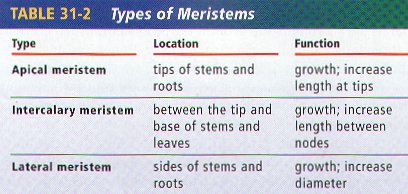 10. APICAL MERISTEMS LOCATED AT THE TIPS OF STEMS AND ROOTS, CAUSE ROOTS AND STEMS TO GROW LONGER AT THEIR TIPS. THEY CAUSE PLANTS TO GROW TALLER AND ROOTS TO GROW DEEPER INTO THE SOIL.
11. Some Monocots have INTERCALRY MERISTEMS located above the bases of leaves and stems. Intercalary Meristems allow grass leaves to quickly regrow after being Grazed or Mowed.
12. Gymnosperms and Most Dicots also have LATERAL MERISTEMS, which allow stems and roots to increase in Diameter. Lateral Meristems are located near the Outside of Stems and roots.
13. There are TWO Types of Lateral Meristems, THE VASCULAR CAMBIUM, AND THE CORK CAMBIUM.
14. The VASCULAR CAMBIUM, located between the Xylem and Phloem, Produces Additional Vascular Tissues.
15. The CORK CAMBIUM, located Outside the Phloem, Produces CORK. Cork Cells replace the Epidermis in Woody Stems and Roots, Protecting the Plant. Cork cells are DEAD CELLS that provide Protection and Prevent Water Loss.
16. THERE ARE TWO PATTERNS OF GROWTH IN SEED PLANTS:
A. PRIMARY GROWTH – THE ELONGATION (GROWTH IN LENGTH) OF STEMS AND ROOTS IS CALLED PRIMARY GROWTH. ALL PLANTS EXHIBIT PRIMARY GROWTH, IT OCCURS WHERE PLANTS GROW TALLER AND THEIR ROOTS GROW DEEPER.
B. SECONDARY GROWTH – GROWTH THAT MAKE PLANTS THICKER (GROWTH IN DIAMETER) IS CALLED SECONDARY GROWTH. SOME SEED PLANTS HAVE SECONDARY GROWTH, IN WOODY PLANTS. THERE IS A MERISTEM (LATERAL MERISTEM) BETWEEN THE XYLEM AND PHLOEM CALLED THE VASCULAR CAMBIUM THAT PRODUCES ADDITIONAL VASCULAR TISSUE.
SECTION 31-2, ROOTS
Plants have Three Kinds of Organs-Roots, Stems, and Leaves. Roots are the structures that typically grow underground. Roots are important because the anchor the plant in soil. They also absorb and transport water and mineral nutrients. The storage of water and organic compounds is provided by roots.
OBJECTIVES: List the three major functions of roots. Explain the difference between a taproot system and a fibrous root system. Distinguish between primary growth and secondary growth in roots. Describe primary root tissues.
TYPES OF ROOTS
1. THE FIRST ROOT TO EMERGE FROM A SEED IS THE PRIMARY ROOT. As the plant matures, branches grow from the Primary Root.
 2. In some Plants the Primary Root Enlarges, If this first Root Becomes the Largest Root it is called a TAPROOT (THE LARGEST ROOT). (Figure 31-3)
3. Taproots can grow deep, reaching water far below the surface of the ground.
4. Beets and Carrots are plants with Taproots that are used for Food.
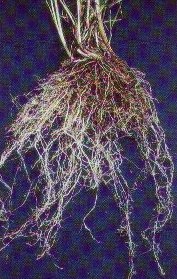 5. Not all plants have Taproots, especially Monocots, such as grasses, the Roots are Numerous and all about the same size.
6. NUMEROUS, EXTENSIVELY BRANCHED ROOTS ARE CALLED FIBROUS ROOTS. These roots grow near the surface and can collect water in a wide area. Because of the numerous branches of the roots these plants are excellent for preventing Erosion (Grasses). Fibrous Roots of Monocots often develop from the base of the Stem rather than from other roots. (Figure 31-3)
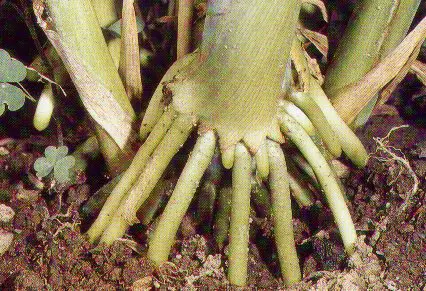 7. A Few plants have special roots called ADVENTITIOUS ROOTS. ROOTS THAT FORM ON A STEM OR LEAF. SOME GROW ABOVE GROUND AND HAVE SPECIAL FUNCTIONS -CORN – PROP ROOTS HELP SUPPORT THE PLANT. (Figure 31-4)
8. Air Roots of Orchids, obtain water and mineral nutrients from the Air. Air roots on the Stems of Ivy and other vines enable them to climb walls and trees. (Figure 31-4)
ROOT STRUCTURES
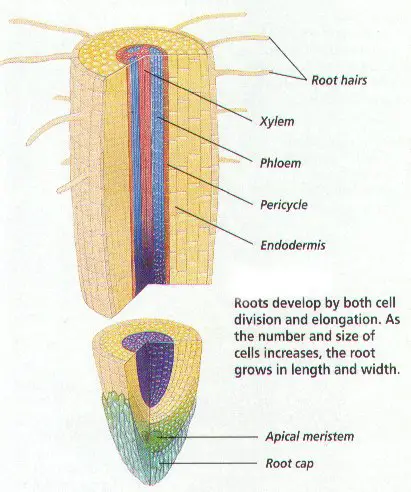 1. The Root TIP is covered by a Protective ROOT CAP, which covers the Apical Meristem. (Figure 31-5)
2. The Root Cap produces a Slimy Substance that functions like Lubricating Oil, allowing the root to move more easily through the soil as it grows.
3. Cells that are crushed or knocked off the root Cap as the root moves through the soil are replaced by new cells produced in the Apical Meristem, where cells are continuously dividing.
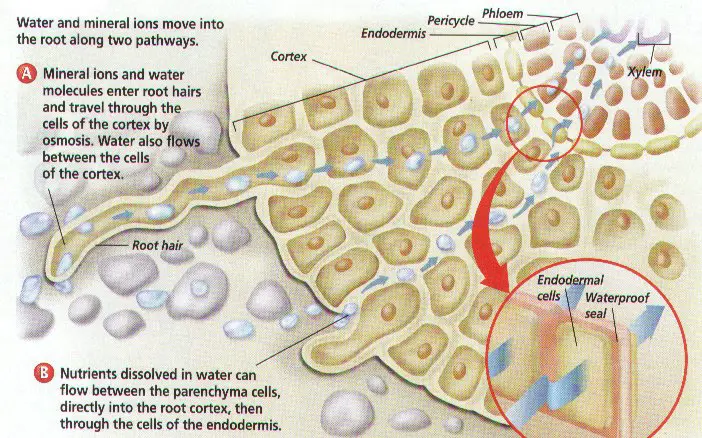
4. Roots do not absorb water and minerals through a smooth Epidermis. Tiny, hairlike projections called ROOT HAIRS on the epidermis absorb water and dissolved minerals from the soil. Root Hairs also INCREASE the Surface Area of the Plant Roots. (Figure 31-6)
5. The Core of a root consists of a Vascular Cylinder. The Vascular Cylinder contains Xylem and Phloem. Surrounding the Vascular Cylinder is a band of Ground Tissue called the CORTEX. Outside the Cortex is the EPIDERMIS. (Figure 31-7)
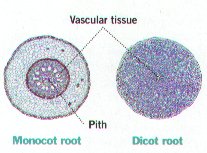 6. The arrangement of Xylem and Phloem DIFFERS in the roots of Monocots and Dicots.
A. DICOTS – In Dicots the Vascular Tissue forms a solid core at the center of the root.
B. MONOCOTS – In Monocots the Vascular Tissue from a ring that surrounds a central region of Cells known as PITH.
7. The Vascular Cylinder is separated from the Cortex by a tightly packed layer of cells. The layer of cells that separates the Cortex from the Vascular Cylinder is called the ENDODERMIS (cell layer like a row of bricks).
8. Where the cells of the endodermis touch each other, they are coated with a waxy layer called the CASPARIAN STRIP.
9. The Casparian Strip blocks the movement of Water between adjacent cells of the Endodermis.
10. This Causes the water and dissolved minerals that enter a root to be channeled through the cytoplasm of the cells of the Endodermis into the Vascular Tissue.
 11. The outermost layer or layers of the Central Vascular Tissue is termed the PERICYCLE. Lateral Roots are formed by the division of Pericycle Cells. (Figure 31-8)
12. Dicots and Gymnosperms Roots often experience Secondary Growth. Secondary Growth begins when the Vascular Cambium forms between Xylem and Phloem.
13. Pericycle Cells form the vascular cambium. The Vascular Cambium produces Secondary Xylem toward the Inside of the Root and Secondary Phloem toward the Outside.
ROOT FUNCTIONS
1. Besides Anchoring a Plant in Soil, Roots Serve Two other Primary Functions; They Absorb Water and a Variety of Minerals, and they are often adapted to Store Carbohydrates and Water.
2. Roots are Selective about which minerals they Absorb. Roots absorb some minerals and exclude others. There are 13 Minerals that are essential for all plants. They are absorbed mainly as Ions. (Table 31-3)
3. Plant Cells use some minerals, such as Nitrogen and Potassium in LARGE amounts. These elements are called MACRONUTRIENTS.
4. Plant Cells use other Minerals is SMALL Amounts, these are called MICRONUTRIENTS.
5. Adequate amounts of all 13 Mineral Nutrients in Table 31-3 are required for Normal Growth. Plants with deficiencies show characteristic symptoms and reduced growth.
6. Severe mineral deficiencies can kill a plant. Excess amounts of some mineral nutrients also can be toxic to a plant.
7. Roots often store Carbohydrates or Water, Phloem Tissue carries Carbohydrates made in the Leaves to the roots.
8. Carbohydrates that the roots do not immediately need for energy are Stored. In roots these excess carbohydrates are usually Converted to STARCH and stored in Parenchyma Cells, Carrots, Turnips, and Sweet Potatoes are stored Starches.
9. The roots of some plants store large amounts of water, which helps the plant to survive during dry periods.
SECTION 31-3, STEMS
In contrast to roots, which are mainly adapted for absorption and anchoring, stems are usually adapted to support leaves. Whatever their size and shapes, stems also function in transporting and providing storage.
OBJECTIVES: Describe the difference between monocot stems and dicot stems. List five differences and five similarities between structure of roots and the structure of stems. Explain how annual rings are formed. Describe the pressure-flow model for organic-compound movement in the phloem. Describe the cohesion-tension theory for water movement in the xylem.
TYPES OF STEMS
 1. The various differences in stem shape and growth represent adaptations to the environment. (Figure 31-9)
2. STEMS HAVE TWO MAIN FUNCTIONS:
A. HOLDING LEAVES UP TO THE SUNLIGHT.
B. TRANSPORTING WATER AND FOOD BETWEEN ROOTS AND LEAVES.
3. In a few plants stems have additional functions, such as Food Storage. Potatoes (tuber) are Underground Stems that store large amounts of food as starch.
STEM STRUCTURES
1. Stems have more complex structure than roots, yet they are similar in many ways.
2. Most Stems, like roots, grow in Length only at their Tips, where Apical Meristems produce new Primary Growth.
3. Stems, like Roots, grow in Circumference through Lateral Meristems.
4. Stems have a SPECIFIC PLACE where Leaves are attached.
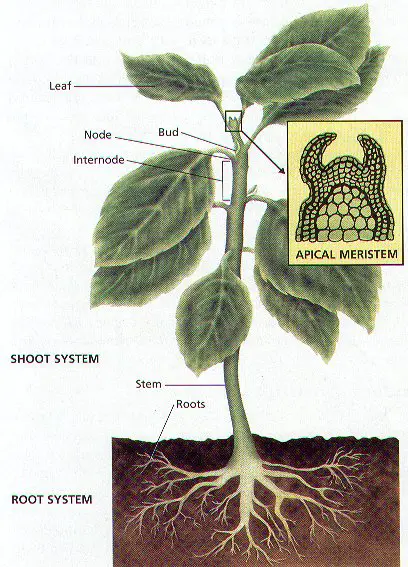
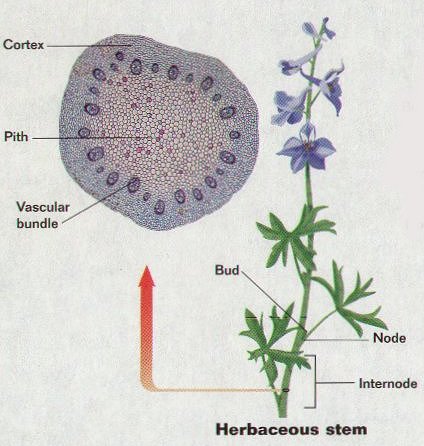
5. Stems are divided into segments called INTERNODES. At the end of each Internode is a NODE. (Figure 31-10)
6. Initially, one or more Leaves are attached at each Node. At the point of attachment of each Leaf, the Stem bears a LATERAL BUD. A BUD is capable of developing into a new shoot.
7. A Bud contains an Apical Meristem and is enclosed by specialized leaves called BUD SCALES. The tip of each stem usually has a TERMINAL BUD. When growth resumes in the spring, the Terminal Bud opens, and the bud scales fall off.
8. LEAVES ATTACH TO STEMS A LOCATIONS CALLED NODES.
9. THE SECTION OF STEM BETWEEN NODES ARE CALLED INTERNODES.
PRIMARY GROWTH IN STEMS
1. Vascular Tissue is Continuous between Roots and Stems, the Arrangement of Vascular Tissue is DIFFERENT in Stems than in Roots.
2. In ROOTS, Vascular Tissue forms a Central Cylinder.
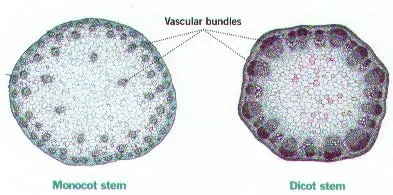 3. In STEMS, Vascular Tissue is arranged in VASCULAR BUNDLES, WHICH CONTAINS BOTH XYLEM (Toward the Inside) AND PHLOEM (Toward the Outside). (Figure 31-11)
4. In DICOTS, Vascular Bundles Form a RING that divides the Ground Tissue into CORTEX and PITH. The PITH is located in the Center of the Stem. (b)
5. In MONOCOTS, Vascular Bundles are SCATTERED throughout the Ground Tissue. The Ground Tissue of Monocot Stems are usually Not clearly separated into Pith and Cortex. Most monocots have No Secondary Growth. (a)
SECONDARY GROWTH IN STEMS
 1. Stems Increase in Thickness due to the division of cells in the Vascular Cambium. The Vascular Cambium in dicot and gymnosperm stems first arises between the Xylem and the Phloem in a Vascular Bundle.
2. The Vascular Cambium forms a Cylinder, and produces Secondary Xylem to the inside and Secondary Phloem to the outside.
3. It usually produces more Xylem than it does Secondary Phloem, The Secondary Xylem is Called WOOD.
4. Occasionally, the Vascular Cambium produces New Cambium Cells, which increase its diameter.
5. As new Xylem is formed, older portions of the Xylem eventually stop Transporting Water. The often become Darker than the New Xylem due to the accumulation of Resins and other organic compounds. This Dark wood in the Center of a Tree Trunk is called HEARTWOOD. (Figure 31-12)
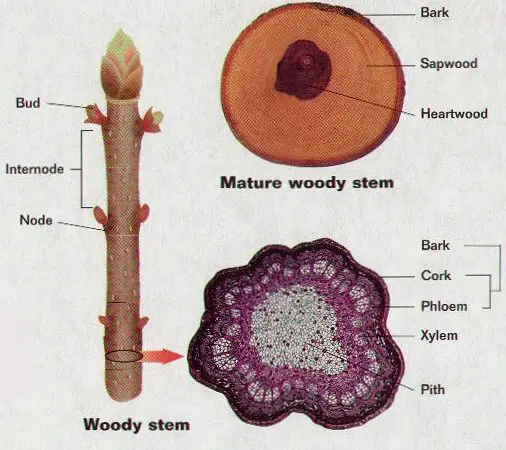 6. The Functional Xylem, often lighter colored wood nearer the Outside of the Tree Trunk is SAPWOOD.
7. In a large diameter Tree, the Heartwood keeps getting wider while the Sapwood remains about the same thickness.
8. The Phloem produced near the Outside of the Stem is part of BARK. Bark is the protective covering of Woody Plants. It consists of Cork, Cork Cambium, and Phloem. The Cork Cambium produces Cork near the outside. Cork Cells are Dead at Maturity.
9. During Spring, when Water is Plentiful, the Vascular Cambium forms New Xylem with cells that are Wide and Thin Walled. This Wood is called SPRINGWOOD.
10. In Summer, when water is more limited, the Vascular Cambium produces SUMMERWOOD, which has smaller cells with thicker walls.
11. In a Stem Cross Section, the abrupt change between Small Summerwood Cells and the following year’s Large Springwood Cells produces an ANNUAL RING.
12. Because one ring is usually formed each year, you can estimate the age of the Stem (Tree) by counting its annual rings.
STEM FUNCTIONS
1. Stems function in the transportation and storage of nutrients and water, and they support the leaves.
2. PHLOEM CELLS move SUGARS (Carbohydrates) from one part of a plant to another.
3. The transport of sugars is CONTROLLED by the overall Activities of a Plant. Where they are Needed.
4. Sugars are moved from a place where they are MADE BY Photosynthesis, called a SOURCE, to a place where they are STORED OR USED, called a SINK.
5. Botanists use the term TRANSLOCATION to refer to the movement of Carbohydrates through the plant.
6. Sugars are also moved from a place of being Stored to a place where they are Used.
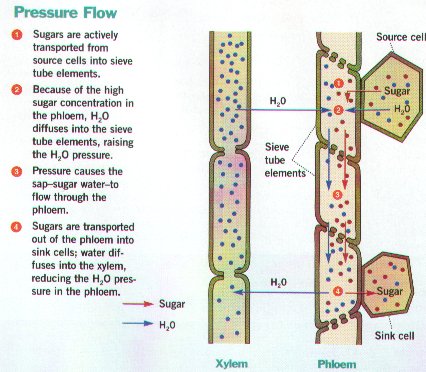 7. The Movement of sugars in Phloem is best explained by the PRESSURE-FLOW HYPOTHESIS. (Figure 31-13)
8. Sugars made in photosynthetic cells are PUMPED into Sieve Tubes by ACTIVE TRANSPORT at the Source. The Pressure Increases as Water enters the Sieve Tube by Osmosis. The pressure increase (TURGOR) moves the SAP toward the SINKS.
9. Because the movement of Sugars in and out of Sieve Tubes require Energy, Cells that make up the Phloem must be alive to function.
10. Sugars move through plants more slowly than water. Most of the sugar that moves in Phloem is SUCROSE, or Table Sugar.
11. Transport in the Phloem can occur in different directions at different times, depending on the needs of the Plant.
THE TRANSPORT OF WATER
1. The Transport of Water and mineral Nutrients occurs in the Xylem of all plant Organs.
2. The THEORY of Water Movement in Plants today is known as the COHESION-TENSION THEORY. According to this theory, water movement in plants is driven by TRANSPIRATION. (Figure 31-13)
3. TRANSPIRATION IS THE EVAPORATION OF WATER FROM THE PARTS OF A PLANT EXPOSED TO THE AIR.
4. As water Evaporates from the cells of a leaf or stem, Replacement Water is PULLED from the Xylem Tissue, more water enters the roots from the soil to replace the lost water.
5. The Evaporation of Water from cells creates a NEGATIVE Pressure in the Xylem, which Pulls water Upward.
6. Transpiration creates a strong PULL, but another Force also helps Pull water up a plant –COHESION.
7. COHESION CAUSES WATER MOLECULES TO STICK TOGETHER AND PULL EACH OTHER UP INSIDE THE NARROW TUBES OF XYLEM.
8. The movement also depends on the rigid xylem walls and the strong attraction of the water molecules to the Xylem Wall, which is called ADHESION.
9. THE MOVEMENT OF WATER IN PLANTS OCCURS BY A COMBINATION OF TRANPIRATION, EVAPORATION, COHESION and ADHESION.
10. Water movement in plants varies with the time of day.
11. At midday, the Stomata are open, and water moves rapidly through the plant.
12. Water movement stops at night, when the Stomata are closed and there is no Transpiration.
SECTION 31-4, LEAVES
Most leaves are thin and flat, an adaptation that helps them capture sunlight for photosynthesis. Although this structure may be typical, it is certainly not universal. Like roots and stems, leaves are extremely variable. This variability represents adaptations to environmental conditions.
OBJECTIVES: Identify the difference between a simple leaf and compound leaf. Describe the tissues that make up the internal structure of a leaf. Describe adaptations of leaves for special purposes. Explain the importance of stomata.
LEAF STRUCTURES AND TYPES
 1. The Main function of Leaves is to Trap Light for Photosynthesis, the process of making Carbohydrates from Carbon Dioxide and Water in the presence of Sunlight.
2. Besides making food, the leaves of a few plants can also store food. An Onion is an underground stem surrounded by thick, fleshy leaves that store food.
3. Leaves perform other functions such as protecting some plants from animals and storing water.
4. We use Leaves as sources of Dyes, Fibers, Fuels, Drugs, Wax, Soap, Spices and Food.
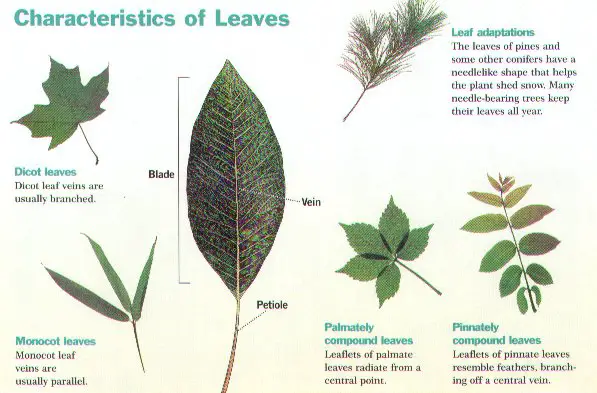
5. Leaves consist of a Flat Broad Blade and a Stem-like Petiole that attaches the Blade to the Stem.
6. SIMPLE LEAVES have ONE Undivided Blade per Petiole.
7. COMPOUND LEAVES have more than one Blade per Petiole. The Blades of Compound Leaves are called Leaflets.
8. Leaves contain the same Three Tissues Types – Dermal, Ground, and Vascular – as stems and roots.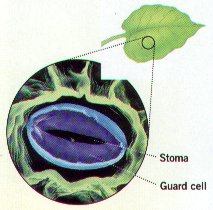
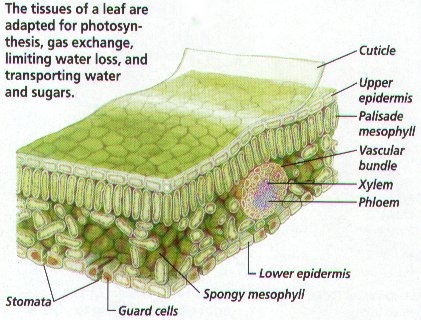
9. Leaf Epidermis has TWO Special Structures that are adaptations for Photosynthesis on land: A WAXY CUTICLE AND STOMATA.
10. STOMATA ARE PORES IN THE EPIDERMIS, CUTICLE IS A WATERPROOF COVERING THAT HELPS PLANTS CONSERVE WATER.
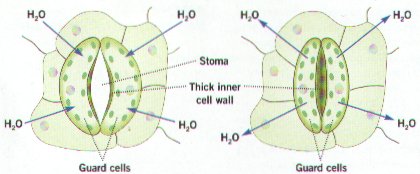 11. The Stomata allow Carbon Dioxide to Enter a Leaf and Water Vapor and Oxygen to go Out.
12. Guard Cells (two kidney-shaped cells) surround the stomata; they open or close the stomata, depending on environmental conditions and the needs of the plant. Guard Cells are modified cells found on the leaf epidermis that regulate gas and water exchange.
13. A Leaf is covered on the top and bottom by epidermis, with Ground Tissue in between the layers.
14. The Middle Region is called the MESOPHYLL. (Figure 31-16) In leaves, the Ground Tissue is called Mesophyll. Mesophyll cells are packed with chloroplast, where photosynthesis occurs. The chlorophyll in chloroplast makes leaves look green.
15. Most plants have leaves with TWO Layers of Mesophyll.
A. One or more rows of closely packed, columnar cells make up the PALISADE LAYER, which lies just beneath the upper epidermis. THIS IS THE SITE OF MOST PHOTOSYNTHESIS.
B. A layer of loosely packed, spherical cells, called the SPONGY LAYER, lies between the Palisade Layer and the Lower Epidermis.
16. Air spaces make up 20 to 70 percent of the volume of the Spongy Mesophyll. The air spaces allow for the exchange of gases involved in Photosynthesis: Carbon Dioxide and Oxygen.
17. THE MESOPHYLL IS WHERE MOST PHOTOSYNTHESIS OCCURS IN LEAVES. It is a ground tissue composed of chloroplast-rich parenchyma cells.
18. All leaves contain Vascular Tissue; The Vascular Bundles in leaves are called VEINS, and transport water and food.
19. Veins are separated from the Mesophyll by a layer of cells called the BUNDLE SHEATH.
20. In most plants, Photosynthesis occurs throughout the Mesophyll, but NOT IN the Bundle Sheath.
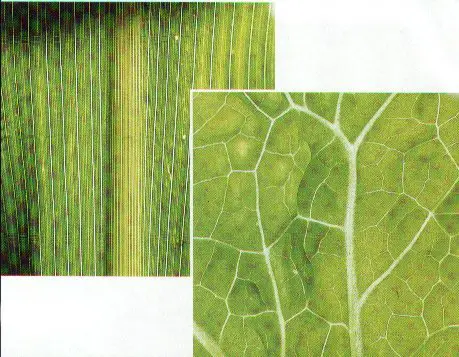 21. VENATION is the arrangement of Veins in a leaf.
22. Veins in Monocots leaves (suck as Grasses or Corn Plants) run Parallel (Parallel Venation) to each other, while Veins in Dicots leaves form a Branched network (Net Venation). The main vein or veins repeatedly branch to form a conspicuous network of smaller veins.
23. Dicot leaves can be either PINNATE or PALMATE.
24. Pinnate Leaves are Featherlike, with smaller veins branching off a central vein called the MIDRIB.
25. Palmate Leaves are lobed and resemble the fingers and palm of your hand, with several main veins radiating from a central point.
26. In Compound Leaves, the words Pinnate and Palmate refer to the arrangement of leaflets around the Petiole.
27. A coiled structure called a Tendril is a specialized leaf found in many vines, such as peas and pumpkins. It wraps around objects to support the climbing vine. In some species, like grape, Tendrils are specialized Stems.
28. An unusual leaf modification occurs in carnivorous plants, in carnivorous plants the leaves function as Food Traps. These plants grow in soil that is Poor in several nutrients, especially Nitrogen. The plant receives substantial amounts of mineral nutrients when it traps and digests insects and other small animals.
29. Spines are modified leaves that protect the plant from being eaten by animals. Because spines are small and non-photosynthetic, they greatly reduce Transpiration in Desert Species such as Cactuses.
LEAF FUNCTIONS
1. Leaves are the primary site of photosynthesis in most plants.
2. Mesophyll Cells in Leaves use Light Energy, Carbon dioxide, and Water to make Carbohydrates.
3. Light Energy is also used by Mesophyll Cells to synthesize amino acids, fats, and a variety of other organic molecules.
4. Carbohydrates made in a leaf can be used by the leaf as an Energy source or as building blocks. They also may be transported to other parts of the plant, where they are either used or stored.
5. A major limitation to plant photosynthesis is insufficient Water due to transpiration. About 98 percent of the water that is absorbed by the roots is lost through transpiration. Transpiration may benefit the plant by cooling it and speeding the transport of mineral nutrients through the Xylem.
MODIFICATIONS FOR CAPTURING LIGHT
1. Leaves absorb light, which provides the energy for photosynthesis.
2. Leaves often adapt to their environment to maximize light interception.
3. On the same Tree, Leaves that develop in full Sun are Thicker, have a Smaller area per leaf, and have More chloroplast per unit area. Shade-leaf chloroplasts are arranged so that shading of one chloroplast by another is minimized, while sun-leaf chloroplast are not.
4. In dry environments, plants often receive more light than they need. These plants often have structures that reduce the amount of light absorbed.
5. Many desert plants have evolved dense coatings of hairs that reduce light absorption.
6. The window plant protects itself from its dry environment by growing underground. Only its transparent leaf tips protrude above the soil to gather light fro photosynthesis. (Figure 31-17)