Nucleic Acids & Protein Synthesis

Nucleic Acids and Protein Synthesis
All Materials © Cmassengale

Cell   à   Nucleus    à    Chromosomes   à   Genes    à     DNA 

Proteins

  • Organic molecules (macromolecules) made by cells
  • Make up a large part of your body
  • Used for growth, repair, enzymes, etc.
  • Composed of long chains of small units called amino acids bonded together by peptide bonds
  • Twenty amino acids exist

DNA

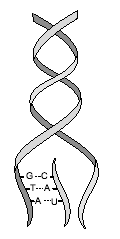
  • Deoxyribonucleic acid is a coiled double helix carrying hereditary information of the cell

  • Contains the instructions for making proteins from 20 different amino acids
  • Appears as chromatin when cell not dividing

  • Structure discovered by Watson & Crick in 1953
  • Sides made of pentose (5-sided) sugars attached to phosphate groups by phosphodiester bonds
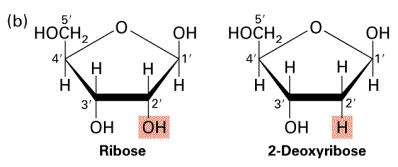
  • Pentose sugar called Deoxyribose

  • Steps or rungs of DNA made of 4 nitrogen-containing bases held together by weak hydrogen bonds
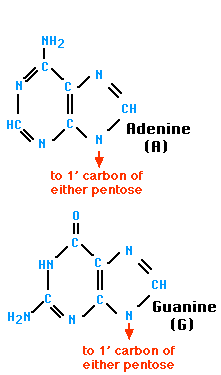
  • Purines (double carbon-nitrogen rings) include adenine (A) and guanine (G)
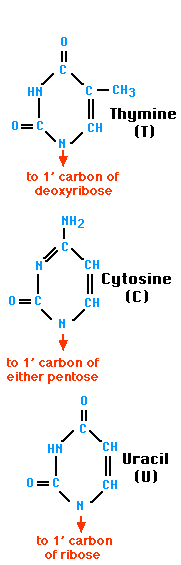
  • Pyrimidines (single carbon-nitrogen rings) include thymine (T) and cytosine (C)
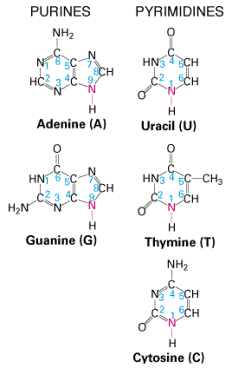
  • Base pairing means a purine bonds to a pyrimidine   (Example:  A — T   and   C — G)
  • Coiled, double stranded molecule known as double helix
  • Make up chromosomes in the nucleus
  • Subunits of DNA called nucleotides
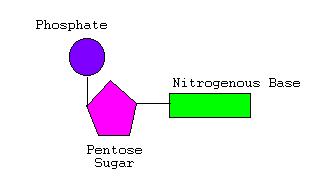
  • Nucleotides contain a phosphate, a Deoxyribose sugar, and one nitrogen base (A,T,C, or G)

  • Free nucleotides also exist in nucleus
  • Most DNA is coiled or twisted to the right
  • Left twisted DNA is called southpaw or Z-DNA
  • Hot spots which can result in mutations occur where right & left twisted DNA meet


History of DNA discovery

  • Freidrich Miescher (1868) found nuclear material to be ½ protein & ½ unknown substance
  • 1890’s, unknown nuclear substance named DNA
  • Walter Sutton (1902) discovered DNA in chromosomes
  • Fredrick Griffith (1928) working with Streptococcus pneumoniae conducted transformation experiments of virulent & nonvirulent bacterial strains
  • Levene (1920’s) determined 3 parts of a nucleotide
  • Hershey & Chase (1952) used bacteriophages (viruses) to show that DNA, not protein, was the cell’s hereditary material
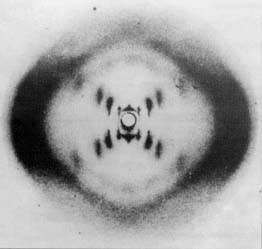
  • Rosalind Franklin (early 1950’s) used x-rays to photograph DNA crystals


Click for larger picture!


  • Erwin Chargraff (1950’s) determined that the amount of A=T and amount of C=G in DNA; called Chargaff’s Rule
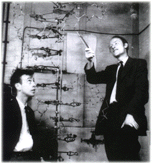
  • Watson & Crick discovered double helix shape of DNA & built the 1st model
Click for larger picture!

 DNA Replication

  •  Process by which DNA makes a copy of itself
  • Occurs during S phase of interphase before cell division
  • Extremely rapid and accurate (only 1 in a billion are incorrectly paired)
  • Requires many enzymes & ATP (energy)
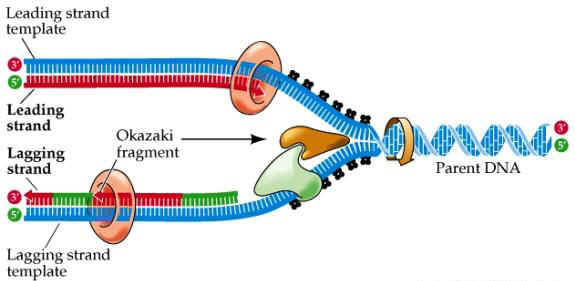
  • Begins at special sites along DNA called origins of replication where 2 strands open & separate making  a replication fork


  • Nucleotides added & new strand forms at replication forks
  • DNA helicase (enzyme) uncoils & breaks the weak hydrogen bonds between complementary bases (strands separate)
  •  DNA polymerase adds new nucleotides to the exposed bases in the 5’ to 3’ direction

  •  Leading strand (built toward replication fork) completed in one piece
  • Lagging strand (built moving away from the replication fork) is made in sections called Okazaki fragments


OKAZAKI FRAGMENTS

  •  DNA ligase helps join Okazaki segments together
  • DNA polymerase proofreads the new DNA checking for errors & repairing them; called excision repair
  • Helicase recoils the two, new identical DNA molecules

RNA

  • Ribonucleic acid
  • Single stranded molecule  

  • Found in nucleus & cytoplasm
  • Contains ribose sugar
  • Contains the nitrogen base uracil (U) instead of thymine so A pairs with U
  • Base pairings are A-U and C-G
  • Three types of RNA exist (mRNA, TRNA, & rRNA)

mRNA

  • Messenger RNA
  • Single, uncoiled, straight strand of nucleic acid
  • Found in the nucleus & cytoplasm
  • Copies DNA’s instructions & carries them to the ribosomes where proteins can be made
  • mRNA’s base sequence is translated into the amino acid sequence of a protein
  • Three consecutive bases on mRNA called a codon (e.g. UAA, CGC, AGU)
  • Reusable

tRNA

  • Transfer RNA
  • Single stranded molecule containing 80 nucleotides in the shape of a cloverleaf
  • Carries amino acids in the cytoplasm to ribosomes for protein assembly
  • Three bases on tRNA that are complementary to a codon on mRNA are called anticodons (e.g. codon- UUA; anticodon- AAU)
  • Amino Acid attachment site across from anticodon site on tRNA
  • Enters a ribosome & reads mRNA codons and links together correct sequence of amino acids to make a protein
  • Reusable  

rRNA

  • Ribosomal RNA
  • Globular shape
  • Helps make up the structure of the ribosomes  
  • rRNA & protein make up the large & small subunits of ribosomes
  • Ribosomes are the site of translation (making polypeptides)
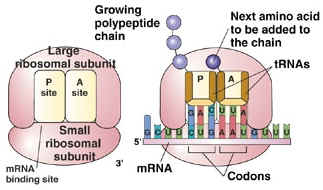
  • Aids in moving ribosomes along the mRNA strand as amino acids are linked together to make a protein

Amino Acids

  • 20 exist
  • Linked together in a process called protein synthesis in the cytoplasm to make polypeptides (subunits of proteins)
  • DNA contains the instructions for making proteins but is too large to leave the nucleus
  • Three consecutive bases on DNA called a triplet (e.g. TCG, ATG, ATT)
  • mRNA codon table tells what 3 bases on mRNA code for each amino acid (64 combinations of 3 bases)
  • Methionine (AUG) on mRNA is called the start codon because it triggers the linking of amino acids
  • UAA, UGA,  & UAG on mRNA signal ribosomes to stop linking amino acids together

Genetic Code (RNA)


 Amino Acid  3 Letter
Abbreviation
 Codons
 Alanine  Ala  GCA GCC GCG GCU
 Arginine  Arg  AGA AGG CGA CGC CGG CGU
 Aspartic Acid  Asp  GAC GAU
 Asparagine  Asn  AAC AAU
 Cysteine  Cys  UGC UGU
 Glutamic Acid  Glu  GAA GAG
 Glutamine  Gln  CAA CAG
 Glycine  Gly  GGA GGC GGG GGU
 Histidine  His  CAC CAU
 Isoleucine  Ile  AUA AUC AUU
 Leucine  Leu  UUA UUG CUA CUC CUG CUU
 Lysine  Lys  AAA AAG
 Methionine  Met  AUG
 Phenylalanine  Phe  UUC UUU
 Proline  Pro  CCA CCC CCG CCU
 Serine  Ser  AGC AGU UCA UCC UCG UCU
 Threonine  Thr  ACA ACC ACG ACU
 Tryptophan  Trp  UGG
 Tyrosine  Tyr  UAC UAU
 Valine  Val  GUA GUC GUG GUU
 Start  AUG
 Stop  UAA UAG UGA


  Practice Table:

DNA
Codon
mRNA
Codon
tRNA
Anticodon
Amino
Acid

GCU

TAC    
    AUU
  UUU  
TCA    
    UCU
CTT    
  ACU
ACU  

Protein Synthesis

  • Consists of 2 parts — Transcription & Translation
  • Begins in the nucleus with mRNA copying DNA’s instructions for proteins (transcription)
  • Completed in the cytoplasm when tRNA enters ribosomes to read mRNA codons and link together amino acids (translation)

 Steps in Transcription

  1. DNA helicase (enzyme) uncoils the DNA molecule
  2. RNA polymerase  (enzyme) binds to a region of DNA called the promoter which has the start codon TAC to code for the amino acid methionine
  3. Promoters mark the beginning of a DNA chain in prokaryotes, but mark the beginning of 1 to several related genes in eukaryotes
  4. The 2 DNA strands separate, but only one will serve as the template & be copied
  5. Free nucleotides are joined to the template by RNA polymerase in the 5’ to 3’ direction to form the mRNA strand
  6. mRNA sequence is built until the enzyme reaches an area on DNA called the termination signal
  7. RNA polymerase breaks loose from DNA and the newly made mRNA
  8. Eukaryotic mRNA is modified (unneeded sections snipped out by enzymes & rejoined) before leaving the nucleus through nuclear pores, but prokaryotic RNA isn’t
  9. All 3 types of RNA called transcripts are produced by this method
Steps in Translation

  1. mRNA brings the copied DNA code from the nucleus to the cytoplasm
  2. mRNA attaches to one end of a ribosome; called initiation
  3. tRNA’s attach the correct amino acid floating in the cytoplasm to themselves
  4. tRNA with its attached amino acid have 2 binding sites where they join the ribosome
  5. The tRNA anticodon “reads” & temporarily attaches to the mRNA codon in the ribosome
  6. Two amino acids at a time are linked together by peptide bonds to make polypeptide -chains (protein subunits); called elongation
  7. Ribosomes) move along the mRNA strand until they reach a stop codon (UAA, UGA, or UAG); called termination
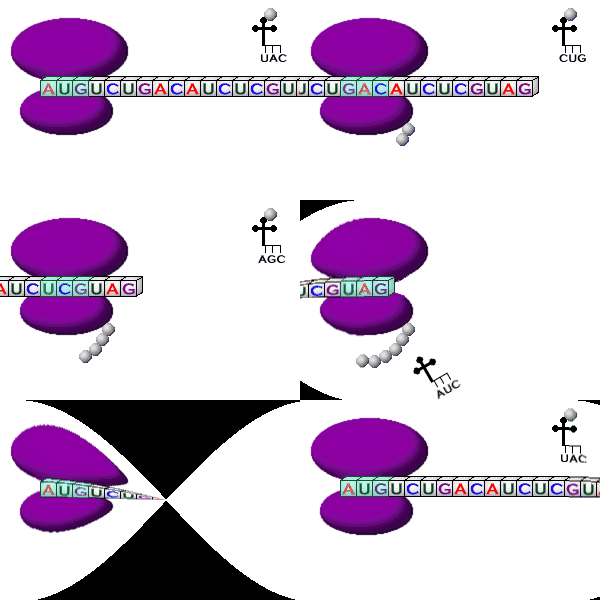
  1. tRNA’s break loose from amino acid, leave the ribosome, & return to cytoplasm to pick up another amino acid

Click here for an animation of Translation 

BACK


Nucleotide Model preap


Model of a Nucleotide


Introduction

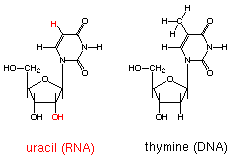
Nucleotides consist of three parts — a pentose sugar, a nitrogen-containing base, and a phosphate group. A pentose sugar is a five-sided sugar. There are 2 kinds of pentose sugars — deoxyribose and ribose. Deoxyribose has a hydrogen atom attached to its #2 carbon atom (designated 2′), and ribose has a hydroxyl group atom there. Deoxyribose-containing nucleotides are the monomers of DNA, while Ribose-containing nucleotides are the monomers of RNA.

A nitrogen-containing ring structure is called a base. The base is attached to the 1′ carbon atom of the pentose. In DNA, four different bases are found — two purines, called adenine (A) and guanine (G) and two pyrimidines, called thymine (T) and cytosine (C). RNA contains The same purines, adenine (A) and guanine (G).  RNA also uses the pyrimidine cytosine (C), but instead of thymine, it uses the pyrimidine uracil (U).


The Purines The Pyrimidines

The combination of a base and a pentose is called a nucleoside.  A phosphate group is attached to the 5′ carbon of the pentose sugar.

Objective

Students will construct a 3-dimensional model of a single nucleotide, the monomer of which nucleic acids are composed.

Materials

Various materials may be used for the atoms that make up a nucleotide such as styrofoam balls, plastic coke bottle caps, beads, etc. Bonds between atoms may be made from toothpicks, plastic stirring sticks, popsicle sticks, etc. Single & double bonds must be represented by the correct number of “sticks”. The atoms and bonds may NOT be made of any food item. Your model should be glued together to make the model rigid for hanging. Attach string and a label with the nucleotide’s name to your model. Models must be sturdy, light weight, and small enough to hang from the ceiling.

Color Code for atoms:

CARBON – BLACK
HYDROGEN – YELLOW
OXYGEN – RED
NITROGEN – BLUE

Structural Formulas of Nucleotides:

Uracil Nucleotide (Ribose ) & Thymine Nucleotide (Deoxyribose)


Adenine Nucleotide (Deoxyribose)
Cytosine Nucleotide (Deoxyribose)
Guanine Nucleotide (Deoxyribose)


Mitosis PPT Questions

Cell Cycle and Mitosis
ppt Questions

Cell Cycle

1.Prokaryotic organisms include ___________, while plants and animals are ____________.

2. Describe prokaryotes.


3. How do bacteria asexually reproduce?

4. Name the 3 main steps of binary fission in bacteria.

    a.

    b.

     c.

5. Name a bacterial cell that reproduces by binary fission.

6. Describe eukaryotes.


7. How do eukaryotes asexually reproduce cells?

8. The stages in the growth and reproduction of a cell are called the __________ ___________.

9. List the 5 stages in the cell cycle.


10. What does G1 stage stand for?

11. Name two things that happen to a cell during G1?


12. What is the S stage of the cell cycle?

13. _________ instructions are copied in the S phase as ___________ are duplicated.

14. _______ stands for second growth stage.

15. G2 is the time between ____________ and ___________.

16. Cells continue to _________ during G2 and to make __________ that will be needed for mitosis or cell division.

17. Mitosis or cell division is known as the ________ stage.

18. How does a cell use its energy during the M phase?

19. Does a cell continue growing & making proteins in the M phase?

20. Mitosis is also called _______________ which means division of the ____________.

21. ____________ is called the resting stage and makes up the longest part of a cell’s life cycle.

22. What happens to cells during interphase?


23. Are chromosomes visible during interphase?

Mitosis

24. Name the 4 stages of mitosis.


25. Name 2 things that happen to a cell during prophase.

     a.

     b.

     c.

     d.

     e.

26. Can chromosomes be seen during prophase?

27. Sketch a eukaryotic chromosome and label the centromere and kinetochore fiber that attaches to it.


28. How many pairs of chromosomes are found in humans?

29. List 3 things that occur during metaphase.

     a.

     b.

     c.

30. Where are chromosomes located during metaphase of a cell?

31. What stage occurs after metaphase?

32. List 2 things that happen to cells during anaphase.

     a.

     b.

33. Sketch and label the mitotic spindle and attached chromosomes.


34. What is the last stage of mitosis?

35. Where are the two sets of chromosomes located at Telophase?

36. What two things reform during Telophase?

37. Chromosomes ___________ during Telophase so they are no longer visible.

38. In plants, what begins to form that will separate the two cells?

39. How are the two cells separated from each other in animals?


40. _____________ or division of the cytoplasm follows ___________, division of the nucleus, and forms ____________ daughter cells.

41. How do the two, new daughter cells compare to each other?


42. Label the following stages of mitosis.


Printable Copy

Metric System

Metric System (SI)
Scientist use a single, standard system of measurement.  The official name of the measurement system is SYSTEME INTERNATIONAL d’UNITES (International System of Measurements) or SI.

The metric system is based on the number 10.

Main Units of Measurement
Length Volume Mass
meter (m) liter (l) gram (g)

Using the above values (meter, liter, & gram) as the base, their value can be increased or decreased by moving the decimal point to the right (lowers the value) or left (raises the value).

Metric Conversion Table

Kilo-
(k)
Base Unit
(m, l, g)
Centi-
(c)
Milli-
(m)
Micro-
(µ)
nano-
(n)
x 1000 meter, gram, liter 100 1000 1000 1000
1000 1 .01 .001 .000001 .000000001

Convert the following values by moving the decimal point the correct number of spaces and in the right direction .

1. 69.8 meters (m) =  ________________ centimeters (cm)

2. 152.97 milliliters (ml)  =  ________________ liters (l)

3. 42.67 liters (l) = _____________ milliliters (ml)

4. 299.32 kilometers (km) = ____________ nanometers (nm)

5. 26 grams (g) = _____________ kilograms (kg)

6. 123.43 centigrams (cg) = ______________ grams (g)

7. 75.2 liters (l)  = __________________milliliters (ml)

8. 456.3 grams (g) = ________________ micrograms µg

9. 4507.22 kilometers (km) = _______________millimeters (mm)

10. 0.00297456 kilograms (kg) = ___________ nanograms (ng)

BACK

Metric Measurement Lab


Metric Measurement Lab


Part A: Count your drops!


Take a guess – How many drops of water will it take to equal 1 milliliter? _____ drops

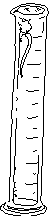
Follow the directions to find the number of drops in 1 milliliter of water, then answer the questions. You will need a small graduated cylinder (25 ml), a beaker of water, and an eyedropper for this section.  Remember to read the bottom of the meniscus when you are reading the volume of a liquid in a graduated cylinder.


  1. Fill a small graduated cylinder with 10 ml of water.
  2. Count the number of drops it takes to raise the water to 11 ml. Record the number in the chart.
  3. Leave the water in the graduated cylinder and count the number of drops it takes to raise the water to 12ml. Record the number in the chart.
  4. Leave the water in the graduated cylinder and count the number of drops it takes to raise the water to 13ml. Record the number in the chart.
  5. Calculate your average and round to the nearest tenth.


Picture of graduated cylinder


# of drops to 11 ml # of drops to 12 ml # of drops to 13 ml Average


Based on your average, how close were you to your guess?________

Based on your average, how many drops would it take to make 1 liter? _______

Part B: Water Displacement


Follow the directions to find the volume of three marbles using water displacement.

  1. Add 20 ml of water to a 100 ml graduated cylinder. Record this amount in the chart.
  2. Add three marbles to the cylinder and measure the volume. Record this amount in the chart.
  3. Find the difference between the two measurements and record in the chart. The difference between the two measurements will be the volume of the three marbles.
Volume of Water Before adding Marbles (ml) Volume of Water After Adding Marbles (ml) Difference in Volume (ml) Volume of 3 Marbles


Part C: Mass Mania


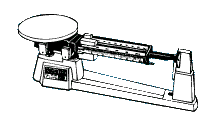
The gram is the standard unit of mass in the metric or SI system. The basic instrument used to measure mass is the mass balance.  Some mass measurements can be made using an electronic balance.


  1. Check to see that the Pointer is pointing to zero.
  2. If it is not, check to see that all the Riders (weights) are all the way to the left at the Zero mark.
  3. Adjust the balance by turning the Adjustment Screw slowly until it points to zero.
  4. Place your metric ruler on the pan and read & record the ruler’s mass.
  5. After resetting the balance to Zero, measure and record the mass of the empty 50-ml graduated cylinder and then the 3 marbles.
  6. Reset the balance to ZERO when all items have been massed.


Mass of Metric Ruler (g) Mass of Empty 50-ml graduated cylinder (g) Mass of 3 Marbles (g)


Part D: Volume by Formula


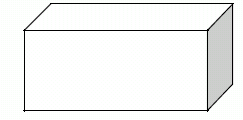
Use the formula to find the volume of the box. Measure to the nearest centimeter before calculating your answer.  If necessary, Round your answer to Two Decimal places.


Volume = length x width x height

__________ x __________ x __________ =________________cm3


Part E: Color Challenge


1. Obtain the following items from your teacher:

  • 3 beakers with colored water- 25 ml of each color (red, blue, and yellow)
  • 1 graduated cylinder (25 ml – 50 ml)
  • 1 eyedropper
  • 6 test tubes labeled A, B, C, D, E, and F

2. Perform each step outlined below using accurate measurements.

  1. Measure 17 ml of RED water from the beaker and pour into test tube A.
  2. Measure 21 ml of YELLOW water from the beaker and pour into test tube C
  3. Measure 22 ml of BLUE water from the beaker and pour into test tube E.
  4. Measure 5 ml of water from test tube A and pour it into test tube B.
  5. Measure 6 ml of water from test tube C and pour it into test tube D.
  6. Measure 8 ml of water from test tube E and pour it into test tube F.
  7. Measure 5 ml of water from test tube C and pour it into test tube B.
  8. Measure 2 ml of water from test tube A and pour it into test tube F.
  9. Measure 4 ml of water from test tube E and pour it into test tube D.

3. Complete the chart.

Test Tube Color Final Volume (ml)
A
B
C
D
E
F

Click HERE for Notebook Copy