Lab & Ap Sample 2 Mitosis & Meiosis

Mitosis & Meiosis -AP lab 3
Introduction
Cells come from preexisting cells. New cells are formed during cell division which involves both replication of the cell’s nucleus, karyokinesis, and division of the cytoplasm, cytokinesis. The two kinds of cellular division are mitosis and meiosis. Mitosis usually makes body cells, somatic cells. Making an adult organism from an egg, asexual reproduction, regeneration, and the maintenance and repair of body parts are performed during mitotic cell division. This process called meiosis makes gametes, in animals, and spores, in plants. Gamete or spore cells have half the chromosomes that the parent cell has.

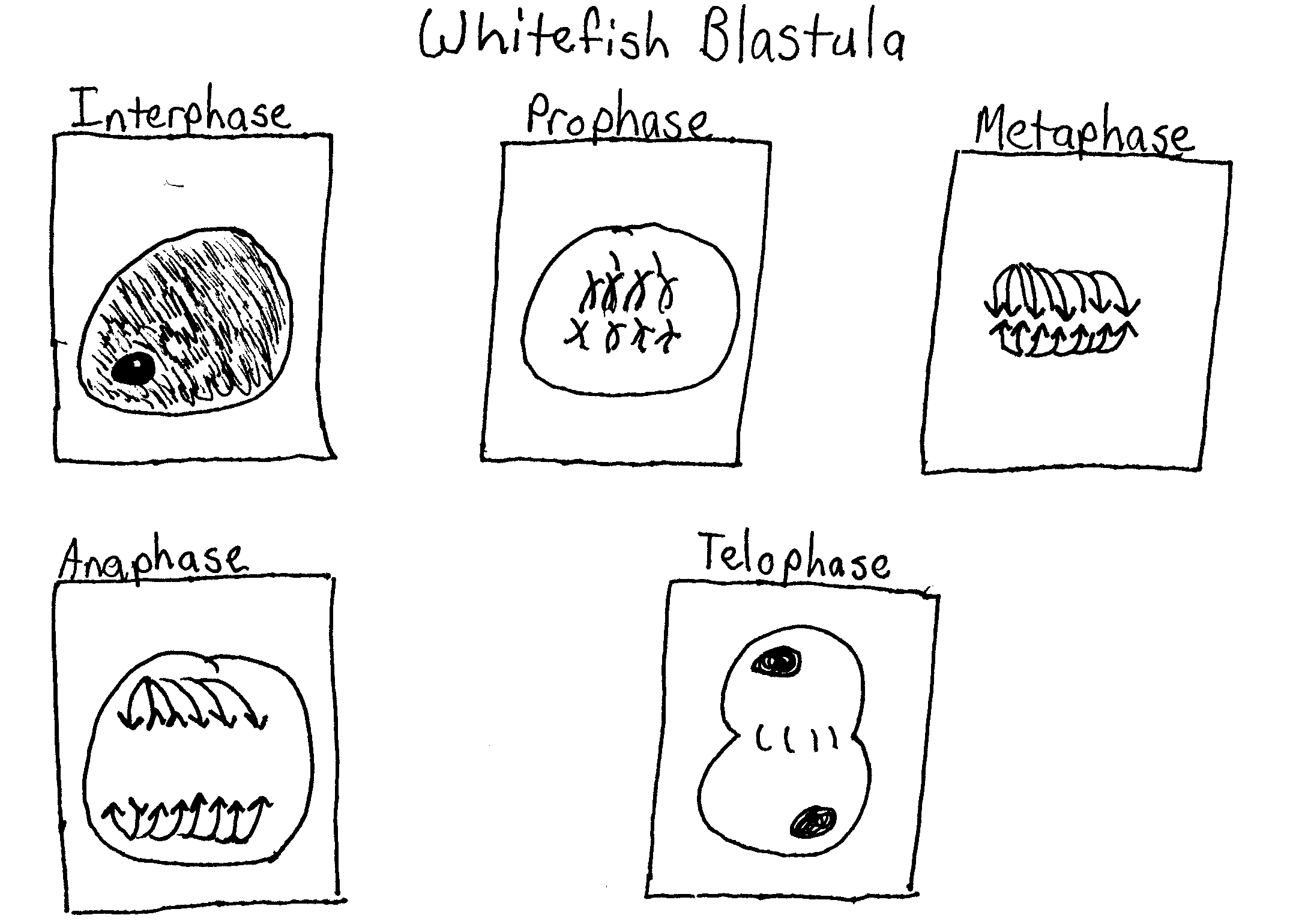
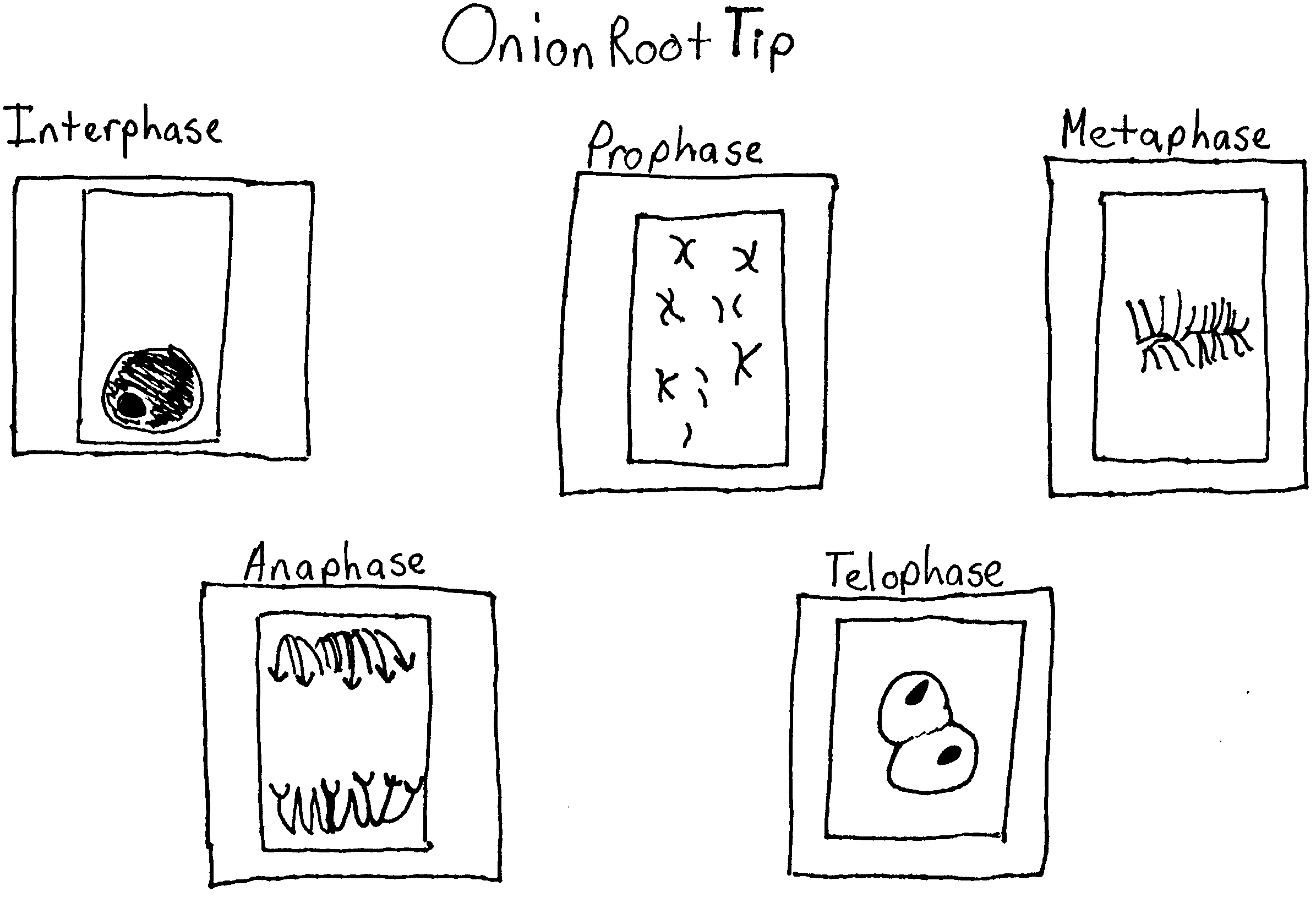
In plants mitosis takes place in the meristems which are normally found at the tips of stems or roots. However, in animal cells cell division takes place every where as new cells are formed and old ones are replaced. Studying mitosis can be accomplished by looking at tissues where there are many cells in a process of meiosis. Two examples are an onion root tip, or developing embryos, in animals such as whitefish blastula. A blastula is formed after an egg is fertilized and the egg begins to divide. There are several phases of the mitotic cell cycle. A precursor to mitosis is interphase. The actual steps of the mitotic cell cycle are prophase, metaphase, anaphase, and telophase. Interphase is a stage in the cell cycle in which the cell is not dividing. The nucleus contains a nucleolus and also contains chromatin. During interphase DNA replication occurs. The first phase of mitotic cell division is prophase. During prophase the chromatin begins to thicken until noticeable chromosomes are formed. Each chromosome has two chromatids that are joined at the centromere. During the later part of prophase, the nuclear envelope and nucleolus disappear. Mitotic spindle fibers, composed of microtubules, also become apparent. Following prophase is metaphase. By the time the cell has reached metaphase the chromosomes have moved to the center of the mitotic spindle. The centromere of the chromosome attaches to the spindle. The centromeres of each chromosome line up on an area called the metaphase plate. Metaphase is followed by anaphase. In the beginning of anaphase, the centromeres of each pair of chromatids separate and moved by the spindle fibers to the opposite ends of the cell. When the daughter chromosomes reach the ends of the cell the form a clump at each spindle pole. The final phase of mitosis is telophase. Telophase is identified by a recognizable condensation of the chromosomes, which is followed by the formation of a new nuclear envelope. The chromosomes slowly uncoil into chromatin once again and the nucleoli and nuclear envelope reform. It is then possible for cytokinesis, the division of the cytoplasm into two cells, to occur. In an animal cells a cleavage furrow forms and the cell pinches off into two new daughter cells.

The process of meiosis involves two nuclear divisions that result in the formation of four haploid cells. Meiosis I, a reduction division, is the first division to reduce the chromosome number from diploid to haploid and separates the homologous pairs. Meiosis II separates the sister chromatids resulting in four haploid gametes. Unlike mitosis meiosis increases genetic variation. In meiosis I each pair of homologous chromosomes come together which is known as a synapse. Chromatids of homologous chromosomes may exchange parts which is called crossing over. The distance between two genes on a chromosome may be estimated by calculating the percentage of crossing over that takes place between them. Meiosis I is preceded by interphase. During interphase DNA synthesis occurs and each chromosome is made of two chromatids joined at the centromeres. The first step of meiosis I is prophase I. During prophase I homologous chromosomes come together and synapse. A tetrad consisting of four chromatids is also formed. Prophase I is followed by metaphase I. In metaphase I the crossed over tetrads line up in the center of the cell. In anaphase I the homologous chromosomes separate and are moved to opposite ends of the cell. The final phase of meiosis I is telophase I. During telophase I centriole duplication is completed. Most of the time cytokinesis and formation of the nuclear envelope occur in order two make to cells. Meiosis II a second mitotic cell division then takes place in order to separate the chromatids in the two daughter cells made in meiosis I. This reduces the amount of DNA to one strand per chromosome. This is the only difference between meiosis I and II. Before meiosis II there is period called interphase or interkenesis. DNA replication does not take place in interphase II. Interphase II is followed by prophase II, No DNA replication occurs in prophase II and replicated centrioles separate and move to opposite sides of the chromosome groups. During metaphase II the chromosomes are centered in the middle of each daughter cell. During anaphase II the centromere regions of the chromatids are separate. The last stage of meiosis II is telophase II. In telophase II the chromosomes are at opposite ends of the cell and a nuclear envelope forms, and sometimes the cytoplasm divides.

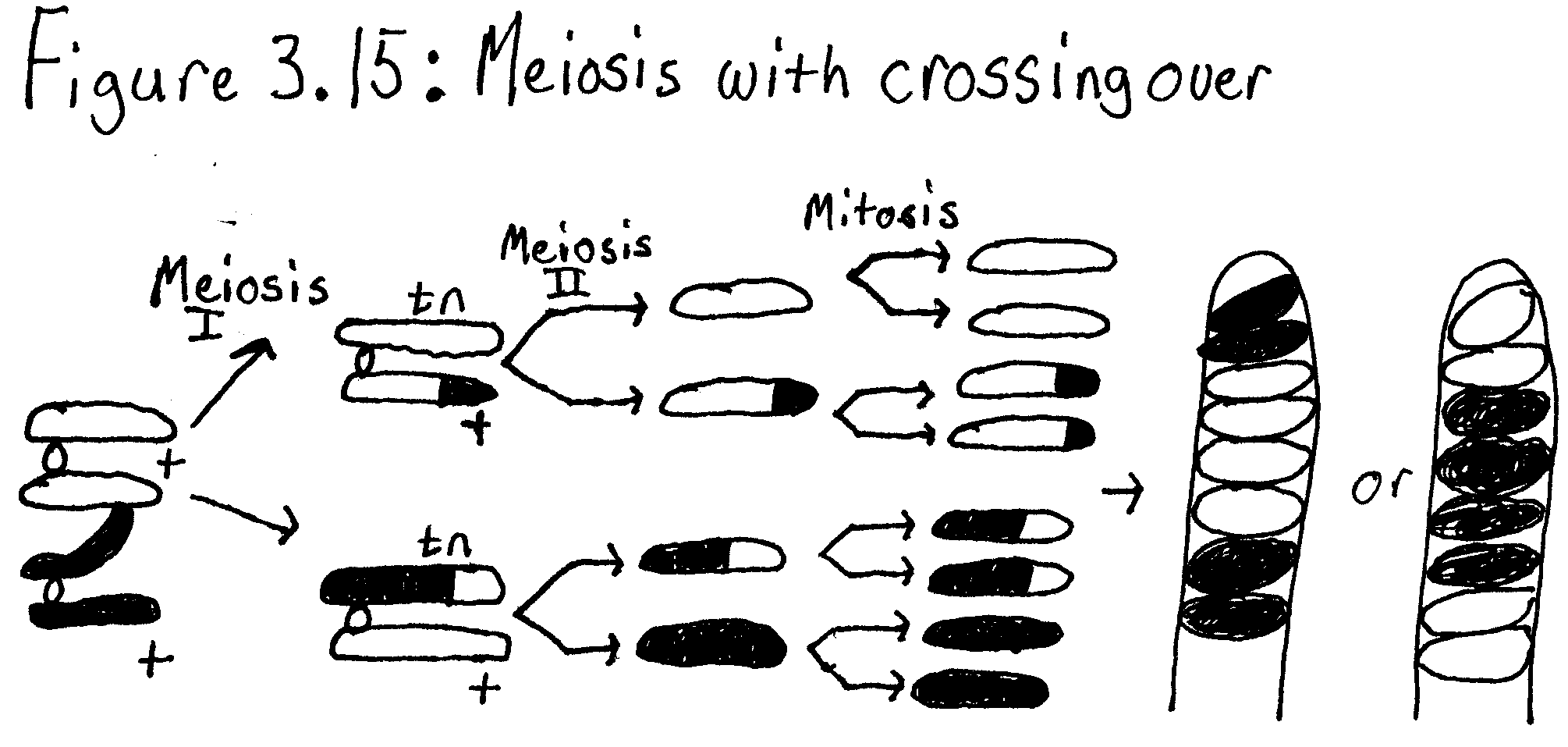
Sordaria fimicola is fungus that may be used to show the results of crossing over during meiosis. Sordaria throughout most of its life is haploid, but becomes diploid after the fusion of two different types of nuclei, which forms a diploid nucleus. In Sordaria meiosis results in the making of eight haploid ascospores found in a sac called an ascus. Most asci are found in a perithecium. The life cycle of Sordaria fimicola is as follows: a spore is discharged through an ascus. The ascospore then undergoes mitosis, which forms a filament. The filament then undergoes mitosis, which forms a mycelium. Mycelial fusion and fertilization then takes place. This forms a diploid zygote. The zygote undergoes mitosis to form four haploid nuclei. The nuclei also undergo mitosis and form eight haploid nuclei, which then form eight ascospores. When mycelia of a mutant strain of Sordaria and a wild type of Sordaria undergo meiosis four black and four tan ascospores form. The arrangement of the ascospores reflects whether crossing over has occurred or not. Gametes, egg and sperm, are made during meiosis. Each egg and sperm cell contains half the total chromosomes a normal cell of that species would have. When the egg and sperm unite during fertilization the total chromosome number is restored.

Exercise 3A.1 –  Hypothesis
While looking at prepared slides of onion root tip cells and whitefish blastula cells under a microscope I will be able to identify and draw the stages of mitosis in these cells.

Materials
The materials used in this experiment were a light microscope and prepared slides of onion root tip cells and whitefish blastula cells.

Methods
Using the microscope examine the slides of onion root tip cells and whitefish blastula cells. Begin by locating the merismatic region of the onion or the blastula using the 10 X objective. Then use the 40 X objective to study individual cells. Identify one cell that clearly represents each phase. Sketch and label the cell on a separate piece of paper.

Exercise 3A.2  –  Hypothesis
When undergoing mitosis most of the cells in an onion root tip will be in interphase. More cells will be in the stage of prophase than metaphase. More cells will be in metaphase than anaphase and more cells will be in anaphase than telophase.

Materials
The materials used in this experiment were a prepared slide of an onion root tip and a light microscope.

Methods
Obtain a prepared slide of an onion root tip and observe every cell in one high power field of view and determine which phase of the cell cycle it is in. Make sure to do this in pairs so one person can observe the cells and the other person can record which phase the cell is in. Make sure to count three full fields of view and at least 200 cells. Then, record your data in table 3.1. Next, calculate the percentage of cells in each phase by using the equation; percentage of cells in stage X 1,440 minutes =_________ minutes of cell cycle spent in stage.

Exercise 3B.1  –  Hypothesis
Using beads it will be possible to show the stages of meiosis I and meiosis II.

Materials
The materials used in this exercise were chromosome simulation kits containing four strands of beads. Two strands will be one color and the other two strands should be another color.

Methods
To show the process of interphase place one strand of each color near the center of your work area. Next, simulate DNA replication by bringing the magnetic centromere region of one strand in contact with the centromere region of the other of the same color. Do the same with its homolog. Next, to show crossing over in prophase I pop the beads apart on one chromatid at the fifth bead. Do the same with the other chromatid. Then reconnect the beads to those of the other color. Proceed through prophase I of meiosis and note how crossing over results in recombination of genetic information. Then to show metaphase I place the chromosomes near the middle of the cell. During anaphase I, the homologous chromosomes separate and are “pulled” to opposite ends of the cell. Next, to show telophase I place each chromosome at opposite sides of the cell.

In prophase II of meiosis II replicated centrioles separate and move to opposite sides of the chromosome groups. Next, to show metaphase II arrange the chromosomes so they are centered in the middle of each daughter cell. Then, separate the chromatids of the chromosomes and pull the daughter chromosomes toward the opposite sides of the daughter cell in order to show anaphase II. Finally in order to show telophase II, place the chromosomes at opposite sides of the dividing cell.

Exercise 3B.2  –  Hypothesis
There will be more asci that maintain a 4:4 relationship of not crossing over than asci that do cross over.

Materials
The materials used in this exercise were a prepared slide of Sordaria fimicola and a light microscope.

Methods
Begin by obtaining a prepared slide that contain asci of Sordaria fimicola. Then, using the 10 X objective, view the slide and locate a group of hybrid asci. Make sure to count at least 50 hybrid asci and enter your data in table 3.3.

Results
Exercise 3A.1


Exercise 3A.2

Table 3.1


Number of Cells

Field 1 Field 2 Field 3 Total
Interphase 42 36 47 125 61.27 14 hours 42 min
Prophase 10 14 18 32 20.10 4 hours 49 min
Metaphase 6 5 4 15 7.35 1 hour 45 min
Anaphase 2 3 2 7 3.43 49 min
Telophase 7 5 4 16 7.84 1 hour 52 min


Exercise 3B.2

Table 3.3


Number of 4:4 Number of Asci showing crossover Total Asci % Asci showing crossover divided by 2 Gene to centromere distance (map units)
60 45 105 21.4 % 21.4 map units


Questions:
Exercise 3A.1

1.Why is it more accurate to call mitosis “nuclear replication” than “cellular division”?

In mitosis two new nuclei are being formed. Also cytokinesis is actually a part of mitosis.

2. Explain why the whitefish blastula and onion root tip are selected for a study of mitosis?

A blastula is a hollow ball of cells that forms when an egg divides quickly; a large amount of mitosis is taking place here. The onion root tip is the place where growth occurs in the onion so a large amount of mitosis is taking place here.

Exercise 3A.1

1. If your observations had not been restricted to the area of the root tip that is actively dividing, how would your results have been different?

The tips are located in the meristem. Cells that are not in the meristem do not divide as quickly but they are elongating and differentiating. None of the phases would have been visible.

2. Based on the data in table 3.1 what can you infer about the relative length of time an onion root-tip cell spends in each stage of cell division?

Prophase is the longest stage and telophase is the shortest.

Exercise 3B.1

1. List three major differences between the events of mitosis and meiosis?

Mitosis has one nuclear division and meiosis has two nuclear divisions. Mitosis makes two identical daughter cells. Meiosis makes four daughter cells that half the number of chromosomes that their parent cells had. Crossing over and the exchange of genes occurs in meiosis but not in mitosis.

2.Compare mitosis and meiosis with respect to the following:


Mitosis Meiosis
Chromosome number of parent cells 2n 2n
Number of DNA replications 1 1
Number of divisions 1 2
Number of daughter cells produced 2 4
Chromosome number of daughter cells 2n n
Purpose Growth and repair Gamete and spore production


3. How are meiosis I and meiosis II different?

Meiosis I starts with a tetrad and separates the homologs. In meiosis the strands separate into 4.

4. How do oogenesis and spermatogenesis differ?

In oogenesis an egg is formed and three cells called polar bodies die. In spermatogenesis sperm are formed.

5. Why is meiosis important for sexual reproduction?

In meiosis the chromosome number is reduced by half. When fertlization occurs chromosome number is restored. Gene exchange causes variation.

6.Using your data in table 3.3 determine the distance between the gene for spore color and the centromere. Record your results in table 3.3.

Table 3.3


Number of 4:4 Number of Asci showing crossover Total Asci % Asci showing crossover divided by 2 Gene to centromere distance (map units)
60 45 105 21.4 % 21.4 map units


7. Draw a pair of chromosomes in MI and MII and show how you would get a 2:4:2 arrangement of ascospres by crossing over.
Error Analysis
In exercise 3A.2 inaccurate results were received. There should have been fewer cells in telophase than any of the other phases and cells should have spent less time in telophase than in any of the other phases. The results received are inaccurate because the number of cells that were in telophase were improperly counted. We received results that more cells were in telophase and spent more time in telophase than anaphase. In exercise 3B.2 improperly identifying some of the asci as crossover or non-crossover might have caused the results that were received to be inaccurate.

Conclusions:

From these experiments one can conclude that it is possible to look at mitotic stages of onion root tip cells and whitefish blastula through a microscope and draw them. Also, from these experiments one can conclude that most of the cell cycle in an onion root tip is spent in interphase. Prophase is after interphase in time spent in each cycle. Metaphase is after prophase. Anaphase is after metaphase. The least amount of time is spent in telophase. Also, a person can simulate the chromosomes in meiosis I and meiosis II using a chromosome simulation kit. Finally, one can conclude form the results of the experiments that more asci do not cross over in Sordaria fimicola than the number of asci that do cross over.

BACK


Invertebrate Worksheet


Invertebrate Lecture Worksheet
All Materials © Cmassengale

1. Approximately what percentage of animals are invertebrates?

2. What are invertebrates?


3. Name the phyla of invertebrates and members of each phyla.


Sponges

4. __________ are in the phylum Porifera.  There are about _____ different species & most of  these are _________ organisms found in oceans & seas.  A few sponges are found in  __________, but these are small and not brightly colored.

5. Sponges are _____________ that trap __________ from water as it flows through them.

6. Sponges have no basic body arrangement and are said to be ________________.

7. Sponges live attached to one spot as adults so they are __________.

8. The skeleton of sponges is made of a flexible protein called ___________ and hard fibers  called __________ which are composed of calcium carbonate or silicon dioxide.

9. Sponges are full of holes called __________ through which water flows into their __________  bodies.

10. Sponges are the simplest animals and lack the __________ level of specialization like all other animals. Sponges do have some specialized _________ in their bodies.

11. Special cells called choanocytes line the pores and have __________ that spin to pull in water.

12. __________cells at the base of choanocytes capture plankton from the water & start digesting it.

13. _______________ are special cells that carry this food to all other parts of the sponge.

14. Wastes and excess water leave a sponge through a large opening at the top called the   __________.

15. Sponges reproduce asexually by internal or external __________ and by _______________ whenever a piece of a sponge breaks off.  This last method helps sponges form   _____________.

16. Sponges reproduce sexually also and are _______________ producing both eggs and sperm.  Sponges __________ sperm with each other and do not fertilize their own eggs.

17. Internal buds or ____________ form if the freshwater supply evaporates and are release  when the sponge __________ and become ___________ when freshwater returns.

 Cnidarians

 17. The phylum Cnidaria includes what organisms?


18. All cnidarians are _______________ organisms except for the __________ which is found in freshwater.

19. Cnidarians all have _______________ symmetry and _____________ or arms that have stinging cells called _______________.  These stinging cells shoot out like a   _______________ and contain a __________ that can kill or paralyze their prey.

20. Cnidarians have _____ body layers; an inner _______________ and an outer ____________.

21. Cnidarians have _______ opening into their hollow bodies called the __________ so food enters and wastes leave through this same opening.  This is called a ________________ digestive system.

22. The hollow cavity the mouth opens into is called the ____________________ cavity.

23. Cnidarians have 2 body forms. ___________ forms have the mouth & tentacles located at the  top like Hydra, corals, and sea anemones. _____________forms like the jellyfish have their  tentacles and mouth located at the bottom.

24. Some cnidarians like the _______________ go through both polyp and medusa forms in their life cycle.

25. Cnidarians have a simple nerve _________ and can reproduce both _____________ and  _____________.

26. Corals build _____________ cases that make underwater ___________.

Flatworms

27. Flatworms are in the phylum _______________ and are flattened ______________ with  __________ symmetry.

28. Flatworms are said to be _________________ because of their solid body.

29. ___________and ____________ are parasitic flatworms having only _______ body opening called the _____________.

30. Specialized _____________ cells remove wastes.

31. The ______________ is the most common free living flatworm.  It is found in __________ or _____________ places.

32. Planarians produce both eggs and sperm and are said to be ________________; however, they _____________ sperm with other planarians.  Planarians also reproduce asexually by  _________________.

33. Flukes and tapeworms usually live in their host’s ______________ tract resistant to digestive  _______________ allowing the __________ to digest their food.

34. Tapeworms are divided into sections called _________________ with complete  _________________ structures.  The head is called the _______________ and has both  _________________ and ______________ to attach to the host.

35. Tapeworms are ___________________ and ______________ their own eggs which pass out of the host’s body in ripe ____________________ along with feces.

36. Humans get tapeworms from eating _______________________, while children pick up tapeworm eggs from ________________ boxes.

 Nematodes

37. _______________ are in the phylum Nematoda and are _________________ in shape and  ________________ at both ends.

38. Roundworms are ____________________ because their body cavity or       ________________is not fully lined. The body cavity is filled with fluid giving them a   ____________________ skeleton against which _______________can contract.

39. Roundworms have a complete gut with both a ______________ and an _____________  giving them a ________________ digestive tract.

40. Roundworms have no ____________ and no ___________ but can digest food.

41. Most roundworms are _________________ with ________________ symmetry and no   _____________________.  They are found in _______________________.

42. A protective __________________covers them and must be _____________.

43. Roundworms reproduce _________________.

44. The roundworm called Trichinella causes the disease _______________ and is picked up when someone eats ________________________.  This disease affects the ______________ and _______________.

45. The roundworm Ascaris parasitizes human _____________________.   __________________  and _________________ are common parasites of humans, and the Filaria worm attacks the _________________ system causing great swelling.

 Rotifers

46. Rotifers are ___________________ worms found in terrestrial & aquatic habitats.

47. Rotifers have a crown of ______________ surrounding their mouth for ________________ and ______________________.  Their bodies are covered with ________________.

48. Rotifers have separate _____________, but some species reproduce by       _______________________.

49. Describe parthenogenesis.


 Mollusks

50. Name several organisms in the phylum Mollusca.


51.Mollusks have a durable shell made of ________________ and are found      ________________.

52. List several economic importance’s of this group.


53. Name the 2 largest invertebrates.


54. Mollusks have ________________ symmetry and a ___________________ containing their body organs.  Mollusks also have a muscular ____________ for movement which can be modified into arms or _________________.

55. Mollusks breathe through ________________ or________________ located below a protective layer called the _______________.  This layer can also form an external  _____________.

56. The ______________ is a rough tongue for scraping food.

57. Mollusks have a ___________________ heart and an ______________________circulatory system.

58. Mollusks reproduce ___________________ and go through a free swimming larval stage called the _______________________.

59. ____________________ mollusks have a muscular foot on their belly and include the shelled  _______________ and the unshelled ________________.

60. ___________________ mollusks have a 2 part hinged shell that is opened and closed by  _________________ muscles.  They move by ___________________ or by extending their muscular _______________, and they respire through __________________.

61. Name some bivalve mollusks.

62. _____________________ are head-foot mollusks that have a _______________ and  ________________, arms or ___________________, and ____________________ to move by jet propulsion.

63. Name some cephalopod mollusks.


64. What is the only shelled cephalopod?

65. Cephalopods breathe through _______________ .

66. Cephalopods are the most ________________________ mollusks.

67. The _____________________ & ________________ can secrete an inky substance into the water to escape predators and have an __________________ shell.

 Annelids

68. Annelids are ____________________ worms found in _________________.

69. External segments correspond to internal segments called _______________.

70. Give two ways that segmentation is an advantage for an organism.


71. Annelids have a tube within a tube body plan called the ___________________ where the body _______________ are located. This tube runs from the _________________ to the _______________ and is fully _______________.

72. Annelids show ______________________ by having bilateral symmetry with an anterior head where most sense organs are found.

73. Coelomic fluid gives annelids a ______________________ skeleton.

74. The best known member of this group is the ____________________ which moves by external bristles called _________________ on each body segment.  These bristles are made of _________________.  Earthworms respire through their ________________________ and have a ___________________ circulatory system and _____________ pairs of hearts or  aortic arches.

75. Describe how an earthworm feeds and tell how this helps the environment.


76. What are castings and where can they be found?


77. ______________ are annelids with _____________ at both the anterior and posterior end.  Anterior suckers are used to __________________________ , while posterior suckers help to  ____________________________.

78. Most leeches are _______________________ or ____________________, but blood sucking leeches are collected for ___________________________.

79. Both leeches and earthworms produce eggs and sperm and are called        _______________________; however, leeches lack ________________ and are flattened  _________________________.

80. ___________________ are marine annelids whose setae are modified into paddle like ____________________ for movement and more area for _______________________.

81. Polychaetes live commensally with what other organisms?


Arthropods

82. Arthropod means _________________ appendages.

83. Give 5 characteristics of all arthropods.


84. What is ecdysis and why is it necessary?


85. What is the exoskeleton of arthropods composed of?

86. What is meant by an open circulatory system?


87. Arthropods are divided on the type of _____________________ they have.       ______________________ have chelicerae or fangs and no_________________,  _______________________ have pincers called ___________________, and      _______________________ have mandibles or jaws.

88. ___________________ are extinct, marine arthropods with a_____________ and segmented _____________________ with a pair of legs on each section.

89. ________________________ arthropods like insects, centipedes, & millipedes breathe through hollow air tubes called _____________________;  aquatic chelicerates like the ____________________ crab have ___________________ to breathe; spiders, ticks, and  scorpions use _____________________ to get air; and crustaceans breathe through  ______________________.

90. Terrestrial mandibulates are ____________________ with one-branched appendages; while aquatic crustaceans are _______________________ with two-branched appendages.

91. Arthropods have a nervous system with an anterior ___________________ and sensory organs that include compound eyes or simple eyes called _______________;  ______________________ membranes for hearing; and ___________________ for smelling, feeling, or tasting.

92. ______________________ tubules filter wastes in arthropods.

93. The subphylum Chelicerarta contains the class ______________________ with the horseshoe Crab and the class ____________________ with spiders, ticks, scorpions, & mites.  Both classes have ___________ body regions, the ___________________ and abdomen, no ___________________, ____________________ legs, and ___________________ or fangs.

94. Appendages on the head of chelicerates called _____________________ are used for sensing the environment and getting food into the mouth.

95. Spiders have posterior glands called ________________ that help make their silken webs to get prey.  Spiders detect movement whenever their prey gets caught in their  ________________ and by sensory ________________ on their body.  Spiders produce  _______________ to kill their prey & are beneficial because they feed mainly on  ____________________.

96. Spiders are unlike insects in that they have _____________ not ___________ legs, only ___________________ eyes and not compound, and _________ body regions and not _____________.

97. Name the body regions of insects and spiders.


98. The ____________________ and ____________________ are two poisonous spiders in our  area.

99. The class Crustacea is in the subphylum _______________________ and includes  _________________, ________________, ________________, _________________,  _________________, and the terrestrial __________________ & ___________________.

100. Crustaceans have a pair of sensory __________________ and a pair of shorter ___________________ for balance.  The head also contains three types of mouthparts –  _____________________, _____________________, and _______________________.  They also have pincers called __________________ to help catch and eat food.

101. Aquatic crustaceans have an external shell or __________________ that must be molted, and they are used by man for ___________________.

102. The class _____________________ contains predators called centipedes with  ________________, _________________ glands,  posterior_______________, &  ________________ pairs of legs per body segment.

103. The class ____________________ contains millipedes which are ____________________ with _______________ pairs of legs per body segment.

104. The largest and most successful group of arthropods are the __________________.

105. Insects have _______ body regions, _________ legs, a pair of sensory ________________, and a pair of ________________ for flight. ___________________ & ___________________ are wingless insects, while flies have their second pair of wings modified into balancing organs called ____________________.

106. Insects have 4 mouthparts which include the jaw or ________________, the   _______________, the lower lip or _________________, and the upper lip or      __________________.

107. Insect mouthparts are modified according to their ___________________.  Butterflies have  ___________________ mouthparts, flies have _________________ mouthparts, mosquitoes have ________________ mouthparts, and grasshoppers have   ___________________ mouthparts.

108.  Wings and legs are both attached to the _________________ on insects, and some female insects have an egg laying tube or ____________________ on the end of their abdomen.

109. Name 2 ways insects communicate.


110. Insects detect sound by _________________ membranes on the abdomen and sensory  _______________ that cover their body.

111. _________________ along the abdomen of insects open into their breathing tubes or ___________________.

112. Insects with _________________ metamorphosis go through egg, larva, pupa, & adult stages; while those with incomplete metamorphosis go through ________________,  ___________________, and _________________ stages.

113. Give examples of insects with complete and incomplete metamorphosis.


114. __________________ control metamorphosis.

Echinoderms

115. Give some examples of echinoderms.


116. What does echinoderm mean?


117. Why are echinoderms considered to be the most advanced invertebrates?


118. All invertebrates, except echinoderms, are considered to be________________ because their blastopore becomes their _________________.

119. Echinoderms have an __________________ made of movable or fixed calcium plates called ___________________, ___________________ symmetry with a ______________ part body plan, no __________________ or _________________ as adults, and extendable ________________________ for movement.

120. Echinoderms have a ___________________________ system composed of canals.  Water enters a pore called the ______________________ and goes through a short  _________________ canal to the _______________ canal. __________________ canals  connect to the ring canal & determine the 5 part body plan.

121. How do starfish use their water vascular system when feeding?


122. _____________________ are used for respiration and________________.

123. Echinoderms reproduce asexually by _____________________ or sexually with _________________ fertilization.

124. Starfish are in the class ____________________ and are active marine _______________ With _______________ arms attached to a _______________________.  Their mouth is located on the underside or _________________ surface. ___________________ mollusks are favorite food of starfish. They can eject their _________________ into the clam and digest it.

125. ___________________ and ____________________ are in the class Echinoidea and they lack distinct __________________.  They do have five rows of protruding _____________________ which they use along with external __________________ for movement.  Triangular ________________ around the mouth help them scrap or crush their food. They graze on __________________,

____________________, & dead fish.

126. The class Crinoidea contains ______________________ & ______________________.

127. Crinoids have upright, highly branching ________________ around their mouth which they use for _________________________.  Sea lilies are attached by a _________________, while feather stars are able to ________________ and move about.

128. Brittle stars are in the class ________________ and have slender _______________ that easily break off to escape predators.

129. Holothuroidea contains ___________________ that are soft, sluglike marine creatures with ___________________ outer skin.  They usually lie ________________________ and can eject part of their _____________________ to scare away predators.  They move with         _________________ or by ____________________________.  Some of these are _________________________ which is unusual for echinoderms.


BACK

Introduction to Life Study Guide bI

Introduction to Life Study Guide

Study of life is known as?
How are genes used by organisms?
Which characteristic of living things relates to stability?
What does homeostasis mean?
What is ecology?
How do heterotrophs obtain energy?
List distinct properties of living things.
What is the smallest unit that can carry on life called?
What are  all living things made of?
Which of the following are characteristics of ALL living things — growth, development, cellular organization, & movement?
A scientist noticed that bacteria weren’t growing in some test tubes. Is this observation, hypothesis, or experimentation?
The scientist suggests that bacteria aren’t growing in some test tubes because they aren’t getting the nutrients they need. Is this observation, hypothesis, experimentation, or conclusion?
A scientist adds a different nutrient to half of the test tubes in which he is growing bacteria. Is this observation, hypothesis, or experimentation?
Define hypothesis.
What is a theory?
A hypothesis is rejected if it does not explain what?
When scientists are planning experiments,  do they have a good idea of the possible results?
If new evidence emerges, do theories change?
Are theories supported with some scientific knowledge?
Are theories proved scientific ideas?
For scientists to communication with each other about their data, what do they do with their data?
How do scientists organize data?
If a microscope has a 30X objective lens & a 10X ocular (eyepiece) lens, what is its magnification?
What are the base units for each of these SI measurements — length? second? volume? mass? 
BACK


Introduction to Animals Worksheet

Introduction to Animals Worksheet

Circle the correct response.

1. Animals are [ heterotrophs / autotrophs ]

2. [ All / Most ] animals are multicellular.

3. The cells in the skin of your hand are [ bigger than / the same size as ] the cells in your heart.

4. Organisms that have 2 copies of each chromosome are [mobile / diploid ]

5. The absence of a cell wall allows animals [ mobility / diploidy ]

6. A hollow ball of cells that forms after fertilization is called a [ blastula / mesoderm ]

7. In all animals except [ humans / sponges ] a zygote undergoes divisions to become a blastula.

8. The cells of animals are organized into functional units called [ blastula / tissues ]

Matching:


9. ______ Ectoderm a. lining of the digestive tract, digestive organs


10. ______ Mesoderm b. outer layer of skin and sense organs


11. ______ Endoderm c. most of the skeleton, muscles Match the body plan to its description
12. ______ radial d. body that is irregular shaped


13. ______ bilateral e. has a distinct right and left half


14. ______asymmetry f. body parts arranged around a central axis, like the spokes of a bicycle wheel


What symmetry do these animals have?

15. ______________

16. ____________________  

17. Segmented animals are constructed from a series of repeating units called [segments /vertebrates]

18. Evidence of segmentation in human beings can be seen in the [ skin / backbone ]

Match the name of the Phylum to the organism:


a. vertebrates

b. segmented worms

c. flatworms

d. jellyfish

e. sea stars

f. sponges

g. clams

h. roundworms

i. insects

19. _____ Cnidaria

20. ______ Mollusca

21. _____ Annelida

22. _____ Chordata

23. ______Nematoda

24. ______Platyhelminthes

25. ______ Porifera

26. ______Arthopoda

27. ______Echinodermata


Animal Body Systems

For each term below, indicate what body system it relates to. Body Systems


28. Gastrovascular Cavity ___________________________

29. Ganglia ____________________________

30. Hermaphrodite ____________________________

31. Blood vessels ____________________________

32. Exoskeleton ____________________________

33. Gills
____________________________

34. Anus
____________________________

35. Nerve Net ____________________________

36. Hydrostatic ____________________________

37. Gametes ____________________________

38. Flame cells
____________________________

39. radula
____________________________

40. trachea & spiracles
___________________________

Circulatory

Excretory

Reproductive

Support (skeletal)

Nervous

Respiration

Digestive


Revised from : www.biologycorner.com


Notes on Invertebrate Animals


Notes on Invertebrate Animals


Phyla:


1. Porifera‑‑sponges

2. Cnidaria

a. sea anemones

b. hydra

c. corals

d. jelly‑fish

3. Platyhelminthes‑‑flatworms

a. flukes

b. tapeworms

4. Nematoda‑‑roundworms

a. Trichinella

b. Ascaris

c. hookworms

d. pinworms

5. Rotifera–rotifers

6. Annelida‑‑segmented worms

a. earthworm

b. leeches

7.  Mollusca‑‑clams, oysters, snails, and octopus

8. Arthropoda

     subphylum: Trilobita–trilobites (extinct)

     subphylum: Chelicerata‑‑horseshoe crabs, spiders, scorpions, mites, & ticks

subphylum: Mandibulata–crustaceans, insects, millipedes, centipedes

9. Echinodermata: starfish, sea cucumbers, sea lilies


About 97% of all animals are invertebrates.  Invertebrates are animals

which do not have a backbone.  In this unit we cover nine phyla of

invertebrates:  Porifera, Cnidaria, Platyhelminthes, Nematoda, Rotifera, Mollusca, Annelida, Arthropoda, & Echinodermata.

SPONGES

The phylum Porifera are sponges.  There are about 800 different species of sponges, and 88% are marine.  “Marine” means that they live in salt water, such as an ocean or a sea.  Freshwater sponges are smaller and less brightly colored than marine sponges.  Sponges are filter feeders.

This means that they use their body as a filter to trap their food, microscopic plankton.


Sponges are asymmetrical and live attached to one spot as adults making them sessile animals. Sponges have a skeleton composed of a flexible protein material called spongin & hard fibers called spicules composed of calcium carbonate or silicon dioxide. The body of a sponge is filled with holes or pore through which water enters their hollow bodies.  Sponges lack the tissue level of organization but they do have some specialized cells.  Choanocytes are specialized cells that line pores in a sponge and have a flagellum that spins to pull in water and food.  Collar cells at the base of choanocytes capture plankton & start digesting it.  Amebocytes are specialized cells that carry food to all other parts of a sponge=s body.  Wastes and excess water leave a sponge through an opening at the top called the osculum.

Sponges reproduce asexually by internal or external buds and by fragmentation whenever a piece of the sponge breaks off. Each piece can form a new sponge. This is how sponges form colonies. Sponges reproduce sexually by dispensing eggs and sperm into the water.

If the freshwater supply evaporates, freshwater sponges become dormant and form an internal bud or gemmule which is release when the sponge dies.  The gemmule is a small freshwater sponge covered with hardened mucus which prevents it  from drying out.  When the freshwater returns, the gemmule becomes an active sponge.


Cnidarians

The phylum Cnidaria include sea anemones, hydra, corals and jellyfish.  All Cnidaria are marine except hydra, which is a freshwater organism. Cnidarians have radial symmetry and are carnivorous using tentacles that surround their mouth to get food. Cnidarians exhibit two body forms – the sessile polyp with tentacles & mouth at the top or the motile medusa with tentacles & mouth on the bottom.  Cnidarians may exist in one of these two stages or go through both stages in their life cycle.  Cnidarians have a hollow gastrovascular cavity on the inside lined with gastrodermisEpidermis covers the outside and a jellylike material called mesoglea is between the layers.  Mesoglea is thin in polyp forms but thick in medusa forms. Cnidarians have stinging cells called nematocysts or cnidocytes on their tentacles that are poisonous & shoot out like a harpoon to kill or paralyze prey.   Their mouth is the only opening to their body so they have a two-way digestive system.  The also have a simple nerve net . Cnidarians reproduce asexually by budding or sexually producing fertilized eggs whenever males release sperm and females release eggs into the water. Some cnidarians like coral build a limestone case that makes an underwater reef.


Platyhelminthes (flatworms)

The phylum Platyhelminthes are dorsoventrally flattened and have a definite anterior and posterior end giving them bilateral symmetry.  Their bodies are solid so they are said to be acoelomate.  Some flatworms are parasites, while others are free-living carnivores or scavengers.  Examples of parasitic flatworms are flukes and tapeworms. Flatworms also have only a mouth for both food and wastes.  Their nervous system is composed of a nerve net and sometimes light-sensitive eyespots at the anterior end.  Specialized flame cells help get rid of wastes.

The planarian is the most common free-living flatworm found in water or moist places. They are hermaphrodites producing both eggs and sperm, but they exchange sperm with each other during sexual reproduction.  Planarians also reproduce asexually by fragmentation.

Flukes and tapeworms often live in their host=s digestive tract resistant to the host=s enzymes.  They  do not have a digestive system allowing the host to digest their food.


Tapeworms are divided into sections called proglottids that each have a complete reproductive system producing fertilized eggs. Tapeworms are hermaphroditic (one body having both sexual parts), and they fertilize their own eggs. Ripe proglottids with their eggs pass out with the host=s feces. Tapeworms anterior end is called the scolex and is modified with both hooks and suckers to attach to the host=s intestines.  Humans most often get tapeworms from undercooked pork, beef. or fish.  Tapeworm eggs can withstand boiling water so it is important to cook these meats well enough to destroy the eggs.  Children sometimes get tapeworms by playing with the feces in the litter box of a cat, getting the eggs on their hands, and placing their hands or fingers in their mouth.  The longest tapeworm ever passed by a person was 39 meters.

Flukes have complex life cycles that involve more than one host. A fluke causes Schistosomiasis, a disease that affects 250 million people world wide.  This blood fluke attacks the kidneys, liver, and intestines causing progressive weakness.  It often takes 20 years to die from Schistosomiases, & there is no cure.


Nematoda (roundworms)

The phylum Nematoda are the roundworms.  Roundworms are cylindrical in shape and vary in length from being microscopic to  20 inches long.  Roundworms are pseudocoelomate having a body cavity that is not completely lined. The body cavity or pseudocoel serves as a hydrostatic skeleton against which muscles can contract.  Unlike flatworms, roundworms have a complete gut.  This means that they have a one-way digestive tract with a gut that begins with a  mouth and ends with an anus. Therefore, they are usually able to digest food.  However, roundworms have no blood or heart.  Nutrients are distributed by a non‑ blood fluid which is not pumped.

Most roundworms are parasites and are found in all habitats. They are bilaterally symmetrical and unsegmented.  Although they are cylindrical in shape, they usually taper at both ends.  They are covered with a thick protective cuticle that is flexible and can be molted.  They have separate sexes generally and reproduce sexually.

The roundworm Trichinella, causes the disease called trichinosis.  People get trichinosis from eating undercooked pork.  Trichinella gets into muscles and leaves calcium deposits which effect muscle contraction.  Trichinosis can affect the heart.  Another roundworm, Ascaris,

parasitizes human lungs. The Filaria worm attacks the lymphatic system causing great swelling. Hookworms and pinworms are also roundworms which parasitize humans.


Rotifers

The phylum Rotifera includes microscopic worms found in aquatic and soil habitats.  They have a crown of cilia at their head end surrounding their mouth for movement and feeding.  Their bodies are covered with an external layer of chitin. Having separate sexes, they reproduce sexually.  Some species contain only females and reproduce by parthenogenesis (unfertilized eggs developing into females).


Mollusks


The phylum Mollusca contains snails and slugs, bivalves, octopus, squid, and the chambered nautilus. Many members of this phylum have durable limestone shells and are found in all habitats. Members of this group are economically important as sources of human food , pearl and shell production, crop & flower damage, destruction to submerged wooden structures, and intermediate hosts for some parasitic diseases. The giant squid and giant clam are the two largest invertebrates.  Mollusks have bilateral symmetry and a visceral mass containing their body organs. Mollusks also have a muscular foot for movement which can be modified into arms or tentacles in some species.  Mollusks breathe through gills or lungs located below a protective layer called the mantle.  The mantle forms the shell in some species and also protects the body organs. All mollusks except bivavles contain a rasping, tongue-like radula for scraping food.  The circulatory system consists of a three-chambered heart  and open-flowing system except for octopus & squids which have a closed circulatory system. Reproduction is sexual even in hermaphroditic forms.  Mollusks go through a free swimming larval stage called the trochophore.

The class of mollusks called gastropods have a foot on their belly.  An example of a gastropod is the snail.  When a snail lacks a shell it is called a slug.  Snails and slugs walk on their belly.  Most snails are marine, but some do live on land.  Marine snails have gills.  Land snails are called pulmonate snails and have an air hole for breathing.  Snails can be very large.  The helmet snail can be as big as 15 pounds.

The class of mollusk called Bivalvia includes clams, oysters, mussels , and scallops.

These mollusks have two shells hinged together by a ligament.  Strong adductor muscles open and close the shells. Incurrent and excurrent siphons circulate water containg food and oxygen through the bivalve.  Gills extract the oxygen from the water,  and they move by jet propulsion.  Their muscular foot can be extended from the shell for movement or anchoring.

The class of mollusks called cephalopods have a foot on their head.  Examples of cephalopods are octopus, squid and nautilus.  Most cephalopods have beaks, tentacles and jaws and are active predators. Their musclar foot has been modified into arms or tentacles. They lack external shells except for the natilus.  These are the most intelligent of all invertebrates.  They used their siphons to move by jet propulsion.  Octopus have their shell inside of their body.  Octopus secrete an inky substance which they spit out to help them escape from predators.  The giant squid is the largest cephalopod.  It can be up to 60 meters in length and has been known to eat whales.


Annelids (segmented worms)

The phylum Annelida are the segmented worms and are abundant in all habitats. External segments  are characterized by ringlike structures along the body, and corresponding internal segments are called septaSegmentation gives worms more flexiblity in movement. If one segment is damaged, it isn=t usually fatal to the animal because their organs are duplicated in other segments.  Annelids have a Atube within a tube@ body plan known as a coelom which is fully lined and contains the body organs.  The coelom runs from the mouth to the anus. Annelids have bilateral symmetry, and a well-developed brain and diverse sense organs showing cephalization. Coelomic fluid serves as a  hydrostatic skeleton.

Earthworms belong to this phylum.  Each segment of the earthworm has setae or external


bristles made of chitin.  These bristles allow the earthworm to move and to burrow into soil.   Earthworms have a head and a central nervous system.  Earthworms respire through their moist skin as they dig through the soil and help loosen it. They have a closed circulatory system in which blood is pumped by five pairs of hearts.  Most earthworms feed on decomposing vegetation causing it to decompose faster. A  pharynx sucks in the organic debris which the muscular gizzard grinds. Earthworms bring the nutrients from the subsoil to the top soil, thereby helping plants to grow.  Undigested materials or castings are deposited outside burrows.

Leeches are also in the phylum Annelida.  Most leeches live in water and have suckers at both ends of their bodies. The tail suckers are used to latch on to a host, while the head suckers

are used to suck blood from the host.  Most leeches are predators or scavengers, but some suck blood.  Because of this, blood sucking leeches are collected for anticoagulant. Leeches bodies are flattened dorsoventrally and lack setae except for one species.  Like earthworms, leeches are hermaphrodites that exchange sperm with other members of their species.

Polychaetes are marine annelids that have their setae modified into paddle-like structures called parapodia.  Parapodia improvement movement and give more area for gas exchange. Polychaetes often live commensally with sponges, mollusks, echinoderms, and crustaceans. Sexes are separate with external fertilization.


Arthropods

The members of the phylum Arthropoda all have jointed appendages.  In fact, the word “arthropod” means jointed leg.  There are more species of arthropods than any other phylum.


Arthropods have these characteristics:

a. hard exoskeleton which is usually composed of substance called  chitin

b. go through periodic ecdysis as they shed or molt their exoskeleton

c. they have specialized body segments (head,  thorax, cephalothorax, & abdomen)

d. jointed appendages such as legs, antenna, and mouthparts.

e. open circulatory system


The phylum Arthropoda is divided according to their type of appendages.  The subphylum Chelicerata possess chelicerae or fangs and no antenna, while the subphylum Mandibulata have antenna and mandibles or jaws.  Crustaceans have pincers called chelipeds.  The subphylum Trilobita are an extinct group with a head and trunk with a pair of legs on each segment.

Terrestrial arthropods like insects, millipedes, & centipedes have a system of hollow air tubes called trachae as their respiratory system. Aquatic chelicerates like the horseshoe crab have book gills, while terrestrial chelicerates such as spiders, ticks, mites, & scorpions  use  book lungs.    Book lungs have numerous blood vessel lined surfaces which look like the pages in a book & get oxygen from air.  Crustaceans respire through gills. Gills are folded tissue which are lined with blood vessels which  remove oxygen from water.

Terrestrial mandibulates are uniraimous with one-branched appendages, but aquatic mandibulates like crustaceans are biramous or two-branched.   Arthropods have a brain and nervous system and possess a variety of sensory receptors such as simple eyes called ocelli or compound eyes, typmpanic membranes for hearing, and antenna that can smell and taste.  Excretory structures in arthropods vary, but terrestrial arthropods have Malpighian tubules to filter nitrogenous wastes.


The subphylum Chelicerata (ki‑LISS‑uh‑ruh) include the class Xiphosura or horseshoe crabs which have a cephalothorax and abdomen, live in marine environments breathing through book gills, lack antenna, but have chelicera & 4 pairs of walking legs.  The class Arachnida containing

spiders, scorpions, mites, and ticks are also chelicerates that lack antenna, have chelicera (fangs) and 4 pairs of legs, but they live in terrestrial habitats and breathe through book lungs or trachae

Chelicerates also have appendages on their head called pedipalps that are sensory and can help move food into their mouth.   Unlike most arthropods,  spiders do not see well; however, they are good at detecting movement.  Spiders have glands called spinnerets on the posterior end of their abdomen that produce silk to make webs.  When prey get caught in a spider’s web, it is the movement which alerts the spider to the captured prey.  Most spiders also have hairs on their body to assist them in feeling movement.  Spiders  poison their prey once they are caught in their webs. Spiders are very beneficial because they catch and eat insects.  Two spiders which are

dangerous are the black widow and the brown recluse.  Both of these spiders have distinct markings on the underside of their abdomen..  Spiders differ from insects in having eight, not six legs,   having simple eyes  and not compound eyes, and having only 2 body regions

(cephalothorax & abdomen) instead of 3 regions ( head, thorax, & abdomen).

The subphylum Mandibulata contains the class Crustacea.  Most crustaceans live in the water and include crabs, shrimp, lobster, crayfish, & barnacles. Terrestrial crustaceans include pillbugs and sowbugs.  Crustaceans have a pair of antenna to smell and detect chemicals and a shorter pair of antennules used for balance. They have 2 body regions (cephalothorax and abdomen), and their mouthparts include mandibles, maxilla, and maxillipeds.  They also have pincers called chelipeds to help them  catch food.  Aquatic crustaceans  have a shell called a carapace that they regularly shed as they grow to produce a larger one.    Crustaceans are economically important to man as a food source.

The classes Chilopoda and Diplopoda are alo in the subphylum Mandibulata.  Chilopoda or centipedes are poisonous predators feeding on other terrestrial arthropods. Centipedes have fangs, venom glands, and a pincer on their tail. They have a single pair of legs per body segment.  Diplopoda or millipedes are vegetarians or scavengers feeding on decaying vegetation that have two pairs of legs per body segment.


The class Insecta in the subphylum Mandibulata includes all of  the insects.  This is the largest and most successful group of arthropods. Insects usually have six legs, a pair of antenna, and a pair of wings although some species may be wingless such as silverfish and termites. Flies have their second pair of wings modified into a balancing structure called halteres.  Insect’s mouths usually have four parts – the mandible or jaw, maxilla, labium or lower lip, and labrum or upper lip and are adapted for a particular food.  For example, grasshoppers  have chewing mouthparts for eating grass, mosquitos have sucking mouthparts for sucking blood, butterflies have siphoning mouthparts for getting nectar from flowers, and the house fly has spongy mouth- parts for soaking up liquid food.  Wings and legs are attached to the midsection or thorax, antenna, eyes, and mouthparts are attached to the head, and the abdomen on females may have an egg-laying tube called the ovipositor.  Insects communicate by producing sounds and by making chemicals called pheromones. Tympanic membranes on the abdomen and sensory hairs detect sound waves.  Spiracles line the sides of the insect=s abdomen and open into their breathing tubes or trachae. Insects may go through stages in their life cycle.  Butterflies, bees, flies, and beetles go through the egg, larva, pupa, and adult stages.  This is known as complete metamorphosis. Dragonflies and grasshoppers go through egg, nymph, and adult stages known as incomplete metamorphosis.  Insects such as silverfish and fleas do not go through metamorphosis.  Metamorphosis and molting are controlled by hormones.


Echinoderms

The phylum Echinodermata include the starfish, sea urchins and sea cucumbers.  The word “echinoderm” means spiny skin.  Echinoderms are the most advanced invertebrates. All other

invertebrates are protostomes in which the blastopore in their development becomes the mouth.  Echinoderms, like chordates, are deuterostomes in which the blastopore becomes the anus. Echinoderms have an endoskeleton composed of movable or fixed calcium plates called ossicles.  The members of this phylum have radial symmetry with a five part body plan. Adults have no head or brain and move be extendable tube feet.  Echinoderms also possess a water vascular system made up of a system of canals that help the organism feed and move.  Water enters through an opening called the madreporite into a short stone canal into the ring canalRadial canals connect to the ring canal and determine the five-part symmetry. This hydraulic water system is strong enough to help starfish open clam shells.  Skin gills are used for respiration and waste removal.   Echinoderms are capable of extensive regeneration whenever parts are dropped.  They can reproduce asexually by fragmentation or sexually with external fertilization.

Starfish are in the class Asteroidea and are active marine predators with 5 arms set off from a central disk and their mouth located on the underside or oral surface. Bivalve mollusks are a favorite food of the starfish, and they consume them by turning their stomach inside

out and sticking it into the clam shell to digest the clam.

Sea urchins and sand dollars are in the class Echinodea and they lack distinct arms. Five rows of tube feet protrude through their skeletal.  They use the spines of their skin and tube feet to move about and graze on algae, coral, or dead fish.  Triangular teeth around the mouth scrap or crush food.

The class Crinoidea contains sea lilies and feather stars with highly branched arms around their mouth for filter feeding.  Sea liles are attached by a stalk to the substrate, but feather stars are able to detach and move about.

Brittle stars in the class Ophuroidea have slender arms attached to their central disk and can move faster than starfish. Sea cucumbers are in the class Holothuroidea and are soft, sluglike organisms with leathery outer skin. Sea cucumbers usually lie on their sides on the ocean bottom and can eject part of their intestines in order toscare away a predator.  They also move by tube feet or by wiggling their entire body. Some of these are hermaphroditic which is unusual for echinoderms.