

Category: Curriculum Map


Evolution PPT Questions
| Evolution ppt Questions |
History of Evolutionary Thought 
1. What were Aristotle’s early ideas about life on Earth?
2. How long did these ideas last?
3. What was Linnaeus first to do?
4. What language is used for scientific naming?
5. What are the two words called in a scientific name?
6. This naming system is known as ____________ ______________.
7. Name the contribution that each of these men made to Darwin’s ideas on evolution:
a. Charles Lyell
b. George Cuvier
c. Thomas Malthus
d. James Hutton
e. Lamarck
f. Wallace
8. Which was published first – the Origin 0f Species by Darwin or Gregor Mendel’s papers on inheritance?
9. What was the name of George Cuvier’s theory on evolution?
10. What did Cuvier study in Paris and what did he find?
11. What did Cuvier decide was responsible for the disappearance of some species?
12. James ___________ was a Scottish _________ who studied fossils of _____________ in the Paris Museum.
13. Hutton’s ideas were known as _____________.
14. Briefly state Hutton’s idea on geological change.
15. Lyell proposed the theory of _________________.
16. Describe uniformitarianism.
17. How old did Lyell propose that the Earth was? How old did most people at this time believe the Earth was?
18. How did reading Lyell’s book help darwin on his voyage on the Beagle?
19. Lamarck was one of the first scientists to understand that change occurs over ___________.
20. Lamarck believed that changes were adaptations to the ____________ that organisms _____________ in their lifetime and that he thought could be passed on to _______________.
21. Explain Lamarck’s idea of the Law of Use and Disuse.
22. Lamarck’s theory of acquiring or losing traits by using or not using them led to his theory of evolution called the _____________ of ______________ _____________.
23. According to this theory new ___________ could arise over time.
24. According to Lamarck, if a blacksmith built up his muscles then he would have what type of sons?
25. According to Lamarck, if a giraffe stretched its neck reaching for leaves, what would its offspring look like?
26. What did Lamarck NOT know that made his theory incorrect?
27. Are genes changed by life activities?
Darwin the Naturalist 
28. In what year and at what age did Darwin become the naturalist for the ship the HMS Beagle?
29. How long was the Beagle voyage around the world?
30. As Darwin sailed around the coast of __________ __________, he collected many different types of plants and animals on the mainland and on the islands.
31. Where are the Galapagos Islands and how were they formed?
32. What did Darwin discover about the animals on each type of island
33. How did the island species of finches and tortoises compare with those on the islands?
34. How did the necks of the tortoises compare with each other?
35. The island finches resembled a finch on the ___________.
36. Was the available food and habitat the same on all the islands? Explain.
37. What was different about the finches and why?
Darwin’s Observations & Conclusions 
38. List three observations Darwin made on his travels that led him to propose his revolutionary idea about the way life changes over time.
a.
b.
c.
39. Give an example of the uneven distribution of species noted by darwin.
40. Darwin collected both ___________ organisms and ____________ of organisms.
41. Give 2 examples of fossils collected by Darwin in which the species were no longer in existence.
42. Give a definition for evolution.
43. Left unchecked, what did Darwin predict would happen to the number od individuals in a population?
44. In nature, what tends to happen to the size of populations over time?
45. Competition among members of a population occur due to a limited number of ____________ _______________.
46. Only a ___________ of the offspring produced survive to the next generation.
47. The struggle for environmental resources is commonly called _____________ of the ____________.
48. How do individuals in population compare with each other?
49. Variation in a population is ______________.
50. Which organisms in a population are most likely to live offspring to pass on their traits?
51. This process is known as _____________ ___________ and was proposed by Charles ___________.
52. State Darwin’s theory of natural selection.
53. New ____________ evolve according to natural selection.
Ideas that Shaped Darwin’s Thinking 
54. _____________ was an economist in 1798 that influenced Darwin’s thinking.
55. Malthus observed what about the birth rate of babies?
56. Malthus knew population size was limited by what?
57. According to Malthus, a high birth rate and limited resources caused what to happen?
58. List several things that organisms struggle for in the environment.
59. What did Malthus say would happen if the population size continued to groww unchecked?
60. The __________ rate should increase to balance the __________ of a population and the limited _____________ in the environment.
61. Did Darwin see this occurring in nature?
62. Most organisms produce ____________ offspring than can survive causing many to ________.
Darwin’s Theory of Evolution 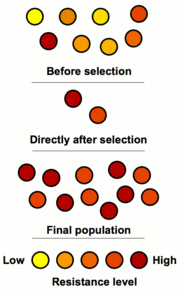
63. Darwin proposed that organisms descended from what?
64. Over time, according to Darwin organisms __________ their form causing evolution of new ____________.
65. ___________ __________ is the driving force for evolution.
66. During the struggle for survival, which organisms survive to pass on their traits?
Origin of Species 
67.How long after he returned to England did Darwin publish his book about evolution?
68. Why did Darwin wait so long to publish his ideas?
69. Darwin’s theory of evolution challenged both the ____________ and _____________ ideas at that time.
70. What made Darwin publish his book?
71. _______________ independently developed the same theory as Darwin.
72. Both Darwin and Wallace believed that __________ changed over time due to a _____________ for existence.
73. Both Darwin’s and Wallace’s papers were presented to the ____________ ______________ in July of __________.
74. How long after this did it take Darwin to finish writing his book?
75. Before Darwin, it was thought that species were perfectly made and _______________.
76. What group of people had been observing and using variations in organisms for a long time?
77. How were farmers using variation?
78. This process is called _____________ ______________ instead of natural selection that occurs in nature.
79. Artificial selection involves ____________ desired traits in stock or crops and __________ them to pass on the trait.
Controversy
80. Define these terms:
a. struggle for existence
b. survival of the fittest
c. descent with modification
d. Fitness
e. adaptation
81.What are the two types of adaptations?
82. Give some examples of physical adaptations.
83. Give some examples of behavioral adaptations.
84. What happens to organisms with LOW fitness?
85. How did changes in the Galapagos finches make them more FIT to survive?
86. Natural selection takes place over a _________ period of time.
87. Natural selection can be observed as changes in _______ structure, ecological _________, and ____________.
88. Do species today look them same as their ancestors?
89. Living species descended with changes from other __________ over periods of time.
90. What was a major problem in Darwin’s Theory?
91. The work of what scientists solved the problem of how variations were passed to offspring?
92. What is the complete title of Darwin’s book?
Theory of Evolution Today
93. List three main things used today to show how organisms are related.
a.
b.
c.
94. Give two examples of evolution that has occurred today in a much shorter period of time.
a.
b.
95. Define macroevolution.
96. Define microevolution.
97. Darwin argued that Earth was ____________ of years old instead of thousands of years old.
98. One of the main pieces of evidence to support this ancient age of the Earth came from ___________ collected by Darwin.
99. Fossils are found in what type of rock layers?
100. Animals on different continents living in similar habitats show similar _______________.
101. All ____________ have similar bon structures known as ______________ structures.
102. Homologous structures have the same structure but different ______________.
103. Give 3 examples of homologous structures in vertebrates.
104. __________ structures seem to have no important function.
105. Give an example of a vestigial structure in humans.
106. What is an embryo?
107. How does the embryonic development of different vertebrates compare to each other?
Effect of Solutions on Cells
Effect of Solutions on Cells
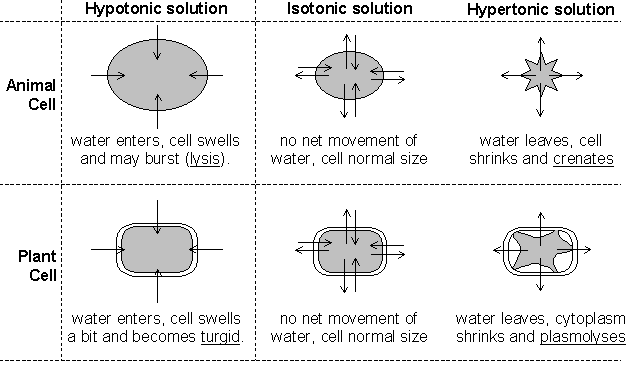
What happens when cells are place in different kinds of solutions
Plant cells placed in a hypertonic solution will undergo plasmolysis, a condition where the plasma membrane pulls away from the cell wall as the cell shrinks. The cell wall is rigid and does not shrink.
 |
The Elodea cells have been placed in a 10% NaCl solution. The contents of the cells have been reduced to the spherical structures shown.
|
 |
Normal Elodea cells
|
Animal cells placed in a hypertonic solution will undergo crenation, a condition where the cell shrivels up as it loses water. Red blood cells in a hypotonic solution will swell and burst or lyse.
Dichotomous Keying
| Dichotomous Keying |
Introduction to Dichotomous Key Maker:
The identification of biological organisms can be greatly simplified using tools such as dichotomous keys. A dichotomous key maker is an organized set of couplets of mutually exclusive characteristics of biological organisms. You simply compare the characteristics of an unknown organism against an appropriate dichotomous key. These keys will begin with general characteristics and lead to couplets indicating progressively specific characteristics. If the organism falls into one category, you go to the next indicated couplet. By following the key and making the correct choices, you should be able to identify your specimen to the indicated taxonomic level.
Couplets can be organized in several forms. The couplets can be presented using numbers (numeric) or using letters (alphabetical). The couplets can be presented together or grouped by relationships. There is no apparent uniformity in presentation for dichotomous keys.
Sample keys to some common beans used in the kitchen:
Numeric key with couplets presented together. The major advantage of this method of presentation is that both characteristics in a couple can be evaluated and compared very easily.
 |
 |
 |
|
 |
 |
||
| 1a. | Bean round | Garbanzo bean |
| 1b. | Bean elliptical or oblong | Go to 2 |
| 2a. | Bean white | White northern |
| 2b. | Bean has dark pigments | Go to 3 |
| 3a. | Bean evenly pigmented | Go to 4 |
| 3b. | Bean pigmentation mottled | Pinto bean |
| 4a. | Bean black | Black bean |
| 4b. | Bean reddish-brown | Kidney bean |
Alphabetical key with couplets grouped by relationship. This key uses the same couplet choices as the key above. The choices within the first and succeeding couplets are separated to preserve the relationships between the characteristics.
| A. | Bean elliptical or oblong | Go to B |
| B. Bean has dark pigments | Go to C | |
| C. Bean color is solid | Go to D | |
| C. Bean color is mottled | Pinto bean | |
| D. Bean is black | Black bean | |
| D. Bean is reddish-brown | Kidney bean | |
| B. Bean is white | White northern | |
| A. | Bean is round | Garbanzo bean |
Rules for Using Dichotomous Keys:
When you follow a dichotomous key, your task becomes simpler if you adhere to a few simple rules of thumb:
- Read both choices in a couplet carefully. Although the first description may seem to fit your sample, the second may apply even better.
- Keep notes telling what sequence of identification steps you took. This will allow you to double-check your work later and indicate sources of mistakes, if they have been made.
- If you are unsure of which choice to make in a couplet, follow both forks (one at a time). After working through a couple of more couplets, it may become apparent that one fork does not fit your sample at all.
- Work with more than one sample if at all possible. This will allow you to tell whether the one you are looking at is typical or atypical. This is especially true when working with plants – examine more than one leaf, branch, cone, seed, flower,…etc.
- When you have keyed out an organism, do not take your effort as the final result. Double check your identification scheme, using your notes. Find a type specimen (if available) and compare your unknown to the type specimen. If a type specimen is unavailable, find a good description of the indicated taxonomic group and see if your unknown reflects this description.
- When reading a couplet, make sure you understand all of the terms used. The best keys will have a glossary of technical terms used in the key. If a glossary is unavailable, find a good reference work for the field (textbook, biological dictionary,…etc.) to help you understand the term.
- When a measurement is indicated, make sure that you take the measurement using a calibrated scale. Do not “eyeball” it or take a guess.
Exercise 1:
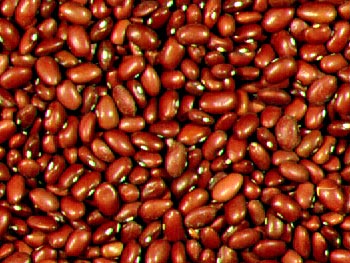
Using a container of beans, use one of the dichotomous keys above to identify the beans. Glue the beans to the card provided and label them with their common name. Indicate what steps you followed to arrive at your answer. Turn the card in to your instructor. Compare your answers to the instructor’s descriptions and type specimen.
Exercise 2:
Obtain samples of the snack chips provided. Develop a dichotomous key to identify the snacks. In your notebook, keep track of the characteristics you used to differentiate between the different snack families. What are the values of the characteristic for each snack food?
Exercise 3:
Use the dichotomous key to conifers provided below to identify conifers.
A Key to Selected North American Native and Introduced Conifers
| 01a | Leaves needle-like | Go to 02 |
| 01b | Leaves flattened and scale-like | Go to 27 |
| 02a | Leaves are in clusters | Go to 03 |
| 02b | Leaves are borne singly | Go to 15 |
| 03a | Two to five leaves in a cluster | Go to 04 Genus Pinus |
| 03b | More than five leaves in a cluster | Go to 14 |
| 04a | Leaves mostly 5 in a cluster | White Pine (Pinus strobus) |
| 04b | Leaves 2 or 3 in a cluster | Go to 05 |
| 05a | Leaves mostly 3 in a cluster | Go to 06 |
| 05b | Leaves mostly 2 in a cluster | Go to 08 |
| 06a | Leaves twisted, less than 5 inches long | Pitch Pine (Pinus rigida) |
| 06b | Leaves straight, more than 5 inches long | Go to 07 |
| 07a | Leaves 5-10 inches long, cones very thorny | Loblolly pine (Pinus taeda) |
| 07b | Leaves mostly over 10 inches long, cones unthorned | Longleaf pine (Pinus palustris) |
| 08a | Leaves mostly longer than 3 inches | Go to 09 |
| 08b | Leaves mostly shorter than 3 inches | Go to 11 |
| 09a | Leaves rigid, bark grayish | Black pine (Pinus nigra) |
| 09b | Leaves narrower than 1.6mm; bark reddish brown or brown | Go to 10 |
| 10a | Cones thornless, twigs brown | Norway pine (Pinus resinosa) |
| 10b | Cones thorny, twigs whitish | Shortleaf pine (Pinus echinata) |
| 11a | Leaves mostly wider than 1.5 mm | Go to 12 |
| 11b | Leaves mostly narrower than 1.5 mm | Go to 13 |
| 12a | Leaves mostly longer than 35 mm | Mugho pine (Pinus mugo) |
| 12b | Leaves mostly shorter than 35 mm | Jack pine (Pinus banksiana) |
| 13a |
Twigs whitened |
Virginia pine (Pinus virginiana) |
| 13b | Twigs not whitened | Scotch pine (Pinus sylvestris) |
| 14a | Leaves deciduous, clusters of 20-40 | Larch (Larix sp.) |
| 14b | Leaves persistent, stiff, and four sided | True cedar (Cedrus sp.) |
| 15a | Needles short and sharp | Giant Sequioa (Sequioadendron giganteum) |
| 15b | Needles longer than 12 mm | Go to 16 |
| 16a | Tiny pegs on twigs | Go to 17 |
| 16b | No pegs on twigs | Go to 22 |
| 17a | Pegs square, needles sharp | Go to 18 Genus Picea |
| 17b | Pegs round, needles flat and blunt | Hemlock (Tsuga sp.) |
| 18a | Leaves dark green or yellow green | Go to 19 |
| 18b | Leaves blue-green | Go to 20 |
| 19a | Branchlets droop | Norway spruce (Picea abies) |
| 19b | Branchlets do not droop | Red spruce (Picea rubens) |
| 20a | Leaves at right angles to stems | Blue spruce (Picea pungens) |
| 20b |
Leaves point forward |
Go to 21 |
| 21a | Leaves about 12 mm long, seed cones 15-32 mm in length, crown narrow and pointed | Black spruce (Picea mariana) |
| 21b | Leaves about 19 mm long, seed cones 50 mm in length, spire-like crown |
White spruce (Picea glauca) |
| 22a | Buds large and pointed | Douglas fir (Pseudotsuga sp.) |
| 22b | Buds small and rounded | Go to 23 |
| 23a | Terminal buds round and clustered | True fir (Abies sp.) |
| 23b | Terminal buds not clustered | Go to 24 |
| 24a | Needles white underneath | Go to 25 |
| 24b | Needles green underneath | Go to 26 Genus Taxus |
| 25a | Needles pointed |
Redwood (Sequoia sempervirens) |
| 25b | Needles blunt | Hemlock (Tsuga sp.) |
| 26a | Leaves 18 mm long or less with inconspicuous midrib | American Yew (Taxus canadensis) |
| 26b | Leaves 25 mm long or more with conspicuous midrib | Japanese Yew (Taxus cuspidata) |
| 27a | All leaves short and sharp | Giant Sequioa (Sequioadendron giganteum) |
| 27b | Some leaves not sharp | Go to 28 |
| 28a | Cones round | Go to 29 |
| 28b | Cones not round | Go to 31 |
| 29a | Cones soft and leathery | Juniper (Juniperus sp.) |
| 29b | Cones woody | Go to 30 |
| 30a | Cones under 12 mm in diameter | False cypress (Chamaecyparis) |
| 30b | Cones over 12 mm in diameter | Cypress (Cuppressus) |
| 31a | Cones resemble rosebuds | White cedar or arbor vitae (Thuja) |
| 31b | Cones resemble duck bills | Incense cedar (Calocedrus) |
Conifers to Identify:
 |
 |
| 1. Name: | 2. Name: |

|

|
| 3. Name: | 4. Name: |
  |

 |
| 5. Name: | 6. Name: |
  |
  |
| 7. Name: | 8. Name: |
  |
  |
| 9. Name: | 10. Name: |
  |
  |
| 11. Name: | 12. Name: |
  |
  |
| 13. Name: | 14. Name: |
  |
  |
| 15. Name: | 16. Name: |


Photos Copyright Nearctica.com
Click here for correct answers to conifer key
Egg Osmosis Sample 1 Lab
Osmosis through the Cell Membrane of an Egg

Introduction:
The cell or plasma membrane is made up of phospholipids and different types of proteins that move laterally. These include peripheral proteins, which are attached to the interior and exterior surface of the cell membrane. Integral proteins are embedded in the lipid bilayer. Attached to these integral proteins are carbohydrate chains. These carbohydrates may hold adjoining cells together, or act as sites where viruses or chemical messengers such as hormones can attach. Cell membranes are selectively permeable. They allow some substances to pass through, but not others. Small molecules that are usually nonpolar, such as oxygen, water, and carbon dioxide, easily move through the lipid bilayer. Larger molecules, such as glucose, the food for all living things, must seek aid from the carrier proteins in a process called facilitated diffusion. Facilitated diffusion is a process used for molecules that cannot diffuse rapidly through cell membranes. Integral proteins are used by calcium, potassium, and sodium ions to move through the cell membrane. The muscles and nerves use these ions.
Diffusion is the movement of molecules from an area of higher concentration to an area of lower concentration. This difference in the concentration of molecules across a space is called a concentration gradient. Diffusion is a type of passive transport, meaning it does not require energy input by the cell. This type of transport and osmosis are the two processes used in this lab. Osmosis is the process by which water molecules diffuse across a cell membrane from an area of higher concentration to an area of lower concentration. When the concentration of the solute is higher outside of the cell, it is known as a hypertonic solution. When the concentration of the solute is lower outside of the cell, it is known as a hypotonic solution.
Hypothesis:
The substance, syrup, which has a higher solute concentration than the interior of the eggs, will cause water to leave the eggs’ membrane; the other substance, distilled water, which has a lower solute concentration than the eggs’ interior, will cause liquid to enter the eggs’ membrane.
Materials:
The materials necessary for this lab are: two fresh eggs in their shells, a felt tip marker, 200mL graduated cylinder, five jars, clear Saran wrap, white vinegar, clear sugar syrup (Karo), distilled water, tap water, pencil, paper, eraser, computer, electronic scale, and a plastic tray.
Methods:
Day One: On day one, label the five jars, with the felt tip marker: one labeled vinegar, two labeled syrup, and two labeled distilled water. Also put the group number on each jar. Find the mass of each egg and record this information in the data table. Place the two eggs in the jar labeled vinegar. Add vinegar until both eggs are submerged by it. Cover the jar with the clear Saran wrap. Place the jar on the plastic tray and allow to set for 24 hours.
Day Two: On day two, observe what has happened to your eggs. Record this in a data table. Now that the eggs’ shells are dissolved, gently remove the eggs from the vinegar. Rinse each egg with tap water. Pat the eggs dry with paper towels and mass them separately on the electronic balance. Record this in the data table. Place the eggs in the jars labeled syrup. Add syrup to each jar (labeled egg 1 or egg 2) until the eggs are submerged in syrup. Loosely cover each jar with Saran wrap. Place the jars on the tray and allow them to soak for 24 hours.
Day Three: On day three, observe what has happened to the eggs and record this information in the data table. Carefully remove the eggs from the syrup and rinse them with tap water. Pat dry with paper towels. Using the electronic balance, find the mass of each egg separately and record these masses in the data table. Place the eggs in the jars labeled distilled water (labeled egg 1 and egg 2). Add distilled water to each jar until the eggs are covered. Cover the jars with the Saran wrap and allow them to sit on the tray for 24 hours.
Day Four: On day four, remove the eggs from the jars and record the eggs’ appearance. Mass each egg on the electronic balance. Record this in the data table. Dispose of the eggs in the container provided by the teacher.
Results:
Egg 1 Data Table
| Substance egg submerged in | Egg’s mass before placed in substance | Egg’s mass after removed from substance | Observations of egg before placed in solution | Observations of egg after removed from substance |
| Vinegar | 59.2 g | 86.0 g | The egg’s shell is intact and is included in the first mass. | The egg’s shell dissolved and wasn’t included in the 2nd mass. |
| Syrup | 86.0 g | 53.2 g | The egg is swollen and soft, yet firm to touch. | The liquid inside the egg diffused into the syrup. |
| Distilled Water | 53.2 g | 86.5 g | The egg has lost some of its firmness. | The water diffused into the egg, increasing the egg’s mass. |
Egg 2 Data Table
| Substance egg submerged in | Egg’s mass before place in substance | Egg’s mass after removed from substance | Observations of egg before placed in solution | Observations of egg after removed from substance |
| Vinegar | 58.8 g | 85.6 g | The egg’s shell is intact and is included in the first mass. | The egg’s shell is mostly dissolved and so wasn’t included in 2nd mass. |
| Syrup | 85.6 g | 52.2 g | The egg is rough to touch and feels rather sturdy. | The liquid inside the egg diffused into the syrup. |
| Distilled Water | 52.2 g | 88.9 g | The egg feels more fragile and lighter in weight. | The water diffused into the egg increasing the egg’s mass. |
| Egg in Hypotonic Solution of Vinegar & Plasmolyzed Egg in Distilled Water | Egg in Hypertonic Solution of Syrup |
 |
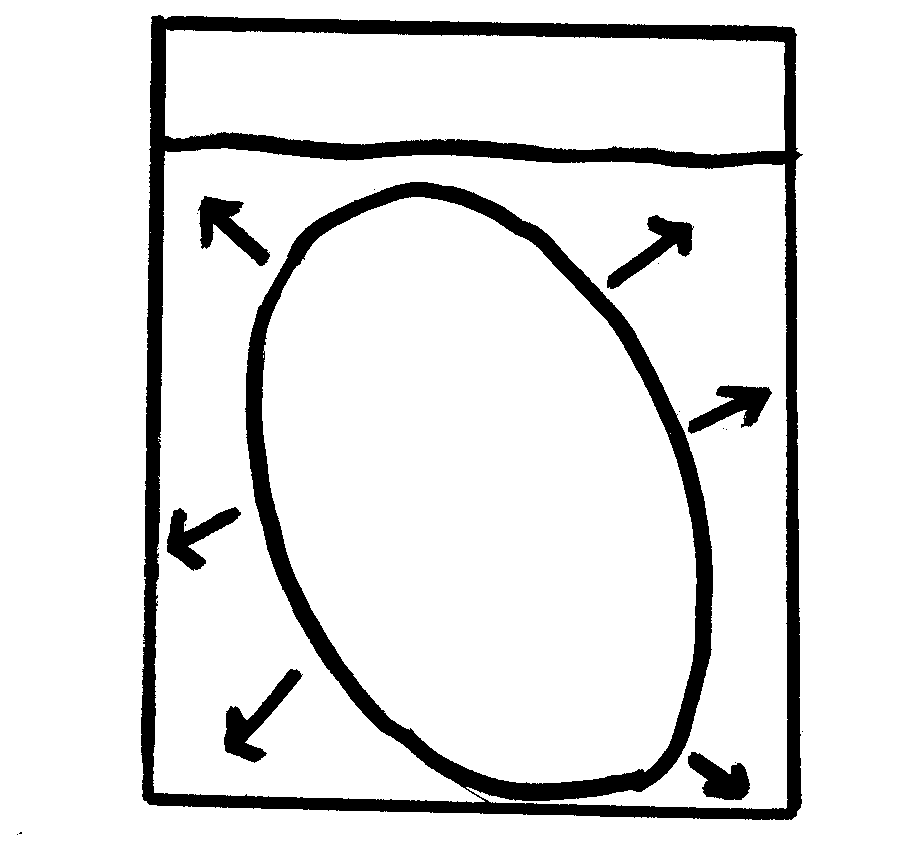 |
1. When the egg was place in the water, in which direction did the water molecules move? The water moved into the eggs from the surrounding environment.
2. On what evidence do you base this? The eggs’ masses had increased from the time they were placed in the water to when the eggs were removed.
3. How do you explain the volume of liquid remaining when the egg was removed from the syrup? The volume of the liquid remaining when the egg was removed from the syrup must have increased because the eggs’ masses had decreased. The liquid within the eggs left the eggs and diffused into the surrounding syrup.
4. When the egg was place in the water after being removed from the syrup, in which direction did the water move? The water moved into the eggs.
Error Analysis:
Several errors may have occurred during this lab. When finding the eggs’ masses, on each occasion, an error may have occurred. Mistakes may have been made when recording these masses on the data table. Some of the eggs’ shell may have been left on the eggs’ membranes and changed the outcome of this lab. When the eggs were rinsed, after being placed in the vinegar and syrup, a small amount of water could have entered through the membranes of the eggs, effecting their masses. These are just a few of the errors that may have taken place throughout the lab.
Discussion and Conclusion:
The hypothesis was correct. When the eggs were placed in the syrup, their masses decreased greatly. This shows that the interior of the eggs must have had a lower solute concentration than their surrounding environment of syrup. The water within the eggs left through the membrane and diffused into the syrup, decreasing its solute concentration. When the eggs were placed in the distilled water, their masses greatly increased. This shows that the interior of the eggs must have had a higher solute concentration than their surrounding environment of distilled water. The distilled water diffused into the eggs’ membrane, decreasing the interior of the eggs’ solute concentration.
 |
Back |