Prefix & Suffix List

    Scientific Prefixes & Suffixes
           Notebook Copy        


Element
Definition
Element
Definition
a-
ab-
ad-
aero-
alveus
arthron-
atrium-
auto-
bacterio-
bi-
bio-
carnis-,carn-
chele-
chloro-
chroma-
-cide
con-
cytis-
-cyte, cyto-
dermis-, derm-
di-
ecto-
endo-
epi-
eu-
exo-
feto-
gastro-
-gen
geo-
gymno-
halo-
hemato-
hemi-
herb-
hetero-
histo-
homo-
hydro-
hyper-
hypo-
inter-
intra-
iso-
-itis
karyo-
leuco-
locus
-logy
lysis
macro-
maxilla
mensis
mesos-
meta-
micro-
mono-
morph-
without
away from
near
air
cavity
joint
entrance room
self
bacteria
two
life
meat
claw
green
color
killer of
with
pouch
cell
skin
two
on the outside
inner, inside
upon
true
outside of
fetus
stomach
producing
earth
naked
salt
blood
half
plant
other
tissue
same, like
water
over
under
between
within
equal
infection
nucleus
white
place
study of
to loosen, break
large
jaw
month
middle
between
small
one
form
multi-
mut-
myco-
neco-
neur-
nomen-
niga-
oculo-
oligo-
-oma
omni-
oo, ovum
osteo-
paleo-
ped, pod
peri-
pestis
phaeo-
phage-
-phore
photo-
-phyll
-phyte, phyto-
pino-
plankto-
poly-
pseudo-
primordis-
pro-
renes-
reptilis-
rhiza, rhizo-
rodere
sacchrum
sapros-
-scopy
soma-
sonus-
sperma-
spirare
-stasis
taxis
telo-
thallus
therm-
thrombos
trans-
tri-
tricho-
troph-
umbilicus
uni-
vasculum
vor-
xero-
zoo-, zoa-
zygon-
many
to change
fungi
corpse
nerve
name
black
eye
few
tumor
all
egg
bone
old
foot
around
plague
brown
to eat
bearer
light
leaf
plant
to drink
drifting
many
false
original
first
kidney
crawling
root
to gnaw
sugar
rotten
observation
body
sound
seed
breathe
position
arrangement
end
green shoot
heat
clot
across
three
hair
feed
navel
one
vessel
to eat, devour
dry
animal
yoke


BACK

Pterosaur Reconstruction Bi


Pterosaur Reconstruction


Introduction:

A common sight during the Cretaceous period was the soaring through the air of a large fur-covered creature called the pterosaur. Pterosaur means flying lizard. Wings of some  pterosaurs were longer than the wings of a small plane. This creature lived on cliffs at the edge of lagoons and would sail from its nest to catch prey.  The bones of one pterosaur, Scaphognathus crassirostris, were discovered in 1826 by the German scientist, August Goldfuss.  The fossilized bones were located in a limestone quarry and were unbroken.  Scaphognathus crassirostris was approximately the size of a large bat with a broad jaw and short tail.

Objective:

Students will reconstruct the skeleton of S. crassirostris and draw conclusions about its method of movement, feeding habits, and other adaptations.

Materials:

Scissors, tape, construction paper, glue, metric ruler, pencil

                     
Fossil Cast of S. crassirostris                                    


Procedure:

  1. Use the drawings of S. crassirostris bones to cut out and reassemble a model of the flying reptile.
  2. Glue the model bones to a sheet of construction paper being sure to center the model and keep all bones on the paper.
  3. Use the metric ruler to measure the complete wingspan of the organism (tip to opposite tip).
  4. Complete the characteristics in data table 1.

Data:

Table 1


Characteristics of S. crassirostris
Wingspan (centimeters)?
Jaw Shape?
Teeth adapted for?
Arms & hands adapted for?
Number of bones in lower arm?
Number of bones making up skull?
Number of fingers?
Finger adaptations?


Questions:

  1. The bones of the lower arm and lower leg are fused (joined together). How might this be an adaptation for flight?
  2. What would be the main function of the long bones of S. crassirostris little finger?
  3. Noting the shape of the teeth and where S. crassirostris lived, what did it probably eat?
  4. Name 3 characteristics that adapted S. crassirostris to flight.
  5. The bones of S. crassirostris were hollow. How was this an adaptation?
  6. The flap of skin that made up the wing of S. crassirostris was very delicate and could tear easily. How could this cause a problem with S. crassirostris competing with other gliding reptiles?


Plant Structure Study Guide

PLANT STRUCTURE AND FUNCTION

1. Cells that support the non-growing parts of plants are called ____________________.

2. Sugars are transported in vascular plants through what tissue?

3. The tissue in a vascular plant that is used to transport water and minerals is __________.
4. Which plant cells are the most abundant and least structurally specialized?
5. Long, narrow cells of xylem with thin separations between them are known as _______.
6. Short, wide cells of xylem with NO end walls function in water transport when the cells are __________.

7. Cells of phloem that help the sieve tube elements to function are called _________________.

8. Growth that makes a plant stem thicker is known as ____________________  ____________.

9. In the meristem regions of plants you would expect to find _____________________ cells.

10. Collenchyma cells would help support which parts of a celery plant?

11. The epidermis on the stems and leaves of young plants prevents ______________________.

12. The vascular cylinder of a root is surrounded by the __________________________.

13.  A plant absorbs water and minerals through  _____________________.

14.  Which type of plant cells function in metabolic activities such as photosynthesis, storage, and healing?

15. Grasses usually have which type of roots?

16. In stems, vascular tissue is arranged to form ________________________.

17. What are the pores in the epidermis of leaves that control water evaporation called?

18.Primary growth in roots results in _________________________ of roots, and secondary growth results in _________________________ of roots.

19. What is the process of the evaporation of water from the leaves of a plant called?

20. The movement of sugars in a plant can be explained by the __________-
_____________  _____________.

21. What causes water molecules to stick together and pull each other up a plant stem?

22. Sugars made in photosynthesis in transported by being pumped into the ___________________________   _______________________________.

23. The function of the endodermis in roots is to _____________________ movement of substances into the ________________________  ___________________ of the root.

24. _______________________________ tissue forms the skin of a plant.

25.  ______________________________ tissue consists of everything that is Not dermal or vascular tissue.

26. The growing regions of plants are called ________________________________________.

27. Meristematic tissue is the only type of plant tissue that produces new cells by _______________.

28. The elongation of stems and roots is called _____________  _______________.

29. Most seed plants have Three basic organs, _________________, ___________________ and
_______________________________.

30. Lateral roots form from the _______________________ inside the root, while lateral stems form from _____________________________ on the surface of stems.

31. Plant cells that are even, thick-walled, rigid cells _____________________________.

32.  The name of the meristem between xylem and phloem  _______________________.

33. The roots that branch off a primary root ________________________  _________________.

34. Plant cells that are irregular, thick-walled cells ______________________________.

35. A root system with an enlarged primary root  _________________________.

36.  Type of meristems found only in monocots  _________________________.

37. Type of root system with many branch roots  _______________________.

38. Type of plants cells that are thin-walled cells that can be cube-shaped or elongated _______________.

39. In Dicots primary growth occurs in _______________________  ________________________ and in monocots it occurs in _______________________ ______________________ and may also occur in _________________________  _________________________.

40. Primary growth results in the ________________________ of plant structures, and secondary growth results in the _____________________ of plant structures.

41. Monocots stems lack ____________________  ____________________ and therefore cannot produce _________________________  growth.

42. Annual rings in woody plants form as a result of the production of _____________________  ___________________, which contain cells of different sizes that were produced during different times of the growing season.

43. Water is transported from the roots to the leaves of a plant by the process of ___________.

Short Answer:
Answer the questions below as completely and as thoroughly as possible. Answer the question in essay
form (not outline form), using complete sentences. You may use diagrams to supplement your answers.

 What are the TWO different types of vascular tissue in plants?  Briefly describe each kind.

2. How are carbohydrates transported throughout a plant? (Explain the pressure-flow hypothesis).

3. Describe tracheids and explain their function.

4. What are the lateral meristems of plants, and what is their function?

5. What is the difference between primary growth and secondary growth?

6. Explain the main functions of stems, roots and leaves.

7. What adaptations of root maximize water and mineral absorption?

8. Identify the structures that a water molecule would move through on its way from the soil into the xylem of a plant root.

9. What is the relationship between stomata and guard cells? Describe how they function and Describe their role in the activities conducted by leaves.

10. What is transpiration?  How is it related to the movement of water in plants?

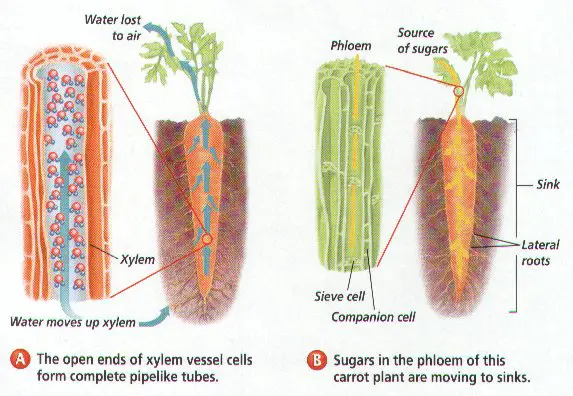
11. What is the relationship between the Source and the Sink in the transport of sugars?

12. What are the Four types of tissue found in plants?

13. What are the Three basic types of plant cells?  What are the functions of each?

14. Explain the cohesion-tension theory.

15. List five differences and five similarities between the structure of roots and the structure of stems.

 

Preap Biology Study Guides


PreAP Biology Chapter Reviews
All Materials © Cmassengale


Plant Taxonomy


Plant Origin & Classification
All Materials © Cmassengale


Overview of Plants:

  • All plants are multicellular & contain chlorophyll inside of chloroplasts
  • Plants (also called autotrophs or producers) trap energy from the sun by photosynthesis & store it in organic compounds
  • Heterotrophs or consumers get their energy directly or indirectly from plants
  • Plants also release oxygen needed by consumers
  • All plants are multicellular, eukaryotic organisms that reproduce sexually
  • Many medicines are produced by plants
  • Plants are very diverse & may be terrestrial or aquatic
  • Vary in size from 1 mm in width to more than 328 feet
  • May live a few weeks or some over 5000 years
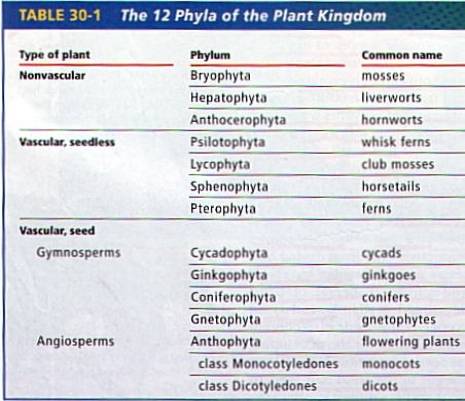
  • Kingdom Plantae is divided into 12 phyla or Divisions
  • More than 270,000 plant species identified, but new species still unidentified in tropical rain forests

Terrestrial Adaptations:

  • Plants probably evolved from green algae

  • Both algae & plants have chlorophyll a & b, have cell walls made of cellulose, and store energy as starch
  • First land plants had to develop adaptations to scarcity of water & climate changes (air temperature changes more rapidly than water temperature)
  • Moving onto land allowed more sunlight, nutrients,  & CO2 for photosynthesis
  • A support adaptation included a compound called lignin (a hard substance that strengthens cell walls so they can support additional weight)
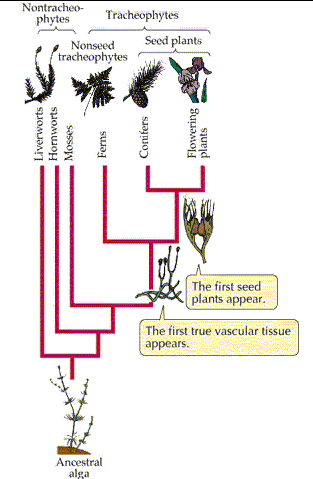
  • The origin of vascular tissue (specialized tissue for carrying food , water, & minerals) was an evolutionary breakthrough in the colonization of land
  • Plants with vascular tissue are known as Tracheophytes
  • Two types of vascular tissue developed — xylem & phloem

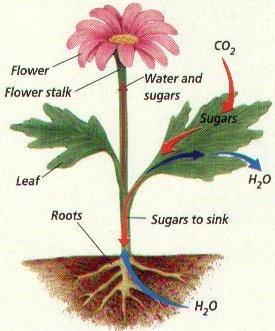
  • Xylem carries water & inorganic nutrients from the roots to the stem & leaves
  • Phloem carries carbohydrates made by the plants to wherever they’re needed or stored in the plant


Copyright Holt, Rinehart, & Winston

  • Some plants formed woody tissue from xylem for extra support, while others kept a flexible, non-woody stem (herbaceous plants)
  • Greater amount of water lost by evaporation (transpiration) on land
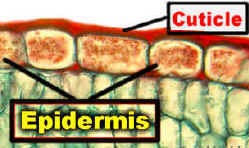
  • A waxy covering or cuticle developed on all plant parts exposed to air which slowed transpiration (water loss)

  • Gases (carbon dioxide & oxygen) had to be able to move into & out of the plant
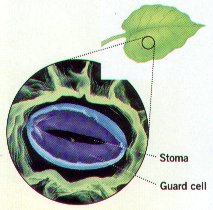
  • Openings in the cuticle called stomata allowed movement of gases
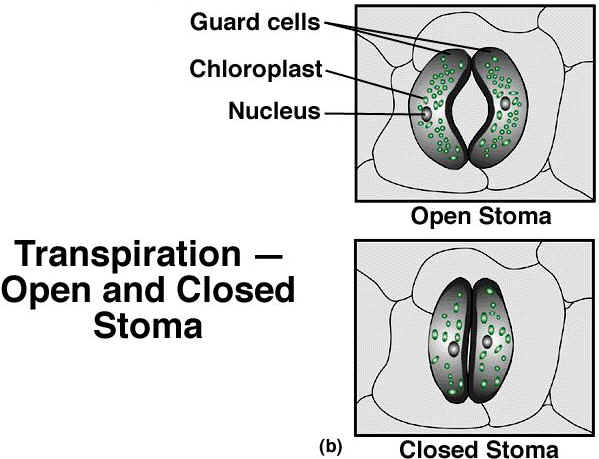
  • Two guard cells on each side of a stoma helped open & close the opening


Copyright Holt, Rinehart, & Winston

  • When guard cells lose water & shrink, the stoma closes (prevents water loss in the hotter times of the day)
  • When guard cells swell with water, the stoma opens for gas exchange 


copyright McGraw-Hill

  • Other structural adaptations to land included roots for absorption of water and minerals leaves for gas exchange and photosynthesis

Reproductive Adaptations:

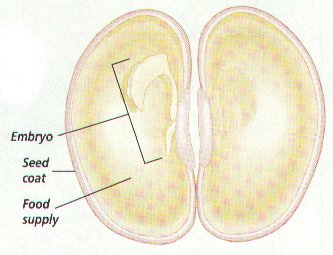
  • To be successful on land, plants had to develop protective seeds for their embryos with stored food or endoderm


Copyright Holt, Rinehart, & Winston

  • Seeds are better at dispersal than spores

Classification of Plants:

  • They’re are 12 Divisions of plants divided into two main groups based on the presence of vascular tissue
  • Nonvascular plants lack vascular tissue and do not have true roots, stems, or leaves (mosses, liverworts, & hornworts)
  • Most plants have vascular tissue with true roots, stems, & leaves, but may or may not produce seeds


Copyright Holt, Rinehart, & Winston

  • Ferns, horsetails, & club mosses are seedless vascular plants that reproduce by spores
  • Plants that reproduce by seeds are divided into 2 groups — gymnosperms & angiosperms
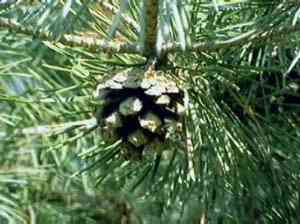
  • Gymnosperms have “naked” seeds usually protected by cones & includes pines, cedars, spruce, fir …

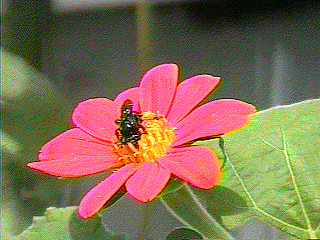
  • Angiosperms are flowering plants whose seeds are produced & protected within the fruit

Plant Life Cycles:

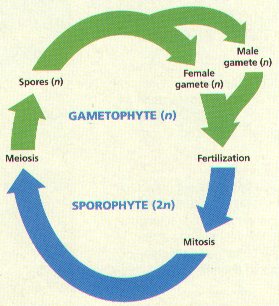
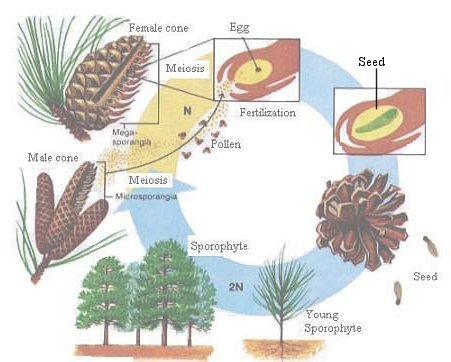
  • Plants have 2 phases in their life cycle called alternation of generation
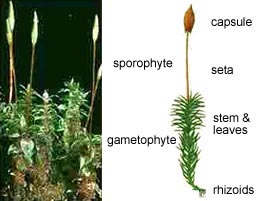
  • The haploid gametophyte stage produces eggs & sperm, while the diploid sporophyte stage produces spores 


Copyright Holt, Rinehart, & Winston

  • Plant gametes are not directly produced by meiosis but rather by mitosis from the haploid multicellular stage
  • Meiosis instead produced specialized haploid cells called spores
  • These spores are released by most Seedless plants, but are retained by Seed plants
  • In nonvascular plants, the Gametophyte stage is dominant (mosses)

  • In vascular plants, the Sporophyte stage is dominant
  • Seedless vascular plants usually have a separate, small gametophyte plant
  • Sexual reproduction in plants ensures that there will be genetic recombination

Seed-Bearing, Vascular Plants:

  • The development of seeds with their protected embryo & stored food supply increased the reproductive success of seed plants
  • Seeds remain dormant or inactive when conditions aren’t favorable
  • Moisture & warmer temperature cause seeds to germinate or sprout
  • Young plant embryos use their endosperm as energy for early growth

  • Seeds plants are divided into 2 groups based on  the type of seed they produce

Gymnosperms:

  • Gymnosperms  produce seeds that not protected within an ovary
  • The seeds are exposed on the upper surfaces of a spore producing structure (e.g. cone scales in conifers)
  • Called “naked” seeds
  • Gymnosperms do not produce flowers or fruit
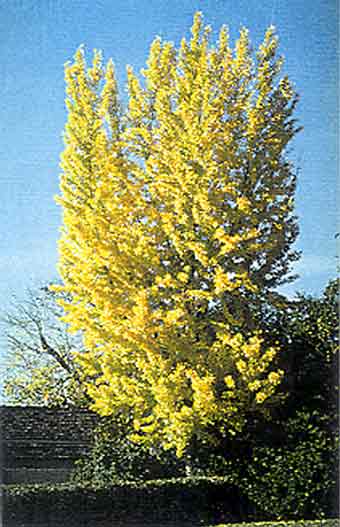
  • The four phyla of gymnosperms alive today include the cycads (Cycadophyta), the ginkgo (Gingkophyta), the gnetophytes (Gnetophyta), and the conifers (Coniferophyta)


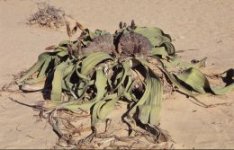
Cycad Welwitshcia
(gnetophyte)
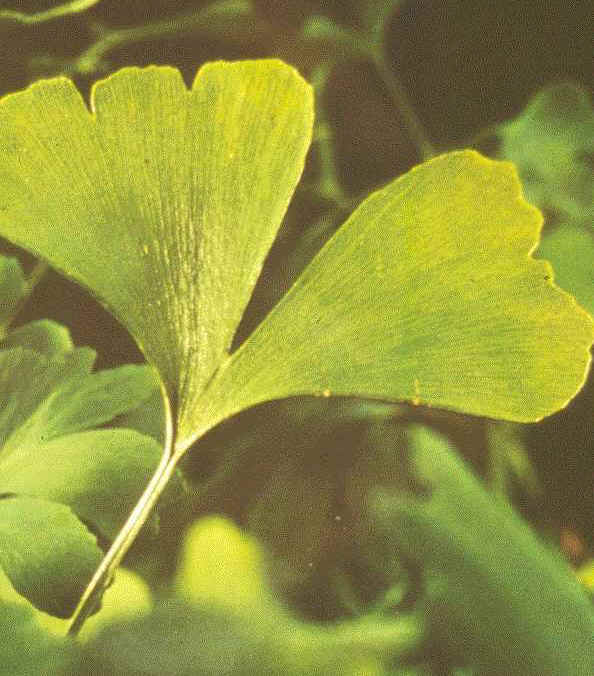
Gingko Fir Tree
(Conifer)


  • All gymnosperms have vascular tissue to conduct food, water & minerals and produce woody tissue
  • Two types of cones are made by gymnosperms — pollen cones & seed cones
  • Pollen cones are small & produce pollen containing the male gametophyte which is spread by wind or insects to the female gametophyte
  • Seed cones are larger and contain eggs on scales that form seeds when they are fertilized

Division Cycadophyta:

  • Dominated earth when dinosaurs lived, but only about 100 species are alive today & are endangered
  • Most are slow growing, palm-like plants found mostly in tropical areas
  • All cycads bear cones, which are made up of seed bearing leaves (sporophylls)
  • They have large compound leaves, a short thick trunk, and are dioecious (either male or female plant)
  • Cycads bear naked seeds


Zamia (native to Georgia)

Division Gingkophyta:

  • Ginkgoes were common in the Mesozoic period,  but today only one species of ginkgo remains (Ginkgo biloba)
  • Gingko trees have distinctive fan shaped leaves & are dioecious (each tree is either male or female but not both)
  • Commonly planted as an ornamental tree
  • Gingkoes are not native to North America (they are found growing wild only in China)
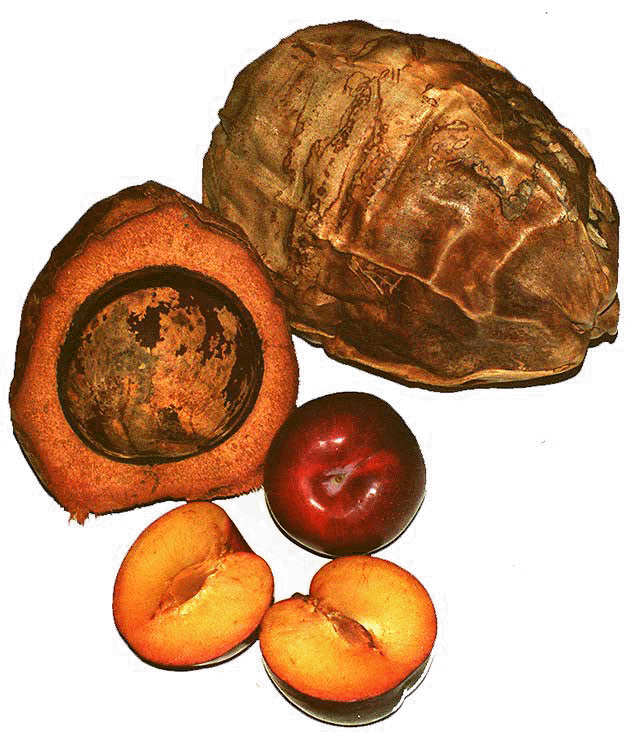
  • Deciduous tree (loses leaves in fall) with plum-shaped, fleshy seeds with a foul odor

Division Coniferophyta:

  • Largest group of gymnosperms
  • Called conifers 
  • Found in abundance in temperate zones
  • Include cedars, pines, spruce, fir, juniper, & bald cypress trees
  • Their leaves are characteristically needle-like, but may be scale-like
  • Usually trees or shrubs
  • Evergreens (don’t lose their leaves in the fall)
  • Almost all conifers are monoecious, producing both male and female cones on the same tree
  • Female cones are larger than male cones with woody scales containing the seeds


Pollen Cone Seed Cone


  • Conifers are dependent on the wind for pollination
  • Pollen grain has air bladders to help it stay aloft in the wind
  • Important source of wood, paper, turpentine, ornamental plants, Christmas trees
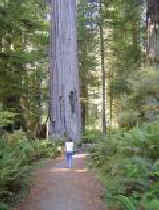
  • Redwoods and Giant Sequoia trees are the largest living organism on earth
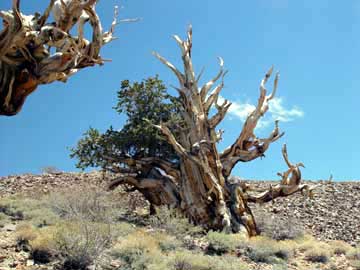
  • Bristlecone pines are the oldest living organism on earth


Redwood Tree Bristlecone pine Tree


Division Gnetophyta:

  • The phylum Gnetophyta consists of 3 genera that are not very closely related
  • Ephedra is the largest genus and consists of plants that resemble horsetails & grow in deserts
  • Welwitshcia is found only in the desert area of south western Africa and has 2 single, long leaves


Welwitshcia Ephedra


Division Anthophyta (Angiosperms):

  • Flowering plants are the most successful group of plants today
  • They live in almost all possible habitats
  • All flowering plants produce both flowers & fruit

  • Fruit is a ripened ovary with its seeds (acorns, apples, dandelion seeds, etc)

  • Flowering plants co-evolved with their insect pollinators
  • May be herbaceous (grasses & snapdragons or woody (oaks & grape vines)
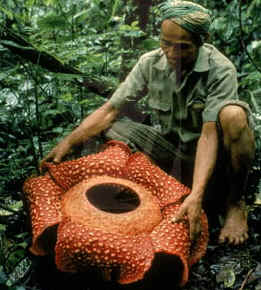
  • Rafflesia, the stinking corpse lily, is the world’s largest flower

  •  Flowering plants have diverse lifestyles (Sundew is carnivorous on insects; Spanish moss is an epiphyte living on another host plant; some orchids are saprophytes living on soil fungi)
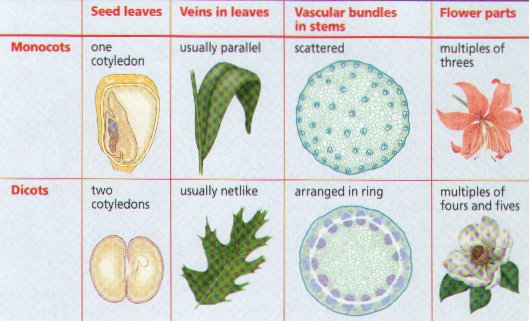
  • Subdivided into 2 classes based on the number of seed leaves or cotyledons in the plant embryo — Monocotyledons & Dicotyledons
  • Monocots have a single seed leaf, leaves with parallel venation, vascular tissue scattered in bundles throughout the stem, and flower parts in 3’s or multiples of 3

  • Dicots have a 2 seed leaf, leaves with net-veined venation, vascular tissue in rings in the stem, and flower parts in 4’s or 5’s multiples of 4 or 5

  • Monocots are usually herbaceous, while dicots often produce wood

Back