If you type answers onto this page, they won’t be saved so be sure to PRINT this page! Answer sheet to download.
Exploring Protists
Domain Eukarya; Kingdom Protista
There are many types of protists, but organisms in this kingdom only have a few things in common:
They are eukaryotes – organisms that have cells with a nucleus and membrane-bound organelles.
They typically live in aquatic or moist environments.
Most protists are unicellular (made of only one cell) but they may live in colonies.
But there are some protists are are multicellular (containing more than one cell)
1. Are protists prokaryotes or eukaryotes?
2. What is a eukaryote?
3. What type of environment would you typically find protists living?
4. Are all protists unicellular? yes or no
5. What are unicellular protists that live together in clusters called?
Obtaining Food / Nutrition / Energy
Protists have a few different methods of obtaining nutrition (food):
Some contain chloroplasts (green pigments) like plants, and are autotrophs. Autotrophs can use photosynthesis to make their own food, for example Algae.
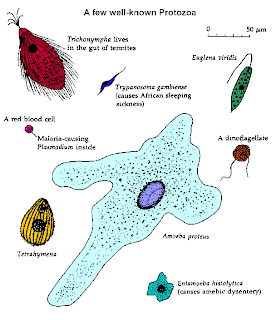
Then there are others that are heterotrophs and obtain their food by absorbing it from their surroundings, for example Paramecium.
But there are some that can do both autotrophic and heterotrophic methods of obtaining food, for example Euglena.
6. How do the heterotroph protists obtain their food?
7. How do the autotroph protists get their food? Name the process.
8. What is an example of a protist that can do both autotrophic and heterotrophic methods of obtaining food?
9. What is an example of a protist that absorbs their food?
10. What is an example of a protist that makes their own food?
Classifying Protists
Protists are classified by how they obtain food. Protists are organized into three main groups:
20. What is an example of a protozoa that uses a flagella for movement?
21. What type of protist phylum uses cilia?
Plant/Algal – Like Protists
Plant/Algal-like protists are eukaryotes that are similar to plants. Scientists classify these protists by the color of their pigments.
They are autotrophic and use chlorophyll and other pigments to harvest and use energy from sunlight. They produce oxygen for our environment.
They are not considered plants because they do not have true roots, stems or leaves and most have flagella for movement at some time in their life cycles.
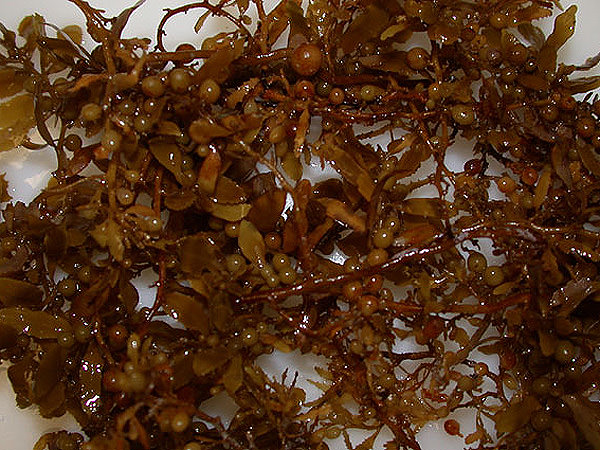
The Giant Kelp or seaweed are also in this group of algae.
Green Algae
Brown Algae
Red Algae
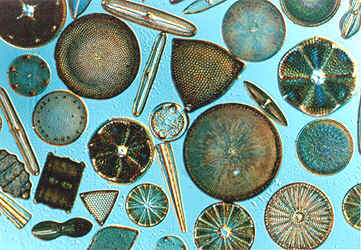
Diatoms
Dinoflagellates
Golden Algae
Euglena
22. What are plant/algal-like protists similar to?
23. How are they classified?
24. How do they obtain food/energy? autotroph or heterotroph?
25. What do they do for the environment?
26. Why are they not plants?
27. Why are diatoms and dinoflagellates so important? (Use the web to research this question)
28. Giant kelp are called what?
29. Red algae produce what substance used as a culture media in lab? (Use the web to research this question)
Fungal – Like Protists
Fungal-like protists are multicellular eukaryotes that are absorptive heterotrophs.
The job of fungal-like protists are decomposers breaking down dead organic matter. They improve the quality of dirt by putting nutrients back into the ground.
They are most commonly known as the slime molds or water molds. Do not confuse these with the mold you see growing on food or bread.
30. Are fungal-like protists unicellular OR multicellular?
31. How do they obtain their food?
32. What is the job of the fungal-like protists?
33. Give two examples of a fungal-like protist.
Protists – Review
Click on the box you choose for the correct answer for each question.
Define the following terms using your prefix-suffix list. Underline the prefix &/or suffix in each biological term.
Example: THERMOMETER – therm means heat & meter means measure of so a thermometer is an instrument used to measure heat.
1. Biology
2. Osteocyte
3. Dermatitis
4. Epidermis
5. Hematology
6. Herbicide
7. Neuritis
8. Protozoa
9. Carnivore
10. Polysaccharide
11. Hypertension
12. Hypodermic
13. Macronucleus
14. Pseudopod
15. Intracellular
Using your prefix-suffix list, write the biological term for each of the following. Example: A bacteria killer – cide means killer so the term is bactericide.
16. White cell
17. Outside skeleton
18. Middle layer of the leaf
19. Outside of the cell
20. Study of animals
21. Study of form
22. A one-celled organism
23. A term describing an organism made up of many cells
Heterotrophs that ingest small food particles & digest it inside food vacuoles containing digestive enzymes
Classified by the way they move (cilia, flagella, pseudopodia…)
Microscopic in size
65,000 identified species with almost half extinct
Found in freshwater, marine, and moist terrestrial habitats
Make up part of the zooplankton & serve as food for animals in marine & freshwater systems
First seen by Leeuwenhoek in 1675
Many species are free living
Some species are parasitic living in the bloodstream of their host & cause malaria, amebic dysentery, or giardiasis
Many serve as food for other organisms in aquatic habitats; called zooplankton
Reproduction:
All reproduce asexually by binary fission (single protozoan divides into two individuals)
Some species reproduce by multiple fission producing more than two individuals
Some species reproduce sexually by conjugation (opposite mating strains join & exchange genetic material)
Adaptations:
Eyespots in some protozoans can detect changes in light
Many can form harden covering called cyst when conditions become unfavorable (no water, pH or temperature changes, nutrient deficiency, decreased oxygen supplies…)
Metabolic activity of protozoans resumes when conditions become favorable again
Some protozoans can detect & avoid obstacles and harmful chemicals in their environment
Freshwater protozoa have contractile vacuoles to pump out excess water
Classification:
Divided into 4 phyla based on their method of movement — Sarcodina, Ciliophora, Zoomastigina, & Sporozoa
Found in the kingdom Protista along with algae, slime molds, & water molds
Sarcodinians move by extending their cytoplasm or pseudopodia (fingerlike projections of the cytoplasm)
Zooflagellates move by whip like flagella
Ciliophorans or ciliates move by hair like cilia move
Sporozoans are nonmotile
Phylum
Common Name
Locomotion
Type of Nutrition
Examples
Sarcodina
sarcodines
pseudopodia
heterotrophic;
some parasitic
Amoeba
Radiolaria
Naegleria
Ciliophora
ciliates
cilia
heterotrophic;
some parasitic
Paramecium
Tetrahymena
Balantidium
Zoomastigina
zooflagellates
flagella
heterotrophic;
some parasitic
Trypanosoma
Leishmania
Giardia
Trichonympha
Sporozoa
sporozoans
(None in Adults)
heterotrophic;
some parasitic
Plasmodium
Toxoplasma
Protozoan Evolution:
First eukaryotic organism thought to have evolved about 1.5 billion years ago
Protozoans possible evolved from the 1st eukaryotes by Endosymbiosis
Endosymbiosis – process where one prokaryote lives inside another becoming dependent upon each other
Phylum Sarcodina:
Includes hundreds of species of amebas
Found in freshwater, marine, & moist soil habitats
Usually reproduce asexually
Their cytoplasm consists of clear, outer ectoplasm and granular, inner endoplasm
Move by extending cytoplasm (cytoplasmic streaming)
Cytoplasm extensions are called “false foot” or pseudopods
Pseudopods form when the inner cytoplasm or endoplasm pushes the outer cytoplasm or ectoplasm forward to make a blunt, armlike extension
Ameba move by cytoplasmic streaming to produce pseudopods; process called ameboid movement
Sarcodines also use their pseudopods for feeding by surrounding & engulfing food particles & other protists; called phagocytosis
Food is surrounded by a pseudopod & then this part of the cell membrane pinches together forming a food vacuole; called endocytosis
Cytoplasmic enzymes enter the food vacuole & digest the food
Undigested food & wastes leave by exocytosis
Most Sarcodinians have contractile vacuoles to pump out excess water
Oxygen & carbon dioxide diffuse through the cell membrane
Sarcodinians may form hard, protective, inactive cysts when conditions become unfavorable (drought, lack of nutrients, heat…)
React to stimuli such as light
Some Sarcodinians have hard shells called the test made of silica or calcium carbonate
Radiolarians found in warm, marine waters have a test made of silica & have sticky pseudopodia to trap food
Marine Foraminiferans have a test made of calcium carbonate with holes through which pseudopodia extend
Foraminiferan tests build up and form limestone or chalk (e.g. White Cliffs of Dover)
Important food source in marine habitats
Entameba histolytica cysts in untreated water supplies cause amebic dysentery which can be fatal
Phylum Ciliophora:
Called ciliates because they move by short, hairlike cilia lining the cell membrane
Cilia may be modified into teeth, paddles, or feet
Largest group of protozoans
Most found in freshwater, but some are marine
Called plankton & serve as a food source
Form protective cysts to survive unfavorable conditions
Members include the Paramecium, Vorticella, & Stentor
Have 2 types of nuclei — smaller micronuclei & larger macronuclei
Macronucleus controls asexual reproduction by mitosis
Can reproduce sexually by conjugation (two paramecia join together & exchange DNA)
Gases diffuse across cell membrane
Stentor:
Trumpet shaped protozoan with cilia around the top
Attaches to feed & then detaches to swim around
Vorticella:
Cup shaped protozoan with cilia at the top
Has a coiled stalk to raise & lower the organism
Can attach to surfaces
Paramecium caudatum:
Slipper shaped protozoan found in freshwater
Clear, elastic covering of cell membrane called pellicle
Pellicle made of protein for protection
Use cilia to swim & obtain food (algae & bacteria)
Have 2 contractile vacuoles to pump out excess water
Cilia sweep food into oral groove where mouth located at the bottom
Food enters short tube called gullet into food vacuoles where it’s digested
Wastes leave through anal pore
Have trichocysts (tiny, toxic darts to help capture prey or anchor to a surface)
Respond to light & learn by trial & error
Reproduce asexually by mitosis & sexually by conjugation
Phylum Zoomastigina:
Called Zooflagellates because have one or more whiplike flagella to move
Flagella made of bundles of microtubules
May be freshwater or marine
Some are parasites such as Trypanosoma that destroy red blood cells & causes fatal African sleeping sickness
without
away from
near
air
cavity
joint
entrance room
self
bacteria
two
life
meat
claw
green
color
killer of
with
pouch
cell
skin
two
on the outside
inner, inside
upon
true
outside of
fetus
stomach
producing
earth
naked
salt
blood
half
plant
other
tissue
same, like
water
over
under
between
within
equal
infection
nucleus
white
place
study of
to loosen, break
large
jaw
month
middle
between
small
one
form
many
to change
fungi
corpse
nerve
name
black
eye
few
tumor
all
egg
bone
old
foot
around
plague
brown
to eat
bearer
light
leaf
plant
to drink
drifting
many
false
original
first
kidney
crawling
root
to gnaw
sugar
rotten
observation
body
sound
seed
breathe
position
arrangement
end
green shoot
heat
clot
across
three
hair
feed
navel
one
vessel
to eat, devour
dry
animal
yoke









.gif)


