BACK TO BIOLOGY I HOME PAGE CHAPTER 8


CHAPTER 8,  CELL REPRODUCTIONSECTION 8-1, CHROMOSOMES

DNA is a long thin molecule that stores Genetic Information.  The DNA in a human cell is estimated to consist of six billion pairs of nucleotides.

OBJECTIVES:  Describe the structure of a chromosome.  Compare prokaryotic chromosomes with eukaryotic chromosomes.  Explain the differences between sex chromosomes and autosomes.  Give examples of diploid and haploid cells.

CHROMOSOME STRUCTURE

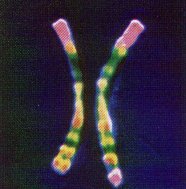
1. During Cell Division, the DNA (CHROMATIN) in an Eukaryotic Cell’s Nucleus is coiled into very tight compact structures called CHROMOSOMES.(Figure 8-1)

2. Chromosomes are Rod Shaped structures made of DNA and Proteins.

3. The Chromosomes of stained Eukaryotic cells undergoing cell division are visible as darkened structures inside the Nuclear Membrane.

4. The DNA in Eukaryotic cells wraps tightly around Proteins called HISTONES. They help to maintain the shape of Chromosomes and aid in the tight packing of DNA.

5. Proteins called NONHISTONE Proteins Do Not participate in packing of DNA, they are involved in Controlling the Activity of Specific Regions of the DNA.
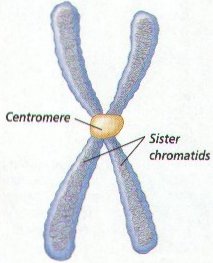
6. When preparing for Cell Division, Chromosomes form Copies of themselves, Each half of the Chromosome is called a CHROMATID or SISTER CHROMATIDS. Chromatids form as the DNA makes copies of itself before cell division.  (Figure 8-2)

7. The constricted area of each Chromatid is called a CENTROMERE . The Centromere holds the Two Chromatids together until the separate during Cell Division.

8. Between Cell Division, DNA IS NOT so Tightly Coiled into Chromosomes.  The Less tightly coiled DNA-Protein complex is called CHROMATIN .

9. Chromosomes are simpler in prokaryotes.  The DNA of most Prokaryotes comprises only ONE Chromosome, which is attached to the inside of the Cell Membrane.

10. Prokaryotic Chromosomes consist of a circular DNA Molecule and associated Proteins.

CHROMOSOME NUMBERS

1. EACH HUMAN BODY CELL CONTAINS 46 CHROMOSOMES, (2n) OR TWO COMPLETE SETS.

2. ANY CELL THAT CONTAINS TWO COMPLETE SETS OF CHROMOSOMES IS CALLED A DIPLOID CELL. A Diploid Cell  is commonly abbreviated as 2n.

3.  THE NUMBER OF CHROMOSOMES IN A DIPLOID CELL IS CALLED THE DIPLOID NUMBER.  EVERY ORGANISM HAS A CHARACTERISTIC DIPLOID NUMBER (2n).

4.  EXAMPLES:  FRUIT FLIES – 8, LETTUCE – 14, GOLDFISH 94, AND HUMANS 46.

5.  A CELL WITH ONLY ONE COMPLETE SET OF CHROMOSOMES IS CALLED A HAPLOID CELL.
A Haploid Cell is abbreviated as 1n.

6.  GAMETES, EGGS AND SPERM CONTAIN ONLY ONE COMPLETE SET.  EACH HUMAN SPERM OR EGG (GAMETE) CONTAINS 23 CHROMOSOMES, THE HAPLOID NUMBER (1n) FOR ALL HUMANS.

7.  WHEN AN EGG AND A SPERM OF THE SAME TYPE OF ORGANISM JOIN TO PRODUCE A NEW INDIVIDUAL, THE PROCESS IS CALLED FERTILIZATION.

8.  THE SINGLE CELL THAT RESULTS FROM FERTILIZATION IS KNOWN AS A ZYGOTE. THE ZYGOTE CONTAINS TWO COMPLETE SETS OF CHROMOSOMES, ONE SET FROM EACH GAMETE, FORMING A DIPLOID CELL.  IN MOST MULTICELLULAR ORGANISMS, THE ZYGOTE IS THE FIRST CELL OF THE NEW INDIVIDUAL.

9.  The Chromosomes in the Zygote exist in PAIRS.  For every Chromosome that was in the egg, there is a matching Chromosome from the sperm.

10. Human and Animal Chromosomes are categorized as either SEX CHROMOSOMES or AUTOSOMES.

11. SEX CHROMOSOMES are Chromosomes that Determine the SEX of an Organism.

12. In Humans, Sex Chromosomes are either X or Y.  Females have TWO X Chromosomes and Males have an X and Y Chromosome.

13. All the Other Chromosomes in an Organism are called AUTOSOMES.

14. TWO of the 46 Human Chromosomes are Sex Chromosomes, while the reaming 44 are Autosomes.
15. MATCH SET OF AUTOSOMES IN A DIPLOID CELL ARE CALLED HOMOLOGOUS PAIRS.  BOTH CHROMOSOMES IN A HOMOLOGOUS PAIR CONTAIN INFORMATION THAT CODE THE SAME TRAIT (GENES).  Example Eye Color.

SECTION 8-2, CELL DIVISION

All cells are derived from preexisting cells.  Cell division is the process by which cells produce offspring cells.  Cell division differs in prokaryotes and eukaryotes.  In eukaryotes, cell division differs in different stages of an organisms life cycle.

OBJECTIVES:  Describe the events of binary fission.  Describe each phase of the cell cycle.  Summarize the phases of mitosis.  Compare cytokinesis in animal cells with cytokinesis in plant cells.
CELL DIVISION IN PROKARYOTES

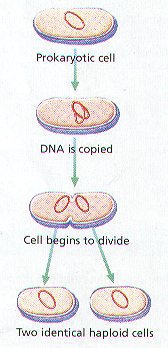
1. BINARY FISSION is the Division of a Prokaryotic cell INTO TWO Offspring Cells.

2. Binary Fission consist of THREE General Stages: (Figure 8-4):

STAGE 1 – The Chromosome, which is attached to the Inside of the Cell Membrane, makes a COPY of Itself, Resulting in Two Identical Chromosomes Attached to the Inside of the Inner Cell Membrane.

STAGE 2 – The Cell continues to grow until it reaches approximately TWICE its Normal Size. Then a CELL WALL Begins forms between the Two Chromosomes.

STAGE 3 – The Cell SPLITS into TWO NEW CELLS.  Each New Cell contains on the Identical Chromosomes.

CELL DIVISION IN EUKARYOTES

1. The trillions of cells that make up your body came from just ONE ORIGINAL CALLED: A FERTILIZED EGG (Zygote).  The Cell Theory states “CELLS COME ONLY FROM THE REPRODUCTION OF EXISTING CELLS” Chapter 4.

2. Each time A Cell Reproduces, the NEW Cells that are formed contained all the ESSENTIAL CYTOPLASM, ORGANELLES, AND NUCLEIC ACIDS NEEDED TO SURVIVE AND FUNCTION.

3. A Cell typically goes through PHASES during its Life, performing life processes of GROWTH AND DEVELOPMENT before it divides into new cells.
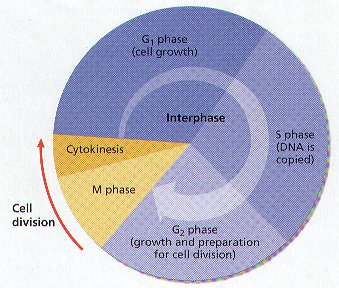
4. THE PHASES OF LIFE OF A CELL ARE CALLED THE CELL CYCLE . THE CELL CYCLE CONSISTS OF THREE PHASES:
      A. INTERPHASE
        B. MITOSIS
        C. CYTOKINESIS.

5. The CELL CYCLE is the Repeating Events that make up the Life of a Cell. (Figure 8-5)

6. Cell Division is One Phase of the Cell Cycle.  Cell Division consists of MITOSIS AND CYTOKINESIS.

7. MITOSIS is a Series of PHASES in Cell Division during which the NUCLEUS of a Cell Divides into TWO NUCLEI WITH IDENTICAL GENETIC MATERIAL.  MITOSIS OCCURS ONLY IN EUKARYOTES.

INTERPHASE

1. INTERPHASE IS THE PORTION OF THE CELL CYCLE BETWEEN DIVISION.

2. Interphase is the LONGEST Phase in the Cell Cycle of a typical Cell.  Interphase used to be referred to as the “RESTING PHASE”.

3. During Interphase, calls carry on all their usual functions, such as respiration and enzyme production.  The Cell also GROWS and DEVELOPS into MATURE FUNCTIONING Cells while in Interphase.  It is the period of normal metabolic activity.

4. INTERPHASE CONSIST OF THREE PHASES:

A. G1 PHASE – PERIOD OF NORMAL METABOLIC CELLULAR ACTIVITIES: THE NUMBER OF ORGANELLES AND AMOUNT OF CYTOPLASM IN A CELL INCREASE. Offspring Cells Grow to Mature Size.

B. S PHASE – THE GENETIC MATERIAL (DNA) IS DUPLICATED (COPIED).  THE CHROMOSOMES OF THE CELL REPLICATE.

C. G2 PHASE – Structure directly involved with mitosis are formed.  The Cell makes the Organelles and substances it needs for Cell Division.  A time during which the Cell prepares to divide.
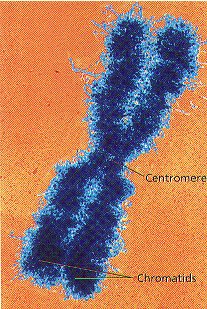
5. REPLICATION IS THE PROCESS OF COPYING GENETIC MATERIAL.

6. REPLICATION RESULTS IN TWO IDENTICAL COPIES OF A CHROMOSOME CALLED SISTER CHROMATIDS.

7. CHROMOSOMES MUST REPLICATE DURING INTERPHASE SO THERE WILL BE A COMPLETE COPY OF EACH CHROMOSOME IN EACH NEW CELL.

8. BECAUSE THE DNA CONTAINED IN CHROMOSOMES CONTROL GROWTH DEVELOPMENT, AND FUNCTION OF EVERY CELL, EACH NEW CELL MUST HAVE AN EXACT COPY OF THE ORIGINAL SET OF CHROMOSOMES.
CELL DIVISION

1. CELL DIVISION IS THE PROCESS BY WHICH ONE CELL PRODUCES TWO NEW IDENTICAL DAUGHTER CELLS.

2. CELL DIVISION INVOLVES TWO STEPS: CALLED MITOTIC CELL DIVISION.

A.  MITOSIS – FIRST STEP. A SERIES OF  PHASES IN CELL DIVISION DURING WHICH THE NUCLEUS OF A CELL DIVIDES INTO TWO NUCLEI WITH IDENTICAL GENETIC MATERIAL.

B. CYTOKINESIS – SECOND STEP. THE CYTOPLASM OF THE CELL DIVIDES INTO TWO NEW CELLS CALLED DAUGHTER CELLS.

3. DAUGHTER CELL NUCLEI ARE IDENTICAL TO THE PARENT CELL NUCLEUS IN EVERY WAY.  LIKE THEIR PARENT CELL, SOME DAUGHTER CELLS WILL PASS THROUGH THE CELL CYCLE OF GROWTH, DEVELOPMENT, AND CELL DIVISION.

4. MULTICELLULAR ORGANISMS GROW AS MORE CELLS REPEAT THE CYCLE OF CELL DIVISION AND GROWTH.

MITOSIS

1. Mitosis is the Division of the Nucleus, which occurs during Cell Division.

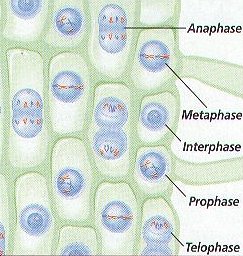
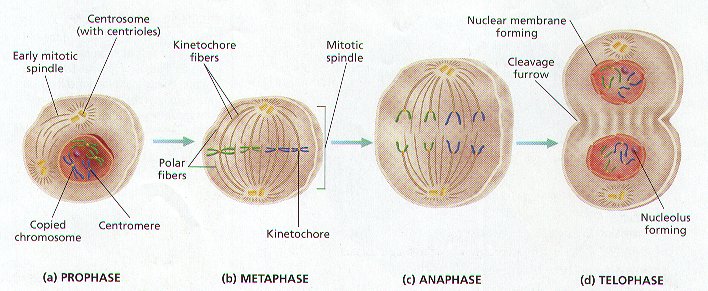
2. Biologist have named the Steps, or Phases, of Mitosis to help study the process.  The FOUR Phases of Mitosis are called PROPHASE, METAPHASE, ANAPHASE, AND TELOPHASE. (Figure 8-6)

3. THE ACTUALLY PROCESS OF MITOSIS IS CONTINUOUS.

4. MITOSIS IS THE PROCESS BY WHICH A NUCLEUS GIVES RISE TO TWO IDENTICAL NUCLEI.

5. INTERPHASE PRIOR TO MITOSIS, THE PERIOD OF NORMAL METABOLIC ACTIVITY. The Chromosomes REPLICATE and the CYTOPLASM Increases as he cell prepares to divide. Interphase includes G1, S, G2 Phases of the Cell Cycle.

FOUR PHASES OF MITOSIS

PHASE 1- PROPHASE  (Figure 8-6 (a))

1. Chromatin condenses into Chromosomes of TWO Sister Chromatids joined together by the CENTROMERE, and visible when viewed through a microscope.

2. THE NUCLEOLUS AND NUCLEAR MEMBRANE DISAPPEAR.

3. TWO Structures called CENTROSOMES appear next to the Disappearing Nucleus.  In Animal Cells, each Centrosome contains a pair of small, cylindrical bodies called CENTRIOLES. Plant Cells lack Centrioles.

4. In BOTH Animal and Plant Cells, the Centrosomes move toward opposite poles of the cell. As they Separate, SPINDLE FIBERS made of microtubules radiate from the Centrosomes in preparation for Mitosis.  The array of Spindle fibers is called the MITOTIC SPINDLE, which serves to Equally divides the Sister Chromatids between the Two Offspring Cells.

5. There are TWO Type of Spindle Fibers:

A. KINETOCHORE FIBERS – They Attached to the Centromere Region of each Sister Chromatids.

B. POLAR FIBERS – they extend across the dividing cell from Centrosome to Centrosome.

PHASE 2 – METAPHASE  (Figure 8-6 (b))

1. The Chromosomes are moved to the CENTER of the CELL (Equatorial Plane) by the Kinetochore Fibers attached to the Centromeres.

2. The Two Sister Chromatids of each Chromosome are attached to Kinetochore Fibers radiating from OPPOSITE ENDS OF THE CELL.

PHASE 3 – ANAPHASE  (Figure 8-6 (c))

1. The Centromeres of Each Chromosome are pulled by the Kinetochore Fibers toward the ends of the cell (OPPOSITE POLES).

2. THE SISTER CHROMATIDS ARE THUS SEPARATED FROM EACH OTHER.  They are now Considered to be Individual Chromosomes.

PHASE 4 – TELOPHASE (Figure 8-6 (d))

1. After the Chromosomes reach opposite ends of the Cell, the Spindle Fibers Disassemble.

2. The Chromosomes return to less tightly coiled Chromatin State.

3. New Nuclear Envelope begins to form around the Chromosomes at each end of the cell.

4. CYTOKINESIS BEGINS.

5.  THE PROCESS OF MITOSIS IS NOW COMPLETE.  THE CELL MEMBRANE BEGINS TO PINCH THE CELL IN TWO AS CYTOKINESIS BEGINS.
CYTOKINESIS
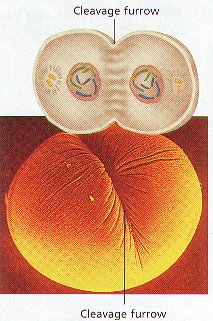
1. Following the last phase of Mitosis, Cytokinesis COMPLETES the process of Cell Division.

2. During Cytokinesis, the Cytoplasm of a cell and its ORGANELLES SEPARATE INTO TWO NEW DAUGHTER CELLS.

3. Cytokinesis proceeds differently in animal and plant cells.

4. CYTOKINESIS OF ANIMAL CELLS: The Cytoplasm Divides when a GROOVE called the CLEAVAGE FURROW forms through the Middle of the Parent Cell.  The Cleavage Furrow Deepens until the parent cell pinches into TWO New Identical Cells.  The New Cells are Now in INTERPHASE.

5. CYTOKINESIS OF PLANT CELLS: In a Plant Cell, the material for NEW CELL WALL CALLED THE CELL PLATE  AND MEMBRANES GATHER AND FUSE ALONG THE EQUATOR, OR MIDDLE OF THE CELL, BETWEEN TWO NUCLEI. Forming TWO New Identical Cells.
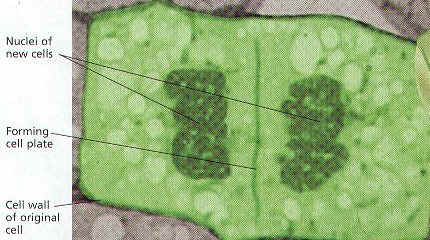
6. In Both Animal and Plant Cells, New Offspring Cells are approximately equal in Size.

SECTION 8-3, MEIOSIS

Meiosis is a process of nuclear division that Reduces the number of chromosomes in new cells to Half the number in the original cell. The Halving of the chromosome number counteracts a fusion of cells later in the life cycle of the organism.  For example, in humans, meiosis produces haploid reproductive cells called GAMETES. Human gametes are sperm and egg cells, each which contains 23(1n) chromosomes.  The fusion of sperm and egg results in a zygote that contains 46 (2n) chromosomes.

OBJECTIVES:  List and describe the phases of meiosis.  Compare the end products of mitosis with those of meiosis.  Explain crossing-over and how it contributes to the production of unique individuals.  Summarize the major characteristics of spermatogenesis and oogenesis.

1. Most organisms are capable of COMBINING CHROMOSOMES FROM TWO PARENTS TO PRODUCE OFFSPRING.

2. WHEN CHROMOSOMES OF TWO PARENTS COMBINE TO PRODUCE OFFSPRING, THE PROCESS IS KNOWN As SEXUAL REPRODUCTION.

3. THE CHROMOSOMES THAT COMBINE DURING SEXUAL REPRODUCTION ARE CONTAINED IN SPECIAL REPRODUCTIVE CELLS CALLED GAMETES.

4. IN MOST ORGANISMS, GAMETES CAN BE EITHER EGG OR SPERM .

5. EGGS are larger than sperm and contain a lot of Cytoplasm.  An egg is nonmotile.

6. SPERM Cells contain very little Cytoplasm, have Flagella, that helps them swim to the nonmotile egg.

7. The Chromosomes of Two Gametes are added together when they join.  The number of Chromosomes in the offspring DOES NOT DOUBLE WITH EACH GENERATION, BUT REMAINS THE SAME BECAUSE OF MEIOSIS.

8. MEIOSIS IS THE WAY MANY ORGANISMS PRODUCE GAMETES THROUGH A TYPE OF CELL REPRODUCTION.

9. MEIOSIS IS A TYPE OF NUCLEAR DIVISION IN WHICH THE CHROMOSOME NUMBER IS HALVED.  LIKE MITOSIS, MEIOSIS IS FOLLOWED BY CYTOKINESIS.

10. IN HUMANS SPECIALIZED REPRODUCTIVE CELLS WITH 46 CHROMOSOMES (2n) (DIPLOID CELL) UNDERGO MEIOSIS AND CYTOKINESIS TO GIVE RISE TO EGG OR SPERM THAT HAVE ONLY 23 CHROMOSOMES (1N) (HAPLOID CELL) EACH.

11. MEIOSIS ONLY OCCURS IN EUKARYOTIC CELLS IN PHASES SIMILAR TO THE PHASES OF MITOSIS.

12. MEIOSIS IS DIFFERENT FROM MITOSIS IN SOME VERY IMPORTANT WAYS.

A. The process of meiosis results in the production of Daughter Cells that have HALF THE NUMBER OF CHROMOSOMES OF THE PARENT CELL (HAPLOID CELL).

B. Daughter Cell produced by meiosis ARE NOT ALL ALIKE.  THE DAUGHTER CELLS     MAY HAVE DIFFERENT CHROMOSOMES FROM EACH OTHER.

C. The NUMBER OF CELLS PRODUCED BY MEIOSIS IS DIFFERENT.

(1) Mitosis – One Parent Cell PRODUCES TWO DIPLOID DAUGHTER CELLS.

(2) Meiosis – One Parent Cell PRODUCES FOUR HAPLOID DAUGHTER CELLS.

STAGES OF MEIOSIS

1. THE PROCESS OF MEIOSIS SEPARATES THE PAIRS OF CHROMOSOMES IN A DIPLOID CELL TO FORM HAPLOID CELLS.

2. ONE PARENT CELL DIVIDES TWICE TO PRODUCE FOUR HAPLOID DAUGHTER CELLS.

3. DURING MEIOSIS, THE NUMBER OF CHROMOSOMES IN EACH CELL IS REDUCED FROM DIPLOID TO HAPLOID BY SEPARATING HOMOLOGOUS PAIRS OF CHROMOSOMES.

4. MEIOSIS PROCEEDS IN TWO MAIN STAGES:

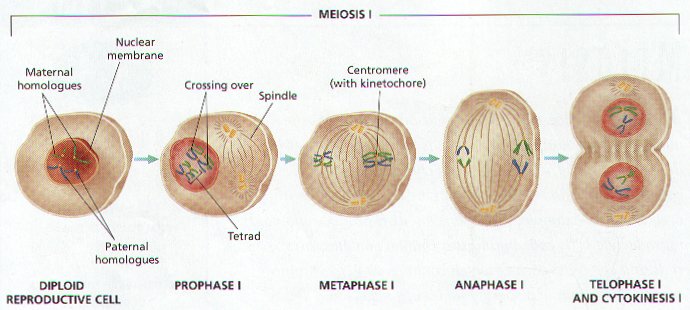
A. MEIOSIS I HOMOLOGOUS PAIRS ARE SEPARATED.
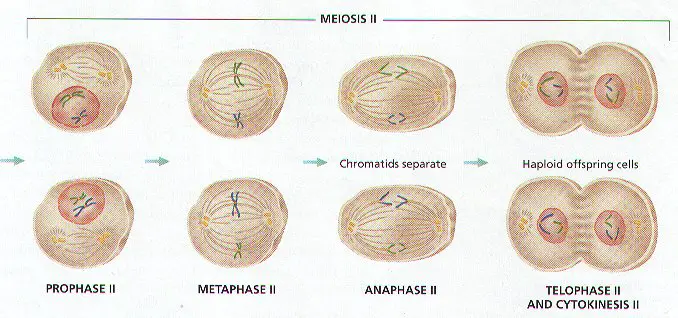
B. MEIOSIS II THE SISTER CHROMATIDS OF EACH CHROMOSOME ARE SEPARATED.
MEIOSIS I  (Figure 8-9)

1. AT THE START OF MEIOSIS I EACH CHROMOSOME CONSIST OF TWO STRANDS OF SISTER CHROMATIDS CONNECTED AT THE CENTROMERE.

2. HOMOLOGOUS PAIRS OF CHROMOSOMES COME TOGETHER BEFORE MEIOSIS BEGINS, AN EVENT THAT DOES NOT OCCUR IN MITOSIS. THIS EVENT IS CALLED SYNAPSIS .

3. Each Pair of Homologous Chromosomes is called a TETRAD .

PROPHASE I.

1. Chromosomes become thick and visible, the chromosomes of each homologous pair are tangled together.
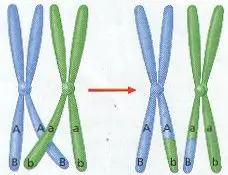
2. Portions of Chromatids may Break Off and attach to Adjacent Chromatids on the homologous Chromosome – a process called CROSSING-OVER. (Figure 8-10)

3. Crossing-Over results in Genetic Recombination by producing a New Mixture of Genetic Material.

4. Each pair consists of FOUR CHROMATIDS, BECAUSE EACH CHROMOSOME IN THE PAIR HAD REPLICATED BEFORE MEIOSIS BEGAN.

5. The Nucleoli and the Nuclear Envelope disappear and the spindle fibers form.

METAPHASE I.  Homologous pairs (Tetrads) are still together and arrange in the middle of the cell.

ANAPHASE I.  The homologous pairs of chromosomes separate from each other, spindle fibers pull one member from each pair to opposite ends of the cell. The Random separation of the Homologous Chromosomes is called INDEPENDENT ASSORTMENT.

TELOPHASE I.  Cytokinesis takes place; each new cell is haploid, containing one chromosome
from each pair.

MEIOSIS II  (Figure 8-11)

1. CHROMOSOMES DO NOT REPLICATE BEFORE BEGINNING THE SECOND PHASE MEIOSIS II WILL DIVIDE CHROMOSOMES INTO HAPLOID CELLS CALLED GAMETES.

2. Each Diploid Cell from Meiosis I will go through a second division, forming the FOUR GAMETES HAPLOID CELL.  (Review Figure 8-11)

CROSSING-OVER
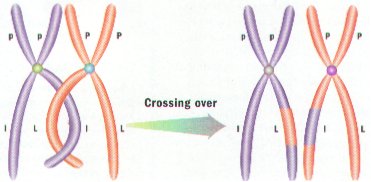
1. CHROMOSOMES OF ALL ORGANISMS CONTAIN REGIONS CALLED GENES .

2. EACH GENE CODES FOR ONE TRAIT, OR CHARACTERISTIC, OF THE ORGANISM.

3. ONE VERY IMPORTANT EVENT THAT CAN OCCUR DURING MEIOSIS I IS CROSSING- OVER.

4. CROSSING-OVER IS THE EXCHANGE OF GENES BETWEEN PAIR OF HOMOLOGOUS CHROMOSOMES.

5. CROSSING-OVER OCCURS ONLY DURING PROPHASE I (ONLY!) WHEN HOMOLOGOUS PAIRS ARE STILL JOINED TOGETHER.  THESE PAIRS CAN SOMETIMES BREAK WHERE THEY MEET AN EXCHANGE GENES. (Figure 8-10)

FORMATION OF GAMETES
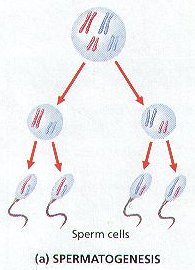
1. In Animals, meiosis produces haploid reproductive cells called GAMETES.

2. Meiosis occurs within the Reproductive Organs, in the TESTES or OVARIES.

3. In the Testes, meiosis is involved in the production of Male Gametes known as Sperm Cells or Spermatozoa.

4. In the development of Sperm Cells, a Diploid Reproductive Cell divides Meiotically to form FOUR Haploid Cells called SPERMATIDS.

5. Each Spermatid then develops into a Mature Sperm Cell.

6. The production of Sperm Cells is called SPERMATOGENESIS . (Figure 8-12 (b))
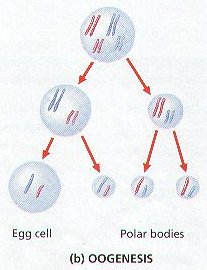
7. OOGENESIS is the production of Mature Egg Cells or OVA.  (Figure 8-12 (c))

8. Notice that the Female only produces ONE EGG (OVUM) under normal circumstances.

9. Although creating 4 Haploid Cells through meiosis, only One Becomes the Egg, the other Three products of meiosis are called POLAR BODIES ,and Degenerate.  This is due to the unequal dividing of the cytoplasm during Cytokinesis I & II.

ASEXUAL AND SEXUAL REPRODUCTION

1. EVOLUTION IS THE PROCESS OF CHANGE IN LIVING POPULATIONS OVER TIME.

2. ASEXUAL REPRODUCTION is the production of Offspring from ONE PARENT.

3. Asexual reproduction DOES NOT Usually involve Meiosis or the Union of Gametes.

4. In Unicellular Organisms, such as bacteria, New Organisms are created by either BINARY FISSION or MITOSIS.

5. Asexual Reproduction in multicellular organisms results from BUDDING OFF a Portion of Their Bodies. (Plants)

6. The Offspring From Asexual Reproduction are Genetically Identical to the Parent.

7. SEXUAL REPRODUCTION is the Production of Offspring through Meiosis and the Union of a Sperm and an Egg.

8. MEIOSIS AND SEXUAL REPRODUCTION RESULTS IN NEW COMBINATIONS OF CHARACTERISTICS WITHIN A POPULATION.

9. ORGANISMS IN A POPULATION THAT REPRODUCE SEXUALLY ARE NOT ALL ALIKE.

10. DIFFERENCES AMONG MEMBERS OF A POPULATION ARE COLLECTIVELY CALLED VARIATION.  WHICH RESULTS FROM THE RECOMBINATION OF GENES DURING MEIOSIS AND FERTILIZATION.

11. MEIOSIS AND FERTILIZATION SHUFFLE THE GENES FROM PARENT ORGANISMS, PRODUCING NEW COMBINATIONS OF GENES IN THE OFFSPRING.

12. AN ORGANISMS CHARACTERISTICS ENABLE IT TO SURVIVE IN IT’S ENVIRONMENT. THE CONDITIONS OF THE ENVIRONMENT DETERMINE WHICH CHARACTERISTICS OR TRAITS BENEFIT THE SURVIVAL AND WHICH DO NOT.

13. THE ORGANISMS WITH THE TRAITS TO SURVIVE WILL THEN REPRODUCE TO PASS THOSE POSITIVE TRAITS ON TO THEIR OFFSPRING.

14. OVER TIME THIS PROCESS LEADS TO THE CHANGE IN THE POPULATIONS, BECAUSE ONLY THOSE WITH POSITIVE TRAITS TO PASS ON WILL REPRODUCE.  NATURAL SELECTION.

15. THE ACCUMULATION OF SUCH GENES AND TRAITS IN EACH GENERATION IS THE BASIS OF EVOLUTION.

16. SINCE ASEXUAL OFFSPRING HAVE THE EXACT SAME GENES AND TRAITS AS THE PARENT, GENETIC VARIATION RARELY OCCURS.

17. A CHANGE IN THE ENVIRONMENT THAT CAN DESTROY ONE INDIVIDUAL COULD DESTROY THE ENTIRE POPULATION.

Chapter 1 – Exploring Life – Lecture Outline

Chapter 1   Exploring Life    Lecture Outline

Overview: Biology’s Most Exciting Era

  •  Biology is the scientific study of life.
  • You are starting your study of biology during its most exciting era.
  • The largest and best-equipped community of scientists in history is beginning to solve problems that once seemed unsolvable.
  • Biology is an ongoing inquiry about the nature of life.
  • Biologists are moving closer to understanding:
  • How a single cell develops into an adult animal or plant.
  •  How plants convert solar energy into the chemical energy of food.
  • How the human mind works.
  • How living things interact in biological communities.
  • How the diversity of life evolved from the first microbes.
  • Research breakthroughs in genetics and cell biology are transforming medicine and agriculture.
  • Neuroscience and evolutionary biology are reshaping psychology and sociology.
  • Molecular biology is providing new tools for anthropology and criminology.
  • New models in ecology are helping society to evaluate environmental issues, such as the causes and biological consequences of global warming.
  •  Unifying themes pervade all of biology.

Concept 1.1 Biologists explore life from the microscopic to the global scale

  • Life’s basic characteristic is a high degree of order.
  •  Each level of biological organization has emergent properties.
  •  Biological organization is based on a hierarchy of structural levels, each building on the levels below.
  • At the lowest level are atoms that are ordered into complex biological molecules.
  • Biological molecules are organized into structures called organelles, the components of cells.
  • Cells are the fundamental unit of structure and function of living things.
  • Some organisms consist of a single cell; others are multicellular aggregates of specialized cells.
  • Whether multicellular or unicellular, all organisms must accomplish the same functions: uptake and processing of nutrients, excretion of wastes, response to environmental stimuli, and reproduction.
  • Multicellular organisms exhibit three major structural levels above the cell: similar cells are grouped into tissues, several tissues coordinate to form organs, and several organs form an organ system.
  •  For example, to coordinate locomotory movements, sensory information travels from sense organs to the brain, where nervous tissues composed of billions of interconnected neurons—supported by connective tissue—coordinate signals that travel via other neurons to the individual muscle cells.
  • Organisms belong to populations, localized groups of organisms belonging to the same species.
  • Populations of several species in the same area comprise a biological community.
  • Populations interact with their physical environment to form an ecosystem.
  • The biosphere consists of all the environments on Earth that are inhabited by life.
  • Organisms interact continuously with their environment.
  • Each organism interacts with its environment, which includes other organisms as well as nonliving factors.
  • Both organism and environment are affected by the interactions between them.
  • The dynamics of any ecosystem include two major processes: the cycling of nutrients and the flow of energy from sunlight to producers to consumers.
  •  In most ecosystems, producers are plants and other photosynthetic organisms that convert light energy to chemical energy.
  • Consumers are organisms that feed on producers and other consumers.
  • All the activities of life require organisms to perform work, and work requires a source of energy.
  • The exchange of energy between an organism and its environment often involves the transformation of energy from one form to another.
  • In all energy transformations, some energy is lost to the surroundings as heat.
  •  In contrast to chemical nutrients, which recycle within an ecosystem, energy flows through an ecosystem, usually entering as light and exiting as heat.
  • Cells are an organism’s basic unit of structure and function.
  • The cell is the lowest level of structure that is capable of performing all the activities of life.
  • For example, the ability of cells to divide is the basis of all reproduction and the basis of growth and repair of multicellular organisms.
  •  Understanding how cells work is a major research focus of modern biology.
  •  At some point, all cells contain deoxyribonucleic acid, or DNA, the heritable material that directs the cell’s activities.
  • DNA is the substance of genes, the units of inheritance that transmit information from parents to offspring.
  •  Each of us began life as a single cell stocked with DNA inherited from our parents.
  • DNA in human cells is organized into chromosomes.
  • Each chromosome has one very long DNA molecule, with hundreds or thousands of genes arranged along its length.
  • The DNA of chromosomes replicates as a cell prepares to divide.
  • Each of the two cellular offspring inherits a complete set of genes.
  • In each cell, the genes along the length of DNA molecules encode the information for building the cell’s other molecules.
  • DNA thus directs the development and maintenance of the entire organism.
  • Most genes program the cell’s production of proteins.
  • Each DNA molecule is made up of two long chains arranged in a double helix.
  • Each link of a chain is one of four nucleotides, encoding the cell’s information in chemical letters.
  • The sequence of nucleotides along each gene codes for a specific protein with a unique shape and function.
  • Almost all cellular activities involve the action of one or more proteins.
  • DNA provides the heritable blueprints, but proteins are the tools that actually build and maintain the cell.
  •  All forms of life employ essentially the same genetic code.
  • Because the genetic code is universal, it is possible to engineer cells to produce proteins normally found only in some other organism.
  • The library of genetic instructions that an organism inherits is called its genome.
  • The chromosomes of each human cell contain about 3 billion nucleotides, including genes coding for more than 70,000 kinds of proteins, each with a specific function.
  • Every cell is enclosed by a membrane that regulates the passage of material between a cell and its surroundings.
  • Every cell uses DNA as its genetic material.
  • There are two basic types of cells: prokaryotic cells and eukaryotic cells.
  • The cells of the microorganisms called bacteria and archaea are prokaryotic.
  • All other forms of life have more complex eukaryotic cells.
  • Eukaryotic cells are subdivided by internal membranes into various organelles.
  •  In most eukaryotic cells, the largest organelle is the nucleus, which contains the cell’s DNA as chromosomes.
  • The other organelles are located in the cytoplasm, the entire region between the nucleus and outer membrane of the cell.
  • Prokaryotic cells are much simpler and smaller than eukaryotic cells.
  • In a prokaryotic cell, DNA is not separated from the cytoplasm in a nucleus.
  • There are no membrane-enclosed organelles in the cytoplasm.
  • All cells, regardless of size, shape, or structural complexity, are highly ordered structures that carry out complicated processes necessary for life.

Concept 1.2 Biological systems are much more than the sum of their parts

  •  “The whole is greater than the sum of its parts.”
  •  The combination of components can form a more complex organization called a system.
  •  Examples of biological systems are cells, organisms, and ecosystems.
  •  Consider the levels of life.
  •   With each step upward in the hierarchy of biological order, novel properties emerge that are not present at lower levels.
  • These emergent properties result from the arrangements and interactions between components as complexity increases.
  •  A cell is much more than a bag of molecules.
  •  Our thoughts and memories are emergent properties of a complex network of neurons.
  • This theme of emergent properties accents the importance of structural arrangement.
  •  The emergent properties of life are not supernatural or unique to life but simply reflect a hierarchy of structural organization.
  • The emergent properties of life are particularly challenging because of the unparalleled complexity of living systems.
  • The complex organization of life presents a dilemma to scientists seeking to understand biological processes.
  • We cannot fully explain a higher level of organization by breaking it down into its component parts.
  • At the same time, it is futile to try to analyze something as complex as an organism or cell without taking it apart.
  •  Reductionism, reducing complex systems to simpler components, is a powerful strategy in biology.
  • The Human Genome Project—the sequencing of the genome of humans and many other species—is heralded as one of the greatest scientific achievements ever.
  • Research is now moving on to investigate the function of genes and the coordination of the activity of gene products.
  • Biologists are beginning to complement reductionism with new strategies for understanding the emergent properties of life—how all of the parts of biological systems are functionally integrated.
  • The ultimate goal of systems biology is to model the dynamic behavior of whole biological systems.
  •  Accurate models allow biologists to predict how a change in one or more variables will impact other components and the whole system.
  •  Scientists investigating ecosystems pioneered this approach in the 1960s with elaborate models diagramming the interactions of species and nonliving components in ecosystems.
  • Systems biology is now becoming increasingly important in cellular and molecular biology, driven in part by the deluge of data from the sequencing of genomes and our increased understanding of protein functions.
  • In 2003, a large research team published a network of protein interactions within a cell of a fruit fly.
  •  Three key research developments have led to the increased importance of systems biology.

1.           High-throughput technology. Systems biology depends on methods that can analyze biological materials very quickly and produce enormous amounts of data. An example is the automatic DNA-sequencing machines used by the Human Genome Project.
2.           Bioinformatics. The huge databases from high-throughput methods require computing power, software, and mathematical models to process and integrate information.
3.           Interdisciplinary research teams. Systems biology teams may include engineers, medical scientists, physicists, chemists, mathematicians, and computer scientists as well as biologists.

  •  Regulatory mechanisms ensure a dynamic balance in living systems.
  •  Chemical processes within cells are accelerated, or catalyzed, by specialized protein molecules, called enzymes.
  • Each type of enzyme catalyzes a specific chemical reaction.
  • In many cases, reactions are linked into chemical pathways, each step with its own enzyme.
  • How does a cell coordinate its various chemical pathways?
  • Many biological processes are self-regulating: the output or product of a process regulates that very process.
  • In negative feedback, or feedback inhibition, accumulation of an end product of a process slows or stops that process.
  • Though less common, some biological processes are regulated by positive feedback, in which an end product speeds up its own production.
  • Feedback is common to life at all levels, from the molecular level to the biosphere.
  • Such regulation is an example of the integration that makes living systems much greater than the sum of their parts.

Concept 1.3 Biologists explore life across its great diversity of species

  • Biology can be viewed as having two dimensions: a “vertical” dimension covering the size scale from atoms to the biosphere and a “horizontal” dimension that stretches across the diversity of life.
  • The latter includes not only present-day organisms, but also those that have existed throughout life’s history.
  • Living things show diversity and unity.
  • Life is enormously diverse.
  • Biologists have identified and named about 1.8 million species.
  • This diversity includes 5,200 known species of prokaryotes, 100,000 fungi, 290,000 plants, 50,000 vertebrates, and 1,000,000 insects.
  • Thousands of newly identified species are added each year.
  • Estimates of the total species count range from 10 million to more than 200 million.
  •  In the face of this complexity, humans are inclined to categorize diverse items into a smaller number of groups.
  • Taxonomy is the branch of biology that names and classifies species into a hierarchical order.
  • Until the past decade, biologists divided the diversity of life into five kingdoms.
  •  New methods, including comparisons of DNA among organisms, have led to a reassessment of the number and boundaries of the kingdoms.
  • Various classification schemes now include six, eight, or even dozens of kingdoms.
  • Coming from this debate has been the recognition that there are three even higher levels of classifications, the domains.
  • the three domains are Bacteria, Archaea, and Eukarya.
  • The first two domains, domain Bacteria and domain Archaea, consist of prokaryotes.
  •  All the eukaryotes are now grouped into various kingdoms of the domain Eukarya.
  • The recent taxonomic trend has been to split the single-celled eukaryotes and their close relatives into several kingdoms.
  • Domain Eukarya also includes the three kingdoms of multicellular eukaryotes: the kingdoms Plantae, Fungi, and Animalia.
  • These kingdoms are distinguished partly by their modes of nutrition.
  •  Most plants produce their own sugars and food by photosynthesis.
  •  Most fungi are decomposers that absorb nutrients by breaking down dead organisms and organic wastes.
  • Animals obtain food by ingesting other organisms.
  • Underlying the diversity of life is a striking unity, especially at the lower levels of organization.
  • The universal genetic language of DNA unites prokaryotes and eukaryotes.
  • Among eukaryotes, unity is evident in many details of cell structure.
  • Above the cellular level, organisms are variously adapted to their ways of life.
  • How do we account for life’s dual nature of unity and diversity?
  • The process of evolution explains both the similarities and differences among living things.

Concept 1.4 Evolution accounts for life’s unity and diversity

  • The history of life is a saga of a changing Earth billions of years old, inhabited by a changing cast of living forms.
  •  Charles Darwin brought evolution into focus in 1859 when he presented two main concepts in one of the most important and controversial books ever written, On the Origin of Species by Natural Selection.
  • Darwin ’s first point was that contemporary species arose from a succession of ancestors through “descent with modification.”
  • This term captured the duality of life’s unity and diversity: unity in the kinship among species that descended from common ancestors and diversity in the modifications that evolved as species branched from their common ancestors.
  • Darwin ’s second point was his mechanism for descent with modification: natural selection.
  • Darwin inferred natural selection by connecting two observations:
  • Observation 1: Individual variation. Individuals in a population of any species vary in many heritable traits.
  • Observation 2: Overpopulation and competition. Any population can potentially produce far more offspring than the environment can support. This creates a struggle for existence among variant members of a population.
  • Inference: Unequal reproductive success. Darwin inferred that those individuals with traits best suited to the local environment would leave more healthy, fertile offspring.
  • Inference: Evolutionary adaptation. Unequal reproductive success can lead to adaptation of a population to its environment. Over generations, heritable traits that enhance survival and reproductive success will tend to increase in frequency among a population’s individuals. The population evolves.
  • Natural selection, by its cumulative effects over vast spans of time, can produce new species from ancestral species.
  •  For example, a population fragmented into several isolated populations in different environments may gradually diversify into many species as each population adapts over many generations to different environmental problems.
  • Fourteen species of finches found on the Galápagos Islands diversified after an ancestral finch species reached the archipelago from the South American mainland.
  • Each species is adapted to exploit different food sources on different islands.
  • Biologists’ diagrams of evolutionary relationships generally take a treelike form.
  •  Just as individuals have a family tree, each species is one twig of a branching tree of life.
  • Similar species like the Galápagos finches share a recent common ancestor.
  • Finches share a more distant ancestor with all other birds.
  • The common ancestor of all vertebrates is even more ancient.
  • Trace life back far enough, and there is a shared ancestor of all living things.
  • All of life is connected through its long evolutionary history.

Concept 1.5 Biologists use various forms of inquiry to explore life

  • The word science is derived from a Latin verb meaning “to know.”
  • At the heart of science is inquiry, people asking questions about nature and focusing on specific questions that can be answered.
  • The process of science blends two types of exploration: discovery science and hypothesis-based science.
  • Discovery science is mostly about discovering nature.
  • Hypothesis-based science is mostly about explaining nature.
  • Most scientific inquiry combines the two approaches.
  • Discovery science describes natural structures and processes as accurately as possible through careful observation and analysis of data.
  • Discovery science built our understanding of cell structure and is expanding our databases of genomes of diverse species.
  • Observation is the use of the senses to gather information, which is recorded as data.
  • Data can be qualitative or quantitative.
  • Quantitative data are numerical measurements.
  • Qualitative data may be in the form of recorded descriptions.
  • Jane Goodall has spent decades recording her observations of chimpanzee behavior during field research in Gambia .
  • She has also collected volumes of quantitative data over that time.
  • Discovery science can lead to important conclusions based on inductive reasoning.
  • Through induction, we derive generalizations based on a large number of specific observations.
  • In science, inquiry frequently involves the proposing and testing of hypotheses.
  •  A hypothesis is a tentative answer to a well-framed question.
  •  It is usually an educated postulate, based on past experience and the available data of discovery science.
  • A scientific hypothesis makes predictions that can be tested by recording additional observations or by designing experiments.
  •  A type of logic called deduction is built into hypothesis-based science.
  •  In deductive reasoning, reasoning flows from the general to the specific.
  •  From general premises, we extrapolate to a specific result that we should expect if the premises are true.
  • In hypothesis-based science, deduction usually takes the form of predictions about what we should expect if a particular hypothesis is correct.
  • We test the hypothesis by performing the experiment to see whether or not the results are as predicted.
  •  Deductive logic takes the form of “If . . . then” logic.
  • Scientific hypotheses must be testable.
  • There must be some way to check the validity of the idea.
  • Scientific hypotheses must be falsifiable.
  • There must be some observation or experiment that could reveal if a hypothesis is actually not true.
  • The ideal in hypothesis-based science is to frame two or more alternative hypotheses and design experiments to falsify them.
  • No amount of experimental testing can prove a hypothesis.
  • A hypothesis gains support by surviving various tests that could falsify it, while testing falsifies alternative hypotheses.
  • Facts, in the form of verifiable observations and repeatable experimental results, are the prerequisites of science.
  • We can explore the scientific method.
  • There is an idealized process of inquiry called the scientific method.
  • Very few scientific inquiries adhere rigidly to the sequence of steps prescribed by the textbook scientific method.
  • Discovery science has contributed a great deal to our understanding of nature without most of the steps of the so-called scientific method.
  • We will consider a case study of scientific research.
  • This case begins with a set of observations and generalizations from discovery science.
  •  Many poisonous animals have warning coloration that signals danger to potential predators.
  • Imposter species mimic poisonous species, although they are harmless.
  • An example is the bee fly, a nonstinging insect that mimics a honeybee.
  • What is the function of such mimicry? What advantage does it give the mimic?
  • In 1862, Henry Bates proposed that mimics benefit when predators mistake them for harmful species.
  • This deception may lower the mimic’s risk of predation.
  •  In 2001, David and Karin Pfennig and William Harcombe of the University of North Carolina designed a set of field experiments to test Bates’s mimicry hypothesis.
  • In North and South Carolina , a poisonous snake called the eastern coral snake has warning red, yellow, and black coloration.
  • Predators avoid these snakes. It is unlikely that predators learn to avoid coral snakes, as a strike is usually lethal.
  • Natural selection may have favored an instinctive recognition and avoidance of the warning coloration of the coral snake.
  • The nonpoisonous scarlet king snake mimics the ringed coloration of the coral snake.
  • Both king snakes and coral snake live in the Carolinas , but the king snake’s range also extends into areas without coral snakes.
  • The distribution of these two species allowed the Pfennigs and Harcombe to test a key prediction of the mimicry hypothesis.
  • Mimicry should protect the king snake from predators, but only in regions where coral snakes live.
  •  Predators in non–coral snake areas should attack king snakes more frequently than predators that live in areas where coral snakes are present.
  • To test the mimicry hypothesis, Harcombe made hundreds of artificial snakes.
  • The experimental group had the red, black, and yellow ring pattern of king snakes.
  • The control group had plain, brown coloring.
  •  Equal numbers of both types were placed at field sites, including areas where coral snakes are absent.
  • After four weeks, the scientists retrieved the fake snakes and counted bite or claw marks.
  • Foxes, coyotes, raccoons, and black bears attacked snake models.
  • The data fit the predictions of the mimicry hypothesis.
  • The ringed snakes were attacked by predators less frequently than the brown snakes only within the geographic range of the coral snakes.
  • The snake mimicry experiment provides an example of how scientists design experiments to test the effect of one variable by canceling out the effects of unwanted variables.
  • The design is called a controlled experiment.
  • An experimental group (artificial king snakes) is compared with a control group (artificial brown snakes).
  • The experimental and control groups differ only in the one factor the experiment is designed to test—the effect of the snake’s coloration on the behavior of predators.
  • The brown artificial snakes allowed the scientists to rule out such variables as predator density and temperature as possible determinants of number of predator attacks.
  •  Scientists do not control the experimental environment by keeping all variables constant.
  •  Researchers usually “control” unwanted variables, not by eliminating them but by canceling their effects using control groups.
  •  Let’s look at the nature of science.
  •  There are limitations to the kinds of questions that science can address.
  •  These limits are set by science’s requirements that hypotheses are testable and falsifiable and that observations and experimental results be repeatable.
  • The limitations of science are set by its naturalism.
  • Science seeks natural causes for natural phenomena.
  •  Science cannot support or falsify supernatural explanations, which are outside the bounds of science.
  •  Everyday use of the term theory implies an untested speculation.
  • The term theory has a very different meaning in science.
  • A scientific theory is much broader in scope than a hypothesis.
  • This is a hypothesis: “Mimicking poisonous snakes is an adaptation that protects nonpoisonous snakes from predators.”
  • This is a theory: “Evolutionary adaptations evolve by natural selection.”
  •  A theory is general enough to generate many new, specific hypotheses that can be tested.
  •  Compared to any one hypothesis, a theory is generally supported by a much more massive body of evidence.
  • The theories that become widely adopted in science (such as the theory of adaptation by natural selection) explain many observations and are supported by a great deal of evidence.
  •  In spite of the body of evidence supporting a widely accepted theory, scientists may have to modify or reject theories when new evidence is found.
  •  As an example, the five-kingdom theory of biological diversity eroded as new molecular methods made it possible to test some of the hypotheses about the relationships between living organisms.
  •  Scientists may construct models in the form of diagrams, graphs, computer programs, or mathematical equations.
  •  Models may range from lifelike representations to symbolic schematics.
  •  Science is an intensely social activity.
  •  Most scientists work in teams, which often include graduate and undergraduate students.
  •  Both cooperation and competition characterize scientific culture.
  • Scientists attempt to confirm each other’s observations and may repeat experiments.
  • They share information through publications, seminars, meetings, and personal communication.
  • Scientists may be very competitive when converging on the same research question.
  • Science as a whole is embedded in the culture of its times.
  • For example, recent increases in the proportion of women in biology have had an impact on the research being performed.
  • For instance, there has been a switch in focus in studies of the mating behavior of animals from competition among males for access to females to the role that females play in choosing mates.
  • Recent research has revealed that females prefer bright coloration that “advertises” a male’s vigorous health, a behavior that enhances a female’s probability of having healthy offspring.
  • Some philosophers of science argue that scientists are so influenced by cultural and political values that science is no more objective than other ways of “knowing nature.”
  • At the other extreme are those who view scientific theories as though they were natural laws.
  • The reality of science is somewhere in between.
  • The cultural milieu affects scientific fashion, but need for repeatability in observation and hypothesis testing distinguishes science from other fields.
  • If there is “truth” in science, it is based on a preponderance of the available evidence.
  •  Science and technology are functions of society.
  • Although science and technology may employ similar inquiry patterns, their basic goals differ.
  • The goal of science is to understand natural phenomena.
  • Technology applies scientific knowledge for some specific purpose.
  • Technology results from scientific discoveries applied to the development of goods and services.
  • Scientists put new technology to work in their research.
  • Science and technology are interdependent.
  • The discovery of the structure of DNA by Watson and Crick sparked an explosion of scientific activity.
  • These discoveries made it possible to manipulate DNA, enabling genetic technologists to transplant foreign genes into microorganisms and mass-produce valuable products.
  • DNA technology and biotechnology have revolutionized the pharmaceutical industry.
  • They have had an important impact on agriculture and the legal profession.
  • The direction that technology takes depends less on science than it does on the needs of humans and the values of society.
  • Debates about technology center more on “should we do it” than “can we do it.”
  • With advances in technology come difficult choices, informed as much by politics, economics, and cultural values as by science.
  • Scientists should educate politicians, bureaucrats, corporate leaders, and voters about how science works and about the potential benefits and hazards of specific technologies.

Concept 1.6 A set of themes connects the concepts of biology

  • In some ways, biology is the most demanding of all sciences, partly because living systems are so complex and partly because biology is a multidisciplinary science that requires knowledge of chemistry, physics, and mathematics.
  • Biology is also the science most connected to the humanities and social sciences.


Chapter 10 – Photosynthesis – Lecture Outline

Chapter 10    Photosynthesis    Lecture Outline

Overview

·         Life on Earth is solar powered.

·         The chloroplasts of plants use a process called photosynthesis to capture light energy from the sun and convert it to chemical energy stored in sugars and other organic molecules.

A. The Process That Feeds the Biosphere

1. Plants and other autotrophs are the producers of the biosphere.

·         Photosynthesis nourishes almost all the living world directly or indirectly.

°         All organisms use organic compounds for energy and for carbon skeletons.

°         Organisms obtain organic compounds by one of two major modes: autotrophic nutrition or heterotrophic nutrition.

·         Autotrophs produce their organic molecules from CO2 and other inorganic raw materials obtained from the environment.

°         Autotrophs are the ultimate sources of organic compounds for all heterotrophic organisms.

°         Autotrophs are the producers of the biosphere.

·         Autotrophs can be separated by the source of energy that drives their metabolism.

°         Photoautotrophs use light as a source of energy to synthesize organic compounds.

§         Photosynthesis occurs in plants, algae, some other protists, and some prokaryotes.

°         Chemoautotrophs harvest energy from oxidizing inorganic substances, such as sulfur and ammonia.

§         Chemoautotrophy is unique to prokaryotes.

·         Heterotrophs live on organic compounds produced by other organisms.

°         These organisms are the consumers of the biosphere.

°         The most obvious type of heterotrophs feeds on other organisms.

§         Animals feed this way.

°         Other heterotrophs decompose and feed on dead organisms or on organic litter, like feces and fallen leaves.

§         Most fungi and many prokaryotes get their nourishment this way.

°         Almost all heterotrophs are completely dependent on photoautotrophs for food and for oxygen, a by-product of photosynthesis.

2. Photosynthesis converts light energy to the chemical energy of food.

·         All green parts of a plant have chloroplasts.

·         However, the leaves are the major site of photosynthesis for most plants.

°         There are about half a million chloroplasts per square millimeter of leaf surface.

·         The color of a leaf comes from chlorophyll, the green pigment in the chloroplasts.

°         Chlorophyll plays an important role in the absorption of light energy during photosynthesis.

·         Chloroplasts are found mainly in mesophyll cells forming the tissues in the interior of the leaf.

·         O2 exits and CO2 enters the leaf through microscopic pores called stomata in the leaf.

·         Veins deliver water from the roots and carry off sugar from mesophyll cells to nonphotosynthetic areas of the plant.

·         A typical mesophyll cell has 30–40 chloroplasts, each about 2–4 microns by 4–7 microns long.

·         Each chloroplast has two membranes around a central aqueous space, the stroma.

·         In the stroma is an elaborate system of interconnected membranous sacs, the thylakoids.

°         The interior of the thylakoids forms another compartment, the thylakoid space.

°         Thylakoids may be stacked into columns called grana.

·         Chlorophyll is located in the thylakoids.

°         Photosynthetic prokaryotes lack chloroplasts.

°         Their photosynthetic membranes arise from infolded regions of the plasma membranes, folded in a manner similar to the thylakoid membranes of chloroplasts.

B. The Pathways of Photosynthesis

1. Evidence that chloroplasts split water molecules enabled researchers to track atoms through photosynthesis.

·         Powered by light, the green parts of plants produce organic compounds and O2 from CO2 and H2O.

·         The equation describing the process of photosynthesis is:

°         6CO2 + 12H2O + light energy à C6H12O6 + 6O2+ 6H2O

°         C6H12O6 is glucose.

·         Water appears on both sides of the equation because 12 molecules of water are consumed, and 6 molecules are newly formed during photosynthesis.

·         We can simplify the equation by showing only the net consumption of water:

°         6CO2 + 6H2O + light energy à C6H12O6 + 6O2

·         The overall chemical change during photosynthesis is the reverse of cellular respiration.

·         In its simplest possible form: CO2 + H2O + light energy à [CH2O] + O2

°         [CH2O] represents the general formula for a sugar.

·         One of the first clues to the mechanism of photosynthesis came from the discovery that the O2 given off by plants comes from H2O, not CO2.

°         Before the 1930s, the prevailing hypothesis was that photosynthesis split carbon dioxide and then added water to the carbon:

§         Step 1: CO2 à C + O2

§         Step 2: C + H2O à CH2O

°         C. B. van Niel challenged this hypothesis.

°         In the bacteria that he was studying, hydrogen sulfide (H2S), not water, is used in photosynthesis.

°         These bacteria produce yellow globules of sulfur as a waste, rather than oxygen.

°         Van Niel proposed this chemical equation for photosynthesis in sulfur bacteria:

§         CO2 + 2H2S à [CH2O] + H2O + 2S

·         He generalized this idea and applied it to plants, proposing this reaction for their photosynthesis:

°         CO2 + 2H2O à [CH2O] + H2O + O2

·         Thus, van Niel hypothesized that plants split water as a source of electrons from hydrogen atoms, releasing oxygen as a byproduct.

·         Other scientists confirmed van Niel’s hypothesis twenty years later.

°         They used 18O, a heavy isotope, as a tracer.

°         They could label either C18O2 or H218O.

°         They found that the 18O label only appeared in the oxygen produced in photosynthesis when water was the source of the tracer.

·         Hydrogen extracted from water is incorporated into sugar, and oxygen is released to the atmosphere (where it can be used in respiration).

·         Photosynthesis is a redox reaction.

°         It reverses the direction of electron flow in respiration.

·         Water is split and electrons transferred with H+ from water to CO2, reducing it to sugar.

°         Because the electrons increase in potential energy as they move from water to sugar, the process requires energy.

°         The energy boost is provided by light.

2. Here is a preview of the two stages of photosynthesis.

·         Photosynthesis is two processes, each with multiple stages.

·         The light reactions (photo) convert solar energy to chemical energy.

·         The Calvin cycle (synthesis) uses energy from the light reactions to incorporate CO2 from the atmosphere into sugar.

·         In the light reactions, light energy absorbed by chlorophyll in the thylakoids drives the transfer of electrons and hydrogen from water to NADP+ (nicotinamide adenine dinucleotide phosphate), forming NADPH.

°         NADPH, an electron acceptor, provides reducing power via energized electrons to the Calvin cycle.

°         Water is split in the process, and O2 is released as a by-product.

·         The light reaction also generates ATP using chemiosmosis, in a process called photophosphorylation.

·         Thus light energy is initially converted to chemical energy in the form of two compounds: NADPH and ATP.

·         The Calvin cycle is named for Melvin Calvin who, with his colleagues, worked out many of its steps in the 1940s.

·         The cycle begins with the incorporation of CO2 into organic molecules, a process known as carbon fixation.

·         The fixed carbon is reduced with electrons provided by NADPH.

·         ATP from the light reactions also powers parts of the Calvin cycle.

·         Thus, it is the Calvin cycle that makes sugar, but only with the help of ATP and NADPH from the light reactions.

·         The metabolic steps of the Calvin cycle are sometimes referred to as the light-independent reactions, because none of the steps requires light directly.

·         Nevertheless, the Calvin cycle in most plants occurs during daylight, because that is when the light reactions can provide the NADPH and ATP the Calvin cycle requires.

·         While the light reactions occur at the thylakoids, the Calvin cycle occurs in the stroma.

3. The light reactions convert solar energy to the chemical energy of ATP and NADPH.

·         The thylakoids convert light energy into the chemical energy of ATP and NADPH.

·         Light is a form of electromagnetic radiation.

·         Like other forms of electromagnetic energy, light travels in rhythmic waves.

·         The distance between crests of electromagnetic waves is called the wavelength.

°         Wavelengths of electromagnetic radiation range from less than a nanometer (gamma rays) to more than a kilometer (radio waves).

·         The entire range of electromagnetic radiation is the electromagnetic spectrum.

·         The most important segment for life is a narrow band between 380 to 750 nm, the band of visible light.

·         While light travels as a wave, many of its properties are those of a discrete particle, the photon.

°         Photons are not tangible objects, but they do have fixed quantities of energy.

·         The amount of energy packaged in a photon is inversely related to its wavelength.

°         Photons with shorter wavelengths pack more energy.

·         While the sun radiates a full electromagnetic spectrum, the atmosphere selectively screens out most wavelengths, permitting only visible light to pass in significant quantities.

°         Visible light is the radiation that drives photosynthesis.

·         When light meets matter, it may be reflected, transmitted, or absorbed.

°         Different pigments absorb photons of different wavelengths, and the wavelengths that are absorbed disappear.

°         A leaf looks green because chlorophyll, the dominant pigment, absorbs red and blue light, while transmitting and reflecting green light.

·         A spectrophotometer measures the ability of a pigment to absorb various wavelengths of light.

°         It beams narrow wavelengths of light through a solution containing the pigment and measures the fraction of light transmitted at each wavelength.

°         An absorption spectrum plots a pigment’s light absorption versus wavelength.

·         The light reaction can perform work with those wavelengths of light that are absorbed.

·         There are several pigments in the thylakoid that differ in their absorption spectra.

°         Chlorophyll a, the dominant pigment, absorbs best in the red and violet-blue wavelengths and least in the green.

°         Other pigments with different structures have different absorption spectra.

·         Collectively, these photosynthetic pigments determine an overall action spectrum for photosynthesis.

°         An action spectrum measures changes in some measure of photosynthetic activity (for example, O2 release) as the wavelength is varied.

·         The action spectrum of photosynthesis was first demonstrated in 1883 in an elegant experiment performed by Thomas Engelmann.

°         In this experiment, different segments of a filamentous alga were exposed to different wavelengths of light.

°         Areas receiving wavelengths favorable to photosynthesis produced excess O2.

°         Engelmann used the abundance of aerobic bacteria that clustered along the alga at different segments as a measure of O2 production.

·         The action spectrum of photosynthesis does not match exactly the absorption spectrum of any one photosynthetic pigment, including chlorophyll a.

·         Only chlorophyll a participates directly in the light reaction, but accessory photosynthetic pigments absorb light and transfer energy to chlorophyll a.

°         Chlorophyll b, with a slightly different structure than chlorophyll a, has a slightly different absorption spectrum and funnels the energy from these wavelengths to chlorophyll a.

°         Carotenoids can funnel the energy from other wavelengths to chlorophyll a and also participate in photoprotection against excessive light.

°         These compounds absorb and dissipate excessive light energy that would otherwise damage chlorophyll.

°         They also interact with oxygen to form reactive oxidative molecules that could damage the cell.

·         When a molecule absorbs a photon, one of that molecule’s electrons is elevated to an orbital with more potential energy.

°         The electron moves from its ground state to an excited state.

°         The only photons that a molecule can absorb are those whose energy matches exactly the energy difference between the ground state and excited state of this electron.

°         Because this energy difference varies among atoms and molecules, a particular compound absorbs only photons corresponding to specific wavelengths.

°         Thus, each pigment has a unique absorption spectrum.

·         Excited electrons are unstable.

·         Generally, they drop to their ground state in a billionth of a second, releasing heat energy.

·         Some pigments, including chlorophyll, can also release a photon of light in a process called fluorescence.

°         If a solution of chlorophyll isolated from chloroplasts is illuminated, it will fluoresce and give off heat.

·         Chlorophyll excited by absorption of light energy produces very different results in an intact chloroplast than it does in isolation.

·         In the thylakoid membrane, chlorophyll is organized along with proteins and smaller organic molecules into photosystems.

·         A photosystem is composed of a reaction center surrounded by a light-harvesting complex.

·         Each light-harvesting complex consists of pigment molecules (which may include chlorophyll a, chlorophyll b, and carotenoid molecules) bound to particular proteins.

·         Together, these light-harvesting complexes act like light-gathering “antenna complexes” for the reaction center.

·         When any antenna molecule absorbs a photon, it is transmitted from molecule to molecule until it reaches a particular chlorophyll a molecule, the reaction center.

·         At the reaction center is a primary electron acceptor, which accepts an excited electron from the reaction center chlorophyll a.

°         The solar-powered transfer of an electron from a special chlorophyll a molecule to the primary electron acceptor is the first step of the light reactions.

·         Each photosystem—reaction-center chlorophyll and primary electron acceptor surrounded by an antenna complex—functions in the chloroplast as a light-harvesting unit.

·         There are two types of photosystems in the thylakoid membrane.

°         Photosystem I (PS I) has a reaction center chlorophyll a that has an absorption peak at 700 nm.

°         Photosystem II (PS II) has a reaction center chlorophyll a that has an absorption peak at 680 nm.

°         The differences between these reaction centers (and their absorption spectra) lie not in the chlorophyll molecules, but in the proteins associated with each reaction center.

°         These two photosystems work together to use light energy to generate ATP and NADPH.

·         During the light reactions, there are two possible routes for electron flow: cyclic and noncyclic.

·         Noncyclic electron flow, the predominant route, produces both ATP and NADPH.

1.       Photosystem II absorbs a photon of light. One of the electrons of P680 is excited to a higher energy state.

2.       This electron is captured by the primary electron acceptor, leaving the reaction center oxidized.

3.       An enzyme extracts electrons from water and supplies them to the oxidized reaction center. This reaction splits water into two hydrogen ions and an oxygen atom that combines with another oxygen atom to form O2.

4.       Photoexcited electrons pass along an electron transport chain before ending up at an oxidized photosystem I reaction center.

5.       As these electrons “fall” to a lower energy level, their energy is harnessed to produce ATP.

6.       Meanwhile, light energy has excited an electron of PS I’s P700 reaction center. The photoexcited electron was captured by PS I’s primary electron acceptor, creating an electron “hole” in P700. This hole is filled by an electron that reaches the bottom of the electron transport chain from PS II.

7.       Photoexcited electrons are passed from PS I’s primary electron acceptor down a second electron transport chain through the protein ferredoxin (Fd).

8.       The enzyme NADP+ reductase transfers electrons from Fd to NADP+. Two electrons are required for NADP+’s reduction to NADPH. NADPH will carry the reducing power of these high-energy electrons to the Calvin cycle.

·         The light reactions use the solar power of photons absorbed by both photosystem I and photosystem II to provide chemical energy in the form of ATP and reducing power in the form of the electrons carried by NADPH.

·         Under certain conditions, photoexcited electrons from photosystem I, but not photosystem II, can take an alternative pathway, cyclic electron flow.

°         Excited electrons cycle from their reaction center to a primary acceptor, along an electron transport chain, and return to the oxidized P700 chlorophyll.

°         As electrons flow along the electron transport chain, they generate ATP by cyclic photophosphorylation.

°         There is no production of NADPH and no release of oxygen.

·         What is the function of cyclic electron flow?

·         Noncyclic electron flow produces ATP and NADPH in roughly equal quantities.

·         However, the Calvin cycle consumes more ATP than NADPH.

·         Cyclic electron flow allows the chloroplast to generate enough surplus ATP to satisfy the higher demand for ATP in the Calvin cycle.

·         Chloroplasts and mitochondria generate ATP by the same mechanism: chemiosmosis.

°         In both organelles, an electron transport chain pumps protons across a membrane as electrons are passed along a series of increasingly electronegative carriers.

°         This transforms redox energy to a proton-motive force in the form of an H+ gradient across the membrane.

°         ATP synthase molecules harness the proton-motive force to generate ATP as H+ diffuses back across the membrane.

·         Some of the electron carriers, including the cytochromes, are very similar in chloroplasts and mitochondria.

·         The ATP synthase complexes of the two organelles are also very similar.

·         There are differences between oxidative phosphorylation in mitochondria and photophosphorylation in chloroplasts.

·         Mitochondria transfer chemical energy from food molecules to ATP; chloroplasts transform light energy into the chemical energy of ATP.

·         The spatial organization of chemiosmosis also differs in the two organelles.

·         The inner membrane of the mitochondrion pumps protons from the mitochondrial matrix out to the intermembrane space. The thylakoid membrane of the chloroplast pumps protons from the stroma into the thylakoid space inside the thylakoid.

·         The thylakoid membrane makes ATP as the hydrogen ions diffuse down their concentration gradient from the thylakoid space back to the stroma through ATP synthase complexes, whose catalytic knobs are on the stroma side of the membrane.

·         The proton gradient, or pH gradient, across the thylakoid membrane is substantial.

°         When chloroplasts are illuminated, the pH in the thylakoid space drops to about 5 and the pH in the stroma increases to about 8, a thousandfold different in H+ concentration.

·         The light-reaction “machinery” produces ATP and NADPH on the stroma side of the thylakoid.

·         Noncyclic electron flow pushes electrons from water, where they have low potential energy, to NADPH, where they have high potential energy.

°         This process also produces ATP and oxygen as a by-product.

4. The Calvin cycle uses ATP and NADPH to convert CO2 to sugar.

·         The Calvin cycle regenerates its starting material after molecules enter and leave the cycle.

·         The Calvin cycle is anabolic, using energy to build sugar from smaller molecules.

·         Carbon enters the cycle as CO2 and leaves as sugar.

·         The cycle spends the energy of ATP and the reducing power of electrons carried by NADPH to make sugar.

·         The actual sugar product of the Calvin cycle is not glucose, but a three-carbon sugar, glyceraldehyde-3-phosphate (G3P).

·         Each turn of the Calvin cycle fixes one carbon.

·         For the net synthesis of one G3P molecule, the cycle must take place three times, fixing three molecules of CO2.

·         To make one glucose molecule requires six cycles and the fixation of six CO2 molecules.

·         The Calvin cycle has three phases.

Phase 1: Carbon fixation

·         In the carbon fixation phase, each CO2 molecule is attached to a five-carbon sugar, ribulose bisphosphate (RuBP).

°         This is catalyzed by RuBP carboxylase or rubisco.

°         Rubisco is the most abundant protein in chloroplasts and probably the most abundant protein on Earth.

°         The six-carbon intermediate is unstable and splits in half to form two molecules of 3-phosphoglycerate for each CO2.

Phase 2: Reduction

·         During reduction, each 3-phosphoglycerate receives another phosphate group from ATP to form 1,3-bisphosphoglycerate.

·         A pair of electrons from NADPH reduces each 1,3-bisphosphoglycerate to G3P.

°         The electrons reduce a carboxyl group to the aldehyde group of G3P, which stores more potential energy.

·         If our goal was the net production of one G3P, we would start with 3CO2 (3C) and three RuBP (15C).

·         After fixation and reduction, we would have six molecules of G3P (18C).

°         One of these six G3P (3C) is a net gain of carbohydrate.

§         This molecule can exit the cycle and be used by the plant cell.

Phase 3: Regeneration

·         The other five G3P (15C) remain in the cycle to regenerate three RuBP. In a complex series of reactions, the carbon skeletons of five molecules of G3P are rearranged by the last steps of the Calvin cycle to regenerate three molecules of RuBP.

·         For the net synthesis of one G3P molecule, the Calvin cycle consumes nine ATP and six NADPH.

·         The light reactions regenerate ATP and NADPH.

·         The G3P from the Calvin cycle is the starting material for metabolic pathways that synthesize other organic compounds, including glucose and other carbohydrates.

5. Alternative mechanisms of carbon fixation have evolved in hot, arid climates.

·         One of the major problems facing terrestrial plants is dehydration.

·         At times, solutions to this problem require tradeoffs with other metabolic processes, especially photosynthesis.

·         The stomata are not only the major route for gas exchange (CO2 in and O2 out), but also for the evaporative loss of water.

·         On hot, dry days, plants close their stomata to conserve water. This causes problems for photosynthesis.

·         In most plants (C3 plants), initial fixation of CO2 occurs via rubisco, forming a three-carbon compound, 3-phosphoglycerate.

°         C3 plants include rice, wheat, and soybeans.

·         When their stomata partially close on a hot, dry day, CO2 levels drop as CO2 is consumed in the Calvin cycle.

·         At the same time, O2 levels rise as the light reaction converts light to chemical energy.

·         While rubisco normally accepts CO2, when the O2:CO2 ratio increases (on a hot, dry day with closed stomata), rubisco can add O2 to RuBP.

·         When rubisco adds O2 to RuBP, RuBP splits into a three-carbon piece and a two-carbon piece in a process called photorespiration.

°         The two-carbon fragment is exported from the chloroplast and degraded to CO2 by mitochondria and peroxisomes.

°         Unlike normal respiration, this process produces no ATP.

§         In fact, photorespiration consumes ATP.

°         Unlike photosynthesis, photorespiration does not produce organic molecules.

§         In fact, photorespiration decreases photosynthetic output by siphoning organic material from the Calvin cycle.

·         A hypothesis for the existence of photorespiration is that it is evolutionary baggage.

·         When rubisco first evolved, the atmosphere had far less O2 and more CO2 than it does today.

°         The inability of the active site of rubisco to exclude O2 would have made little difference.

·         Today it does make a difference.

°         Photorespiration can drain away as much as 50% of the carbon fixed by the Calvin cycle on a hot, dry day.

·         Certain plant species have evolved alternate modes of carbon fixation to minimize photorespiration.

·         C4 plants first fix CO2 in a four-carbon compound.

°         Several thousand plants, including sugarcane and corn, use this pathway.

·         A unique leaf anatomy is correlated with the mechanism of C4 photosynthesis.

·         In C4 plants, there are two distinct types of photosynthetic cells: bundle-sheath cells and mesophyll cells.

°         Bundle-sheath cells are arranged into tightly packed sheaths around the veins of the leaf.

°         Mesophyll cells are more loosely arranged cells located between the bundle sheath and the leaf surface.

·         The Calvin cycle is confined to the chloroplasts of the bundle-sheath cells.

·         However, the cycle is preceded by the incorporation of CO2 into organic molecules in the mesophyll.

·         The key enzyme, phosphoenolpyruvate carboxylase, adds CO2 to phosphoenolpyruvate (PEP) to form oxaloacetate.

°         PEP carboxylase has a very high affinity for CO2 and can fix CO2 efficiently when rubisco cannot (i.e., on hot, dry days when the stomata are closed).

·         The mesophyll cells pump these four-carbon compounds into bundle-sheath cells.

°         The bundle-sheath cells strip a carbon from the four-carbon compound as CO2, and return the three-carbon remainder to the mesophyll cells.

°         The bundle-sheath cells then use rubisco to start the Calvin cycle with an abundant supply of CO2.

·         In effect, the mesophyll cells pump CO2 into the bundle-sheath cells, keeping CO2 levels high enough for rubisco to accept CO2 and not O2.

·         C4 photosynthesis minimizes photorespiration and enhances sugar production.

·         C4 plants thrive in hot regions with intense sunlight.

·         A second strategy to minimize photorespiration is found in succulent plants, cacti, pineapples, and several other plant families.

°         These plants are known as CAM plants for crassulacean acid metabolism.

°         They open their stomata during the night and close them during the day.

§         Temperatures are typically lower at night, and humidity is higher.

°         During the night, these plants fix CO2 into a variety of organic acids in mesophyll cells.

°         During the day, the light reactions supply ATP and NADPH to the Calvin cycle, and CO2 is released from the organic acids.

·         Both C4 and CAM plants add CO2 into organic intermediates before it enters the Calvin cycle.

°         In C4 plants, carbon fixation and the Calvin cycle are spatially separated.

°         In CAM plants, carbon fixation and the Calvin cycle are temporally separated.

·         Both eventually use the Calvin cycle to make sugar from carbon dioxide.

6. Here is a review of the importance of photosynthesis.

·         In photosynthesis, the energy that enters the chloroplasts as sunlight becomes stored as chemical energy in organic compounds.

·         Sugar made in the chloroplasts supplies the entire plant with chemical energy and carbon skeletons to synthesize all the major organic molecules of cells.

°         About 50% of the organic material is consumed as fuel for cellular respiration in plant mitochondria.

°         Carbohydrate in the form of the disaccharide sucrose travels via the veins to nonphotosynthetic cells.

§         There, it provides fuel for respiration and the raw materials for anabolic pathways, including synthesis of proteins and lipids and formation of the extracellular polysaccharide cellulose.

§         Cellulose, the main ingredient of cell walls, is the most abundant organic molecule in the plant, and probably on the surface of the planet.

·         Plants also store excess sugar by synthesis of starch.

°         Starch is stored in chloroplasts and in storage cells in roots, tubers, seeds, and fruits.

·         Heterotrophs, including humans, may completely or partially consume plants for fuel and raw materials.

·         On a global scale, photosynthesis is the most important process on Earth.

°         It is responsible for the presence of oxygen in our atmosphere.

°         Each year, photosynthesis synthesizes 160 billion metric tons of carbohydrate.


Chapter 10 – Photosynthesis Objectives


Chapter 10   Photosynthesis
Objectives
The Process That Feeds the Biosphere

1.  Distinguish between autotrophic and heterotrophic nutrition.

2.  Distinguish between photoautotrophs and chemoautotrophs.

3.  Describe the structure of a chloroplast, listing all membranes and compartments.

The Pathways of Photosynthesis

4.  Write a summary equation for photosynthesis.

5.  Explain van Niel’s hypothesis and describe how it contributed to our current understanding of photosynthesis. Explain the evidence that supported his hypothesis.

6.  In general terms, explain the role of redox reactions in photosynthesis.

7.  Describe the two main stages of photosynthesis in general terms.

8.  Describe the relationship between an action spectrum and an absorption spectrum. Explain why the action spectrum for photosynthesis differs from the absorption spectrum for chlorophyll a.

9.  Explain how carotenoids protect the cell from damage by light.

10. List the wavelengths of light that are most effective for photosynthesis.

11. Explain what happens when a solution of chlorophyll a absorbs photons. Explain what happens when chlorophyll a in an intact chloroplast absorbs photons.

12. List the components of a photosystem and explain the function of each component.

13. Trace the movement of electrons in noncyclic electron flow. Trace the movement of electrons in cyclic electron flow.

14. Explain the functions of cyclic and noncyclic electron flow.

15. Describe the similarities and differences in chemiosmosis between oxidative phosphorylation in mitochondria and photophosphorylation in chloroplasts.

16. State the function of each of the three phases of the Calvin cycle.

17. Describe the role of ATP and NADPH in the Calvin cycle.

18. Describe what happens to rubisco when O2 concentration is much higher than CO2 concentration.

19. Describe the major consequences of photorespiration. Explain why it is thought to be an evolutionary relict.

20. Describe two important photosynthetic adaptations that minimize photorespiration.

21. List the possible fates of photosynthetic products.


BACK


Protein Synthesis Quiz

Name: 

DNA & Protein Synthesis


True/False
Indicate whether the sentence or statement is true or false.
1.
When a tRNA anticodon binds to an mRNA codon, the amino acid detaches from the tRNA molecule and attaches to the end of a growing protein chain.
2.
Only ribosomal RNA plays a role in translation.
3.
During DNA replication, the molecule unzips and the exposed DNA nucleotides pair with other
specific nucleotides present in the nucleus
4.
Humans pass exact copies of their DNA to their offspring.
5.
Watson and Crick proposed a model of DNA
6.
Amino acids are linked together by hydrogen bonds.
7.
During transcription, the information on a DNA molecule is “rewritten” into an mRNA molecule.
8.
All codons encode amino acids.
 

Multiple Choice
Identify the letter of the choice that best completes the statement or answers the question.
9.
Purines and pyrimidines are
a.
bases found in amino acids.
b.
able to replace phosphate groups from defective DNA.
c.
names of specific types of DNA molecules.
d.
bases found in nucleotides.
10.
Chargaff’s rules, or the base-pairing rules, state that in DNA
a.
the amount of adenine equals the amount of thymine.
b.
the amount of guanine equals the amount of cytosine.
c.
the amount of guanine equals the amount of thymine.
d.
Both a and b
11.
ATTG : TAAC ::
a.
AAAT : TTTG
c.
GTCC : CAGG
b.
TCGG : AGAT
d.
CGAA : TGCG
12.
Which of the following types of RNA carries instructions for making proteins?
a.
mRNA
c.
tRNA
b.
rRNA
d.
All of the above
13.
Which of the following is not found in DNA?
a.
adenine
c.
uracil
b.
cytosine
d.
None of the above
14.
Suppose that you are given a polypeptide sequence containing the following sequence of amino acids: tyrosine, proline, aspartic acid, isoleucine, and cysteine. Use the portion of the genetic code given in the table below to determine the DNA sequence that codes for this polypeptide sequence.
mRNA
Amino acid
UAU, UAC
tyrosine
CCU, CCC, CCA, CCG
proline
GAU, GAC
aspartic acis
AUU, AUC, AUA
isoleucine
UGU, UGC
cysteine
a.
AUGGGUCUAUAUACG
c.
GCAAACTCGCGCGTA
b.
ATGGGTCTATATACG
d.
ATAGGGCTTTAAACA
15.
In order for protein synthesis to occur, mRNA must migrate to the
a.
ribosomes.
c.
RNA polymerase.
b.
lac operon.
d.
heterochromatin.
16.
After the primary structure of a protein has been completed
a.
the codons and anticodons unite.
b.
an enzyme attaches adjacent amino acids to each other to form a chain.
c.
the protein folds into the secondary and tertiary structures.
d.
the tRNA molecules remain attached until the protein is secreted from the cell.
17.
Which of the following is  not  part of a molecule of DNA?
a.
deoxyribose
c.
phosphate
b.
nitrogenous base
d.
ribose
18.
During replication in a molecule of DNA, one separation likely to occur is between
a.
cytosine and guanine
c.
ribose and adenine
b.
phosphate and deoxyribose
d.
uracil and thymine
19.
A gene may be described as
a.
a sequence of amino acids.
b.
special proteins found in chromosomes.
c.
a sequence of nucleotides that controls the production of a certain protein.
d.
a sequence of nucleotides coding for the production of starches and sugars.
20.
The synthesis of a new double strand of DNA begins when the two strand of the original DNA helix
a.
‘unzip’.
c.
attract nitrogenous bases.
b.
act as a template.
d.
destroy a genetic code.
21.
Genes(DNA) affect cell structure and function by directing the synthesis of
a.
nucleic acids
c.
nucleotides
b.
hereditary traits
d.
proteins
22.
Protein molecules are made up of
a.
fats
c.
lipids
b.
nucleotides
d.
amino acids
23.
During, DNA replication, DNA
a.
converts to RNA
c.
joins mRNA
b.
joins tRNA
d.
strands separate
24.
Which is not true about proteins?
a.
They control biochemical pathways within the cell.
b.
They direct the synthesis of lipids.
c.
They are composed of sugars.
d.
They take responsibility for cell movement.
25.
Molecules of DNA are composed of long chains of
a.
amino acids.
c.
monosaccharides.
b.
fatty acids.
d.
nucleotides.
26.
Watson and Crick were the first scientists to state that DNA
a.
contains phosphate groups
c.
has four nitrogen bases
b.
undergoes transcription
d.
has a double helix shape
27.
The two chains of a DNA molecule are connected by
a.
nitrogen bonds
c.
bases
b.
relatively weak chemical bonds
d.
nucleotides
28.
All nucleotide molecules contain the same kind of
a.
ribose sugar
c.
pyrimidine
b.
purine
d.
phosphate group
29.
After DNA replication, the two DNA molecules that are made
a.
are complementary.
c.
must replicate again.
b.
are identical.
d.
cannot replicate again.
30.
Sixty-four codons for 20 amino acids requires that
a.
some amino acids lack codons
b.
some amino acids have more than one codon
c.
all amino acids have two codons
d.
none of the above
31.
Which of the following combines with amino acids
a.
DNA
c.
tRNA
b.
mRNA
d.
B and C
32.
rRNA has a function in
a.
synthesizing DNA.
c.
forming ribosomes.
b.
synthesizing mRNA.
d.
transferring amino acids to ribosomes.
33.
The DNA code consists of sequences of nucleotides arranged in groups of
a.
variable number
c.
threes
b.
twos
d.
fours
34.
Unlike mRNA, the DNA molecule is
a.
double-stranded
c.
like a ladder
b.
single-stranded
d.
both A and C
35.
The number of bases in a row in a gene that codes a protein composed of 200 amino acids is
a.
200
c.
600
b.
400
d.
800
36.
A DNA molecule unzips during
a.
replication
c.
translation
b.
transcription
d.
both A and B
37.
A DNA chain has the following sequence of bases, TAG.  The corresponding messenger RNA
chain should have the sequence
a.
ATC
c.
ATG
b.
UTC
d.
AUC
38.
Unlike DNA, RNA
a.
contains deoxyribose.
c.
contains thymine.
b.
is double stranded.
d.
contains uracil.
39.
Which molecule contains deoxyribose
a.
DNA
c.
tRNA
b.
mRNA
d.
both B and C
40.
Each combination of three nitrogenous bases on messenger RNA forms a (an)
a.
anticodon.
c.
enzyme.
b.
codon.
d.
nuclei acid.
41.
In RNA, uracil is complementary to:
a.
guanine
c.
thymine
b.
adenine
d.
cytosine
42.
Once a molecule of transfer RNA has released its amino acid, the tRNA
a.
becomes attached to messenger RNA.
b.
becomes attached to ribosomal RNA.
c.
is destroyed as an individual molecule.
d.
moves away to pick up another amino acid.
43.
If the sequence of bases in a segment of a DNA strand were cytosine, guanine, adenine, thymine, adenine, then the sequence in a complimentary strand of newly-made mRNA would be
a.
cytosine, uracil, adenine, guanine, uracil
c.
uracil, adenine, cytosine, uracil, guanine
b.
guanine, cytosine, uracil, adenine, uracil
d.
cytosine, guanine, uracil, uracil, adenine
44.
Which sugar is present in RNA
a.
glucose
c.
ribose
b.
sucrose
d.
deoxyribose
45.
RNA differs from DNA, in that RNA
a.
is single-stranded.
c.
contains the nitrogen base uracil.
b.
contains a different sugar molecule.
d.
All of the above are correct.


Check Your Work     Reset