Chapter 10 Questions PPT

DNA & Replication
ppt Questions

History of DNA

1. Early scientists believed that _________ was the genetic material of the cell. Explain why.


2. Proteins are made of 20 different ________________.

3. Long chains of amino acids make up _________________.

4. Fred Griffith worked with what type of bacteria?

5. What did he find to be true after his experiments with the S and R strains of bacteria?


6. This process of picking up DNA from the environment is called ____________________.

7. Did Griffith’s experiment prove DNA was the genetic material?

8. What 2 main things make up chromosomes?

9. What did Hershey and Chase use in their experiments to prove DNA was the cell’s genetic material?

10. Hershey and Chase radioactively tagged the viral DNA with _______________ and the protein capsid with ______________.

11. Which radioactive substance was injected into and took over the host cell’s DNA?

12. What scientists showed the amount of the 4 nitrogen bases present in DNA?

13. Name the bases and their amounts found in somatic or body cells of humans.


14. What bases are complementary (pair with each other) on DNA?

15. What type of bonds join base pairs on DNA?

16. Are these strong or weak bonds?

17. What was Rosalind Franklin’s contribution to finding DNA’s structure?


18. Who built the first model of DNA and what did they use to help get the correct measurements for the molecule?

DNA Structure 

19. DNA is two coiled strands known as a ___________________.

20. What makes up the sides of a DNA molecule?

21. What bonds the deoxyribose sugars to the phosphate groups?

22. Where are the nitrogen bases found on DNA & how are they bonded?

23. Most DNA has a ______________ twist with ________ base pairs in a complete turn.

24. DNA stands for ___________________________.

25. ______________ are the subunits making up DNA.

26. Name the 3 parts of a nucleotide.


27. Why is deoxyribose called a pentose sugar?

28. Sketch a pentose sugar and include the carbons correctly numbered.


29. The sugars on one DNA strand of DNA are from 5′ to _________, while the sugars on the other strand are antiparallel running from _________ to ___________.

30. Double ring nitrogen bases are called ____________, while single ring nitrogen bases are called ________________.

31. Name the purines.

32. Name the pyrimidines.

33. Purines will only pair with ________________.

34. __________ hydrogen bonds are required to join guanine to cytosine, while only ________ bonds join adenine to thymine.

35. If there is 30% adenine, how much cytosine is present?

DNA Replication 

36. Cells must copy their DNA before they do what? Explain why.


37. During what part of the cell cycle is DNA copied?

38. In eukaryotes, where are the copies of DNA made?

39. The process of copying DNA is known as DNA ________________.

40. Replication of DNA begins at points called __________________________.

41. The two DNA strands ______________ at origins of replication forming Y-shaped areas called _______________________.

42. New DNA strands grow at the _____________.

43. As the two strands open at the origins of replication, replication _____________ form.

44. Prokaryotic chromosomes have a ___________ replication bubble, while eukaryotic cells have ___________ bubbles.

45. What enzyme uncoils DNA so it can be replicated or copied?

46. What other job does this enzyme perform?

47. What is the job of single-strand binding proteins?


48. What enzyme relieves stress on the DNA strands at the replication forks?

49. An RNA __________ must be present to start the addition of new nucleotides.

50. What enzyme makes the RNA primer?

51. DNA ______________ is the enzyme that adds new complementary base pairs.

52. DNA polymerase can only add nucleotides to what end of the DNA molecule?

53. Which DNA strand is synthesized continuously as a single strand?

54. The leading strand is made from the ______________ toward the _________________ as it opens.

55. The ____________ strand is synthesized ____________ the overall direction of replication.

56. The lagging strand is made in __________ short segments from the _____________ fork toward the _____________ of replication.

57. The short segments of the lagging strand are called ______________ fragments.

58. What enzyme joins Okazaki fragments together into one strand?

59. Sketch half of a replication bubble. Label the point of origin and the replication fork. Draw two arrows showing the leading strand and the lagging strand.


60. DNA polymerase initially makes how many errors?

61. Proofreading enzymes correct mistakes in DNA to a one in ______________ base pairing errors?

62. Explain the semiconservative model for DNA replication.


63. Who developed this idea about replication?

64. Chemicals and _____________ radiation can damage DNA in our body cells so it must be ________________ repaired.

65. What is excision repair?


66. What 2 enzymes replace damaged sections of DNA and rebind the molecule?

67. What is the complementary DNA strand for: 5′ -CGTATG -3′ ?


Cell Respiration


Cellular Respiration
All Materials © Cmassengale


C6H12O6 + 6O2 —–> 6CO2 + 6H20 + energy (heat and ATP)

Energy

  • Capacity to move or change matter
  • Forms of energy are important to life include Chemical, radiant (heat & light), mechanical, and electrical
  • Energy can be transformed from one form to another
  • Chemical energy is the energy contained in the chemical bonds of molecules
  • Radiant energy travels in waves and is sometimes called electromagnetic energy. An example is visible light
  • Photosynthesis converts light energy to chemical energy
  • Energy that is stored is called potential energy

Laws of Thermodynamics

  • 1st law- Energy cannot be created or destroyed.

    Energy can be converted from one form to another. The sum of the energy before the conversion is equal to the sum of the energy after the conversion.

  • 2nd law- Some usable energy is lost during transformations.

    During changes from one form of energy to another, some usable energy is lost, usually as heat. The amount of usable energy therefore decreases.


Adenosine triphosphate (ATP)

  • Energy carrying molecule used by cells to fuel their cellular processes
  • ATP is composed of an adenine base, ribose sugar, & 3 phosphate (PO4) groups


  • The PO4 bonds are high-energy bonds that require energy to be made & release energy when broken


  • ATP is made & used continuously by cells
  • Every minute all of an organism’s ATP is recycled
  • Phosphorylation refers to the chemical reactions that make ATP by adding Pi to ADP ADP + Pi + energy «  ATP + H2O
  • Enzymes  (ATP synthetase& ATPase) help break & reform these high energy PO4 bonds in a process called substrate-level phosphorylation
  • When the high-energy phosphate bond is broken, it releases energy, a free phosphate group, & adenosine diphosphate (ADP)


Enzymes in Metabolic Pathways:

  • Biological catalysts
  • Speeds up chemical reactions
  • Lowers the amount of activation energy needed by weakening existing bonds in substrates

  • Highly specific protein molecules
  • Have an area called the active site where substrates temporarily join
  • Form an enzyme-substrate complex to stress bonds
  • Enzyme usable

enzyme substrate complex

 
Energy Carriers During Respiration:

NADH: A second energy carrying molecule in the mitochondria; produces 3 ATP


FADH2: A third energy carrying molecule in the mitochondria; produces 2 ATP


Mitochondria:

  • Has outer smooth, outer membrane & folded inner membrane
  • Folds are called cristae
  • Space inside cristae is called the matrix & contains DNA & ribosomes
  • Site of aerobic respiration
  • Krebs cycle takes place in matrix
  • Electron Transport Chain takes place in cristae 

Cellular Respiration Overview:

C6H12O6 + 6O2 —–> 6CO2 + 6H20 + energy (heat and ATP)

  • Controlled release of energy from organic molecules (most often glucose)
  • Glucose is oxidized (loses e-) & oxygen is reduced (gains e-)
  • The carbon atoms of glucose (C6H12O6) are released as CO2
  • Generates ATP (adenosine triphosphate)


  • The energy in one glucose molecule may be used to produce 36 ATP
  • Involves a series of 3 reactions — Glycolysis, Kreb’s Cycle, & Electron Transport Chain

Glycolysis:

  • Occurs in the cytoplasm
  • Summary of the steps of Glycolysis:

    a. 2 ATP added to glucose (6C) to energize it.

    b. Glucose split to 2 PGAL (3C). (PGAL = phosphoglyceraldehyde)

    c. H+ and e- (e- = electron) taken from each PGAL & given to make 2 NADH.

    d. NADH is energy and e- carrier.

    e. Each PGAL rearranged into pyruvate (3C), with energy transferred to make 4 ATP (substrate phosphorylation).

    f. Although glycolysis makes 4 ATP, the net ATP production by this step is 2 ATP (because 2 ATP were used to start glycolysis). The 2 net ATP are available for cell use.

    g. If oxygen is available to the cell, the pyruvate will move into the mitochondria & aerobic respiration will begin.


    Net Yield from Glycolysis
    4 NADH2
    2 CO2
    4 ATP ( 2 used to start reaction)


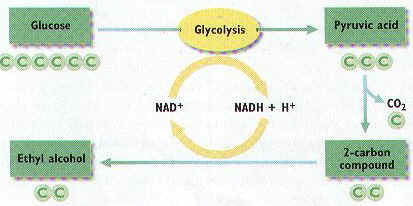
h. If no oxygen is available to the cell (anaerobic), the pyruvate will be fermented by addition of 2 H from the NADH (to alcohol + CO2 in yeast or lactic acid in muscle cells). This changes NADH back to NAD+ so it is available for step c above. This keeps glycolysis going!


Alcoholic Fermentation


Lactic Acid Fermentation


Aerobic Respiration:

  • Occurs in the mitochondria
  • Includes the Krebs Cycle & the Electron Transport Chain
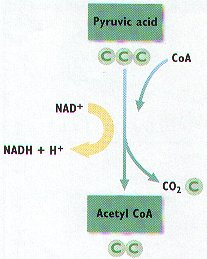
  • Pyruvic acid from glycolysis diffuses into matrix of mitochondria & reacts with coenzyme A to for acetyl-CoA (2-carbon compound)
  • CO2 and NADH are also produced

Kreb’s Cycle:

  • Named for biochemist Hans Krebs
  • Metabolic pathway that indirectly requires O2 
  • Kreb’s Cycle is also known as the Citric acid Cycle
  • Requires 2 cycles to metabolize glucose
  • Acetyl Co-A (2C) enters the Kreb’s Cycle & joins with Oxaloacetic Acid (4C) to make Citric Acid (6C)
  • Citric acid is oxidized releasing CO2 , free H+, & e- and forming ketoglutaric acid (5C)
  • Free e- reduce the energy carriers NAD+ to NADH2 and FAD+ to FADH2
  • Ketoglutaric acid is also oxidized releasing more CO2 , free H+, & e-
  • The cycle continues oxidizing the carbon compounds formed (succinic acid, fumaric acid, malic acid, etc.) producing more CO2, NADH2, FADH2, & ATP
  • H2O is added to supply more H+
  • CO2 is a waste product that diffuses out of cells
  • Oxaloacetic acid is regenerated to start the cycle again
  • NADH2 and FADH2 produced migrate to the Electron Transport Chain (ETC)


Net Yield from Kreb’s Cycle (2 turns)
6 NADH2
2 FADH2
4 CO2
2 ATP


Electron Transport Chain:

  • Found in the inner mitochondrial membrane or cristae
  • Contains 4 protein-based complexes that work in sequence moving H+ from the matrix across the inner membrane (proton pumps)
  • A concentration gradient of H+ between the inner & outer mitochondrial membrane occurs
  • H+ concentration gradient causes the synthesis of ATP by chemiosmosis
  • Energized e- & H+ from the 10 NADH2 and 2 FADH2 (produced during glycolysis & Krebs cycle) are transferred to O2 to produce H2O (redox reaction)

O2  +  4e-  +  4H+  2H2O


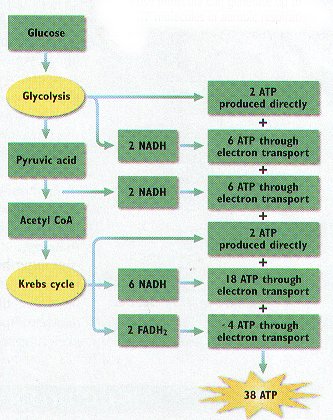
Energy Yield from Aerobic Respiration
Glycolysis Kreb’s Cycle Total
4 NADH2 6 NADH2 10 NADH2 x 3 = 30 ATP
0 FADH2 2 FADH2 2 FADH2 x 2 = 4 ATP
2 ATP 2 ATP                          4 ATP
38 ATP


  • Most cells produce 36- 38 molecules of ATP per glucose (66% efficient)
  • Actual number of ATP’s produced by aerobic respiration varies among cells


Chapter 13 Biotechnology PPT Questions


DNA Technology
ppt Questions

DNA Extraction

1. When cells are treated with certain chemicals, it causes the plasma membrane to __________ or lyse.

2. DNA can be pulled out of cells because it is ________________ and can be ______________.

3. Describe the appearance of DNA spooled from cells.


4. What may be used to cut DNA into smaller pieces?

5. Do all restriction enzymes cut DNA at the same place?

6. What 2 properties can be used to separate DNA fragments?

7. Why does DNA have a negative charge?


8. To separate DNA fragments, it is placed in a ____________ with a current of _____________ running through it.

9. This process is called ____________________.

10. What determines the direction DNA will move in a gel?


11. Which fragments move further and faster?

12. DNA fragments are loaded into depression on the gel called _____________.

13. The DNA gel floats in a chamber covered with a ____________ solution.

14. DNA fragments closest to the wells are ___________ in size, while the __________ DNA fragments are further from the wells.

Steps in DNA Sequencing 

15. Many copies of a ______________ of DNA are placed in a test tube and ________________ is added to begin the process.

16. What else must be added?

17. How are the different nucleotide bases marked or tagged?


18. Dyed and _____________ nucleotides are added, but the large __________ molecules stop the chain from growing producing DNA fragments of _______________ sizes.

19. The fragments make banding patterns on an electrophoresis gel of different _____________ that can be identified.

20. The separated fragments are then read by _____________ from the ________ of the gel to the top.

Copying DNA

21. Define PCR and tell what it stands for.


22. To make many copies of DNA, DNA polymerase is added that can work at very high _______________. 

23. DNA is _____________ to separate the two strands.

24. What is added next to the test tube of DNA and DNA polymerase?

25. What are primers?


26. When the tube is cooled, DNA polymerase adds new ___________ to the separated DNA strands.

27. Even though a small amount of DNA is used to start PCR, ___________ amounts of DNA can be copied.

Cloning

28. What is a clone?


29. Clones may be produced by _____________ reproduction.

30. What two types of cells are combined in order to clone an organism?


31. Once a body cell fuses to an egg cell, the cell divides like a normal _____________.

32. What was the first successfully cloned organism?


Human Genome Project

33.  When was the project started?

34. What is the goal of the project?


35. How many nucleotides approximately make up the human genome?  How many chromosomes?


36. Who is mapping the genes on the human chromosomes?

37. From working on the Human Genome project, scientists have discovered that only about ________ actually codes for proteins; these genes are called _____________.

38. What is the other 98% or non-coding genes of DNA known as?

39. How many genes have been found on DNA?  Is this more or less than the expected number?


40. What are SNP’s that the scientists found?


41. Define proteome.


42. Human Genome researchers discovered transposons.  What are these structures?


43. The Human Genome Project was produced an area of science known as bioinformatics.  how is this helpful in sequencing DNA?


44. Define biotechnology.


45. Give an example of an agricultural crop grown in this area that has been improved by genetic engineering.

46. What product was 1st made in 1982 by genetic engineering to help diabetics?

47. Explain how biotechnology has improved each of these fruits or vegetables:

a. bananas

b. rice

c. garlic

d. potatoes


48. Give 4 ways biotechnology has helped the environment.


Catalase Lab Sample 1


Enzyme Rate of Reaction for Catalase


Introduction:
Enzymes are an important part of life that regulate chemical reactions with in the body. Enzymes speed up chemical reactions in four different ways, one way is heat, another is increasing the rate of reactants, the third way is decreasing the amount of products and the fourth way is enzymes, which speed up reaction without themselves being used up. Enzymes are also involved in digestion, respiration, reproduction, vision, movement, thought, and also in the productions of other enzymes. Simple cells may have as many as 2000 enzymes with each one catalyzing a different reaction. An enzyme can speed up a reaction making it 10, 000,000,000 times faster. An enzyme is a catalyst. A catalyst is a chemical that reduces the amount of activation interim needed for a reaction. Without enzymes a reaction would take much longer than if it had and enzyme. Enzymes also the control the rate and direction of the reaction.
Without catalysts chemical reactions would take much longer that the average human life expectancy. So that would mean that in 76 years only a couple chemical reactions would take place. Since our bodies have enzymes though hundreds of chemical reactions a day. If our bodies didn’t have catalysts our bodily cells couldn’t function. Some bacteria, however, possess a defense mechanism which can minimize the harm done by the two compounds. These resistant bacteria use two enzymes to catalyze the conversion of hydrogen peroxide  back into diatomic oxygen and water. One of these enzymes is catalase and its presence can be detected by a simple test. The catalase test involves adding hydrogen peroxide to a cultures sample or an agar slant.


Hypothesis:
The reaction rate of catalase splitting hydrogen peroxide into water and oxygen will increase over time.

Materials:
The materials used consisted of 100 paper H2O2 molecules, a data table, paper, pencil, calculator, scissors, watch with a second hand, and an enzyme rate of reaction catalase worksheet.

Methods:
Cut out 100 hydrogen peroxide paper molecules. Double check to make sure there are only 100 paper molecules and place them in an envelope. Then one person will keep track of the time while another person acts as a catalase and tears the paper hydrogen peroxide molecules in half. The torn paper molecules should be returned to the envelope each time. Another person times the person acting as the catalase.  The time intervals in which the paper molecules are to be ripped are 10 seconds, 20 seconds, 30 seconds, and two different 60second periods of time. The results should be  recorded in a data table. The reaction rate for catalase is figured using the formula:
M2 – M1 = Reaction Rate
T2  –  T1


Results:


Time in Seconds Ripped H2O2 Molecules Rate of Reaction
0-10 5 .5
10-30 13 .4
30-60 31 .6
60-120 61 .5
120-180 91 .5


1. What is an enzyme? What are its functions in living things?
chemicals that reduce the amount of activation energy needed for reactions to occur; they are proteins in cells that control metabolic reactions


2. Name several things that can affect the functioning of an enzyme.
temperature, pH, and the amount of reactant or product


3. Write the chemical equation for the breakdown of hydrogen peroxide by the enzyme catalase.
H2O2   +   Catalase –>  H2O  + O2


4. An enzyme’s efficiency increases with greater substrate concentration, but only up to a point. Why?
once all active sites are filled, the enzyme’s reaction rate won’t continue increasing


5. If you were allowed to continue this lab and rip hydrogen peroxide molecules for 240 and 300 seconds, what would happen to the reaction rate and why would this happen?
there would be more molecules ripped because of the increased amount of time


6. What can you say about the length of time and the reaction rate?
The more time available, the faster the reaction will occur.


7. What would happen to the reaction rate if you removed the water and oxygen molecules as soon as they were produced?
The rate of reaction would go even faster


Error Analysis:
The counting of the time  may have been off a couple of seconds.


Discussion and Conclusion:
The data shows that the more time there is, the more hydrogen peroxide molecules will be ripped. The catalase in the lab ripped about 6 molecules every 5 seconds. The same thing occurs in a cell as more hydrogen peroxide is produced, catalase speeds up breaking down this waste into water and oxygen.

Back


Catalase Peroxide Lab


Enzyme Rate of Catalase


Introduction:

Enzymes are molecular substances found in cells.  Enzymes act as catalysts and most are proteins.  Enzymes bind temporarily to one or more of the reactants of the reaction they catalyze. In doing so, they lower the amount of activation energy needed and thus speed up the reaction.
 Not only do enzymes economize energy usage, but also provide a variety of other functions. Cells uses an enzyme (catalase) to rid itself of a poisonous substance (hydrogen peroxide). The rate at which this occurs depends on the amount of catalase that is available. In this lab we are going to measure the time it takes for a disc of filter paper, soaked with different concentrations of enzyme, to make its way to the top of a plastic vial filled with peroxide.  Rate of enzyme activity = distance (depth of hydrogen peroxide in mm)/time (in sec).

Catalase catalyzes the decomposition of hydrogen peroxide into water and oxygen.  One molecule of catalase can break 40 million molecules of hydrogen peroxide each second.

catalase
2H2O2 —–> 2H2O + O2

Objectives:

Students will prepare various dilute solutions from a 100% enzyme solution.
Students will determine how enzyme concentration affects reaction rate.


Materials:

6 medicine cups for dilutions, *catalase stock solution, clear plastic vial, forceps, 18 filter paper disks, Hydrogen Peroxide (H2O2), paper towel, apron, safety glasses, watch with second hand, marker, metric ruler, calculator

* The enzyme has been prepared for you as follows: 50g of peeled potato was mixed with 50 ml cold distilled water and crushed ice and homogenized in a blender for 30 seconds. This extract was filtered through cheesecloth and cold distilled water was added to a total volume of 100 ml. Extract concentration is arbitrarily set at 100 units/ml. ENZYME SHOULD BE KEPT ON ICE AT ALL TIMES!!

Procedure:

  1. Make a series of dilutions of the enzyme catalase using the following table.


Final Quantity Needed Concentration of Final Solution mL of Catalase mL of Water
10 ml 100% c10 0
10 ml 80% 8 2
10 ml 60% 6 4
10 ml 40% 4 6
10 ml 20% 2 8
10 ml 0% 0 10


  1. Use a marking pencil and mark the enzyme solutions as follows: 100%, 80%, 60%, 40%, 20%, and 0%.
  2.  Fill a clear vial with 20 mL of hydrogen peroxide.
  3. Using your forceps, pick up one filter paper disk and submerge it in the 100% enzyme solution for 5 seconds. Continue to hold the disk with the forceps.
  4. Using your forceps, pick up one filter paper disk and submerge it in the 100% enzyme solution for 5 seconds. Continue to hold the disk with the forceps.
  5. Remove the disk from the solution and blot it dry, for five seconds, using your paper towel.
  6. Drop the disk in the hydrogen peroxide and measure the time it takes for the disk to rise up from the bottom. Begin timing as soon as the disk touches the surface of the hydrogen peroxide.
  7. Use the metric ruler to measure the distance the disk sinks into the hydrogen peroxide. multiply by two to determine the entire distance the disk traveled. Enter the time and distance the disk traveled in the column for Trial 1 in the data table below.


% Catalase

Time in seconds

Distance in millimeters

Reaction Rate mm/s
Trial 1 Trial 2 Trial 3 Avg. Trial 1 Trial 2 Trial 3 Avg.
100
80
60
40
20
0


  1. Repeat the above steps for the remainder of the solutions. Remember to use clean filter paper each time you use a different solution. Enter the times and distances for trial 2 and 3 in their appropriate columns.

Analysis & Conclusion:

1. Which concentration of catalase had the fastest reaction time?

2. Which concentration of catalase had the slowest reaction time?

3. What is catalase & why is it important to cells in your body?


4. How did you know that catalase was present in the above compounds?


5. What 2 substances form when catalase breaks down hydrogen peroxide?


6. What type of organic compound is catalase?

7. Produce a line graph of the above data. Use the enzyme concentration as the independent variable and the reaction rate as the dependent variable.

Graph Title:__________________________________________________

Legend:

8.  Based on the graph and overall slope of the line, what can you conclude about the effect of enzyme concentration on reaction rate?