AP Genetics Problems


Genetics Problems

1. A rooster with gray feathers is mated with a hen of the same phenotype. Among their offspring, 15 chicks are gray, 6 are black, and 8 are white.

  • What is the simplest explanation for the inheritance of these colors in chickens?
  • What offspring would you predict from the mating of a gray rooster and a black hen?

2. In some plants, a true-breeding, red-flowered strain gives all pink flowers when crossed with a white-flowered strain: RR (red) x rr (white) —> Rr (pink). If flower position (axial or terminal) is inherited as it is in peas what will be the ratios of genotypes and phenotypes of the generation resulting from the following cross: axial-red (true-breeding) x terminal-white? What will be the ratios in the F2 generation?

3. Flower position, stem length, and seed shape were three characters that Mendel studied. Each is controlled by an independently assorting gene and has dominant and recessive expression as follows:


Character Dominant Recessive
Flower position Axial (A ) Terminal (a )
Stem length Tall (T ) Dwarf (t )
Seed shape Round (R ) Wrinkled (r)


If a plant that is heterozygous for all three characters were allowed to self-fertilize, what proportion of the offspring would be expected to be as follows: (Note – use the rules of probability (and show your work) instead of huge Punnett squares)

  1. homozygous for the three dominant traits
  2. homozygous for the three recessive traits
  3. heterozygous
  4. homozygous for axial and tall, heterozygous for seed shape

4. A black guinea pig crossed with an albino guinea pig produced 12 black offspring. When the albino was crossed with a second one, 7 blacks and 5 albinos were obtained.

  • What is the best explanation for this genetic situation?
  • Write genotypes for the parents, gametes, and offspring.

5. In sesame plants, the one-pod condition (P ) is dominant to the three-pod condition (p ), and normal leaf (L ) is dominant to wrinkled leaf (l) . Pod type and leaf type are inherited independently. Determine the genotypes for the two parents for all possible matings producing the following offspring:

  1. 318 one-pod normal, 98 one-pod wrinkled
  2. 323 three-pod normal, 106 three-pod wrinkled
  3. 401 one-pod normal
  4. 150 one-pod normal, 147 one-pod wrinkled, 51 three-pod normal, 48 three-pod wrinkled
  5. 223 one-pod normal, 72 one-pod wrinkled, 76 three-pod normal, 27 three-pod wrinkled

6. A man with group A blood marries a woman with group B blood. Their child has group O blood.

  • What are the genotypes of these individuals?
  • What other genotypes and in what frequencies, would you expect in offspring from this marriage?

7. Color pattern in a species of duck is determined by one gene with three alleles. Alleles H and I are codominant, and allele i is recessive to both. How many phenotypes are possible in a flock of ducks that contains all the possible combinations of these three alleles?

8. Phenylketonuria (PKU) is an inherited disease caused by a recessive allele. If a woman and her husband are both carriers, what is the probability of each of the following?

  1. all three of their children will be of normal phenotype
  2. one or more of the three children will have the disease
  3. all three children will have the disease
  4. at least one child out of three will be phenotypically normal

(Note: Remember that the probabilities of all possible outcomes always add up to 1)

9. The genotype of F1 individuals in a tetrahybrid cross is AaBbCcDd. Assuming independent assortment of these four genes, what are the probabilities that F2 offspring would have the following genotypes?

  1. aabbccdd
  2. AaBbCcDd
  3. AABBCCDD
  4. AaBBccDd
  5. AaBBCCdd

10. In 1981, a stray black cat with unusual rounded curled-back ears was adopted by a family in California. Hundreds of descendants of the cat have since been born, and cat fanciers hope to develop the “curl” cat into a show breed. Suppose you owned the first curl cat and wanted to develop a true breeding variety.

  • How would you determine whether the curl allele is dominant or recessive?
  • How would you select for true-breeding cats?
  • How would you know they are true-breeding?

11. What is the probability that each of the following pairs of parents will produce the indicated offspring (assume independent assortment of all gene pairs?

  1. AABbCc x aabbcc —-> AaBbCc
  2. AABbCc x AaBbCc —–> AAbbCC
  3. AaBbCc x AaBbCc —–> AaBbCc
  4. aaBbCC x AABbcc —-> AaBbCc

12. Karen and Steve each have a sibling with sickle-cell disease. Neither Karen, Steve, nor any of their parents has the disease, and none of them has been tested to reveal sickle-cell trait. Based on this incomplete information, calculate the probability that if this couple should have another child, the child will have sickle-cell anemia.

13. Imagine that a newly discovered, recessively inherited disease is expressed only in individuals with type O blood, although the disease and blood group are independently inherited. A normal man with type A blood and a normal woman with type B blood have already had one child with the disease. The woman is now pregnant for a second time. What is the probability that the second child will also have the disease? Assume both parents are heterozygous for the “disease” gene.

14. In tigers, a recessive allele causes an absence of fur pigmentation (a “white tiger”) and a cross-eyed condition. If two phenotypically normal tigers that are heterozygous at this locus are mated, what percentage of their offspring will be cross-eyed? What percentage will be white?

15. In corn plants, a dominant allele I inhibits kernel color, while the recessive allele i permits color when homozygous. At a different locus, the dominant gene P causes purple kernel color, while the homozygous recessive genotype pp causes red kernels. If plants heterozygous at both loci are crossed, what will be the phenotypic ratio of the F1 generation?

16. The pedigree below traces the inheritance of alkaptonuria, a biochemical disorder. Affected individuals, indicated here by the filled-in circles and squares, are unable to break down a substance called alkapton, which colors the urine and stains body tissues. Does alkaptonuria appear to be caused by a dominant or recessive allele? Fill in the genotypes of the individuals whose genotypes you know. What genotypes are possible for each of the other individuals?
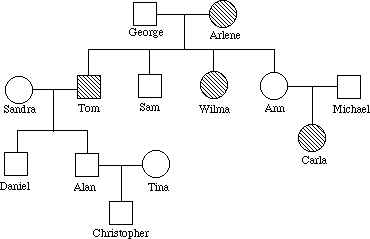
 
17. A man has six fingers on each hand and six toes on each foot. His wife and their daughter have the normal number of digits (5). Extra digits is a dominant trait. What fraction of this couple’s children would be expected to have extra digits?

18. Imagine you are a genetic counselor, and a couple planning to start a family came to you for information. Charles was married once before, and he and his first wife had a child who has cystic fibrosis. The brother of his current wife Elaine died of cystic fibrosis. What is the probability that Charles and Elaine will have a baby with cystic fibrosis? (Neither Charles nor Elaine has the disease)

19. In mice, black color (B ) is dominant to white (b ). At a different locus, a dominant allele (A ) produces a band of yellow just below the tip of each hair in mice with black fur. This gives a frosted appearance known as agouti. Expression of the recessive allele (a ) results in a solid coat color. If mice that are heterozygous at both loci are crossed, what will be the expected phenotypic ratio of their offspring?

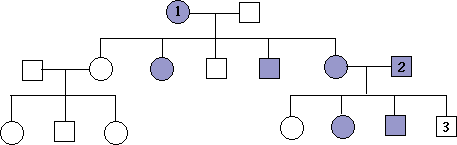
20. The pedigree below traces the inheritance of a vary rare biochemical disorder in humans. Affected individuals are indicated by filled-in circles and squares. Is the allele for this disorder dominant or recessive? What genotypes are possible for the individuals marked 1, 2, and 3.


Solutions

AP Grades


AP Biology Grades    

August 20, 2011
First Nine Weeks Grades

2nd Period 4th Period
CHERYL MASSENGALE COMPLETE DETAILED RECORD – Quarter 1
2 AP BIOLOGY 1 2
Qtr. 1 Aug 18, 2011 100100 QUARTER Method: Weight/Categories
Student H T HOMEWORK LAB QUIZ TEST Qtr. 1
= = > 100100 A 100% A 100% A 100%
= = > 100 94 A 100% A 94% A 95%
= = > 80 94 B- 80% A 94% A- 92%
= = > 100 89 A 100% B+ 89% A- 90%
= = > 100 87 A 100% B+ 87% B+ 89%
= = > 100 83 A 100% B- 83% B 85%
= = > 80 B- 80% B- 80%
= = > 100 72 A 100% C- 72% C 76%
Average = = > 98 91 A 98% A- 91% A- 92%
WT.10% WT.20% WT.70% Weight/Percentages
ASSIGNMENTS FOR 2 AP BIOLOGY Quarter 1
AUG 16 1 H 100 IS SAM ALIVE WKSH AUG 17 2 T 100 SAFETY TEST


CHERYL MASSENGALE COMPLETE DETAILED RECORD – Quarter 1
4 AP BIOLOGY 1 2
Qtr. 1 Aug 18, 2011 100100 QUARTER Method: Weight/Categories
Student H T HOMEWORK LAB QUIZ TEST Qtr. 1
= = > 100 A 100% A 100%
= = > 100 94 A 100% A 94% A 95%
= = > 80 94 B- 80% A 94% A- 92%
= = > 100 89 A 100% B+ 89% A- 90%
= = > 100 83 A 100% B- 83% B 85%
= = > 100 72 A 100% C- 72% C 76%
Average = = > 99 89 A 99% B+ 89% A- 90%
WT.10% WT.20% WT.70% Weight/Percentages
ASSIGNMENTS FOR 4 AP BIOLOGY Quarter 1
AUG 16 1 H 100 IS SAM ALIVE WKSH AUG 17 2 T 100 SAFETY TEST


6th Period 7th Period
CHERYL MASSENGALE COMPLETE DETAILED RECORD – Quarter 1
6 AP BIOLOGY 1 2
Qtr. 1 Aug 18, 2011 100100 QUARTER Method: Weight/Categories
Student H T HOMEWORK LAB QUIZ TEST Qtr. 1
= = > 100100 A 100% A 100% A 100%
= = > 100 94 A 100% A 94% A 95%
= = > 100 89 A 100% B+ 89% A- 90%
= = > 100 83 A 100% B- 83% B 85%
= = > 100 78 A 100% C+ 78% B- 81%
= = > 100 72 A 100% C- 72% C 76%
= = > EX EX
Average = = > 100 89 A 100% B+ 89% A- 90%
WT.10% WT.20% WT.70% Weight/Percentages
ASSIGNMENTS FOR 6 AP BIOLOGY Quarter 1
AUG 16 1 H 100 IS SAM ALIVE WKSH AUG 17 2 T 100 SAFETY TEST


CHERYL MASSENGALE COMPLETE DETAILED RECORD – Quarter 1
7 AP BIOLOGY 1 2
Qtr. 1 Aug 18, 2011 100100 QUARTER Method: Weight/Categories
Student H T HOMEWORK LAB QUIZ TEST Qtr. 1
= = > 100100 A 100% A 100% A 100%
= = > 100 94 A 100% A 94% A 95%
= = > 100 89 A 100% B+ 89% A- 90%
= = > 100 83 A 100% B- 83% B 85%
= = > EX EX
Average = = > 100 90 A 100% A- 90% A- 91%
WT.10% WT.20% WT.70% Weight/Percentages
ASSIGNMENTS FOR 7 AP BIOLOGY Quarter 1
AUG 16 1 H 100 IS SAM ALIVE WKSH AUG 17 2 T 100 SAFETY TEST


cmassengale

Worksheet Specialist Characteristics

SPECIALIST’S DATA SHEET

Using the table below list the characteristics that are used to help describe and classify each of your specialization areas. Be sure to explain in as much detail as possible what traits and characteristics are used to identify and classify the specific organism or kingdom that you have become a specialist.


  #1:  (Example – Monera Characteristics)
#2: ( Example – Protista Characteristics)


BACK

AP Calendar 2010-11


1st Semester AP Biology


AUGUST SEPTEMBER OCTOBER NOVEMBER DECEMBER JANUARY FEBRUARY MARCH APRIL MAY


2010

Monday Tuesday Wednesday Thursday Friday
16 17 18 19 20
23 24 25 26 27
30 31


TOP


2010

Monday Tuesday Wednesday Thursday Friday
1 2 3


6 7 8 9 10
UNIT 1A BIOCHEMISTRY TEST
(Chapters 1-3)

13 14 15 16 17
UNIT 1B BIOCHEMISTRY TEST
(Chapters 4 & 5)


EARLY LEAF COLLECTION DUE (20)

20 21 22 23 24
EARLY LEAF COLLECTION DUE (10)

LEAF COLLECTION DUE

INTERIMS

P-T Conference SHS

P-T Conference SJHS

27 28 29 30  


TOP


2010

Monday Tuesday Wednesday Thursday Friday
1
4 5 6 7 8
UNIT 2 CELL TEST

11 12 13 14 15

PROFESSIONAL DEVELOPMENT
18 19 20 21 22
25 26 27 28 29


UNIT 3 CELLULAR ENERGETICS TEST


TOP


2010

Monday Tuesday Wednesday Thursday Friday
1 2 3 4 5
  • Start Mendelian Genetics ppt
  • Handout: Mendelian Genetics Notes
  • Finish Mendelian Genetics ppt
  • Start Chromosomes ppt
8 9 10 11 12
  • Genetic Problem Worksheet DUE
  • Continue Chromosomes ppt
  • Finish Chromosomes ppt
  • Finish going over Genetics Problems
UNIT 4 GENETICS TEST

  • Cry Quiz #2
  • Continue Corn Genetics Lab
15 16 17 18 19
  • Chapter 16 Reading Guide DUE
  • Start Nucleic acids ppt
  • Corn Genetics Lab DUE
  • Continue Nucleic acids ppt
  • Read Chapter 17 Gene to Protein
  • Answer Chapter 17 Reading Guide
  • Handout: Nucleic acids
  • Start Gene to Protein ppt
  • Continue Gene to Protein ppt
  • Chapter 17 Reading Guide DUE
  • Finish Gene to Protein ppt
  • Spool DNA
  • Read Chapter 20 Biotechnology
  • Answer Chapter 20 Reading Guide
22 23 24 25 26
 
29 30
  • Start Biotechnology ppt
  • Continue Biotechnology ppt
  • Answer Chapter 20 Reading Guide DUE


TOP


2010

Monday Tuesday Wednesday Thursday Friday
1 2 3
  • Start Lab 3 Sordaria Lab
  • Finish Sordaria Lab
  • Cry Quiz #3
6 7 8 9 10
UNIT 5 MOLECULAR BIOLOGY TEST
  • Sordaria Lab DUE
  • Start Population Ecology Lab
  • Complete Population Ecology Lab
  • Cry of the Kalahari paper DUE!
  • Assign Ecology Unit
  • Population Ecology Lab DUE
  • Work on Ecology Unit
13 14 15 16 17
Proficient-Advanced Students Exempt

ECOLOGY UNIT

Proficient-Advanced Students Exempt

ECOLOGY UNIT

Proficient-Advanced Students Exempt

ECOLOGY UNIT

Proficient-Advanced Students Exempt

ECOLOGY UNIT

END OF 2ND 9 WEEKS

ECOLOGY UNIT DUE JANUARY 5

Enjoy Your Christmas Vacation!


TOP


2nd Semester Biology


2011

Monday Tuesday Wednesday Thursday Friday
 3 4 5 6 7
 ECOLOGY UNIT DUE
10 11 12 13 14
UNIT 11 ECOLOGY TEST
17 18 19 20 21

MLK DAY!
24 25 26 27 28
UNIT 6 EVOLUTION TEST
31
  • Assign Darwin Day Project


TOP


2011

Monday Tuesday Wednesday Thursday Friday
1 2 3 4
7 8 9 10 11
P-T Conference SJHS
P-T Conference SHS
  • Darwin Day Celebration; Project DUE
14 15 16 17 18
UNIT 7 VIRUSES & SIMPLE ORGANISMS TEST
21 22 23 24 25
President’s Day
28


TOP


2011

Monday Tuesday Wednesday Thursday Friday
1 2 3 4
UNIT 8A PLANTS TEST
7 8 9 10 11
Literacy Test Literacy Test END OF 3rd 9 WEEKS
14 15 16 17 18
UNIT 8B PLANTS TEST
21 22 23 24 25
BREAK BREAK BREAK BREAK BREAK
28 29 30 31


TOP


2011

Monday Tuesday Wednesday Thursday Friday
1
4 5 6 7 8
UNIT 9A INVERTEBRATES
11 12 13 14 15
UNIT 9B VERTEBRATES
18 19 20 21 22
  • Assign Wildflower Collection
EOC GEOMETRY EOC GEOMETRY
25 26 27 28 29
UNIT 10A BODY SYSTEMS TEST


TOP


2011

Monday Tuesday Wednesday Thursday Friday
 2 3 4 5 6
 AP CALCULUS EXAM AP ENGLISH LIT EXAM UNIT 10B BODY SYSTEMS TEST
9 10 11 12 13
AP BIOLOGY EXAM
  • Start Fetal Pig Dissection
AP ENGLISH COMP EXAM AP HISTORY EXAM
  • Wildflower Collection DUE
16 17 18 19 20
  • TEST over FETAL PIGS
23 24 25 26 27
SEMESTER TEST SEMESTER TEST SEMESTER TEST
30 31
MEMORIAL DAY SEMESTER TEST


  2011

Monday Tuesday Wednesday Thursday Friday
1 2 3 4
 STUDENT’S LAST DAY  TEACHER’S WORK DAY


BACK