Teddy Graham Natural Selection Lab

Natural Selection in Teddy Grahams

Introduction

You are a bear-eating monster. There are two kinds of bears that you like to eat: happy bears and sad bears. You can tell the difference between them by the way they hold their hands. Happy bears hold their hands high in the air, and sad bears hold their hands down low. Happy bears taste sweet and are easy to catch. Sad bears taste bitter, are devious and hard to catch. Because of this you only eat happy bears. The happy trait in bears is caused by the expression of a recessive allele. The homozygous recessive condition is being happy. The sad trait is caused by a dominant allele. New bears are born every year (when they are hibernating in their den, the cardboard box), and the birth rate is one new bear for every old bear left from last year.

Materials:

Teddy Bear Grahams, lab worksheet, pencil

Procedure:

1. Obtain a population of 10 bears and record he number of happy and sad bears and the total population number. Using the equation for Hardy-Weinberg equilibrium, calculate the frequencies of both the dominant and recessive alleles and the genotypes that are represented in the population. Example: If 5 of the 10 bears are happy, then 10 out of 20 alleles would be happy alleles. Therefore the q2 number would be 0.5. You must then determine the q number by taking the square of 0.5.

2. Now, go hunting! Eat 3 happy bears. (If you do not have 3 happy bears then eat the difference in sad bears.)

3. Once you have consumed the bears obtain a new generation from your den (the box). You should only remove seven additional bears from the den for a total of 14 bears.

4. Repeat the procedures again. Be sure to record the number of each type of bear and the total population.

Table:


Generations P2 (sad) 2pq (sad) q2 (happy) P q
1. Initial
2.
3.
4.


Questions:

1. Describe what is happening to the genotype and allele frequencies in the population of Teddy Grahams?


2. What would you expect to happen if you continued the selection process for additional generations?


3. How would the frequencies change if you were to now select for the sad bears?


4. Why doesn’t the recessive allele disappear from the population? How is it protected?


TRAINING – HOW TO USE SMART BOAR

TRAINING – HOW TO USE SMART BOARDS
http://www.teacheronlinetraining.com/complimentary/ – Online training(60 minutes)
SMART BOARD FORUMS
Learn and share with other educators.
http://smartboardrevolution.ning.com/ – All SMART Board educators, unite! Let’s share ideas, tips, and lesson files and collaborate to maximize our students’ learning.
http://projects.minot.k12.nd.us/groups/smarttechnologies/ – SMART board Technology site: area to share and learn.
LESSONS AND TEMPLATES
http://www1.center.k12.mo.us/edtech/SB/templates.htm – Templates available for K-12 classes. http://eduscapes.com/sessions/smartboard/ – all grades
http://www1.center.k12.mo.us/edtech/resources/SBsites.htm – Interactive sites to use with your SMART board.
GAMES AND QUIZZES
Class Tools – Use this site to create your own interactive games using your curriculum.
http://tinyurl.com/27sbntd – Classroom games and quizzes, and other teacher resources
http://www.jigsawdoku.com/ – Jig Saw Doku http://tinyurl.com/25km2uo – SMART Boards and the Fifty Nifty States and Capitals
SCIENCE
http://www.getbodysmart.com/index.htm – AN ONLINE TEXTBOOK ABOUT HUMAN ANATOMY AND PHYSIOLOGY
SOCIAL STUDIES
http://tinyurl.com/25km2uo – SMART Boards and the Fifty Nifty States and Capitals

Understanding Graphs

Understanding Graphs

Graph 1: Rabbits Over Time

a. The graph shows a __________ growth curve.
b. The carrying capacity for rabbits is ______
c. During which month were the rabbits in exponential growth?


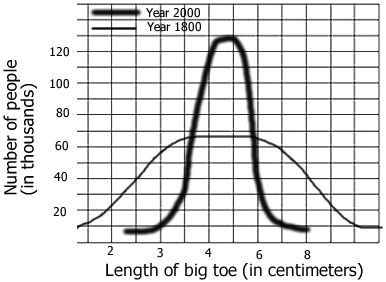
Graph 2: Average Toe Length

a. In 1800, about how many people surveyed had a 3 cm toe? _______
How many in 2000? _______
b. The data shows the ____________ selection has occurred?
c. In 2000, what is the average toe length? ______ What is the average toe length in 1800 _______?


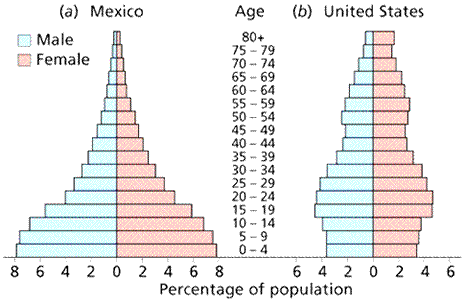
Graph 3: Mexico and US

a. In Mexico, what percentage of the population is between 0-4 years of age? _______ In the US? ______
b. Which population is growing the fastest? ________
c. Which age group has the smallest number in both countries? _____


Chart 4: Trapping Geese

In order to estimate the population of geese in Northern Wisconsin, ecologists marked 10 geese and then released them back into the population. Over a 6 year period, geese were trapped and their numbers recorded.

a. Use the formula to calculate the estimated number of geese in the area studied? _____________
b. This technique is called ____________ & ______________.
c. Supposing more of the geese found in the trap had the mark, would the estimated number of geese in the area be greater or lesser? _____


Year Geese Trapped Number with Mark
1980 10 1
1981 15 1
1982 12 1
1983 8 0
1984 5 2
1985 10 1

Chart 5: Mushroom Plots

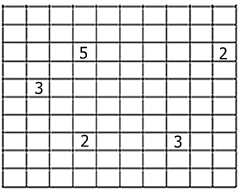
Another ecologist uses a different method to estimate the number of mushrooms in a forest. She plots a 10×10 area and randomly chooses 5 spots, where she counts the number of mushrooms in the plots and records them on the grid.

a. Calculate the number of mushrooms in the forest based on the grid data: _________________
b. This technique is called _______________


Chart 6: Snakes & Mice

The data shows populations of snake and mice found in an experimental field.

a. During which year was the mouse population at zero population growth? ______
b. What is the carrying capacity for snakes ? ______
c. What is the carrying capacity for mice? _____
d. What is the rate of growth (r) for mice during 1970? _____ During 1980? ______

Year Snakes Mice born Mice died
1960 2 1000 200
1970 10 800 300
1980 30 400 500
1990 15 600 550
2000 14 620 600
2001 15 640 580

Click here for printable copy (landscape) 

BACK

Semester Test Study Guide 2004 BI

Study Guide Semester Test 2004
Taxonomy, Plants, Invertebrates, & Vertebrates 

1.     Fruits of cereal plants are called __________________.

2.     Viral DNA becomes integrated into the host cell’s DNA during the ________________ cycle.

3.     Viruses only reproduce in ___________________.

4.      ____________________ use reverse transcriptase to transcribe DNA from RNA.

5.     Prions are composed only of __________________.

6.      RNA or DNA covered by a protein coat makes up a _______________.

7.     Classifying living things is called ______________________.

8.     From the kingdom to the species level organisms become more ___________________ in appearance.

9.     The system of classifying organisms by assigning genus & species names was developed by _________________.

10.    Which word in a scientific name is the genus?

11.   Noncellular structures that can’t make proteins or use energy, but can reproduce inside living cells would be ____________________.

12.  Scientists all over the world use the _______________, scientific name for an organism.

13.  Scientific names are written in ________________, a dead language.

14. The taxonomic hierarchy is kingdom, phylum, _________________, order, ______________, genus and _______________.

15. A waxy ________________ on the outside of plants prevents evaporation of fluids from the plant.

16. An internal system of connected tubes and vessels in some plants is called ______________________ tissue.

17.   __________________ tissue in plants transports water and minerals.

18. All seed plants have a seed containing an _________________, a ________________ supply, and a protective __________________.

19. Pines, cedars, spruce, and fir are examples of ____________________.

20. Monocot leaves have __________________ venation.

21. Plants grow in regions of active cell division called ________________.

22. Leaves connect to stems at areas called __________________.

23. ____________________ is the loss of water by the leaves & stem of a plant.

24. ____________________ tissue in plants transports sugars.

25. Multicellular heterotrophic organisms without cell walls would be in the kingdom _______________________.

26. Most animals have a head at the _________________ end and a tail located at the _______________ end.

27. Name a freshwater cnidarian closely related to the jellyfish.

28. The concentration of sensory organs on the anterior end of an animal is known as ________________________.

29. The sea anemone has ______________________ symmetry.

30.  The head of a fish would be located on the _______________ end.

31.   _________________ are animals whose cells are specialized but aren’t organized into tissues.

32.  The absence of a vertebral column or backbone is characteristic of all ______________________.

33. ________________ cells help draw water into a sponge.

34. Hard needle-like structures in the wall of a sponge are called __________________.

35. Sponges obtain food by _________________ feeding.

36. _________________ in sponges are cells that move throughout the sponge’s body wall to deliver food to the organism’s cells.

37. _____________________ organisms can produce both eggs and sperm.

38.  A sea anemone captures its prey using ___________________ in its tentacles.

39.  _________________ and _________________ are the two distinct life stages of cnidarians.

40. Name 3 cnidarians.

41. Sea anemones exist as _____________ in the adult stage.

42.                         Housed in chambers on each side of the head are the ______________ of bony fish.

43.                         __________________ mammals keep their offspring inside the mother until their development ids complete.

44. The ____________________ of fish helps them be buoyant in the water.

45. Amphibians breathe through lungs and their _______________.

46. The skin of reptiles is dry and ___________________.

47. Bird’s bones are _________________ and ________________.

48. Amphibian skin is thin and ______________ for __________ exchange.

49. The _______________ is a sheet of muscle below the rib cage in mammals to help them breathe.

50.  The _______________ egg allowed reptiles to adapt to life on land.

Simple Plants PowerPoint Questions

Simple Seedless Nonvascular & Vascular Plants
PowerPoint Worksheet

Seedless Nonvascular plants

1. Name the 3 divisions of seedless vascular plants and a member of each division.

     a.

     b.

     c.

Division Bryophyta

2. What is the common name for mosses, liverworts, and hornworts?

3. Bryophytes lack what type of tissue?

4. Name the 2 vascular tissues lacking in bryophytes and tell their function.


5. What is the 2 stage life cycle of plants called?

6. Name the 2 life cycle stages.

7. which stage is DOMINANT in bryophytes (mosses, liverworts, & hornworts)?

8. How do bryophytes reproduce?

9. Which stage of the moss looks like a lush green carpet?

10. Name the division for moss.

11. Why are moss small plants?

12. Do moss have TRUE roots, stems, or leaves?

13. In what type of area do moss grow?  Give several examples.


14.Moss gametophytes must grow close together in moist areas. Give 2 reasons why this is so.

     a.

     b.

15. What covers the outside of a moss plant to prevent water loss?

16. What anchors moss plants?

17. Can rhizoids absorb water like true roots?

18. Where does the sporophyte generation occur on moss plants?


19. What is at  the top of the sporophyte?

20. Label the following moss plant.
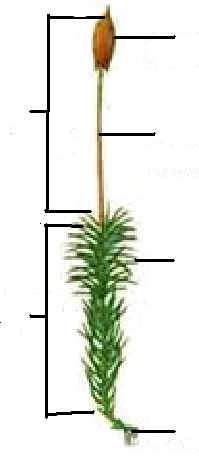
21. ___________ moss is used by florist. What characteristic makes it useful?


22. Because moss will grow on bare ground, it is called a _________ plant.

23. How is peat moss used?


24. Give 4 other uses for moss.


25. Moss are capable of asexual reproduction. Name and describe 2 types of this vegetative reproduction.

     a.

     b.

26. What are gemmae?


27. How are gemmae separate from the parent plant & dispersed?


28. Which stage of the moss is haploid and which is diploid?

29. The gametophyte generation produces what 2 cells? 

30. Why do these cells have half the chromosome number?

31. ____________ have a ________ set of chromosomes and reproduce ___________.

32. the sporophyte grows attached to the top of the ______________.

33. Since sporophytes lack chlorophyll, what cellular process are they incapable of doing?

34. How does the sporophyte get its food?

35. What is the setae on a moss plant?

36. How are the moss gametes protected?


37. Name the female gametangia & tell what it produces.

38. Eggs of moss are _____________ & ___________.

39. Label the female gametangia.
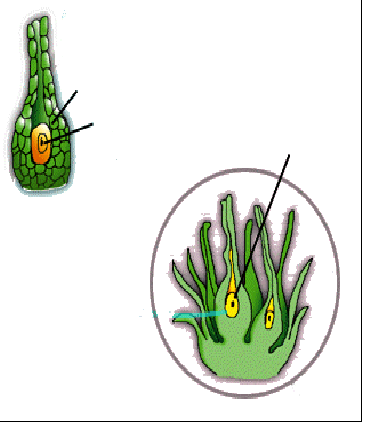
40.  Name the male gametangia & tell what it produces.

41.How does the sperm cell know the direction in which to swim to the egg?


42. Label the male gametangia.
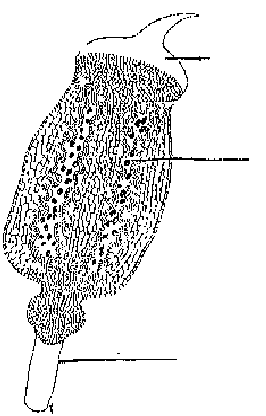
43. The moss ___________ or fertilized egg develops into the ____________.

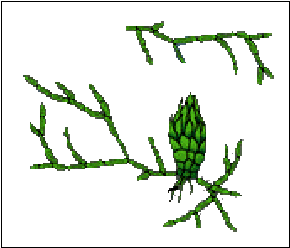
44. Spores of the sporophyte capsule germinate into young plants called ______________.

45. Protonema develop into the _____________ stage

46. Label the protonema & developing gametophyte in this picture.
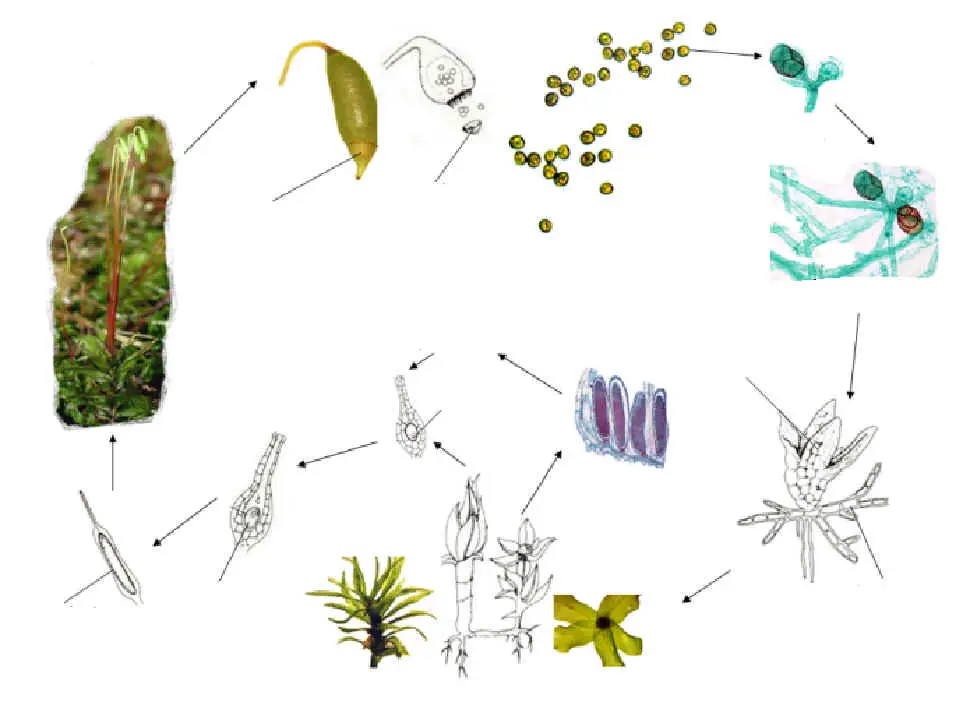
47. Label the life cycle of the moss.
Division Hepatophyta

48. ___________ are nonvascular, _________ producing bryophytes.

49. What stage is dominant in liverwort’s life cycle?

50. Describe the liverwort gametophyte.


51.Liverworts are found growing where?


52. Liverworts need lots of water for ____________.

53. How do liverworts reproduce asexually?

54. How do liverworts reproduce sexually?

Division Anthocerophyta

55._____________ are small, nonvascular ____________ with a dominant, leafy ____________ like liverworts.

56. Where are the antheridia & archegonia in hornworts?

57. Zygotes develop into ______________ sporophytes.

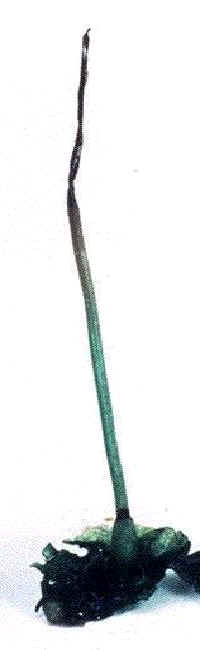
58. Is the horn-shaped sporophyte capable of photosynthesis?

59. Is the horn-shaped sporophyte attached to or separate from the gametophyte?

60. Label the parts of the hornwort.
Seedless Vascular Plants

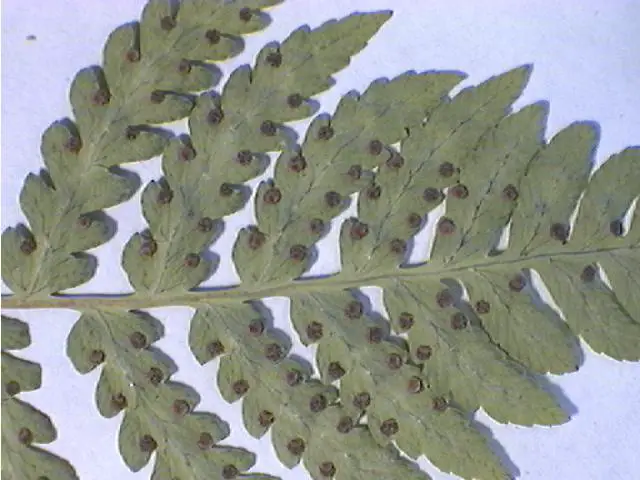
61.Label these structures on the back of this fern.
62. Name and give an example of a plant in the 4 divisions of seedless vascular plants.

     a.

     b.

     c.

     d.

63. Name the vascular tissues.

64. Do seedless vascular plants go through alternation of generations?

65. Which stage is dominant?

66. How do they reproduce?

Division Psilophyta

67.Describe whisk ferns.


68. Do they have true roots, stems, or leaves?

69.How many extant genera are there?

70. Name the root like structures of whisk ferns and tell whether they can or can’t absorb water.

71. How do whisk ferns reproduce asexually?

72. How do whisk ferns reproduce sexually?

73. Make and label a sketch of an aerial branch of whisk with sporangia.


74. What is the purpose of sporangia?

Division Lycophyta

75. The division Lycophyta contains the ______________ living vascular plants.

76. Club moss are commonly called ______________ ____________.  Explain why this is true.


77.Club moss have ________ growing root like ___________.

78. Describe the habitat needed by club moss.

79. Describe the leaves of club moss.


80. Are these TRUE leaves? Explain why.


81. What is found in the axils of the leaves & what is their purpose?

82. What are strobili?

83. Some club moss are homosporous while others are heterosporous.  Explain what each of these terms means.

     a. homosporous-

     b. heteroporous-

84. Give an example of a homosporous club moss.

85. Lycopodium is used in fireworks. Explain the reason for this.


86. What do the spores of Lycopodium look like?


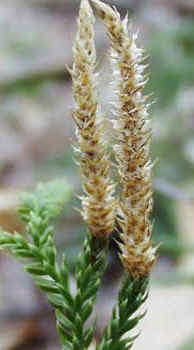
87.What is the purpose of each of these structures.
   

88. Give 3 other uses for club mosses.

     a.

     b.

     c.

Division Sphenophyta

89. How many extant species of horsetails are there?

90. Name the living genera of horsetails.

91. What is another name for horsetails?

92. Why are they called this?

93. Describe the stems of horsetails.


94. Where does photosynthesis take place in horsetails?

95. How are horsetails anchored?

96. How do horsetails reproduce?

97. Where are their spores found?

98. In prehistoric times, what was true of the size of horsetails?

99. Describe the habitat of horsetails.

100. How do horsetails prevent water loss from the parts of the plant above ground?

101. What special spore dispersing structures are found on the spores of horsetails?

102. Describe how elaters work.


103. Label the stem, node, and leaves on this horsetail.
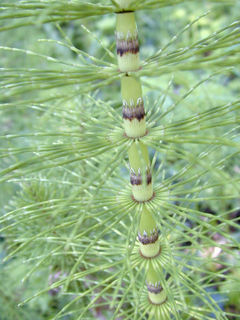
104. Give 3 other uses for  horsetails.

     a.

     b.

     c.

104. Can animals eat horsetails? Why or why not?


Division Pterophyta

105. Ferns are in the ____________ group of extant vascular plants.

106. Describe the habitats for ferns.


107. How do ferns reproduce asexually?

108. What stage is dominant in the life cycle of the fern?

109. What is the only part of the fern plant that appears above ground?  What parts are found below ground?

110. Fern leaves are called ______________ and are attached to the plant by short stems called ______________.

111. Describe the appearance of newly forming fern fronds and tell what they are called.


112. What are sori and where are they found?

113. How are fern spores spread?

114. What forms when a fern spore lands on moist ground and germinates (starts growing)?

115. The prothallus starts what stage in the life cycle?

116. What is the shape of the gametophyte and does it live long?

117. What 2 structures grow ON the gametophyte?

118. Label the gametophyte and the male and female gametangia.
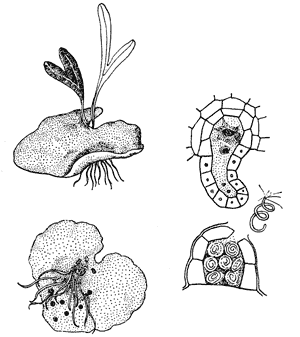
119. Label the parts of a fern.
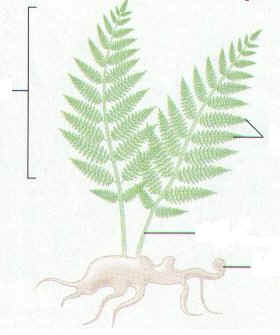
120. Label the life cycle of the fern.
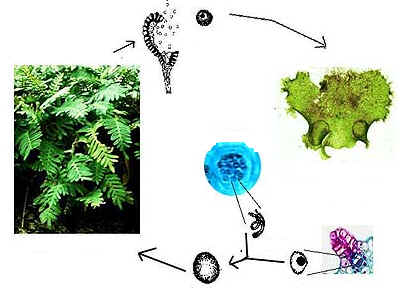
121. Give 4 uses for ferns.     a.

     b.

     c.

     d.