Loss of Biodiversity Activity


Loss of Biodiversity


Students will make a PowerPoint presentation on the topic of loss of biodiverisity in one of the following areas:

  • Fauna of Arkansas
  • North American Vertebrates
  • North American Invertebrates
  • North American Plants
  • Flora of Arkansas
  • Aquatic Habitats of Arkansas
  • Florida Everglades
  • Alaskan Tundra
  • United States Deserts
  • Along the Mississippi River
  • North American Waterfowl
  • North American Raptors
  • North American Reptiles
  • North American Amphibians
  • North American Mammals

The PowerPoint presentation will be presented to the class and must include 25 slides, 15 of which must include graphics such as images from your web search (save on disk as .jpeg), pictures from books or magazines that you have scanned and inserted into your program, or photographs taken with a digital camera. You should also include three of the following as part of your slide presentation:

  1. Maps
  2. Graphs
  3. Lists
  4. Photograph of a person you interviewed

Your PowerPoint presentation must be accompanied by a written script that corresponds to the numbered order of your slides. The following must be included in your PowerPoint presentation and script:

  1. Name/Description of your chosen area (include a picture if available)
  2. Explanation of the physical environment of the area — climate, water, temperature, etc.
  3. Examples of threatened organisms ( include pictures)
  4. Reasons for organisms endangerment
  5. How the loss of these organisms is affecting other organisms &/or the environment
  6. Conservation measures being taken to prevent the loss of biodiversity in this area


Isopod Behavior


Isopods in Training  


Introduction:

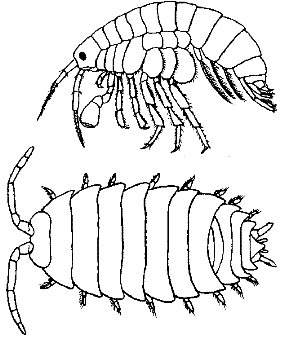
Terrestrial isopods are land dwelling crustaceans, commonly known as sowbugs or pillbugs (or rollypollys). They are related to lobsters, crabs, and shrimp and terrestrial isopods breath with gills. While they look similar, sow bugs are different from pill bugs. Pill bugs will curl into a ball when threatened whereas sow bugs will attempt to flee.

Ethology is the study of animal behavior. Many behaviors involve movement of the animal within its environment. In this exercise, you will investigate some innate (instincts) behaviors of isopods. Orientation is a process by which animals position themselves with respect to spatial features of their environments. Taxis involves the turning of an animal’s body relative to a stimulus – either toward or away. Kinesis is a random turning or movement of an animal in relation to a stimulus.

Materials:

isopods, behavior chamber, paper towels, water

Procedure – Orientation of Isopods in Response to Moisture

  1. Cut paper towels to fit into the bottom of BOTH sides of your behavior chamber.
  2. Moisten one side with tap water while keeping the other side dry.
  3. Transfer 5 isopods to each side of the chamber (total of 10).
  4. Count and record the number of animals on each side of the chamber every 30 seconds for ten minutes.
  5. Record your data in the data table.

Data:


Time # in Wet # in Dry
0:00
0:30
1:00
1:30
2:00
2:30
3:00
3:30
4:00
4:30
5:00
5:30
6:00
6:30
7:00
7:30
8:00
8:30
9:00
9:30
10:00


Analysis:

1. Based on your observations, do isopods prefer a moist or dry environment.

2. Would this movement be taxis or kinesis? Explain your answer.


3. Suggest a reason why this behavior might be advantageous to an isopod


4. Select one of the following factors and design an experiment to test for your hypothesis.


Factor Materials (suggested)
Temperature cold pack, warm pack
Light lamps, flashlights, dark construction paper, aluminum foil
pH low pH (HCl), high pH (NaOH)
Substrate (surface) soil, sand, sandpaper, bark, paper, cedar chips, gravel
Odor ammonia
Food apple, potato, fish food, lunchmeat
Other Organisms mealworms, crickets, earthworms


No Slide Title

This page uses frames, but your browser doesn’t support them.

Koch Postulates & Fungal Disease


Koch’s Postulates 


Introduction: 

    In the late nineteenth century, German scientist Robert Koch established a set of procedures to isolate and identify the causative agent of a particular microbial disease. The following four steps, which are still used today, are known as Koch’s Postulates.

  1. A specific organism must be always be observed in association with the disease.
  2.  The organism must be isolated from an infected host and grown in pure culture in the laboratory.
  3. When organisms from the pure culture are inoculated into a susceptible host organism, it must cause the disease.
  4. The infectious organism must be re-isolated from the diseased organism and grown in pure culture.

Objective:

In this investigation, your group will demonstrate Koch’s Postulates by using oranges as the host organisms. The infectious agent will be Penicillium notatum, a mold. You will isolate the culture on petri dishes of Potato Dextrose Agar.


Materials:

Penicillium notatum mold,  3 oranges, incubator, 10% bleach solution, apron, gloves, paper towels, detergent, small scrub brush, wide-mouth jar, portable burner, dissecting needle, large Ziplock bags, permanent marker, petri dish, potato dextrose agar, sterile swab


Click here for Aseptic Techniques


Procedure – Part A:     


Postulate 1.  A specific organism must be always be observed in association with the disease.


1. Disinfect the work area.


2. Obtain an orange and wash it thoroughly in cool, soapy water, scrubbing with a scrub brush. Rinse well.


3. Place the orange in a jar and cover with a 10% bleach solution. Let it stand for 10 minutes.


4. Rinse the orange for 10 minutes.


5. Flame a dissecting needle and allow it to cool. Then pierce the skin of the orange three or four times with the needle.


6. Flame the mouth of the tube of fungus and, using a sterile swab, aseptically remove a small sample and smear it over the puncture wounds in the orange.


7. Place the orange in a Ziploc bag. Label with your group number and date. The bag will be allowed to remain at room temperature or in an incubator at 25oC for about a week.


7. Prepare a data chart (Figure 1) to record daily observations. The chart should have places for the date, room temperature or incubator temperature, description of changes in the orange, and sketches.


8. Each day, record in a data chart your observations of the orange and the progress of the infection.


FIGURE 1:

Date Room/Incubator Temperature Observations


Procedure – Part B  


Postulate 2. The organism must be isolated from an infected host and grown in pure culture in the laboratory.


During the week or so of incubation, you should see a white powdery spore mass on the orange that soon changes to a greenish color. When the green appears, it is time to isolate the pathogen.


1. Disinfect work area.


2. Obtain a petri dish of Potato Dextrose Agar. Label the bottom of the plate with your group number and the date.


3. With a sterile swab, aseptically transfer some of the spore mass to the plate of Potato Dextrose Agar. Streak across the plate in parallel lines.


4. Incubate the plates upside down at room temperature or in an incubator at 25oC for 5 – 7 days until the mold produces spores.


5. Make another data chart (Figure 2) to record observations of the growth on the petri dish.


6. Each day, record in a data chart your observations of the growth in the petri dish. (Do not remove the cover of the dish when making observations.)


FIGURE 2:

Date Room/Incubator Temperature Observations


Procedure – Part C:  


Postulate 3. When organisms from the pure culture are inoculated into a susceptible host organism, it must cause the disease.


Once the culture in the petri dish has produced spores, you can inoculate susceptible organisms.


1. Disinfect work area.


2. Obtain two oranges and scrub them thoroughly in cool, soapy water. Rinse well.


3. Place the oranges in a jar and cover with a 10% bleach solution. Let stand for 10 minutes.


4. Rinse the oranges for 10 minutes.


5. Flame a dissecting needle and allow it to cool. Then pierce the skin of each orange three or four times with the needle.


6. Using a sterile swab, aseptically remove a small sample of mold spores from the petri dish. Smear it over the puncture wounds in one of the oranges.


7. Place the oranges in separate Ziploc bags. Label with your group number and date. Label the orange that is NOT inoculated, “CONTROL.” The bags will be allowed to remain at room temperature or in an incubator at 25oC for about a week.


8. Prepare a data chart (Figure 3) to record daily observations.


9. Each day, record in the data chart your observations of the oranges and the progress of the infection.


FIGURE 3:

Date Room/Incubator Temperature Observations


Procedure – Part D:  


Postulate 4. The infectious organism must be re-isolated from the diseased organism and grown in pure culture.


When the spore mass appears on the inoculated orange, it is time to re-isolate the culture.


1. Disinfect work area.


2. Aseptically transfer a sample of the spores from the inoculated orange from Procedure 3 to a petri dish of Potato Dextrose Agar. Label the plate.


3. Incubate for the same length of time that you incubated in Procedure 2.


4. Make a data chart (Figure 4) to record your observations.


6. Each day, record in the data chart your observations of the growth in the petri dish.


FIGURE 4:

Date Room/Incubator Temperature Observations


Analysis:


1. What is the importance of Koch’s Postulates?


2. Why have Koch’s Postulates remained unchanged for over a century?


3. Why were oranges and a mold used in this investigation?


4. Why were you instructed to scrub the oranges with a brush?


5. What was the reason you punctured the control orange?


6. What led you to the conclusion that the same organism caused the infection each time? Be sure that your data sheets support your answer.


7. Other than observations of appearance, what further investigations might have been done to prove that the organism that grew on the plates in Procedure 4 was the same one that you started with in Procedure 1?




Introduction to Animals Worksheet

Introduction to Animals Worksheet

Circle the correct response.

1. Animals are [ heterotrophs / autotrophs ]

2. [ All / Most ] animals are multicellular.

3. The cells in the skin of your hand are [ bigger than / the same size as ] the cells in your heart.

4. Organisms that have 2 copies of each chromosome are [mobile / diploid ]

5. The absence of a cell wall allows animals [ mobility / diploidy ]

6. A hollow ball of cells that forms after fertilization is called a [ blastula / mesoderm ]

7. In all animals except [ humans / sponges ] a zygote undergoes divisions to become a blastula.

8. The cells of animals are organized into functional units called [ blastula / tissues ]

Matching:


9. ______ Ectoderm a. lining of the digestive tract, digestive organs


10. ______ Mesoderm b. outer layer of skin and sense organs


11. ______ Endoderm c. most of the skeleton, muscles Match the body plan to its description
12. ______ radial d. body that is irregular shaped


13. ______ bilateral e. has a distinct right and left half


14. ______asymmetry f. body parts arranged around a central axis, like the spokes of a bicycle wheel


What symmetry do these animals have?

15. ______________

16. ____________________  

17. Segmented animals are constructed from a series of repeating units called [segments /vertebrates]

18. Evidence of segmentation in human beings can be seen in the [ skin / backbone ]

Match the name of the Phylum to the organism:


a. vertebrates

b. segmented worms

c. flatworms

d. jellyfish

e. sea stars

f. sponges

g. clams

h. roundworms

i. insects

19. _____ Cnidaria

20. ______ Mollusca

21. _____ Annelida

22. _____ Chordata

23. ______Nematoda

24. ______Platyhelminthes

25. ______ Porifera

26. ______Arthopoda

27. ______Echinodermata


Animal Body Systems

For each term below, indicate what body system it relates to. Body Systems


28. Gastrovascular Cavity ___________________________

29. Ganglia ____________________________

30. Hermaphrodite ____________________________

31. Blood vessels ____________________________

32. Exoskeleton ____________________________

33. Gills
____________________________

34. Anus
____________________________

35. Nerve Net ____________________________

36. Hydrostatic ____________________________

37. Gametes ____________________________

38. Flame cells
____________________________

39. radula
____________________________

40. trachea & spiracles
___________________________

Circulatory

Excretory

Reproductive

Support (skeletal)

Nervous

Respiration

Digestive


Revised from : www.biologycorner.com