Cell Respiration PPT Q-B1

ADP, ATP, & Cellular Respiration
PowerPoint Question Guide

1. _______ is the energy used by all cells.

2. ATP stands for ________________ ______________.

3. ATP is an ___________ molecule containing high-energy ____________ bonds.

4. The sugar in ATP is ____________, while the nitrogen base is ___________.

5. How many phosphate groups does ATP contain?

6. How do we get energy from ATP?


7. Make a simple sketch of ATP and show the high-energy bond that is broken.


8. To break the last phosphate bond in ATP, _________ must be added.

9. The process is called ___________.

10. What enzyme is used to help weaken & break the last phosphate bond in ATP?

11. Can ATP be remade?

12. When the last phosphate bond of ATP is broken, __________ and a free __________ form.

13. What enzyme can be used to rejoin ADP and a free phosphate to make more ATP?

14. Using ATP’s energy and then remaking it is called the ________________ cycle.

15. In the body, ATP is made during the process of _____________ ________________.

16. Cellular respiration takes place in both ____________ and ____________.

17. Cellular respiration requires the gas ____________.

18. In cellular respiration, _____________ is oxidized (loses electrons) and ___________ is reduced (gains electrons).

19. The breakdown of one glucose molecule results in ________ to _______ ATP molecules of energy.

20. Write the overall equation for cellular respiration.


21. Cellular respiration is an example of a ________ reaction.

22. REDOX stands for _____________-____________ reactions.

23. What are the products of cellular respiration?

24. What carries the energized electrons from glucose in cellular respiration?

25. NAD+_ is a _____________ that forms ____________ when it is reduced (picks up electrons).

26. What does NAD+ stand for?

27. Name a second coenzyme that acts as an energy carrier in cellular respiration.

28. What does FAD+ stand for?

29. FAD+ becomes __________ whenever it is reduced.

30. Cellular respiration like photosynthesis is a _______________ ____________ because it involves many reactions to make or break down carbohydrates.

31. Cellular respiration is an ______________ reaction because it releases energy from glucose.

32. Glucose is broken down into __________ and _________.

33. Is cellular respiration catabolic or anabolic? explain why.


34. Name the 3 stages of cellular respiration.


35. ____________ takes place in the cytoplasm of cells., while the __________ cycle and ETC take place in the _______________.

36. Sketch and label the parts of a mitochondrion.


37. Describe the outer surface of the mitochondria.

38. The inner membrane of the mitochondria is ___________.

39. The folds of the inner mitochondrial membrane are called ___________.

40. The innermost space of the mitochondria is known as the ___________.

41. Using the PowerPoint diagram, answer the following:

a. Glycolysis occurs where?

b. Glycolysis produces what energy molecule?

c. The products of glycolysis enter what other part of a cell?

d. What organic compound enters the Krebs cycle?

e. Electron carriers (NADH & FADH) carry electrons to what?

f. The ETC occurs across what?

g. What is the product at the end of the ETC?

h. What gas is added at the end of the ETC?

i. The Krebs cycle occurs where?

j. What gas is a product of the Krebs cycle?

k. Is ATP made in the Krebs cycle?

l. Is ATP in the ETC?

42. Is glycolysis aerobic or anaerobic? Explain why.


43. Glycolysis requires how much ATP to get started?

44. In glycolysis, glucose is split into two molecules of ______________ or pyruvic _________.

45. Is any CO2 produced during glycolysis?

46. Glycolysis uses 2 ATP and produces ______ ATP.

47. How much NADH (energy carrier) is made during glycolysis?

48. Glycolysis does ______ require oxygen but may occur if _________ is present.

49. If oxygen is NOT present, the products of glycolysis enter a process called _______________.

50. Fermentation is an _____________ process because no ___________ is needed.

51. Name the 2 types of fermentation.


52. Which fermentation occurs in tired muscle cells?

53. _________ acid builds up and makes muscles feel tired.

54. ____________ fermentation in yeasts produces an alcohol called _____________.

55. Fermentation only nets ______ molecules of ATP.

56. Why did Hans Krebs receive the Nobel Prize in medicine in 1953?


57. Why did he have to leave Germany before WWII?

58. Does the Krebs cycle need oxygen?

59. Processes needing oxygen are said to be ____________.

60. How many turns of the Krebs cycle are needed to burn one molecule of glucose?

61. What gas is made during the Krebs Cycle?

62. Where does the Krebs cycle take place?

63. TWO TURNS of the Krebs cycle produces ______ CO2 molecules, ______ NADH, _____FADH, and ____ ATP molecules.

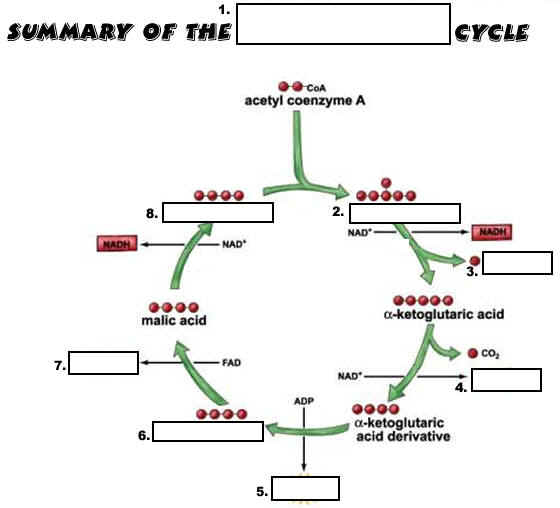
64. Label the parts of the Krebs Cycle.

65. The ETC occurs across the inner membrane of the ____________ and produces ________ as an end product.

66. The ETC uses the energized electrons carried by the coenzymes __________ and ________ to make 34 ATP’s of energy.

67. Each NADH makes _______ ATP’s, while each FADH makes only ______ ATP’s.


CLICK HERE FOR PRINTABLE COPY


Chapter 10 Protein Synthesis PPT Questions


Protein Synthesis
ppt Questions

DNA and Genes

1. What are genes and what do they code for?


2. Proteins are made of chains of _______________.

3. How do cells use proteins?


4. The subunits making up polypeptides are called _________________.

5. How many amino acids exist?

6. Sketch and label the basic structure of an amino acid.


7. The group that makes amino acids different from each other & gives the amino acid its unique properties is called the ___________ group.

8. DNA is found in the ____________ of a cell and begins the process of making a _______________.

9. Where are proteins made?

10. Describe the two types of ribosomes.


11. The first step in making a protein is to make a copy of ___________ in the nucleus.

RNA

12. What nucleic acid contains the master code for making proteins?

13. What nucleic acids acts as a blueprint in copying the master code?

14. Compare and contrast the sugars on DNA and RNA.


15. Compare and contrast the nitrogen bases on DNA and RNA.


16. RNA is made of a ____________ strand, while DNA is a ___________ stranded molecule.

17. What base replaces thymine on RNA?

18. Name the 3 types of RNA molecules.


19. What is the function of mRNA?


20. What is the function of rRNA?


21. What is the function of tRNA?


22. Describe the shape of mRNA.

23. How does mRNA get out of the nucleus once it has copied DNA’s instructions?

24. What bases pair together on RNA?

25. How long is mRNA?

26. What is a codon?


27. Methionine is called the __________ codon & is represented by the bases ________.

28. Name the 3 stop codons.

29. How long in rRNA?

30. What is the shape of rRNA?

31. What two things make up ribosomes?

32. What process occurs at the ribosomes?

33. Each codon stands for an _______________.

34. Can amino acids have more than one codon?

35. There are ______ amino acids and ______ possible codons.

36. How do you read the circular genetic codon table?


37. Use the genetic codon table and name these amino acids:

GGG?
UCA?
CAU?
GCA?
AAA?

38. Name the complementary bases on DNA.


39. Name the complementary bases on RNA.


40. What is the shape of tRNA?

41. What can attach to one end of a tRNA molecule for transport?

42. Opposite the attachment site on tRNA are 3 nucleotide bases called the ______________.

43. Make a sketch of a tRNA molecule with its attachment site and anticodon labeled.


44. A codon on mRNA is complementary to an _____________ on tRNA.

45. What anticodon is complementary to the codon – ACU?

Transcription and Translation

46. Sketch the pathway to making a protein.


47. define protein synthesis.


48. Name the 2 phases of protein synthesis.

49. Before mRNA can leave the nucleus it must be _______________ in order to correctly make proteins.

50. Define transcription and tell where it occurs.


51. What RNA copies DNA?

52. Are both strands of DNA copied?

53. What enzyme is required to copy DNA?

54. The DNA strand that is copied is called the _____________ strand.

55. What would be the complementary RNA sequence for the DNA sequence- 5′- GCGTATG-3′?

56. What enzyme separates the DNA strands in transcription?

57. RNA polymerase adds complementary ____________ to the DNA template strand.

58. ___________ are regions on DNA where RNA polymerase binds to start transcription.

59. The promoter contains a sequence called the _________ box.

60. Other sequences on DNA called __________ signals tell the RNA polymerase when to stop transcribing.

61. Newly made mRNA must be _________ to make the nucleic acid functional.

62. What are introns & what happens to them during mRNA processing?


63. What are exons and what happens to them during mRNA processing?


64. Describe the cap that is added to the new mRNA transcript.


65. What type of tail is added to the mRNA transcript?

66. The new mRNA transcripts is made of _____________ with a 5′ _________ and a 3′ ____________ tail.

67. What happens next to the newly made mRNA?

68. Define translation & tell where it occurs?


69. How do ribosomes read mRNA?

70. Describe the structure of a ribosome.


71. Ribosomes are composed of ________ rRNA and ________ protein.

72. Ribosomes have 2 tRNA sites called _______ and ______ along with an exit site.

73. The first part of translation is called ____________.

74. The small ribosomal subunit attaches to what codon on mRNA?

75. Once the mRNA and small subunit attach, what happens next?

76. Sketch an label a ribosome with both its subunits, its 2 tRNA sites, and the attached mRNA transcript.


77. The ______________ moves along the mRNA strand ________ codon at a time.

78. How many tRNA’s will fit into a ribosome at one time?

79. What happens to the two amino acids carried by the 2 tRNA’s inside a ribosome?

80. The joining of amino acids by ___________ bonds is the second part of translation called ______________.

81. Once an amino acid is joined to the growing polypeptide chain, the tRNA leaves the _______________ to pick up another ________________.

82. When a tRNA leaves the ribosome, the ribosome moves down the _________ strand allowing another ________ and its amino acid to enter.

83. each time the ribosome moves, it moves over _________ codon.

84. The last stage of translation is called _______________.

85. Name the 3 termination codons.

86. The sequence of amino acids in the polypeptide chain is called the ____________ protein structure.


Chapter 10 Questions PPT

DNA & Replication
ppt Questions

History of DNA

1. Early scientists believed that _________ was the genetic material of the cell. Explain why.


2. Proteins are made of 20 different ________________.

3. Long chains of amino acids make up _________________.

4. Fred Griffith worked with what type of bacteria?

5. What did he find to be true after his experiments with the S and R strains of bacteria?


6. This process of picking up DNA from the environment is called ____________________.

7. Did Griffith’s experiment prove DNA was the genetic material?

8. What 2 main things make up chromosomes?

9. What did Hershey and Chase use in their experiments to prove DNA was the cell’s genetic material?

10. Hershey and Chase radioactively tagged the viral DNA with _______________ and the protein capsid with ______________.

11. Which radioactive substance was injected into and took over the host cell’s DNA?

12. What scientists showed the amount of the 4 nitrogen bases present in DNA?

13. Name the bases and their amounts found in somatic or body cells of humans.


14. What bases are complementary (pair with each other) on DNA?

15. What type of bonds join base pairs on DNA?

16. Are these strong or weak bonds?

17. What was Rosalind Franklin’s contribution to finding DNA’s structure?


18. Who built the first model of DNA and what did they use to help get the correct measurements for the molecule?

DNA Structure 

19. DNA is two coiled strands known as a ___________________.

20. What makes up the sides of a DNA molecule?

21. What bonds the deoxyribose sugars to the phosphate groups?

22. Where are the nitrogen bases found on DNA & how are they bonded?

23. Most DNA has a ______________ twist with ________ base pairs in a complete turn.

24. DNA stands for ___________________________.

25. ______________ are the subunits making up DNA.

26. Name the 3 parts of a nucleotide.


27. Why is deoxyribose called a pentose sugar?

28. Sketch a pentose sugar and include the carbons correctly numbered.


29. The sugars on one DNA strand of DNA are from 5′ to _________, while the sugars on the other strand are antiparallel running from _________ to ___________.

30. Double ring nitrogen bases are called ____________, while single ring nitrogen bases are called ________________.

31. Name the purines.

32. Name the pyrimidines.

33. Purines will only pair with ________________.

34. __________ hydrogen bonds are required to join guanine to cytosine, while only ________ bonds join adenine to thymine.

35. If there is 30% adenine, how much cytosine is present?

DNA Replication 

36. Cells must copy their DNA before they do what? Explain why.


37. During what part of the cell cycle is DNA copied?

38. In eukaryotes, where are the copies of DNA made?

39. The process of copying DNA is known as DNA ________________.

40. Replication of DNA begins at points called __________________________.

41. The two DNA strands ______________ at origins of replication forming Y-shaped areas called _______________________.

42. New DNA strands grow at the _____________.

43. As the two strands open at the origins of replication, replication _____________ form.

44. Prokaryotic chromosomes have a ___________ replication bubble, while eukaryotic cells have ___________ bubbles.

45. What enzyme uncoils DNA so it can be replicated or copied?

46. What other job does this enzyme perform?

47. What is the job of single-strand binding proteins?


48. What enzyme relieves stress on the DNA strands at the replication forks?

49. An RNA __________ must be present to start the addition of new nucleotides.

50. What enzyme makes the RNA primer?

51. DNA ______________ is the enzyme that adds new complementary base pairs.

52. DNA polymerase can only add nucleotides to what end of the DNA molecule?

53. Which DNA strand is synthesized continuously as a single strand?

54. The leading strand is made from the ______________ toward the _________________ as it opens.

55. The ____________ strand is synthesized ____________ the overall direction of replication.

56. The lagging strand is made in __________ short segments from the _____________ fork toward the _____________ of replication.

57. The short segments of the lagging strand are called ______________ fragments.

58. What enzyme joins Okazaki fragments together into one strand?

59. Sketch half of a replication bubble. Label the point of origin and the replication fork. Draw two arrows showing the leading strand and the lagging strand.


60. DNA polymerase initially makes how many errors?

61. Proofreading enzymes correct mistakes in DNA to a one in ______________ base pairing errors?

62. Explain the semiconservative model for DNA replication.


63. Who developed this idea about replication?

64. Chemicals and _____________ radiation can damage DNA in our body cells so it must be ________________ repaired.

65. What is excision repair?


66. What 2 enzymes replace damaged sections of DNA and rebind the molecule?

67. What is the complementary DNA strand for: 5′ -CGTATG -3′ ?


Chapter 13 Biotechnology PPT Questions


DNA Technology
ppt Questions

DNA Extraction

1. When cells are treated with certain chemicals, it causes the plasma membrane to __________ or lyse.

2. DNA can be pulled out of cells because it is ________________ and can be ______________.

3. Describe the appearance of DNA spooled from cells.


4. What may be used to cut DNA into smaller pieces?

5. Do all restriction enzymes cut DNA at the same place?

6. What 2 properties can be used to separate DNA fragments?

7. Why does DNA have a negative charge?


8. To separate DNA fragments, it is placed in a ____________ with a current of _____________ running through it.

9. This process is called ____________________.

10. What determines the direction DNA will move in a gel?


11. Which fragments move further and faster?

12. DNA fragments are loaded into depression on the gel called _____________.

13. The DNA gel floats in a chamber covered with a ____________ solution.

14. DNA fragments closest to the wells are ___________ in size, while the __________ DNA fragments are further from the wells.

Steps in DNA Sequencing 

15. Many copies of a ______________ of DNA are placed in a test tube and ________________ is added to begin the process.

16. What else must be added?

17. How are the different nucleotide bases marked or tagged?


18. Dyed and _____________ nucleotides are added, but the large __________ molecules stop the chain from growing producing DNA fragments of _______________ sizes.

19. The fragments make banding patterns on an electrophoresis gel of different _____________ that can be identified.

20. The separated fragments are then read by _____________ from the ________ of the gel to the top.

Copying DNA

21. Define PCR and tell what it stands for.


22. To make many copies of DNA, DNA polymerase is added that can work at very high _______________. 

23. DNA is _____________ to separate the two strands.

24. What is added next to the test tube of DNA and DNA polymerase?

25. What are primers?


26. When the tube is cooled, DNA polymerase adds new ___________ to the separated DNA strands.

27. Even though a small amount of DNA is used to start PCR, ___________ amounts of DNA can be copied.

Cloning

28. What is a clone?


29. Clones may be produced by _____________ reproduction.

30. What two types of cells are combined in order to clone an organism?


31. Once a body cell fuses to an egg cell, the cell divides like a normal _____________.

32. What was the first successfully cloned organism?


Human Genome Project

33.  When was the project started?

34. What is the goal of the project?


35. How many nucleotides approximately make up the human genome?  How many chromosomes?


36. Who is mapping the genes on the human chromosomes?

37. From working on the Human Genome project, scientists have discovered that only about ________ actually codes for proteins; these genes are called _____________.

38. What is the other 98% or non-coding genes of DNA known as?

39. How many genes have been found on DNA?  Is this more or less than the expected number?


40. What are SNP’s that the scientists found?


41. Define proteome.


42. Human Genome researchers discovered transposons.  What are these structures?


43. The Human Genome Project was produced an area of science known as bioinformatics.  how is this helpful in sequencing DNA?


44. Define biotechnology.


45. Give an example of an agricultural crop grown in this area that has been improved by genetic engineering.

46. What product was 1st made in 1982 by genetic engineering to help diabetics?

47. Explain how biotechnology has improved each of these fruits or vegetables:

a. bananas

b. rice

c. garlic

d. potatoes


48. Give 4 ways biotechnology has helped the environment.


Caught Red-Handed


Caught Red-Handed  


Introduction:

Bacteria are everywhere. They have evolved the ability to inhabit almost every surface on the planet; however, they are invisible to the naked eye due to their small size. Bacteria have been found living in the deepest part of the ocean, in volcanic vents, in boiling hot springs, and even deep in polar ice caps. Many species of bacteria live inside of other organisms in a harmless commensalistic way such as the intestinal bacteria, Escherichia coli. Bacteria can reproduce at very rapid rates whenever conditions are favorable, as often as every 20 minutes doubling in number. The bacterial population is kept in check by the natural defenses of the host, such as the immune system and proper washing habits. When these natural defenses fail, bacteria can quickly become a problem. Some bacteria produce poisons or toxins that can be life-threatening if the bacterial population isn’t controlled by our natural defenses.

The United States Centers for Disease Control (CDC) states that the best way to prevent bacterial spread and infection is through the use of proper sanitary techniques. Perhaps the most critical step in this prevention is the use of proper hand washing. When improperly washed, your hands are one of the most easily colonized areas of your body and many of our behaviors involve the use of our hands.  Proper hand washing requires the use of water as hot as you can stand, soap, and lots of rubbing. The soap and water serve to destroy bacteria, and the rubbing helps slough off dead skin cells along with lots of bacteria.

Objective:

Students will examine:

  1. The spread of bacteria through surface contact
  2. Surface washing techniques to reduce the spread of bacteria

Materials (Part A):

Black light, Glo-Germ powder, lotion or Glo-Germ oil, hand soap, water, paper towels, pencil, lab sheet

Procedure (Part A):

  1. Choose one student in the lab group and have them spread a SMALL AMOUNT of Glo-Germ powder or lotion evenly over the entire surface of their hands. Be sure to include hard to clean areas such as around & under the fingernail.
  2. Have another student use the Black light to check your hands for the fluorescent “germs”.
  3. Estimate the percentage of your hand that you have covered with Glo-Germ powder and record this percentage in your data table 1 under time “0”.
  4. Wash your hands for 10 seconds and then recheck your hands with Black light and record the percentage of “germs” remaining.
  5. Repeat step 5 for washing times of 30 seconds, 60 seconds, and 120 seconds.
  6. Return Glo-Germ powder, lotion, or oil to lab cart. 

Data Table 1


Time of Wash in Seconds Percent of Hand Covered with “germs”
0 (initial observation)
10
30
60
120


Materials (Part B):

Tennis ball, “play” money, stuffed toy, pencil, lab sheet

Procedure (Part B):

  1. Choose a different member of your lab group and use the Black light to check their hands for the presence of germs.  IF they are “infected”, have them thoroughly wash their hands to remove the “germs”.
  2. Record the percentage of their hand that is covered with “germs”.
  3. Pick up the basket from the lab cart with your materials for part B.
  4. Handle the tennis ball for at least 20 to 30 seconds.
  5. After handling the tennis ball, have your hands rechecked with the Black light for “germs”.
  6. Record this percentage in data table 2.
  7. Return to your lab table and handle each of the other items ONE AT A TIME, checking for “germs after EACH item and recording this percentage in table 2.
  8. Return the black light and basket with handled items to the lab cart.

Data Table 2


Name of Item Percent Coverage
Initial Hand Coverage
Tennis Ball
“Play” money
Toy


Questions:

  1. If almost every surface we touch is inhabited by bacteria, why don’t bacterial infections occur more often?
  2. Name 3 ways you  might prevent the spread of bacteria each day.
  3. Name several bacterial diseases.
  4. Name and describe the 3 shapes of bacteria.
  5. Are all bacteria harmful? Explain your answer.
  6. What effect, if any, did increased washing time have on the percentage of “germ” coverage on your hands?
  7. Name 3 areas of your home that are most susceptible to bacterial contamination. Explain steps you could take in each of these areas to prevent the spread of bacteria to other places in your home.

Optional:

Create a graph based on the data from table 1.

Title _____________________________