Chapter 10 Questions PPT

DNA & Replication
ppt Questions

History of DNA

1. Early scientists believed that _________ was the genetic material of the cell. Explain why.


2. Proteins are made of 20 different ________________.

3. Long chains of amino acids make up _________________.

4. Fred Griffith worked with what type of bacteria?

5. What did he find to be true after his experiments with the S and R strains of bacteria?


6. This process of picking up DNA from the environment is called ____________________.

7. Did Griffith’s experiment prove DNA was the genetic material?

8. What 2 main things make up chromosomes?

9. What did Hershey and Chase use in their experiments to prove DNA was the cell’s genetic material?

10. Hershey and Chase radioactively tagged the viral DNA with _______________ and the protein capsid with ______________.

11. Which radioactive substance was injected into and took over the host cell’s DNA?

12. What scientists showed the amount of the 4 nitrogen bases present in DNA?

13. Name the bases and their amounts found in somatic or body cells of humans.


14. What bases are complementary (pair with each other) on DNA?

15. What type of bonds join base pairs on DNA?

16. Are these strong or weak bonds?

17. What was Rosalind Franklin’s contribution to finding DNA’s structure?


18. Who built the first model of DNA and what did they use to help get the correct measurements for the molecule?

DNA Structure 

19. DNA is two coiled strands known as a ___________________.

20. What makes up the sides of a DNA molecule?

21. What bonds the deoxyribose sugars to the phosphate groups?

22. Where are the nitrogen bases found on DNA & how are they bonded?

23. Most DNA has a ______________ twist with ________ base pairs in a complete turn.

24. DNA stands for ___________________________.

25. ______________ are the subunits making up DNA.

26. Name the 3 parts of a nucleotide.


27. Why is deoxyribose called a pentose sugar?

28. Sketch a pentose sugar and include the carbons correctly numbered.


29. The sugars on one DNA strand of DNA are from 5′ to _________, while the sugars on the other strand are antiparallel running from _________ to ___________.

30. Double ring nitrogen bases are called ____________, while single ring nitrogen bases are called ________________.

31. Name the purines.

32. Name the pyrimidines.

33. Purines will only pair with ________________.

34. __________ hydrogen bonds are required to join guanine to cytosine, while only ________ bonds join adenine to thymine.

35. If there is 30% adenine, how much cytosine is present?

DNA Replication 

36. Cells must copy their DNA before they do what? Explain why.


37. During what part of the cell cycle is DNA copied?

38. In eukaryotes, where are the copies of DNA made?

39. The process of copying DNA is known as DNA ________________.

40. Replication of DNA begins at points called __________________________.

41. The two DNA strands ______________ at origins of replication forming Y-shaped areas called _______________________.

42. New DNA strands grow at the _____________.

43. As the two strands open at the origins of replication, replication _____________ form.

44. Prokaryotic chromosomes have a ___________ replication bubble, while eukaryotic cells have ___________ bubbles.

45. What enzyme uncoils DNA so it can be replicated or copied?

46. What other job does this enzyme perform?

47. What is the job of single-strand binding proteins?


48. What enzyme relieves stress on the DNA strands at the replication forks?

49. An RNA __________ must be present to start the addition of new nucleotides.

50. What enzyme makes the RNA primer?

51. DNA ______________ is the enzyme that adds new complementary base pairs.

52. DNA polymerase can only add nucleotides to what end of the DNA molecule?

53. Which DNA strand is synthesized continuously as a single strand?

54. The leading strand is made from the ______________ toward the _________________ as it opens.

55. The ____________ strand is synthesized ____________ the overall direction of replication.

56. The lagging strand is made in __________ short segments from the _____________ fork toward the _____________ of replication.

57. The short segments of the lagging strand are called ______________ fragments.

58. What enzyme joins Okazaki fragments together into one strand?

59. Sketch half of a replication bubble. Label the point of origin and the replication fork. Draw two arrows showing the leading strand and the lagging strand.


60. DNA polymerase initially makes how many errors?

61. Proofreading enzymes correct mistakes in DNA to a one in ______________ base pairing errors?

62. Explain the semiconservative model for DNA replication.


63. Who developed this idea about replication?

64. Chemicals and _____________ radiation can damage DNA in our body cells so it must be ________________ repaired.

65. What is excision repair?


66. What 2 enzymes replace damaged sections of DNA and rebind the molecule?

67. What is the complementary DNA strand for: 5′ -CGTATG -3′ ?


Chapter 13 Biotechnology PPT Questions


DNA Technology
ppt Questions

DNA Extraction

1. When cells are treated with certain chemicals, it causes the plasma membrane to __________ or lyse.

2. DNA can be pulled out of cells because it is ________________ and can be ______________.

3. Describe the appearance of DNA spooled from cells.


4. What may be used to cut DNA into smaller pieces?

5. Do all restriction enzymes cut DNA at the same place?

6. What 2 properties can be used to separate DNA fragments?

7. Why does DNA have a negative charge?


8. To separate DNA fragments, it is placed in a ____________ with a current of _____________ running through it.

9. This process is called ____________________.

10. What determines the direction DNA will move in a gel?


11. Which fragments move further and faster?

12. DNA fragments are loaded into depression on the gel called _____________.

13. The DNA gel floats in a chamber covered with a ____________ solution.

14. DNA fragments closest to the wells are ___________ in size, while the __________ DNA fragments are further from the wells.

Steps in DNA Sequencing 

15. Many copies of a ______________ of DNA are placed in a test tube and ________________ is added to begin the process.

16. What else must be added?

17. How are the different nucleotide bases marked or tagged?


18. Dyed and _____________ nucleotides are added, but the large __________ molecules stop the chain from growing producing DNA fragments of _______________ sizes.

19. The fragments make banding patterns on an electrophoresis gel of different _____________ that can be identified.

20. The separated fragments are then read by _____________ from the ________ of the gel to the top.

Copying DNA

21. Define PCR and tell what it stands for.


22. To make many copies of DNA, DNA polymerase is added that can work at very high _______________. 

23. DNA is _____________ to separate the two strands.

24. What is added next to the test tube of DNA and DNA polymerase?

25. What are primers?


26. When the tube is cooled, DNA polymerase adds new ___________ to the separated DNA strands.

27. Even though a small amount of DNA is used to start PCR, ___________ amounts of DNA can be copied.

Cloning

28. What is a clone?


29. Clones may be produced by _____________ reproduction.

30. What two types of cells are combined in order to clone an organism?


31. Once a body cell fuses to an egg cell, the cell divides like a normal _____________.

32. What was the first successfully cloned organism?


Human Genome Project

33.  When was the project started?

34. What is the goal of the project?


35. How many nucleotides approximately make up the human genome?  How many chromosomes?


36. Who is mapping the genes on the human chromosomes?

37. From working on the Human Genome project, scientists have discovered that only about ________ actually codes for proteins; these genes are called _____________.

38. What is the other 98% or non-coding genes of DNA known as?

39. How many genes have been found on DNA?  Is this more or less than the expected number?


40. What are SNP’s that the scientists found?


41. Define proteome.


42. Human Genome researchers discovered transposons.  What are these structures?


43. The Human Genome Project was produced an area of science known as bioinformatics.  how is this helpful in sequencing DNA?


44. Define biotechnology.


45. Give an example of an agricultural crop grown in this area that has been improved by genetic engineering.

46. What product was 1st made in 1982 by genetic engineering to help diabetics?

47. Explain how biotechnology has improved each of these fruits or vegetables:

a. bananas

b. rice

c. garlic

d. potatoes


48. Give 4 ways biotechnology has helped the environment.


Chemistry Powerpoint Worksheet

Chemistry PowerPoint Notes  

1. What makes up everything in the universe?  

2. Name 2 properties of all matter.  


3. Define mass.  


4. How does weight differ from mass?  


5.What are elements?  


6. Name the 4 elements that make up most of a living thing.  


7. What is used to represent an element?  

8. Name the smallest part of an element.  

9. What are the 2 main regions of an atom?  

10. Where is the nucleus of an atom found and what does it contain?  

11. What is the charge on a proton?              A neutron?  

12. All atoms of the same element have the ________ number of protons.  

13. The number of protons in an atom determines the _________________________.  

14. What is the charge on an electron?  

15. If you know the number of protons in an atom, how can you determine the number of electrons?  


16. Do all the atoms of the same element have the same number of neutrons?  

17. Atoms of the same element with different numbers of neutrons are called ___________.  

18. The mass of an atom is centered in the ___________.  

19. The number of protons PLUS neutrons in an atom determines its ___________________.  

20. What atomic particle has a negative charge?  

21. Why isn’t the mass of an electron used to determine the atomic mass of an element?  


22. Where are electrons found?

23. Which electrons in an atom have the most energy?  

24. How many energy levels are there & name them?  

25. How many electrons will each energy level hold?  


26. Elements are arranged on a __________________ by their atomic _____________.  

27. What are Periods & what do they tell you about elements?  


28.What are Families & what do they tell you about elements?  


29. Two or more elements combined together make a _____________.  

30. Chemical ______________ represent compounds.  

31. _____________ are the smallest part of a compound.  

32. ______________ in chemical formulas tell the number of atoms of each element.  

33. _____________ in a formula tell the number of molecules.  

34. Compounds have ____________ properties than its elements.  

35.  The outermost _______________ in elements determine if they will combine.  

36. Elements with ___________ outer energy levels are stable & won’t react.  

37. Why do elements tend to react with other elements?  


38. Chemical _____________ represent chemical reactions.  

39. ______________ appear on the right of the equation, while ___________ are on the left.  

40. Chemical bonds store ____________.  

41. How do covalent bonds form?


42. How do ions form?


43. Positive ions _________ electrons, while negative ions ___________ electrons.  

44.  Define energy.  


43. Give some examples of different forms of energy.  

44. Atoms are in constant ________________, which determines the atom’s ____________.  

45.  List the 3 main states of matter.  

46. _______________ energy must be added or removed to change the state of matter.  

47. In reactions the amount of product must ____________ the amount of reactants.  

48. Most of an organism’s energy comes from _____________ in foods.  

49. _______________ reactions release energy.  

50. Give an example of an exergonic reaction in cells.  

51. _________________ reactions store energy.  

52.  Give an example of an endergonic reaction in cells.  

53. Most reactions in cells are _________________.  

54.  _________________ energy is the energy needed to start a reaction.  

55. Catalysts _____________ the amount of activation energy needed.  

56. Catalysts in organisms are called ______________ and are usually ______________.  

57. Enzymes act on ____________ which join at the _______________ site.  

58. Can enzymes be reused?  

59. Redox reactions stands for _________________________ reactions.  

60. The oxidized substance _____________ electrons & becomes _____________ charged.  

61. The reduced substance _____________ electrons & becomes _____________ charged.  

62. Define solution.


63. The _____________ is dissolved in the ____________ in a solution.  

64. _______________ is the universal solvent.  

65. A solution becomes _____________ when no more solute will dissolve.  

66. ______________ solutions have water as the solvent & are important to ______________.  

67. What is the dissociation of water?


68. Write the equation for this.


69.  OH is the ______________ ion, while H+ is the ______________ ion.  

70. Acids produce _____________ ions, while bases have an excess of ________ ions.  

71. The _______ scale measures the concentration of H+ ions and goes from ____________.  

72. From 0 to 7 are ___________, a pH of 7 is __________, & above 7 to 14 are _________.  

73. _____________ are used in the body to control pH and keep it near a pH of ______ or neutral.  


Cell Model Instructions


 Cell Model 


    Construct a 3-dimensional eukaryotic plant or animal cell that includes the organelles listed in the table below. Your cell must show all of the cellular organelles listed on the table. These organelles should be LABELED with straight pin “flags” with the FUNCTION of each organelle written on the back  Make sure that your cell has a FLAT NOT round bottom so it will sit on a table or shelf. 

  •  NO FOOD ITEMS MAY BE USED IN THE CONSTRUCTION OF YOUR CELL MODEL! 
  •  DO NOT USE CLAY OR PLAY DOUGH AS THE CELL WILL BE TOO HEAVY OR NOT STAY TOGETHER!


Cellular Organelles
Cell Membrane Nucleus Nucleolus
Cell Wall (plants) Chromatin Rough ER
Smooth ER Attached Ribosomes Mitochondria
Chloroplast (plant) Lysosome Golgi Bodies
 Vacuole Free Ribosomes Centrioles (animal)


ANIMAL CELL

Copyright Pearson Education, Inc.

PLANT CELL

Copyright Pearson Education, Inc.


Cell Respiration Worksheet Ch 7 BI


Cellular Respiration


Section 7-1 Glycolysis & Fermentation

1. What organisms trap sunlight & store it in carbohydrates?

2. What 2 organisms break down carbohydrates to release energy from cells?

3. What is the main energy currency of a cell?

4. Define cellular respiration.

5. What process begins cellular respiration & does it produce much ATP?

6. If there is no oxygen in cells, the products of glycolysis enter ________________________
pathways that yield no additional ______________________.

7. Fermentation is __________________________ because no oxygen is used.

8. If oxygen is present in cells, the glycolysis products enter the ______________________
respiration pathway.

9. Does aerobic respiration produce much ATP?

10. What simple sugar starts glycolysis?

11. In glycolysis, glucose is broken into 2 molecules of _______________________ acid
in the ______________________ of the cell.

12. In which part of the cell does fermentation occur? Is oxygen involved?

13. Name the 2 types of fermentation.

14. __________________________ acid fermentation helps make cheese & yogurt and also
occurs in _______________________ cells during heavy exercise.

15. What effect does lactic acid have on muscle cells?

16. Yeasts carry on what type of fermentation?

17. What alcohol is made in alcoholic fermentation?

18. Table _____________________________ and ____________________ are made by yeasts
during alcoholic fermentation.

19. One molecule of sugar produces _________________ kilocalories of energy.

20. _______________________________ respiration, like glycolysis, produces less energy than
____________________________ respiration of pyruvic acid.

Section 7-2 Aerobic Respiration

21. Aerobic respiration requires what gas?

22. How much more ATP does aerobic respiration produce than glycolysis alone?

23. Name the 2 major stages of aerobic respiration.

24. What is completed in the Krebs cycle?

25. The energy carrier NAD+ is reduced to what substance?

26. Which part of aerobic respiration makes most of the ATP (cell’s energy)?

27. Where does aerobic respiration take place in prokaryotes?

28. Where do these reactions take place in eukaryotes?

29. What is the mitochondrial matrix & what product of glycolysis diffuses into this matrix?

30. What is found inside the mitochondrial matrix to help catalyze the reactions of the Krebs cycle?

31. What is acetyl CoA & to what does it combine?

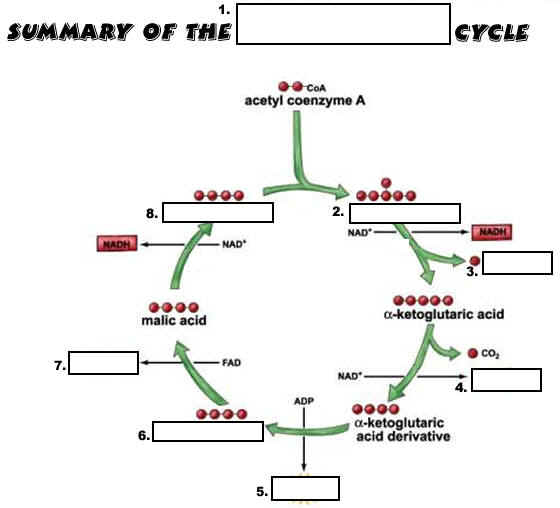
32. Define Krebs cycle.

33. The first acid produced in the Krebs cycle is _________________ acid. (Diagram p. 135)

34. Two energy carriers are reduced in the Krebs cycle; ________________becomes NADH
and _________________ becomes FADH.

35. Is any ATP made in the Krebs cycle?

36. What gas is a waste product produced in the Krebs cycle?

37. The _________________________________ is the second part of aerobic respiration.

38. Where does the ETS take place in eukaryotic cells?

39. _________________________ is made in the ETS when NADH and FADH2 release
______________________ ions.

40. What gas serves as the final acceptor of electrons in the ETS (electron transport system)?

41. Write the equation for this gas accepting electrons at the end of the ETS (see page 137).

42. What is the final product of the ETS?

43. How many ATP’s of energy are made during glycolysis?

44. How many ATP’s of energy are made during the Krebs cycle?

45. Each FADH can generate how many ATP’s of energy?

46. Each NADH can generate how many ATP’s of energy?

47. _______________________ NADH molecules & ______________________ FADH
molecules are made by aerobic respiration.

48. How many ATP molecules are made by the electron transport system?

49. What is the maximum number of ATP molecules that can be produced from each glucose molecule?

50. Write the summary equation for cellular respiration.