Caught Red-Handed


Caught Red-Handed  


Introduction:

Bacteria are everywhere. They have evolved the ability to inhabit almost every surface on the planet; however, they are invisible to the naked eye due to their small size. Bacteria have been found living in the deepest part of the ocean, in volcanic vents, in boiling hot springs, and even deep in polar ice caps. Many species of bacteria live inside of other organisms in a harmless commensalistic way such as the intestinal bacteria, Escherichia coli. Bacteria can reproduce at very rapid rates whenever conditions are favorable, as often as every 20 minutes doubling in number. The bacterial population is kept in check by the natural defenses of the host, such as the immune system and proper washing habits. When these natural defenses fail, bacteria can quickly become a problem. Some bacteria produce poisons or toxins that can be life-threatening if the bacterial population isn’t controlled by our natural defenses.

The United States Centers for Disease Control (CDC) states that the best way to prevent bacterial spread and infection is through the use of proper sanitary techniques. Perhaps the most critical step in this prevention is the use of proper hand washing. When improperly washed, your hands are one of the most easily colonized areas of your body and many of our behaviors involve the use of our hands.  Proper hand washing requires the use of water as hot as you can stand, soap, and lots of rubbing. The soap and water serve to destroy bacteria, and the rubbing helps slough off dead skin cells along with lots of bacteria.

Objective:

Students will examine:

  1. The spread of bacteria through surface contact
  2. Surface washing techniques to reduce the spread of bacteria

Materials (Part A):

Black light, Glo-Germ powder, lotion or Glo-Germ oil, hand soap, water, paper towels, pencil, lab sheet

Procedure (Part A):

  1. Choose one student in the lab group and have them spread a SMALL AMOUNT of Glo-Germ powder or lotion evenly over the entire surface of their hands. Be sure to include hard to clean areas such as around & under the fingernail.
  2. Have another student use the Black light to check your hands for the fluorescent “germs”.
  3. Estimate the percentage of your hand that you have covered with Glo-Germ powder and record this percentage in your data table 1 under time “0”.
  4. Wash your hands for 10 seconds and then recheck your hands with Black light and record the percentage of “germs” remaining.
  5. Repeat step 5 for washing times of 30 seconds, 60 seconds, and 120 seconds.
  6. Return Glo-Germ powder, lotion, or oil to lab cart. 

Data Table 1


Time of Wash in Seconds Percent of Hand Covered with “germs”
0 (initial observation)
10
30
60
120


Materials (Part B):

Tennis ball, “play” money, stuffed toy, pencil, lab sheet

Procedure (Part B):

  1. Choose a different member of your lab group and use the Black light to check their hands for the presence of germs.  IF they are “infected”, have them thoroughly wash their hands to remove the “germs”.
  2. Record the percentage of their hand that is covered with “germs”.
  3. Pick up the basket from the lab cart with your materials for part B.
  4. Handle the tennis ball for at least 20 to 30 seconds.
  5. After handling the tennis ball, have your hands rechecked with the Black light for “germs”.
  6. Record this percentage in data table 2.
  7. Return to your lab table and handle each of the other items ONE AT A TIME, checking for “germs after EACH item and recording this percentage in table 2.
  8. Return the black light and basket with handled items to the lab cart.

Data Table 2


Name of Item Percent Coverage
Initial Hand Coverage
Tennis Ball
“Play” money
Toy


Questions:

  1. If almost every surface we touch is inhabited by bacteria, why don’t bacterial infections occur more often?
  2. Name 3 ways you  might prevent the spread of bacteria each day.
  3. Name several bacterial diseases.
  4. Name and describe the 3 shapes of bacteria.
  5. Are all bacteria harmful? Explain your answer.
  6. What effect, if any, did increased washing time have on the percentage of “germ” coverage on your hands?
  7. Name 3 areas of your home that are most susceptible to bacterial contamination. Explain steps you could take in each of these areas to prevent the spread of bacteria to other places in your home.

Optional:

Create a graph based on the data from table 1.

Title _____________________________


Cell Analogy


Cell City Analogy
By Shannan Muskopf

In a far away city called Grant City, the main export and production product is the steel widget. Everyone in the town has something to do with steel widget making and the entire town is designed to build and export widgets. The town hall has the instructions for widget making, widgets come in all shapes and sizes and any sizes and any citizen of Grant can get the instructions and begin making their own widgets. Widgets are  generally produced in small shops around the city, these small shops can be built by the carpenter’s union (whose headquarters are in town hall).

After the widget is constructed, they are placed on special carts which can deliver the widget anywhere in the city. In order for a widget to be exported, the carts take the widget to the postal office, where the widgets are packaged and labeled for export. Sometimes widgets don’t turn out right, and the “rejects” are sent to the scrap yard where they are broken down for parts or destroyed altogether. The town powers the widget shops and carts from a hydraulic dam that is in the city. The entire city is enclosed by a large wooden fence, only the postal trucks (and citizens with proper passports) are allowed outside the city.


Match the parts of the city (underlined) with the parts of the cell.

1. Mitochondria _____________________________________________
2. Ribosomes _____________________________________________
3. Nucleus _____________________________________________
4. Endoplasmic Reticulum _____________________________________________
5. Golgi Apparatus _____________________________________________
6. Protein _____________________________________________
7. Cell Membrane _____________________________________________
8. Lysosomes ____________________________________________________________
9. Nucleolus _____________________________________________

** Create your own analogy of the cell using a different model. Some ideas might be: a school, a house, a factory, or anything you can imagine**


Cell Division Worksheet Ch 8 BI


Cell Division


Section 8-1 Chromosomes


1. What molecule in cells stores the genetic information?

2. DNA is built of billions of subunits called __________________________.

3. What are chromosomes, & when can they be seen?

4. What is the shape of chromosomes, & what 2 things are they made of?

5. Each chromosome is a single ________________ molecule with ____________________.

6. What is the purpose of histones?

7. What is the purpose of nonhistone proteins?

8. Chromosomes consist of two identical _____________________ called _________________.

9. What is a centromere?

10. Draw and label the parts of a chromosome.

11. Chromatids _______________________ during cell division so the two new cells will each
receive _________________ chromatid.

12. How does DNA appear in a cell between cell divisions?

13. What is chromatin & when does it exist in cells?

14. How many chromosomes do prokaryotes have?

15. How many chromosomes do each of these organisms have:
a. humans?
b. dog?
c. fruit fly?

16. What are the two categories of chromosomes?

17. Give 2 functions of the sex chromosomes.

18. Name the 2 sex chromosomes & tell what combination determines a male and a female organism.

19. What are autosomes & how many autosomes are in human cells?

20. What are homologous chromosomes & how do they compare to each other?

21. What is a karyotype?

22. In a human karyotype, where would each of these be found:
a. sex chromosomes?
b. longest homologs?
c. autosomes?

23. What is the main difference between diploid & haploid cells?

24. What type of cells in human would be diploid? Haploid?

25. How are diploid cells abbreviated? Haploid cells?

26. When a haploid (1n) ______________________ cell combines with a haploid
_______________________ cell, the new cell will be ______________________
or ____________________________.


Section 8-2 Cell Division


27. All cells are derived from ___________________________________.

28. What is cell division?

29. Define binary fission.

30. Describe the stages in binary fission of a prokaryote.

31. How do the two new cells compare to each other after binary fission? How do they compare to the original cell?

32. What two main cellular parts must be divided in eukaryotic cell division?

33. Name the 2 types of cell division in eukaryotes.

34. Define mitosis.

35. What type of cell uses mitosis?

36. What effect does meiosis have on the chromosome number of a cell?

37. How do the cells produced by meiosis reestablish a complete set of chromosomes?

38. What is the cell cycle?

39. Draw & label all parts of the cell cycle. (Figure 8-5, page 149)

40. What is the time between divisions in the life of a cell called?

41. How many phases is interphase divided into? Cell division?

42. Name the 2 parts of cell division.

43. What happens to the cell in each of these two parts of cell division?

44. In what stage do cells spend most of their time?

45. What is the size of cells immediately following cell division?

46. Name the 1st stage of interphase & tell what happens to the cell.

47. What stage of interphase do cells enter once they become mature?

48. What happens to a cell during the S phase of interphase?

49. What is the last stage of interphase called & what is happening to the cell?

50. What is the Go phase and what type of human cells are in this phase?

51. Name the 4 stages of mitosis in order.

52. What cellular part actually divides during mitosis?

53. Describe everything that happens to a cell during prophase.

54. Sketch and label a picture of a cell in prophase.

55. What are centrosomes & when do they appear?

56. What type of cell has centrosomes?

57. What is found inside centrosomes?

58. Are centrioles found in both plant & animal cells? Explain.

59. What forms from centrioles & what is their function?

60. Name the 2 types of fibers that make up the mitotic spindle & describe each one.

61. Describe everything that happens to a cell during metaphase.

62. Sketch & label a cell during metaphase.

63. Describe everything that happens to a cell during anaphase.

64. Sketch and label a cell during anaphase.

65. Describe everything that happens to a cell during telophase.

66. Sketch & label an animal cell during telophase.

67. Mitosis is division of the _______________________, while ________________________
is the division of the cytoplasm.

68. Define cytokinesis.

69. Describe how cytokinesis occurs in animal cells & include a drawing (figure 8-7, page 151)

70. The ____________________ pinches a dividing animal cell into two new cells by the action
of ______________________________.

71. How does the cell plate from during cytokinesis of a plant cell?

72. Sketch and label a plant cell during cytokinesis (figure 8-8, page 151)

73. How do the new cells formed after mitosis & cytokinesis compare in size & chromosome number to each other and the original cell that divided?

74. The original cell that divides is called the _______________________ cell, while the
two new cells are called ____________________ cells. (from lecture)


Section 8-3 Meiosis


75. What is meiosis?

76. What type of cell undergoes meiosis?

77. Meiosis produces ___________________ reproductive cells called ____________________.

78. Name the 2 human gametes & tell their chromosome number.

79. What is the chromosome number for humans?

80. The fusion of a _________________ and an _____________ produces a
________________ with 46 (2n) chromosome number.

81. Cells starting mitosis & meiosis begin with a ____________________ set of chromosomes.

82. How many times do cells divide during meiosis?

83. What are the stages of meiosis called?

84. Explain what happens during Meiosis I to each of these structures:
a. chromosomes?
b. spindle?
c. nucleus?
d. nucleolus?

85. What is synapsis & when does it occur?

86. What is a tetrad?

87. How are genes aligned on homologous chromosomes?

88. Explain what happens during crossing-over?

89. Sketch and color a picture of chromosomes during crossing-over. (Figure 8-10, page 154)

90. What type of material is exchanged during crossing-over?

91. Crossing over results in genetic _______________________________.

92. Draw a cell during anaphase I and explain what is occurring.

93. What is independent assortment & what result does it produce?

94. Name 2 things that occur during telophase I.

95. How many cells are formed at the end of Meiosis I & how many copies of chromosomes does each cell have?

96. Is DNA copied before Meiosis II?

97. How many cells form at the end of Meiosis II and how many chromosomes do they contain?

98. In humans, meiosis occurs in the ___________________ and in the __________________
producing cells called ________________________.

99. Define spermatogenesis & tell where it occurs.

100. Sketch spermatogenesis (Figure 8-12a, page 155).

101. What are spermatids & how many form from meiosis?

102. Define oogenesis & tell where it occurs.

103. Sketch oogenesis (Figure 8-12B, Page 155).

104. Mature egg cells are called ___________________.

105. Explain how only one egg cell is formed instead of four from meiosis.

106. What are the 3 other products of meiosis called?

107. Define asexual reproduction.

108. Name 2 types of asexual reproduction.

109. Name a type of asexual reproduction in unicellular organisms.

110. How do the offspring of asexual reproduction compare to their parents?

111. Define sexual reproduction.

112. How do offspring from sexual reproduction compare to their parents?

113. Is there ever a case in sexual reproduction where offspring can be genetically alike? Explain.

114. What is the evolutionary advantage of sexual reproduction?

BACK


Cell Drawings HRWch4

Cell Drawings

Holt, Rinehart, Winston    Modern Biology

Draw on separate sheets of unlined paper, label drawing & each part, color, and tell the function of EACH LABELED PART (FUNCTION MUST BE WRITTEN NEXT TO THE LABEL) for the following cell drawings:

Page 72    Figure 4.4         Cell Shapes

Page 74    Figure 4.6         Animal Cell

Page 75    Figure 4.7         Bacterial cell (Prokaryote)

Page 76    Figure 4.9         Cell Organization

Page 77    Figure 4.10       Phospholipid

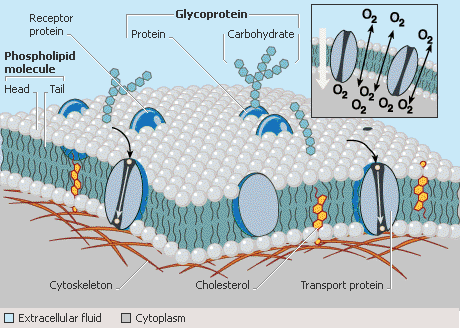
Page 78    Figure 4.11        Cell Membrane

Page 79    Figure 4.12        Nucleus & Nucleolus

Page 80    Figure 4.13        Mitochondria

Page 80    Figure 4.14        Ribosome

Page 81    Figure 4.15        Endoplasmic Reticulum

Page 82    Figure 4.16        Golgi

Page 84    Figure 4.18        Cytoskeleton

Page 85    Figure 4.19        Microtubule

Page 87    Figure 4.21        Plant Cell

Page 89    Figure 4.23        Chloroplast

When all drawings are complete — drawn, colored, labeled, and all functions written — then make a cover sheet with your name and a title and staple this to the top of your drawings. Number the pages in the lower right hand corner.

NO FUNCTIONS; NO GRADE!