Lab 6 & Molecular Biology


AP  Lab 6 

             Molecular Biology                                  

Introduction: Exercise 6A: Recombinant DNA Technology

     To study the structure and function of a single protein-coding gene, one must prepare the gene in a purified form. Vertebrate cells contain enough DNA to code for more than I 00,000 proteins; therefore it is not very practical to isolate a gene by conventional biochemical procedures. This is why recombinant DNA technology is so important; it can be used to isolate and amplify a specific gene relatively simply.
    Plasmids, small circular DNA molecules, are usually extra chromosomal; they exist apart from the chromosomes in most bacterial species. Plasmids are not necessary for the survival of the host bacteria, but they can contain genes that enable the bacteria to survive in certain environments. If a bacterial cell contains a plasmid carrying a gene that confers resistance to antibiotics, then that cell could survive in the presence of the drug.
Plasmids can be introduced into bacterial cells by the process of transformation. Bacteria placed in a calcium chloride solution can take in plasmid DNA molecules. In this way, large amounts of specific plasmid DNA can be prepared, because one transformed cell gives rise to duplicate cells also containing the plasmid DNA molecule.
Plasmids are very important for the molecular biologist because they serve as gene- carrier molecules called cloning vectors. A gene of interest can be joined to vector DNA to form a hybrid or recombinant molecule that can replicate in bacteria. When preparing a recombinant DNA molecule, a procedure is required for cutting cloning vectors and cellular DNA molecules in precise positions.
    Restriction nucleases are important for recombinant DNA technology because they cut DNA at specific sites. These enzymes are usually made by bacterial species in which they degrade invading foreign DNA within the bacterial cell. Most restriction enzymes recognize a specific sequence of nucleotides in DNA and cut a long DNA double helix into restriction fragments, which are measured in the process of agarose gel electrophoresis.

Introduction: Exercise 6B: DNA Fingerprinting

    Electrophoresis is the movement of charged particles in solution under the influence of an electric field. In gel electrophoresis, agarose gel is the stabilizing medium that serves as a matrix for the buffer in which the sample molecules travel. The gel is submerged in buffer within the electrophoretic gel cell. The samples are loaded into the sample wells in the gel, and electric current is passed through the gel.
    Molecules of DNA are negatively charged because of negative charges on the phosphate group. In this exercise, nucleic acids migrate through the pores of the gel from the negative end of towards the positive end. The large DNA molecules move more slowly than smaller molecules, therefore molecules are sorted according to size.


Objective: Exercise 6A


    Investigate basic genetic concepts by transforming bacterial cells by inserting an ampicillin-resistant gene into E. coli cells.

Objective: Exercise 6B

Investigate basic genetic concepts by using restrictive enzymes to digest phage lambda DNA and separate and identify the DNA fragments using gel electrophoresis.

Materials and Methods: Exercise 6A


    The materials used in this exercise included: 2 Luria agar plates, 2 Luria agar plates with ampicillin, 2 microcentrifuge tubes, 1 inoculating loop, 1 Bacti-Spreader, sterile micropipets, calcium chloride, Luria broth, plasmid pUC8, Bunsen burner, hotplate, ice, waterbath.
The two microcentrifuge tubes were marked !I+” and !1-!1, and 250IJI cold calcium chloride was added to each using a pipet. A large colony of bacteria was added to each tube with a sterile inoculating loop. A micropipet was used to transfer 10IJI of the plasmid pUCS solution to the !I+” tube. Both tubes were incubated on ice for 15 minutes, and meanwhile, the two Luria agar plates were labeled “+” and “-” and so were the two Luria plates with ampicillin. The tubes were removed from ice and placed in a 42°C hot waterbath for 90 seconds. The tubes were then removed from the waterbath and placed on ice for two minutes. A micropipet was used to add 250IJI Luria broth to each tube. Another micropipet was used to add 100IJI of the !I+” solution to the two !I+” plates and 1oomicroliters of the  solution to the two “-” plates. The bacteria was flamed to sterilize, and after cooling, was used to spread the cells over the entire surface of the plates. After five minutes, the plates were placed in a 37°C incubator, inverted, overnight.

Materials and Methods: Exercise 6B


    The materials used in this exercise included: 8% agarose gel, 2 electrophoresis chambers, power pack, running buffer- Tris, micropipetter and tips, staining tray, methylene blue dye, gloves, aprons, 4 DNA samples cut with restrictive enzymes, vial tray, microcentrifuge, paper, pencil, distilled water, spatula, plastic container for destaining, masking tape, light box, ruler, semi-Iog graph paper. The gel, on the gel tray, was placed in the center of the chamber, with the well-side of the gel near the black electrode. Approximately 350ml of running buffer were added to the chamber. Of each DNA sample, 10 microliters was loaded into the corresponding gel lane with a micropipet. The power cords were attached to the appropriate connections, and the power supply was turned on, set to 50 volts. The samples were allowed to migrate for three hours. The gel was then removed, stained, and destained overnight. The gel was viewed on a light board, and the band migration distances were measured.

Results: Exercise 6A

  Questions

1. Based on your experimental results, did transformation occur? Why or why not?
Yes, transformation did occur. Colonies of E. coli grew in the presence of ampicillin.

2. What other methods can be used to verify that transformation occurred?
DNA fingerprinting

Results: Exercise 6B


Questions

1. Compare the banding patterns. Do you think the DNA samples were the same?
No, the samples were different sizes

2. Which of the two suspects were the real burglar? Suspect #2

3. Explain the function of each of these steps in DNA fingerprinting:
a. Restriction Enzyme digest – used to cut DNA

b. Gel electrophoresis – used to separate different size pieces of DNA

c. Denaturing into single-stranded DNA – process used to view only one strand of the DNA double helix

d. Southern Blot – DNA bands transferred to a nitrocellulose paper

e. Radioactive DNA probe – used to find & bind to the complementary sequence in one or more RLFP’s

f. Autoradiograph – used to show similarities in DNA samples

Error Analysis

Lab 6A: Not enough agar was poured on the plates.

Lab 6B: Base pair counts for the DNA bands could have been inaccurate as suggested by the best-fit line on the graph.

Conclusion

Lab 6A: This lab showed that genes can be inserted into living bacterial cells thus transforming the cells and giving them new properties such as ampicillin-resistance.

Lab 6B:  Through gel electrophoresis of the DNA samples, it was determined that suspect #2 was guilty. Their DNA banding pattern matched the banding pattern taken of the DNA at the crime scene.

BACK

Lab 7 Sample 3 Fruitflies

Drosophila Genetics

Introduction

Drosophila Melanogaster, the fruit fly, is a great organism for genetic use because it has simple food requirements, occupies little space, is hardy, completes its life cycle in 12 days, makes a large number of offspring, can be knocked out easily, and it has many types of hereditary variations that can be seen with low power microscopes. Drosophila has a small number of chromosomes, four pairs. They are easily located in the large salivary glands. The Drosophila can be obtained from many places. Research of Drosophilae has led to a lot of knowledge about many of its genes.

Many factors combine to affect the length of the Drosophila life cycle. Temperature affects the life cycle the most. At room temperature the average life cycle of the Drosophila is about 12 days. Eggs of the Drosophila are small, oval shaped, and have two filaments at one end. They are usually laid on the surface of the culture medium, and with practice, can be seen with the naked eye. After one day the eggs hatch into the larva.

The larval stage of the Drosophila eats all the time. Larvae tunnel into the culture medium when they eat. The larva will shed its skin as it increases in size. In the last of the three larval stages, the cells of the salivary glands contain giant chromosomes that can be seen under low power in a microscope.

The pupal stage. Before a larva becomes a pupa it climbs the side of the container. The last larval covering then becomes harder and darker, forming the pupal case. Through this case the later stages of metamorphosis to an adult fly can be seen. In particular, the eyes, the wings, and the legs become visible.

The adult stage. When metamorphosis is over, the adult fly emerges form the pupal case. They are fragile and light in color and their wings are not fully expanded. They get darker in about an hour. They live about a month and then die. A female refrains from mating for about 12 days after she emerges from the pupal case. After she mates her receptacles contain large amounts of sperm and she lays her eggs. Make sure that the first flies you use are virgins.

The experiment will take several weeks. You will be assigned Drosophila with well-defined mutant traits by your teacher. You will keep a close record of what happens as each of these flies mate and pass there traits off to their offspring over a few generations.

There are three types of crosses that are studied in this lab. In monohybrid crosses the mode of inheritance is determined when a single contrasting pair of characteristics is involved. In a dihybrid cross the mode of inheritance is determined when the two pairs of contrasting of characteristics are considered simultaneously. In a sex-linked cross the mode of inheritance is determined when the mutant characteristic is associated with the X chromosome.

Hypothesis

In the sex linked cross of Drosophila Melanogaster, a phenotypic ratio of 1:1 will be obtained.

Materials

The materials used in this lab are as follows: a vile of Drosophilia with c designated trait, vials containing a medium, a refrigerator, ice packs, Petri dishes, a light microscope, a vial of wild type flies, an incubator, a pencil and paper.

Methods

Begin by obtaining a vial of wild type flies. Practice immobilizing and sexing these flies. Make sure to examine the flies and determine the characteristics of their eyes, wings, bristles, and antennae. Next, these are the steps for immobilizing the flies. Hold the vial containing the flies at an angle and place it in a refrigerator for several minutes. When the flies are immobilized, place them into a small plastic Petri dish. Then place the Petri dish on top of the icepack in order to maintain the cool temperature necessary to keep flies immobilized. Use the dissecting microscope to view the flies. Make sure to top the petri dish on when viewing the flies.

You can easily distinguish male flies from females by looking for the following characteristics: males are usually smaller than the females, males have dark blunt abdomens and females have lighter pointed abdomens. The males have sex combs, which are black bristles on the uppermost joint of the forelegs. Next, get a vial containing experimental flies. Make sure to write down the number of the vial that you have. The flies you now have are the P1 generation. The females should have laid eggs. The eggs and larvae are the F1 generation. Then after there are eggs present knock out remove the adult flies from the vial. Sex the adult flies and write down any mutations. Place the flies in the morgue that contains alcohol. Make sure to label the vial with the symbols for the mating.

After about another week has passed knock out and record characteristics of the remaining F1 flies and record the results in table 7.1. Then place the six pairs of these flies in a new vial and place the remaining flies in the morgue. Label the new vial F1, and tell the cross, date and your name.

After another week has passed, remove the F1 flies and put them in the morgue. The F2 generation are the eggs and larvae in the vial. Place the vial back into the incubator. Once again, after another week has passed remove the F2 flies and record their sex and characteristics and place the results in Table 7.2. Recording a greater number of F2 flies will make your results more accurate. Try to collect at least 200 flies. In order to analyze your data you will first have to be able to be able to complete Chi-Square Analysis.

Results

Table 7.1 F1 Generation


Phenotype females males
Red eyes 33 0
White eyes 0 31
 

Table 7.2 F2 Generation

Phenotype Male Female
Red eyes 50 52
White eyes 56 67


1. Describe the observed mutations? In the F1 generation the males had white eyes and the females had red eyes. In the F2 generation the males and females could have had either red or white eyes.

2. Write a hypothesis which describes the mode of inheritance of the trait you studied. This is your null hypothesis ( as described in the Statistical Analysis Section). For a sex linked cross there will always be a one to one ratio of the phenotypes. In the F1 generation there will be a one to one ratio of red eyed females to the number of white eyed males. In the F2 generation there will be a one to one ratio of red eyed females to white eyed females. There will also be a one to one ratio of red eyed males to white eyed males.

3. Refer to a textbook and review Punnett squares. In the space below construct two Punnett squares to predict the expected results of both the parental and F1 crosses from your null hypothesis.

Parental cross


Y Xr
Xr YXr Xr Xr
Xr YXr Xr Xr


F1 cross


Y Xr Y XR
XR YXR XR Xr YXR XRXR
XR YXR XR Xr YXr XR Xr
Xr YXr XrXr YXr X RXr
Xr YXr XrXr YXr XRXr


4. Refer to the Punnett squares above. Record the expected ratios for the genotypes and phenotypes of the F1 and F2 in the experiment below.


Expected Genotypic Ratio Expected Phenotypic ratio
F1 1:1 1:1
F2 1:1 1:1


        5. Do the actual results deviate from what was expected? If so, explain how.
No my results do no deviate much from what was expected. However in the F2 generation there were 67 white females and 52 red females.

6. For the results describe your cross? My cross is a sex linked cross.


7. Are the deviations for the phenotypic ratio of the F2 generation within the limits expected by chance?
To answer this question, statistically analyze the data using the Chi-Square-Analysis. Calculate the Chi-Square for the F2 generation in the chart below. Refer to the critical values of the Chi Square distribution table to determine the P value that is associated with your statistic.


Observed Phenotypes (o) Expected (e) (o-e) (o-e)2 (o-e)2

e

67 Xr Xr 56 11 121 2.16
52 XR XR 56 -4 16 .28
50 YXR 56 -6 36 .64
56YXr 56 0 0 0
3.02


(a) Calculate the Chi-Square value for these data.

1. How many degrees of freedom are there? 3 degrees of freedom

2. Chi Square=2.52

3. Referring to the critical values chart what is the probability value for these data? Greater than .05 probabilities that the null hypothesis is right.

(b) According to the probability value, can you accept or reject your null hypothesis? Explain why. I can accept the null hypothesis because my Chi-Square answer is less than the critical value form the table. I have 3 degrees of freedom and my Chi- Square answer was3.0 which is less than 7.82.

        1. Why was it necessary for the females of the parental generation to be virgins? The females store sperm in their receptacles and if they were not virgins we would not be able to tell who the fathers were.

2. Why was it not necessary to isolate virgin females for the F1 cross? The females store sperm in their receptacles and if they were not virgins we would not be able to tell who the fathers were

3. Why the adult flies were removed from the vials at weeks 2 and 4? So, they are not be able to mate with the next generation.

Chi-Square Analysis

Introduction

Statistics can be used to determine if differences among groups are significant, or simply the result of predictable error. The statistical test most frequently used to determine whether data obtained experimentally provide a good fit, or approximation to the expected or theoretical data is the Chi-square test. This test can be used to determine if deviations from the expected values are due to chance alone or to comeother circumstance.

To determine if the observed data fall with in acceptable limits, a Chi-Square analysis is performed to test the validity of a null hypothesis; that there is no statistically significant difference between the observed and expected data. If the Chi-Square analysis indicates that the data vary too much from the expected 3: 1 an alternative hypothesis is accepted.

Methods

The formula for Chi-square is:

X2=E(o-e)2
E

O= observed number of individuals

e= expected number of individuals

E= the sum of the values

The (df) are determined by taking the number of possible phenotypes and subtracting one from it. If the Chi- Square answer is greater than the number from the critical values chart then the null hypothesis is incorrect. The results are said to be significant at .05. This means that only 5 % of the time you would expect to see similar data if the null hypothesis were correct. The probability can also be rejected at .001. This time it means that less than 1 % of the time would you expect to see similar data.

Results

Critical Values Chart


Degrees of Freedom (df)

1 2 3 4 5
.05 3.84 5.99 7.82 9.49 11.1
.01 6.64 9.21 11.3 13.2 15.1
.001 10.8 13.8 16.3 18.5 20.5


Practice Problem

An investigator observes that when pure-breeding long winged Drosophila are mated with pure breeding short wing flies the F1 have an intermediate wing length. When several intermediate wing length flies are allowed to interbreed the following results are obtained. 230 long wings. 510 intermediate length wings. 260 short wings.

a. What is the genotype of the F intermediate wing length flies? The genotype is Ll.

b. Write a hypothesis describing the mode of inheritance of wing length in Drosophila. There will be 333 long winged flies. 666 intermediate winged flies. There will be 33 short wing flies.

c. Complete the table

Table 7.8


Observed Phenotypes Expected (e) (o-e) (o-e)2 (o-e)2/ e
LL 333 -103 10609 31.86
Ll 666 -156 24336 36.54
ll 333 -73 5329 16.00

84.4


1. How many degrees of freedom are there? There are 2 degrees of freedom.

2. Chi-Square= 84.4

3. Referring to the critical values chart, what is the probability value for these data? Less than .001.

4. According to the probability value can you except or reject the null hypothesis? 

I can reject the null hypothesis because the Chi-square answer is greater than the critical value from the table.

Error Analysis

Results from this lab could have been affected by many things. The constant knocking out of flies could have caused some of the larvae to not hatch therefore affecting our numbers. Also, incorrectly identifying the characteristics of the flies could have also greatly affected the results received. Improper calculation of numbers could have also caused inaccurate results. Finally, some flies could have gotten stuck in the medium and could have been identified.

Conclusion

From the results of the experiment I can conclude that I received results that were close to a 1:1 ratio. The Chi- Square worked from my data was accepted at a possibility greater than .05. The null hypothesis in this case can be accepted.

BACK


Introduction Worksheet BI

Introduction to Biology Review

1. All living things are called _______________________.

2. The approximately 40 million types of living things on Earth are known as ______________________.  How many have been identified? __________________.

3. The land, water, and air on Earth that sustains life is known as the ___________________________.

4. A species is a group of organisms so similar to one another that they can _______________________ or _____________________________.

5. Evolution simply means ______________________________________.

6. When hereditary information from two parts of a single organism or from two organisms of the same species is combined it is called  _______________________.

7. An organism that must take in food is a(n) _________________________.

8. The encoded, genetic instructions for making many other molecules necessary for life is called  __________________. 

9.  Produces greatly magnified images of surface details ________________  _____________  __________________  or ______________.

10. Increase of an object’s apparent size is ________________________________.

11. The production of offspring is called __________________________________.

12. The formation of two cells from an existing cell is called ______________   _____________________________.

13. Produces a greatly magnified image of internal details ___________________  _______________   ______________ or _____________.

14. Ultimately, almost all living organisms get their energy from the _______________.

15. ______________________  reproduction involves no recombination of genetic material, or exact duplication of the parent.

16. ________________________ reproduction involves combining hereditary information from two  different species or from two organisms of the same species.

17. A short segment of DNA that contains instructions for a single trait is called a(n) __________________________.

18. What is the smallest unit of life capable of carrying out all life functions?

19. Sum of all chemical processes of an organism _______________________________.

20. Through the process of ____________________________________ plants capture the energy from the sun and change it into a form of energy that can be used by living things.

21. Capability of showing clear details refers to ________________________________.

22. The study of how organisms interact with each other and their environment is called ___________________________.

23. The process by which an adult organism arises is called _______________________.

24. When hereditary information from different organisms is not combined it is called __________________________ reproduction.

25. An organism that makes its own food is called a(n) __________________. Give an example.

26. To maintain their internal organization, all living things must have a constant supply of _____________________.

27. Reproduction involves the transfer of genetic information from _____________________  to ____________________.

28. The stable internal environment maintain by living things is called ________________.

29. The most important driving force in evolution is ____________________.

30. The scientific process that involves using the five senses is _______________________.

31. Data that are quantitative are always represented by __________________________.

32. A hypothesis is a statement that can be _______________________________.

33. A broad and comprehensive statement of what is believed to be true is a(n) ______________________________.

34. A small part used to represent an entire population is called a(n) __________________________________.

35. Organisms that are composed of only one cell are called _________________.

36. Organisms composed of more than one cell, such as a plant, are called ______________________.

37. What type of microscope has the greatest magnification?

38.  Cell division and cell enlargement together results in ____________________.

39. Cell division and cell differentiation results in ________________________.

40. How does a theory differ from a hypothesis?

41. List the six major characteristics of living things.


42.  Compare cell division in unicellular & multicellular organisms.


43. Why is it important for scientist to communicate about their work?


44. Why do scientists use SI rather than the system of measurement adopted for use in their own country?

45. How do autotrophs differ from heterotrophs in obtaining energy?

46.  Would a field biologist who studies the ecology of a bird species necessarily use the same scientific methods as a laboratory biologist who studies how a virus infects cells?  Why or Why Not?

47.  How does the growth of a nonliving thing differ from growth of a living thing?

48. Why are so many organisms yet to be discovered, identified, and described?


49. List the six major themes of biology.

BACK


Insect Web Page


Insects on the Web

Task:

Your Team is responsible for comparing 5 insect species within an order of insects. You will present your findings on a web page that other students will view. There are hundreds of sites on the web that will help you in your quest. Try to be creative and engaging as you plan your presentation. Pictures and color are good! Imagine that your classmates will be reading and judging these pages.

Process:

  1. First, your Team must choose what order of insects will be studied. You may choose from the following groups. Each order may have hundreds or even thousands of individual species. Your final project should showcase 5 of these species.
Insect Orders
Coleoptera

Lepidoptera (only moths)

Hymenoptera (ants only)

Lepidoptera (only butterflies)

Hemiptera

Odonata (dragonflies only)

Odonata (damselflies only)

Homoptera

Isoptera

Hymenoptera (wasps only)

Hymenoptera (bees only)

Diptera (mosquitoes only)

Diptera (flies only)

Orthoptera (grasshoppers only) 


  1. Collect resources and information about your insect. You may want to divide responsibilities among the group members.

Questions to consider as you investigate.

  • How are these insects alike?
  • How are these insects different?
  • Where does the insect live?
  • What does it eat?
  • Is it a pest insect or is it an insect that is good for the environment?
  • How does the insect reproduce?
  • What does it look like? (snag pictures for use on your presentation-left click mouse and choose “save image”)
  1.  Compile the data to make a website. Your website should include:
  • A Title
  • At least one picture of each species
  • Include the common and scientific name of each species
  • Descriptions of each insect that answer your investigation questions
  • An explanation of why the five insects are grouped together (related)
  • Economic effect of these species (good &/or bad)
  • A list of web sites (links) where the reader can find more information about your insects
  • Credits: list of your team members and the areas they were responsible for.
  • Five questions that can be answered with the information found on your page. These questions will be answered by your classmates when they look at your page.
  1. Construct the website. Your website can be made using Project Poster at http://poster.hprtec.org/. Here you can place your pictures and information for others to view it. Your teacher will give you more information on how to name your account and use Project Poster.

Daily Goals – use as a guideline to stay on track in your project

Day One
Day Two
Day 3
Day 4
Team assigned, they should get together and discuss which insect grouping they want to study. Each should go to the computers and find resources on that insect. Jot down notes about the groupings, and list species. This information can be used for the Overview section of the project.


Group discusses their findings from Day 1, responsibilities are assigned. Determine who will study which species. Use computers to study your species, gather data and collect images. Team reforms to share data and begin designing the layout of the page. Determine what information should be included, and how the pictures should be arranged. Begin creating web page Finish web page creation, tie up any loose ends and consult the evaluation rubric to make sure you’ve included all the information you need to get an A.

Resources

Search engines

www.yahoo.com
www.lycos.com
www.google.com
www.dogpile.com


Useful Sites

Entomology for Beginners
City Bugs
Antboy’s BugWorld
Insect Science Education Outreach
Bugbios

Evaluation Rubric

Needs work (1 pt)
Satisfactory (2 pts)
Excellent
(3 pts)
Total Possible
Page Layout Either title or team names missing, responsibilities not present Title and team names included but are not obvious, responsibilities vague Title and Team names included, and easy to find, team responsibilities listed 3
Images Some insect images present Most insect images are present All insect images are present 3
Creativity Page is hard to read and disorganized Page has some organization and can be followed Page organized and easy to follow 3
Content
Insect descriptions Insects are not well described, investigation lacking and most of the insects are not identified correctly Insects are described, only a few of the investigation questions are answered. Some names included Each insect has a thorough description, answers most of the investigation questions. Species name included 3
Questions for Content Less than 5 questions included, but are not related to the site and cannot be easily answered. 5 questions are included, some cannot be easily answered from the page content 5 related questions are included and can be answered from your page 3
References Less than 3 links present, sources unreliable Less than 3 links present, but sources are reliable 3 links present to other reliable sources 3
Overview Some relationships between the insects are given, unclear or not obvious Project describes how the insects are related and how they different, slightly unclear Project shows a good introduction that describes the group of insects and how they are related 3
Total Possible for Project
24 pts

Intro to Human Body 46 Bi

CHAPTER 46, SECTION 1
THE HUMAN BODY PLAN
INTRODUCTION TO THE STUDY OF
ANATOMY and PHYSIOLOGY
REVIEW THE HUMAN BODY PLAN

SECTION 46-1,  THE HUMAN BODY PLAN

The human body begins to take shape during the earliest stages of embryonic development.  While the embryo is a tiny hallow ball of dividing cells, it begins forming the tissues and organs that compose the human body.  By the end of its third week, human embryo has bilateral symmetry (a body plan in which the left and right sides mirror each other) and is developing vertebrate characteristics that will support an upright body.

OBJECTIVES:  Define Anatomy and Physiology, and explain how they are related. List and describe the major characteristics of life. Define homeostasis, and explain its importance to survival. Describe a Homeostatic Mechanism.List and describe the four types of tissues that make up the human body.  Explain how tissues, organs, and organ systems are organized.  Summarize the functions of the primary organ systems in the human body. Name and locate four human body cavities, and describe the organs that each contain. Properly use terms that describe relative positions, body sections, and body regions.

1. The human body is a precisely structured container of Chemical Reactions.

2. Biology is the Study of Living Things including the Study of the Human Body.

3. The Study of BODY STRUCTURE, which includes Size, Shape, Composition, and perhaps even Coloration, is called ANATOMY.

4.  The Study of HOW the BODY FUNCTIONS is called PHYSIOLOGY.

5. The purpose of this course is to enable you to gain an understanding of Anatomy and Physiology with the emphasis on Normal Structure and Function.  You will examine the anatomy and physiology of the major body systems.

LEVELS OF STRUCTURAL ORGANIZATION

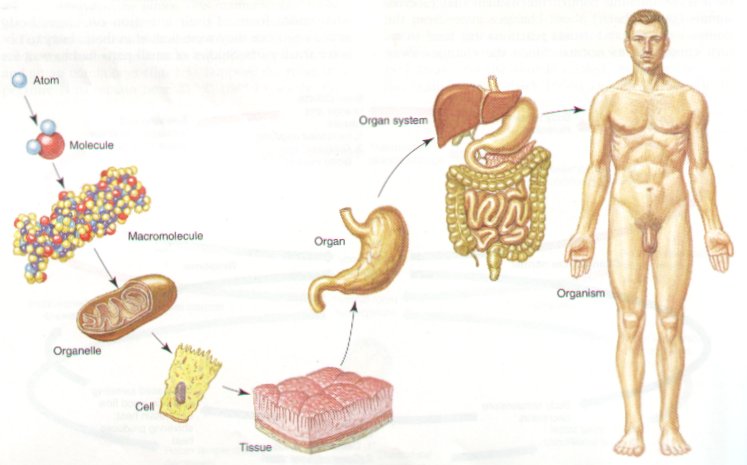
1. CHEMICAL LEVEL

A. The Chemicals that make up the body may be divided into TWO major categories:  INORGANIC AND ORGANIC.

B. INORGANIC CHEMICALS are usually simple molecules made of one or more elements other than CARBON.  Examples:  Water, Oxygen, Carbon Dioxide (an exception), and Minerals such as iron, calcium, and sodium.

C. ORGANIC CHEMICALS are often VERY Complex and ALWAYS CONTAIN THE ELEMENTS CARBON AND HYDROGEN.  Examples:  Carbohydrates, Fats, Proteins, and Nucleic Acids.

2. CELLULAR LEVEL

A. The SMALLEST LIVING UNITS OF STRUCTURE AND FUCTION ARE CELLS.

B. Cells are the smallest living subunits of a multicellular organism such as a human being.

C. There are many different types of cells; each is made of chemicals and carries out specific chemical reactions.

3. TISSUE LEVEL

A. A Tissue is a group of cells with similar structure and function.

B. There are FOUR Groups of Tissue.

C. EPITHELIAL TISSUE – Cover or line body surfaces; some are capable of producing secretions with specific functions.  The outer layer of the Skin and Sweat Glands are examples of Epithelial Tissue.

D. CONNECTIVE TISSUE – Connects and supports parts of the body; some transport or store materials.  Blood, Bone, and Adipose Tissue (Fat) are examples.

E. MUSCLE TISSUE – Specialized for CONTRACTION, which brings about movement.  Our Skeleton Muscles and the Heart are examples.

F. NERVE TISSUE – Specialized to generate and transmit Electrochemical Impulses that regulate body functions.  The Brain and Optic Nerves are examples.

4. ORGAN LEVEL

A. An Organ is a group of TWO or more different types of Tissues precisely arranged so as to accomplish Specific Functions and usually have recognizable shape.

B. Heart, Brain, Kidneys, Liver, Lungs are Examples.

5. ORGAN SYSTEMS (System Level)

A. An Organ System is a group of organs that all contribute to a Particular Function.

B. Examples are the Circulatory, Respiratory, and Digestive Systems.

C. Each organ system carries out its own specific function, but for the organism to survive the organ systems must work together- this is called INTEGRATION OF ORGAN SYSTEM.

6. ORGANISM LEVEL

A. The MOST Complex Level.

B. ALL the Organ Systems of the body functioning with one another constitute the TOTAL ORGANISM – ONE LIVING INDIVIDUAL.

LIFE PROCESSES or CHARACTERISTICS OF LIFE

1. All living organisms carry on certain processes that set them apart from nonliving things.

2. The Following are Several of the more important life processes of Humans:

A. METABOLISM is the sum of all the chemical reactions that occur in the body.  One phase of Metabolism called CATABOLISM provides the ENERGY needed to sustain life by BREAKING DOWN substances such as food molecules.  The other phase called ANABOLISM uses the energy from catabolism to MAKE various substances that form body structures and enable them to function.

B. ASSIMILATION is the changing of Absorbed substances into forms that are chemically different from those that entered body fluids.

C. REPONSIVNESS is the ability to Detect and Respond to changes Outside or Inside the Body. Seeking Water to quench thirst is a response to water loss from body tissue.

D. MOVEMENT includes motion of the whole body, individual organs, single cells, or even structures inside cells.

E. GROWTH refers to an Increase in Body Size.  It may be due to an increase in the size of existing cells, the number of cells, or the amount of substance surrounding cells. It occurs whenever an organism produces new body materials faster than old ones are worn out or replaced.

F. DIFFERENTIATION is the process whereby unspecialized cells become specialized cells.  Specialized Cells differ in Structure and Function from the cells from which they originated.

G. REPRODUCTION refers either to the formation of new cells for Growth, Repair, or Replacement or to the making of a New Individual.

H. Others Include:
Respiration – obtaining Oxygen.
Digestion – Chemically and Mechanically breaking down food substances.
Absorption – The passage of substances through certain membranes.
Circulation – the movement of substances within the body in Body Fluids.
Excretion – Removal of wastes that the body produces.

MAINTENANCE OF LIFE OR SURVIVAL NEEDS

1. The structures and functions of almost all body parts help maintain the Life of the Organism. The ONLY Exceptions are an Organisms Reproductive Structures, which ensure that its species will continue into the future.

2. Life requires certain Environmental Factors, including the Following:

A. WATER – this is the most abundant chemical in the body and it is required for many Metabolic Processes and provides the environment in which Most of them take place. Water also transports substances within the organism and is important in regulating body temperature.

B. FOOD – the Substances that provide the body with necessary Chemicals (Nutrients) in addition to Water. Food is used for Energy, supply the raw materials for building new living matter, and still others help regulate vital chemical reactions.

C. OXYGEN – It is required to release Energy from food substances. This energy, in turn, drives metabolic processes. Approximately 20% of the air be breathe is oxygen.

D. HEAT (BODY TEMPERATURE) –  a form of energy, it is a product of Metabolic Reactions. Normal Body Temperature is around 37 C or 98 F. both low or high body temperatures are dangerous to the organism.

E. PRESSURE (ATMOSPHERIC) – Necessary for our Breathing.

PRINCPAL ORGAN SYSTEMS OF THE HUMAN BODY (TABLE 46-1)

1. INTEGUMENTARY SYSTEM

A. The Skin and Structures derived from it, such as hair, nails, and sweat and oil glands.

B. Is a barrier to pathogens and chemicals (Protects the body), Helps regulate body temperature, Eliminates waste, Helps synthesize vitamin D, and receives certain stimuli such as Temperature, Pressure, and Pain.

2. SKELETAL SYSTEM

A. All the Bones of the body (206), their associated Cartilage, and the Joints of the Body.

B. Bones Support and Protect the body, assist in body movement, They also house cells that produce blood cells, and they store minerals.

3. MUSCULAR SYSTEM

A. Specifically refers to Skeletal Muscle Tissue and Tendons.

B. Participates in bringing about movement, maintaining posture, and produces heat.

4. CIRCULATORY A nd CARDIOVASCULAR SYSTEM

A. The Heart, Blood and Blood Vessels.

B. Transports oxygen and nutrients to tissues and removes waste.

5. LYMPHATIC SYSTEM- Sometimes included with the Immune System or Circulatory System becuase it works closely with Both Systems.

A. The Lymph, Lymphatic Vessels, and Structures or Organs (Spleen and Lymph Nodes) containing Lymph Tissue.

B. Cleans and Returns tissue fluid to the blood and destroys pathogens that enter the body.

6. NERVOUS SYSTEM

A. The Brain, Spinal Cord, Nerves, and Sense Organs, such as the eye and ear.

B. Interprets sensory information, Regulates body functions such as movement by means of Electrochemical Impulses.

7. ENDOCRINE SYSTEM

A. ALL Hormone producing Glands and Cells such as the Pituitary Gland, Thyroid Gland, and Pancreas.

B. Regulates body functions by means of Hormones.

8. RESPIRATORY SYSTEM

A. The Lungs and a series of associated passageways such as the Pharynx (Throat), Larynx (Voice Box), Trachea (Windpipe), and Bronchial Tubes leading into and out of them.

B. Exchange oxygen and carbon dioxide between the air and blood.

9. DIGESTIVE SYSTEM

A. A long tube called the Gastrointestinal (GI) Tract and associated organs such as the Salivary Glands, Liver, Gallbladder, and Pancreas.

B. Breaks down and absorbs food for use by cells and eliminates solid and other waste.

10. URINARY And EXCRETORY SYSTEMS

A. The Kidneys, Urinary Bladder, and Urethra that together produce, store, and eliminate Urine.

B. Removes waste products from the blood and regulates volume and pH of blood.

11. IMMUNE SYSTEM

A.  The Immune System Consists of Several Organs, as well as White Blood Cells in the Blood and Lymph.
Includes the Lymph Nodes, Spleen, Lymph Vessels,Blood Vessels, Bone Marrow, and White Blood Cells (Lymphocytes).

B. Provides protection against Infection and Disease.

12. REPRODUCTIVE SYSTEM

A. Organs that produce, store, and transport reproductive cells (Sperm and Eggs).

B. Produces eggs and sperm, in women, provides a site for the developing embryo-fetus.

HOMEOSTASIS

1.  All of the above systems function together to help the Human Body to Maintain HOMEOSTASIS.

2.   A person who is in good health is in a state of Homeostasis.

3.   Homeostasis reflects the ability of the body to maintain relative Stability and to Function Normally despite constant Changes.

4.   Changes may be External or Internal, and the body must Respond Appropriately.

5.   As we continue to study the Human Body, keep in mind that the Proper Functioning of each Organ and Organ System has a role to perform in maintaining HOMEOSTASIS.

6.  The Human Body uses Homeostasis Mechanisms to maintain its stable internal environment. Homeostasis Mechanisms work much like a Thermostat (NEGATIVE FEEDBACK) that is sensitive to temperature and maintains a relative constant room temperature whether the room gets to Hot or Cold.

BODY CAVITIES

1. Many  organs and organ systems in the human body are housed in compartments called BODY CAVITIES. (Figure 46-2)

2.  These cavities protect delicate internal organs from injuries and from the daily wear of walking, jumping, or running.

3.  The body cavities also permit organs such as the lungs, the urinary bladder, and the stomach to expand and contract while remaining securely supported.

4.  The human body has FOUR Main Body Cavities:

A.  CRANIAL CAVITY – encases the brain.

B.  SPINAL CAVITY – extending from the cranial cavity to the base of the spine, surrounds the Spinal Cord.

THE TWO MAIN CAVITIES IN THE TRUNK OF THE HUMAN BODY ARE SEPARATED BY A WALL OF MUSCLE CALLED THE DIAPHRAGM.

C. THORACIC CAVITY – The upper compartment, contains the heart, the esophagus, and the organs of the respiratory system – the lungs, trachea, and bronchi.

D.  ABDOMINAL CAVITY – The lower compartment, contains organs of the digestive, reproductive, and excretory systems.

ANATOMICAL TERMINOLOGY

To communicate effectively with one another, researchers and clinicians have develop a set of Terms to describe anatomy that have precise meaning.  Use of these terms assumes the body in the ANATOMICAL POSITION.  This means that the body is standing erect, face forward with upper limbs at the sides and with the palms forward.

RELATIVE POSITION

Terms of Relative position describe the location of one body part with respect to another.  The include the following:

1. SUPERIOR – means that a body part is above another part or is closer to the head.

2. INFERIOR – means that a body part is below another body part or toward the feet.

3. ANTERIOR – means toward the front.

4. VENTRAL – also means toward the front

5. POSTERIOR – is the opposite of anterior; it means toward the back.

6. DORSAL – also is the opposite of anterior; it means toward the back.

7. MEDIAL – relates to an imaginary midline dividing the body in equal right and left halves. Sample:  The nose is medial to the eyes.

8. LATERAL – means toward the side with respect to the imaginary midline.  Sample:  The ears are lateral to the eyes.

9. PROXIMAL – describes a body part that is closer to a point of attachment or closer to the trunk of the body than another part.  Sample:  The elbow is proximal to the wrist.

10. DISTAL – is the opposite of proximal.  It means that a particular body part is farther from the point of attachment or farther from the trunk of the body than another part.  Sample:  The fingers are distal to the wrist.

11. SUPERFICIAL – means situated near the surface.

12. PERIPHERAL – also means outward or near the surface.

13. DEEP – describes parts that are more internal.

14. CORTEX  –  the outer layer of an organ

15. MEDULLA –  the inner portion of an organ.