10 Tips to Strengthen Your Impact on Public Health


Public health plays a vital role in creating healthier, safer communities. It focuses on preventing diseases, promoting wellness, and improving the overall quality of life for people. Whether it’s through educating others, advocating for better policies, or working directly with communities, individuals can make a significant difference in this field.

Strengthening your impact on health initiatives doesn’t always require years of professional experience. Anyone can contribute meaningfully with the right knowledge, skills, and actions. From pursuing education to engaging with your local community, there are various ways to create positive change. This article outlines practical tips to help you make a stronger impact in this area.

1. Understand the Core Principles of Public Health

Before taking action, it’s important to understand the basics. Key principles include disease prevention, health promotion, and addressing inequalities in access to care. By learning these principles, you can focus your efforts where they are needed most. For example, promoting vaccination or educating people about nutrition are ways to prevent illness. Addressing disparities by supporting underserved communities ensures everyone has access to the necessary resources. With a solid foundation, you can approach health-related challenges more effectively.

2. Advance Your Education

Furthering your education is a key step toward making a greater impact in the field. By gaining deeper knowledge and specialized skills, you’ll be better equipped to address complex challenges and implement effective solutions. Advanced learning provides insights into areas like disease prevention and data analysis, all of which are critical to improving outcomes. Whether through formal education, workshops, or certifications, continued learning broadens your understanding and opens up new opportunities.

Pursuing an advanced degree can be transformative for those seeking to add value to the field. For those looking to make a more meaningful impact in public health, an online bachelors in public health offers the flexibility to gain essential skills while balancing personal and professional commitments. It also enhances your ability to contribute to community initiatives, advocate for meaningful policies, and collaborate effectively with other professionals.

3. Promote Health Education in Your Community

One of the most impactful ways to help is by educating others. This can be as simple as sharing information about healthy eating, exercise, or the importance of routine check-ups. When people have accurate information, they can make better decisions about their well-being. To spread awareness, consider partnering with local schools, community centers, or social groups. Even informal efforts, like talking to friends and family about important topics, can have a big effect. Health education is a powerful tool for improving outcomes and empowering individuals.

4. Advocate for Policy Changes

Policies play a huge role in shaping access to care and promoting wellness. By advocating for evidence- based policies, you can drive meaningful change. Examples include supporting smoking bans, promoting vaccinations, or pushing for better nutrition programs in schools. You don’t need to be a policy expert to get involved. Writing to local representatives, signing petitions, or joining advocacy groups are accessible ways to make your voice heard. Policy changes often have long-lasting effects, benefiting many people over time.

5. Volunteer with Public Health Organizations

Volunteering is an excellent way to make a direct impact. Many organizations work to improve access to care, distribute resources, and educate the public. By offering your time and skills, you can support these efforts and learn more about the challenges communities face. Look for opportunities with local health departments, non-profits, or global initiatives. Volunteering helps others and gives you valuable experience and insights into pressing challenges. It’s a hands-on way to make a difference while learning more about the field.

6. Leverage Technology to Improve Public Health

Technology offers countless tools to make efforts more effective and far-reaching. Mobile apps, data tracking systems, and online platforms allow professionals and community members to share information, monitor trends, and provide resources efficiently. For example, apps that track fitness or diet encourage healthier lifestyles, while tele-health services bring medical care to those in remote areas. Additionally, platforms like social media can spread health awareness quickly and widely. By staying informed about technological advancements and using these tools, you can contribute to better outcomes for individuals and communities.

7. Collaborate with Diverse Stakeholders

Improving health outcomes often requires teamwork. Collaboration with educators, healthcare providers, local governments, and non-profits can amplify your efforts. Each group brings unique perspectives and resources, making solutions more comprehensive and effective. For instance, working with schools to implement nutrition programs or teaming up with community centers to organize vaccination drives can address specific health needs. Building strong relationships with these stakeholders ensures a unified approach to solving challenges and creates a greater impact on overall well-being.

8. Address Health Disparities in Underserved Communities

Health disparities, such as unequal access to medical care or resources, remain a major challenge. Focusing efforts on underserved populations ensures that no one is left behind. Whether it’s providing education, facilitating access to healthcare, or advocating for policy changes, targeting these disparities can create lasting improvements. Consider volunteering at clinics in low-income neighborhoods, supporting food banks, or mentoring youth in underserved areas. These efforts help bridge the gap and ensure everyone has a fair chance at leading a healthy life.

9. Stay Informed About Emerging Public Health Issues

Staying updated on the latest trends and challenges is essential for anyone working to improve community well-being. Whether it’s responding to pandemics, addressing mental health crises, or tackling climate change’s impact on health, keeping yourself informed allows you to adapt your efforts effectively. Follow reliable sources like government health departments, research institutions, and trusted media outlets to stay ahead. Engaging in webinars, conferences, or reading scientific publications can also deepen your understanding. Knowledge is a powerful tool that helps you make informed decisions and contribute more effectively.

10. Measure and Celebrate Your Impact

Evaluating the results of your efforts is crucial to understanding what works and what doesn’t. Tracking outcomes through data collection or personal observations provides valuable insights for future initiatives. For example, measuring participation rates and improvements can help refine your approach if you start a community fitness program. It’s also important to celebrate achievements, no matter how small. Acknowledging your progress keeps you motivated and inspires others to get involved. Sharing successes, like a completed project or a positive outcome, reinforces the importance of your work and builds momentum for future efforts.

Improving public health is a shared responsibility that requires dedication, education, and collaboration. By applying these tips—embracing technology, working with others, addressing disparities, staying informed, and celebrating milestones—you can make a meaningful difference in your community. Whether you’re pursuing advanced education in public health, volunteering, or advocating for policy change, your efforts contribute to healthier and more equitable outcomes. Remember, small steps add up, and each action brings us closer to a healthier future for all.

Chemistry Study Guide BI


Chemistry Study Guide


Give the name & charge for the 3 subatomic particles in an atom.
What is the smallest particle of matter that keeps all the same properties of oxygen?
What is an element?
All matter in the universe is made of what?
Where are electrons found in atoms?
Electrons will move to a higher energy level whenever they absorb what?
If atoms are packed tightly together is the substance a solid, liquid, or gas?
If the outer energy level of an atom is filled with electrons, will it react?
If an atom only has 6 outer electrons, will it gain or lose electrons to form an ionic bond?
If an atom has 2 outer electrons, will it gain or lose electrons to form an ionic bond?
Why is carbon able to form four covalent bonds with other atoms?
Are covalent bonds formed from sharing or transferring electrons between atoms?
Where are the electrons found that are involved in ionic & covalent bonding?
What is an atom called that has lost or gained electrons?
Are ionic bonds formed from sharing or transferring electrons between atoms?
If the products have less energy than the reactants in a chemical reaction, is the reaction endergonic or exergonic? 
Has energy been released or absorbed if the products of a reaction have less energy than the reactants?
Chemical reactions drive all of the activities within __________.
Sketch a graph showing an exergonic reaction. 
What helps reduce the amount of activation energy required in chemical reactions?
Biological catalysts are called __________.
Cells contain thousands of different enzymes. True or False
Has a molecule been oxidized or reduced when it gains an electron & hydrogen ion?
Oxidation-reduction reactions in organisms allow the passage of _________ from molecule to molecule.
__________ is determined by the number of particles of a substance in a solution.
If a solution is neutral, what is true about its number of hydrogen & hydroxide ions?
If a solution is alkaline or a base, does it have more hydroxide or hydrogen ions?
If a solution has a pH of 11, is it an acid or base?
Solutions with a pH less than 7, would be acids or bases?
_________ in organisms help prevent great changes in pH.
BACK


Chemistry of Organisms

Chemistry
All Materials © Cmassengale

Composition of Matter

Ø  Everything in the universe is made of matter

Ø  Matter takes up space & has mass

Ø  Mass is a measure of the amount of matter in the substance

Ø  Mass & weight are NOT the same

Ø  Weight is a measure of the pull of gravity on an object

Question: Is the mass of an object the same on the moon as it is on the Earth? Is its weight the same? (Hint: Gravitational pull on the moon is 1/6 of that on the Earth.)

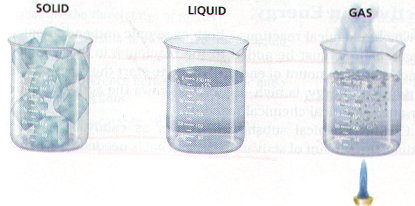
Ø  Matter exists in 4 states – solid, liquid, gas, & plasma

Ø  Solids have both a definite volume & definite shape (rock)

Ø  Liquids have a definite volume but no definite shape; they can be    poured (water)

Ø  Gases do not have a definite volume or definite shape, but they take the  volume & shape of their container

Ø  Plasmas have no definite volume, no definite shape, and only exist at extremely high temperatures such as the sun

Ø  Chemical Changes in matter are essential to all life processes

Ø  Biologists study chemistry because all living things are made of the same kinds of matter that make up nonliving things

Elements

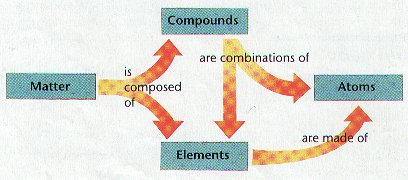
Ø     Elements are pure substances which cannot be chemically broken down into simpler kinds of matter

Ø     More than 100 elements have been identified, but only about 30 are important in living things

Ø     All of the Elements are arranged on a chart known as the Periodic Table

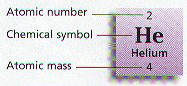
Ø     Periodic charts tell the atomic number, atomic mass, & chemical symbol for every element

Ø     Four elements, Carbon – C, Hydrogen – H, Oxygen – O, and Nitrogen – N make up almost 90% of the mass of living things

Ø     Every element has a different chemical symbol composed of one to two letters

Ø     Chemical symbols usually come from the first letter or letters of an element like C for Carbon and Cl for Chlorine

Ø     Some chemical symbols come form their Latin or Greek name such as  Na for Sodium (natrium) or K for Potassium (Kalium)

Ø      Elements in the same horizontal period on the periodic table have the same number of energy levels (e.g. H & He in period 1 have only a K energy level)

[Periodic Table]
All Period 2 elements have 2 energy levels
(K & L)

Ø      Elements in the same vertical Family on the periodic table have the same number of electrons in their outermost energy level & react similar (e.g. Family IV, the Carbon family all have 4 electrons in their outermost energy level)

Atoms

Ø     Atoms are the simplest part of an element that keeps all of the element’s properties

Ø     Atoms are too small to be seen so scientists have developed models that show their structure & properties

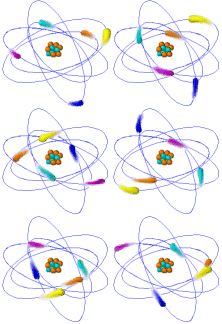
Ø     Atoms consist of 3 kinds of subatomic particlesprotons & neutrons in the center or nucleus, and electrons spinning in energy levels around the center

Ø     The nucleus is the center of an atom where most of the mass is concentrated

Ø     Protons are positively charged ( p+ ),  have a mass of 1 amu (atomic mass unit) , are found in the nucleus, and determine the atomic number of the element

Example:  Carbon has 6 protons so its atomic number is 6

Ø     Neutrons are neutral or have no electrical charge (n), have a mass of 1 amu, are found in the nucleus, and when added to the number of protons, determine the atomic mass of the element

Example:  Sodium has 11 protons and 12 neutrons so its atomic mass is 11+12=23 amu

Ø     Electrons (e-) are negatively charged, high energy particles with little mass that spin around the nucleus in energy levels

Ø     Seven energy levels (K, L, M, N, O, P, & Q) exist around the nucleus and each holds a certain number of electrons

Ø     The K energy level is closest to the nucleus & only holds 2 electrons, while the  L – Q energy levels can hold 8 electrons  

Ø     Electrons in outer energy level are traveling faster & contain more energy than electrons in inner levels  

Ø     The number of protons (positive charges) and electrons (negative charges in an atom are equal so the net electrical charge on a atom is zero making it electrically neutral

Ø     Stable or non-reactive atoms have an outer energy level that is filled with electrons  

Compounds

Ø     Most elements do not exist by themselves; Most elements combine with other elements

Ø      Compounds are made of atoms of two or more elements chemically combined

Ø      Chemical Formulas represent a compound & show the kind & number of atoms of each element  (e.g. H2O has 2 hydrogen & 1 oxygen)

Ø      Compounds have different physical & chemical properties than the atoms that compose them  (e.g. hydrogen & oxygen are gases but H2O is a liquid)

Ø      The number & arrangement of electrons in an atom determines if it will combine to form compounds

Ø      Chemical reactions occur whenever unstable atoms (outer energy level not filled) combine to form more stable compounds

Ø      Chemical bonds form between atoms during chemical reactions

Types of Chemical Bonds

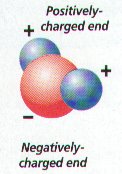
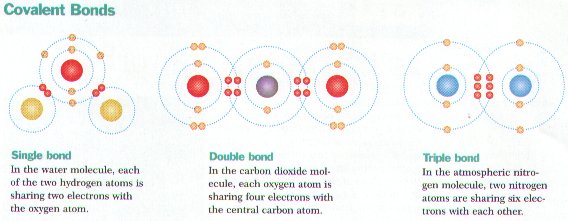
Ø     Covalent bonds form between atoms whenever they share 1 or more pairs of electrons (e.g. H2O)  

Ø     Molecules form from covalent bonding & are the simplest part of a compound (e.g. NaCl, H2O, O2)  

Ø     Ionic bonding occurs between a positively & negatively charged atom or ion  

Ø     Positively charged ions have more electrons (-) than protons (+); negatively charged ions have more protons than electrons

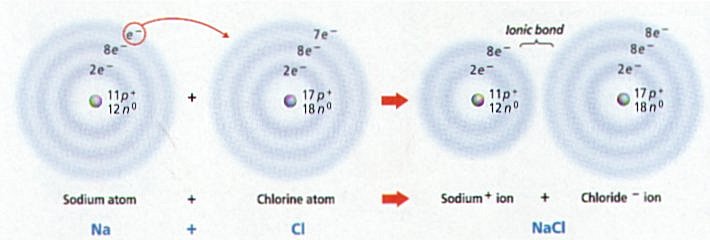
Ø     Table salt (NaCl) forms when the 1 outer electron of Na is transferred to the outer energy level of chlorine that has 7 electrons (e-)

Ø     Sodium (Na) with 1 less e- becomes positively charged, while Chlorine (Cl) with 1 more e- becomes negatively charged; the + and – charges attract & form the ionic bond holding NaCl together

Ø     Other types of chemical bonding include hydrogen bonding

Energy

Ø     Energy is the ability to do work

Ø     Energy occurs in several forms & may be converted from one form to another

Ø     Sunlight is the ultimate energy for all life on earth

Ø     Forms of energy include chemical, electrical, mechanical, thermal, light, & sound

Ø     Free energy is the energy available for work (e.g. cells have energy to carry out cell processes)

Ø     Cells convert the chemical energy stored in food into other types of energy such as thermal & mechanical

Ø     Energy is used to change matter form one state into another (e.g. liquid into a gas)

Chemical Reactions

Ø     Living things undergo thousands of chemical reactions

Ø     Chemical equations represent chemical reactions

Ø     CO2 + H20—–goes to—–H2CO3  (carbonic acid) is a sample Chemical Reaction in living things

Ø     Reactants are on the left side of the equation, while products are on the right side

Ø Activation energy is required to start many reactions

Ø     Chemical bonds are broken, atoms rearranged, and new bonds form in chemical reaction

Ø     Plants use sunlight to produce sugars such as C6H12O6 glucose; the chemical energy from the sun is stored in the chemical bonds of glucose

Ø      Organisms eat plants, break down the sugars, and release energy along with CO2 & H2O

Ø      Exergonic reactions involve a net release of energy; while endergonic reactions involve a net absorption of energy

Ø      Energy must be added to the reactants for most chemical reactions to occur; called activation energy

Ø      Enzymes are chemical substances in living things that act as catalysts & reduce the amount of activation energy needed

Ø      Organisms contain thousands of different enzymes

Ø      Most enzymes end with –ase (e.g. lipase is the enzyme that acts on lipids)

Reduction-Oxidation (Redox) reactions

Ø     Reactions in which e- are transferred between atoms is a redox or reduction-oxidation reaction (e.g. formation of table salt NaCl)

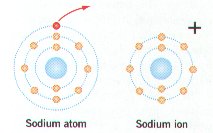
Ø     In oxidation reactions, a reactant loses 1 or more e- & becomes positively (+) charged (e.g. Sodium atom becomes a Na+ ion)

Ø     In a reduction reaction, a reactant gains 1 or more e- and becomes negatively (-) charged (e.g. Chlorine atom becomes a Cl- ion)

Ø     REDOX reactions always occur together; the electron(s) from the oxidation reaction are then accepted by another substance in the reduction reaction

Solutions

Ø     A large percentage of the mass of organisms is water & many of the chemical reactions of life occur in water

Ø     A solution  is a uniform mixture of one substance in anther

Ø     Solutions may be mixtures of solids, liquids, or gases

Ø     The solute is the substance uniformly dissolved in the solution & may be ions, molecules, or atoms

Ø     The solvent is the substance in which the solute is dissolved

Ø     Water is known as the universal solvent 

Ø     Dissolving one substance in another does not alter their chemical properties

Ø     The concentration of a solution is a measure of the amount of solute dissolved in a given volume of solvent

Ø     Increasing the amount of solute increases the solution’s concentration

Ø     Aqueous solutions are solutions in which water is the solvent; these are important in living things (e.g. blood, cytoplasm of cell…)

Acids and Bases

Ø     The degree of acidity or alkalinity (basic) is important in organisms

Ø     The force of attraction between molecules is so strong that the oxygen atom of one molecule can actually remove the hydrogen from other water molecules; called Dissociation

Ø      H20—–GOES TO—– H+  +  OH-

Ø     OH- called hydroxide ion; H+ called hydrogen ion

Ø     Free H+ ion can react with another water molecule to form H3O+  (hydronium ion)

Ø     Acidity or alkalinity is a measure of the relative amount of H+ and OH- ions dissolved in a solution

Ø     Neutral solutions have an equal number of H+ and OH- ions

Ø     Acids have more H3O+ ions than OH- ions; taste sour; and can be corrosive

Ø     Bases contain more OH- ions than H3O+ ions; taste bitter; & feel slippery  


Examples of Common Acids

  • citric acid (from certain fruits and veggies, notably citrus fruits)
  • ascorbic acid (vitamin C, as from certain fruits)
  • vinegar (5% acetic acid)
  • carbonic acid (for carbonation of soft drinks)
  • lactic acid (in buttermilk)
Examples of Common Bases

  • detergents
  • soap
  • lye (NaOH)
  • household ammonia

PH Scale

Ø     Compares the relative concentration of H3O+ ions and OH- ions

Ø     Scale ranges from 0 to 14; 0-3 is very acidic; 7 is neutral; 11-14 is very basic or alkaline


Ø    Litmus paper, phenolphthalein, pH paper, & other indicators that change color can be used to measure pH

Buffers

Ø     Control of pH is important to organisms

Ø     Enzymes function only within a narrow pH range; usually neutral

Ø     Buffers neutral acids or bases in organisms to help control pH

Chemistry Study Guide Chemistry On-line


BACK