
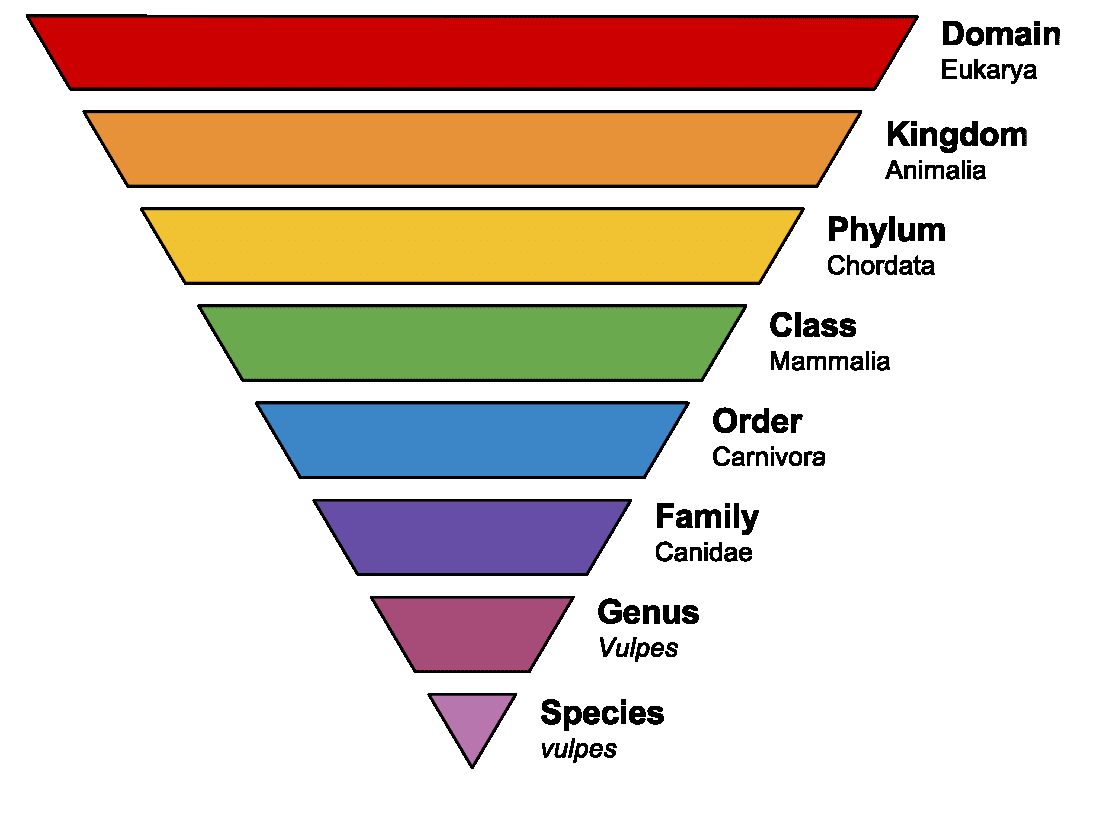
Classification of living things organizes organisms into named groups so that biologists can identify them, communicate about them, and investigate their relationships. A common classroom hierarchy is domain → kingdom → phylum → class → order → family → genus → species. The chart below shows those eight ranks using humans as an example.
Classification chart: broadest to most specific
Each group sits within a broader group. Two organisms can share a domain but belong to different kingdoms; two members of the same genus share all the broader ranks in that classification. The ranks describe groups, not fixed counts of individual organisms.
| Rank | Human example | How to read it |
|---|---|---|
| Domain | Eukarya | Broad grouping; humans are eukaryotes. |
| Kingdom | Animalia | Humans belong to the animals. |
| Phylum | Chordata | A group defined by shared chordate features during development. |
| Class | Mammalia | The mammal group within chordates. |
| Order | Primates | One order within mammals. |
| Family | Hominidae | The great ape family, including humans. |
| Genus | Homo | The genus part of the scientific name. |
| Species | Homo sapiens | The complete two-part species name, not “sapiens” alone. |
This is a selection of major ranks. Taxonomic databases may also show subphyla, superfamilies, and other intermediate groups. The ITIS human record includes several of them.
Why do some worksheets list seven levels?
A seven-rank list usually begins with kingdom. An eight-rank list adds domain above it. Read the instructions before answering: a question about Linnaeus’s historical hierarchy may be asking for seven ranks, while a modern classroom overview may include domain.
A memory prompt is Dear King Philip Came Over For Good Soup. Use it to recall the order, then check understanding: which is broader, order or family? Which includes more kinds of organisms, a particular genus or a species within it?
Domains and kingdoms are different ranks
The widely taught three-domain model uses Bacteria, Archaea, and Eukarya. Bacteria and Archaea have prokaryotic cell organization; eukaryotic organisms have cells with a membrane-bound nucleus as part of their basic cell organization. Archaea are not simply bacteria living in extreme places; the two groups differ, and many archaea live in ordinary environments.
Older school materials often use six kingdoms: Eubacteria, Archaebacteria, Protista, Fungi, Plantae, and Animalia. Treat that as a teaching framework with a history, rather than the only possible current classification. “Protists” cover varied eukaryotic lineages rather than one natural group containing every descendant of a shared ancestor. Modern classifications change as evolutionary evidence improves. For further explanation, see OpenStax on eukaryotic origins and protists.
Use the terminology required by a course while explaining its limits. A domain is not a synonym for kingdom, and neither a list of kingdoms nor a ladder of ranks is a complete evolutionary tree.
Classification examples and common mistakes
Humans are chordates, but not all chordates have a backbone
Humans belong to Chordata and its vertebrate subgroup. A notochord is one of the defining chordate features during development. Defining the whole phylum only by a backbone leaves out chordates such as lancelets and tunicates. Similarly, “invertebrate” is a useful broad description, not one formal class equivalent to Mammalia.
Red maple: a name is not an explanation of ancestry
The red maple is Acer rubrum, in the genus Acer. Kew currently places it in the family Sapindaceae; older resources may show Aceraceae. The name of its order, Sapindales, does not mean that trees enter the group simply because they produce sap. Use a taxonomic source instead of inferring group membership from an English word association. See Kew’s red maple record.
How to write a scientific name
- Use the genus and specific epithet together: Homo sapiens.
- Capitalize the genus; keep the specific epithet lowercase. Italicize both when typing, or underline each word separately when handwriting.
- After introducing the full name, shorten the genus when the reference remains clear: H. sapiens.
- The second word alone is not the complete species name. Shared word endings do not establish close relationship.
Binomial nomenclature is the two-part naming system. Classification concerns where the organism is placed; a scientific name labels the organism within the relevant naming system. Names may be Latin or Latinized forms drawn from different languages. The biology word-part list can help interpret a clue, but literal word meanings cannot replace evidence about the organism.
Classification, identification, and evolutionary trees
Classification places organisms in groups. Identification determines what a specimen is, often by comparing features with a key. Phylogeny concerns evolutionary history. A dichotomous key works through paired choices; it is not automatically a diagram of ancestry. A phylogenetic tree is a hypothesis about relationships, tested using evidence such as anatomy and molecular sequences. The University of Hawaiʻi classification lesson connects these ideas.
For many sexually reproducing organisms, the biological species concept emphasizes interbreeding natural populations and reproductive isolation. That approach has limits for asexual organisms, fossils, and some hybridizing groups. Species identification therefore cannot always be reduced to a test of whether two individuals can have fertile offspring.
Original practice with explanations
- Two organisms share a family. Must they share an order? Yes, within the same classification: the family is nested within an order. They need not share a genus.
- Correct “homo Sapiens.” Write Homo sapiens: capital genus, lowercase epithet, both italicized.
- Does “both have wings” prove two animals belong to the same class? No. A similar function can arise in different lineages. Classification needs relevant shared features and broader evolutionary evidence.
- A worksheet asks for seven ranks, starting with kingdom. Where did domain go? It is above kingdom in the eight-rank overview; its omission may reflect the scope of that worksheet.
- A leaf key identifies a specimen as red maple. Has it proved the tree’s ancestry? No. Identification with a key and inference of evolutionary relationships answer different questions.
Choose a teaching route
- Prepare: revisit cell structures and prokaryotic/eukaryotic organization and the scientific word-parts lesson.
- Explain: use the classification chart, then compare grouping, naming, and identification.
- Apply: use the Alien Taxonomy Project as a fictional naming and key-design exercise. Its invented organisms and two made-up kingdoms are not a model of Earth’s accepted taxonomy.
- Extend carefully: preview the legacy Taxonomy Review download. It contains older kingdom terminology and naming questions that need teacher discussion; it is not presented here as an updated assessment or verified answer key.
For an AP extension, ask students what new molecular evidence could change a proposed grouping. Require an explanation of the evidence rather than only recall of rank names.