|
|
|
|

Instructor: Cheryl Massengale
Textbook: Modern Biology by Holt, Reinhart, & Winston
Updated April 10, 2006
| First Semester | ||
| Subject | Weeks of Instruction | Chapters |
| Chemistry of Life | 2.5 | |
| Cells | 6.5 | |
| Genes | 6.5 | |
| Second Semester | ||
| Mechanics of evolution | 2 | |
| Biological Diversity | 2.5 | |
| Plant Form & Function | 3.5 | |
| Animal Form & Function | 7.0 | |
| Ecology | 2.0 | |

| Date | Topic of Study | Chapters to read | Labs | Tutorial Links | |
| 8/21
to 9/12 |
Chemistry & Biochemistry |
Chapter 1 Chapter 2 Chapter 3 Chapter 4 Chapter 5 |
Lab 2: Enzyme Catalysis
Organic Models |
Periodic Table
|
|
| Unit one Test – Biochemistry | |||||
| 9/13
to 10/6 |
Cells | Chapter 7 Chapter 8 Chapter 11 Chapter 12 Chapter 13 |
Lab 1: Osmosis & Diffusion
Microscopy Lab
|
Cell Size | |
| Unit 2 Test over Cells (chapters 7,8,11,12,13) | |||||
| 10/9
to 10/24 |
Cellular Energetics | Chapter 6
Chapter 9 Chapter 10 |
Lab 5: Cell Respiration
Lab 4: Plant Pigments & Photosynthesis |
Photosynthesis Problem Set 1 | |
| Unit 3 Test over Cellular Energetics (chapters 6, 9, & 10) | |||||
| Second Nine Weeks – Genetics | |||||
| 10/25
to 11/14 |
Heredity | Chapter 14
Chapter 15 |
Lab 3: Mitosis & Meiosis
|
The Cell Cycle & Mitosis Tutorial
Online Onion Root Tip Activity Cell Division Laboratory Tutorial |
|
| Unit 4 Test over Heredity (chapters 14 & 15) | |||||
| 11/15
to 12/20 |
Molecular Genetics | Chapter 16
chapter 17 Chapter 18 Chapter 19 Chapter 20 Chapter 21 |
Lab 6: Molecular Biology
|
J. Watson bio | |
| Unit 5 Test over Molecular Genetics (chapters 16 – 21) | |||||
| Third Nine Weeks – Evolution, Taxonomy, Plants | |||||
| 1/9
to 1/30 |
Evolutionary Biology | Chapter 22
Chapter 23 Chapter 24 Chapter 25 |
Lab 7: Genetics of Drosophila | The Museum of Paleontology (UCMP) | |
| Unit 6 Test over Evolution (chapters 22-25) | |||||
| 1/31
to 2/13 |
Diversity of Organisms | Chapter 26
Chapter 27 Chapter 28 Chapter 31 |
Lab 8: Population Genetics & Evolution
Gram Staining Lab |
Introduction to Viruses | |
| Unit 7 Test over Taxonomy, Prokaryotes, & Simple Eukaryotes (chapters 26, 27,28, and 31) |
|||||
| 2/14
to 3/13 |
Structure & Function of Plants | Chapter 29 Chapter 30 Chapter 35 Chapter 36 Chapter 37 Chapter 38 Chapter 39 |
Lab 9: Transpiration
|
Angiosperm Structure and Function | |
| Units 8A & 8B Tests over Plants ( Chapters 29 & 30, 35 – 39 ) | |||||
| Fourth Nine Week – Animals & Ecology | |||||
| 3/14
to 4/17 |
Invertebrates & Vertebrates | Chapter 32
Chapter33 Chapter34 |
Invertebrate/Vertebrate Dissections | Interactive Animal Diversity Test | |
| Unit 9A & 9B Test over Vertebrates & Invertebrates (chapters 32-34) | |||||
| 4/18
to 4/30 |
Structure & Function of Animals | Chapter 40 Chapter 41 Chapter 42 Chapter 43 Chapter 44 Chapter 45 Chapter 46 Chapter 47 Chapter 48 Chapter 49 |
Lab 10: Physiology of Circulatory System
|
Arteriosclerosis | |
| Units 10A & 10 B Tests over Animal Systems ( Chapters40 – 49 ) | |||||
| 5/1
to 5/11 |
Ecology | Chapter 50 Chapter 51Z Chapter 52 Chapter 53 Chapter 54 Chapter 55 |
Lab 11: Behavior
Lab 12: Dissolved Oxygen & Aquatic Primary Productivity |
Tall-grass prairie | |
| Unit 11 Test over Ecology ( Chapters 50 – 55 ) | |||||
| AP Exam – May 14 | Final Exam – May 23 | ||||
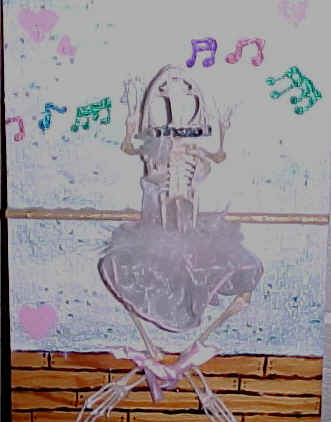
| Bullfrog Skeleton Reconstruction |
Introduction:
The skeleton of the frog consists chiefly of bony and cartilaginous elements. The functions of a skeleton include providing support for the body, protection of delicate internal organs and attachment surfaces for muscles. In vertebrates, the axial skeleton consists of the skull, vertebral column, sternum (breast bone) and ribs (which are not present in amphibians). The vertebral column of frogs is made up of 10 vertebrae, the first of which (called the atlas) articulates with the base of the skull. The atlas is the only cervical vertebra in the frog. The next seven vertebrae are abdominal vertebrae, which is the large sacrum with two strong transverse processes that join with the ileum. The last vertebra is the long and highly modified urostyle. Note: Most vertebrates have a tail supported by caudal vertebrate, but frogs and toads are atypical in that they lack any tail and are therefore called anurans (“tail less amphibians”).
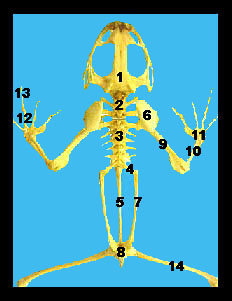 |
1. Skull
|
The appendicular skeleton includes the limbs and the pectoral and pelvic girdles that support them. In most vertebrates the forelimbs consist of three major bones — the humerus, radius and ulna, along with the smaller bones of the hand (carpals, metacarpals and phalanges). Note that in the frog the radius and ulna have become fused into a single bone, the radio-ulna. Likewise, the hindlimbs consist of three major bones — the femur, tibia and fibula, along with the smaller bones that make up the feet (tarsals, metatarsals and phalanges). Once again, in frogs and toads the tibia and fibula have become fused into a single bone, the tibio-fibula. The pectoral girdle consists of four pairs of bones (the suprascapula, scapula, coracoid, and clavicle). The last three pairs are connected to the sternum. In frogs, the pelvic girdle, which supports the hindlimbs, is formed by the fusion of the ilium, ischium and non-ossified pubis. Each femur fits into a socket on the pelvic girdle called an acetabulum. Note that the pelvic girdle and limb structure are well adapted for giving a powerful, synchronous thrust of both hind limbs in swimming and jumping
Objective:
By reassembling an amphibian skeleton, students will learn the bones and modifications of a vertebrate.
Materials:
Dermestid beetles, small aquarium with air-vented lid, dermestid bedding, food, & water supply, freeze-dried bullfrogs, tweezers, small container with lid for bones, 20% H2O2, thin piece of wood, paints, and glue.
Procedure:
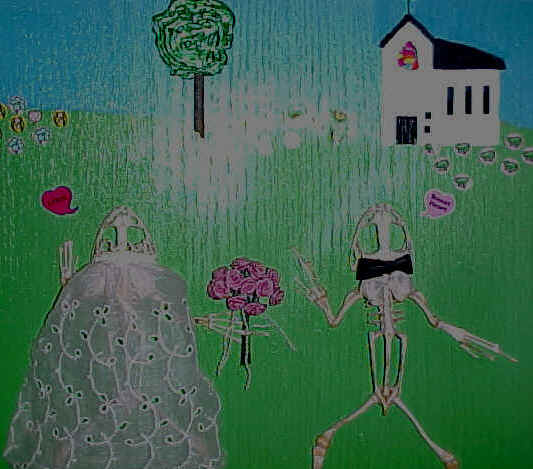
Examples:
 |
 |
 |
| Birds All Materials © Cmassengale |
 |
Birds:
| Well adapted to marine, freshwater, & terrestrial habitats | |
| Bodies adapted for flight | |
| Endothermic – body temperature controlled by metabolism |
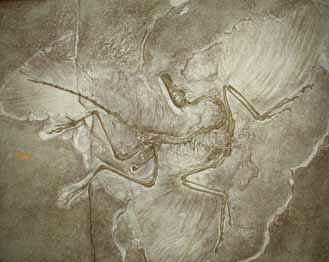
Evolution:
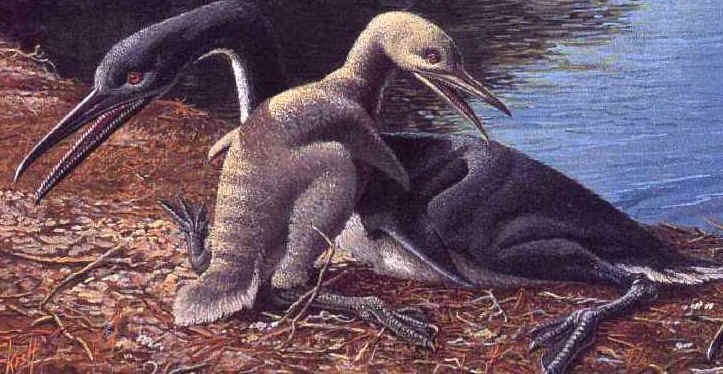
Hesperonis

Characteristics of Birds:
Feathers:
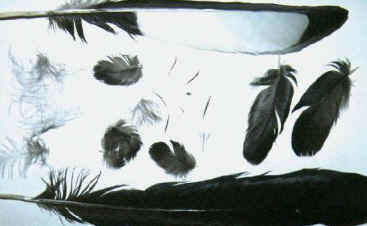
Types of Feathers
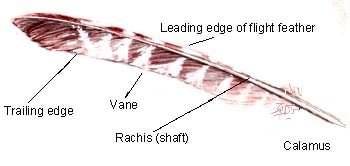
Parts of a feather:
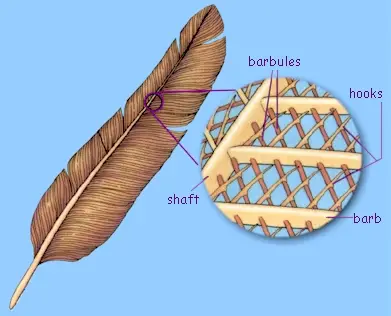
Parts of a Flight Feather
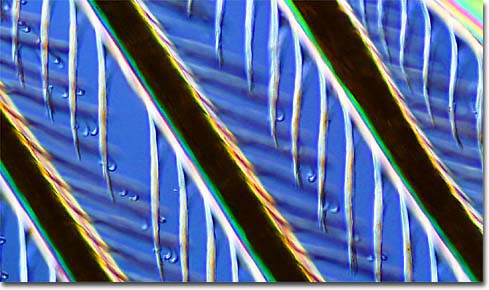
Microscopic Hooks on Barbules
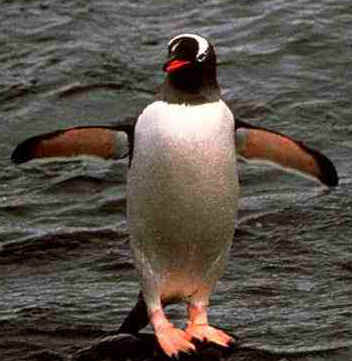
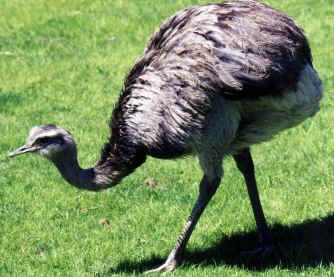
Beaks and Feet:
 |
||
| Talons | Hooked Beak | Penguin Flippers |
 |
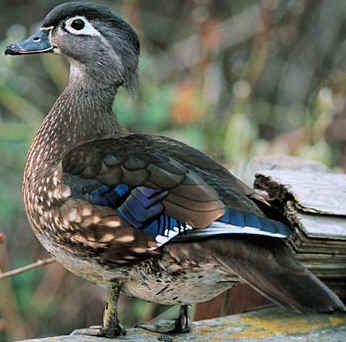 |
| Running Legs of Ostrich | Webbed Feet on Duck |
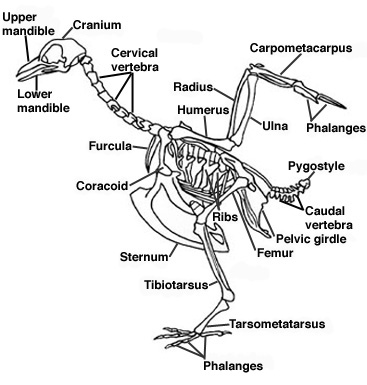
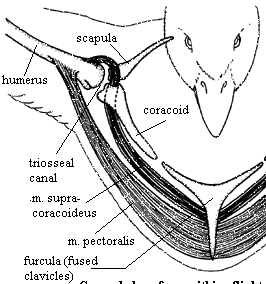
Skeleton and Muscles:
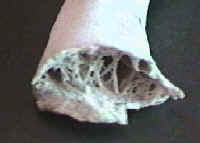
Hollow Bones
Body Temperature:
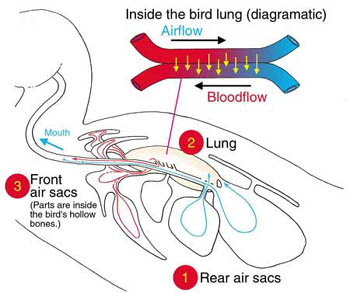
Air Sacs in Bird Lungs
Digestive System:
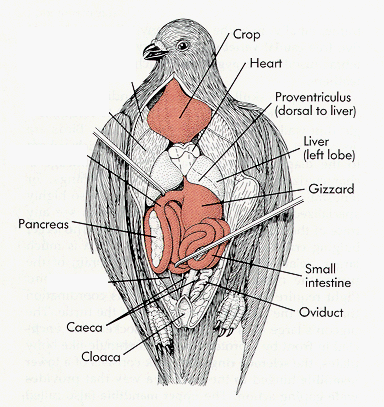
Excretory System:
Respiratory System:
 trachea (windpipe) syrinx (voice box) 2 primary bronchi 75% of air into two posterior air sacs and 25% of air into lungs
  air from lungs into other seven air sacs
Circulatory System:
Nervous System:
Reproductive System:
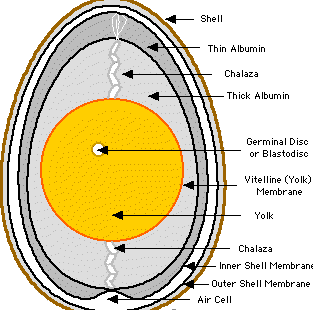
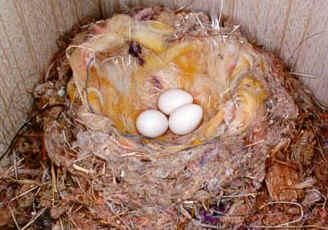
Bird Egg
Incubation & development of Egg:
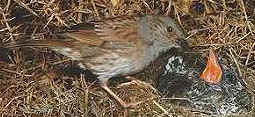 |
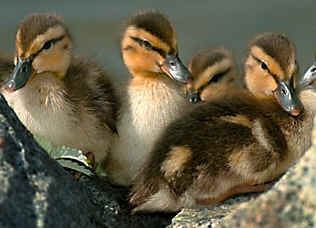 |
| Altricial Young | Precocial Young |
Behavior:
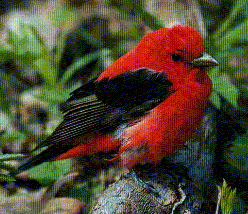
Male Scarlet Tanager Breeding Plumage
| Section 2 Review |
Classification:
 |
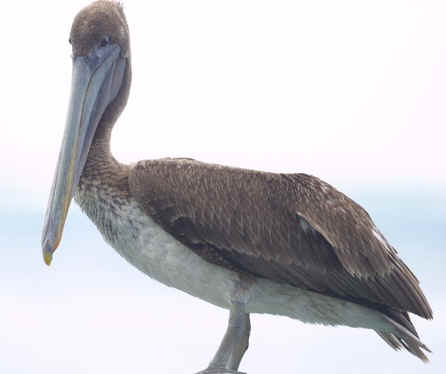 |
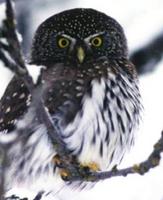
| Pygmy Owl | Brown Pelican |
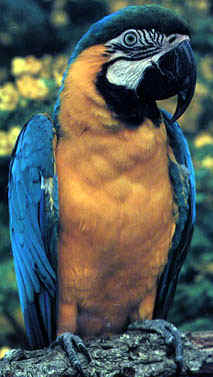 |
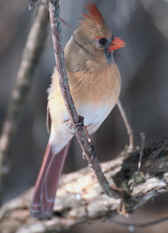 |
| Macaw | Female Cardinal |
Food & Habitat Adaptations:
| Section 3 Review |
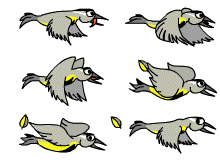 Birds & Mammals Study Guide
| What replaces teeth in modern birds? |
| How many chambers are there in a bird’s heart? a mammal’s heart? |
| Name 2 vertebrate groups that lay amniote eggs? |
| Did all fossilized birds have beaks? Explain. |
| Do most terrestrial vertebrates use internal or external fertilization? |
| Which mammal group carries its young in a pouch? |
| What mammal order lives entirely in water? |
| What characteristic of retile, bird, & mammal skin allows them to live on land? |
| Give several uses for hair or fur in mammals. |
| Name 2 main characteristics of all mammals. |
| What determines the type of teeth a mammal will have? |
| What group of mammals are egg layers? |
| What is the purpose of the placenta? |
| List several ways that birds are different from reptiles. |
| What were the earliest flying vertebrates? |
| From what group did birds probably arise? |
| Besides amniote eggs & living on land, name another way reptiles & birds are alike? |
| What group of mammals remain inside the mother until they are completely developed? |
| What mammal group has forelimbs modified into flippers? |
| What type of teeth are found in deer? |
| Name 2 sirenians. |
| What mammal group is born immature & finishes developing in the mother’s pouch? |
| In what order are dogs found? |
| Give 2 uses for the sounds that bats make? Can humans hear these sounds? |
| Name 2 marsupial mammals. |
| Echidnas & duck billed platypus are what type of mammals? |
| What are monotremes? |
| What are placental mammals? |
| Feathers are modified __________. |
| Describe the bones of birds. |
| What is the purpose of the crop in birds? |
| Birds excrete their nitrogenous waste as ____________. |
| Why is a bird’s respiration so efficient? |
| What are talons & what is their function? |
| Do all songbirds produce songs? Explain. |
| Where is the diaphragm located in mammals? What is its purpose? |
| Give the function of the syrinx in birds. |
| Reptiles called therapsids gave rise to what vertebrate group? |
| What type of teeth would carnivorous mammals have? |