Energy in Food Writeup

Energy in Food Write Up

Introduction:

Use your lab and your textbook to locate and include the following information in your introduction.

  • What organisms are capable of making their own food?
  • What process do they use to do this?
  • Where do these organisms get their energy for food-making?
  • This energy is captured with the help of what pigment?
  • This energy is stored in what organic molecules?
  • Where exactly in the organic molecules is the energy stored and so it can be used again later? (Hint: Energized electrons form these and then energy is released again when they are broken.)
  • What process takes place in plants & animals to release energy?
  • What gas is required for the process to occur?
  • When foods are “burned” in our bodies, where is the energy being released from? Where did this energy originally come from?
  • What is the usable form of energy for our cells?
  • Define calorimetry and explain how it can be used to measure energy stored in chemical bonds of food.

Hypothesis:

  • Write a statement explaining that calorimetry can be used to detect the amount of energy stored in the chemical bonds of foods.

Materials:

In sentence form, write a statement listing the materials required for this lab.

Procedure:

  • In paragraph form, write the procedures for completing this lab.

Results:

  • Draw and fill in table 1 showing the results of burning
  • Draw and fill in table 2 showing your data analysis for nut calorimetry
  • Write out and answer the questions on the lab. Remember to write and underline the question, but do NOT underline the answer.

Conclusion: (Write in paragraph form.)

  • Restate your hypothesis.
  • Tell how were you able to measure the amount of energy in each nut
  • Did all three nuts contain the same amount of food energy? Explain by giving data from your experiment..
  • Explain why some foods contained more energy than others
  • Tell where this energy originally come from and how it got into the nuts
  • Explain any errors you might have made in lab that could have affected your results

Earthworm Worksheet

Name(s)_______________________________ Group_______ Date__________ Period_______

Earthworm Worksheet 


1. What is the name of the pumping organs of an earthworm?


2. Trace the parts of the digestive tract through which food passes.


3. Which parts of the earthworm serve as its brain?  How are these parts connected to the rest of the body?


4. Which of the parts of the worm’s body that you saw are included in the excretory system?


5. How can you find out whether an earthworm eats soil?


6. Among the earthworm’s structural adaptations are its setae. How do you think the earthworm’s setae make it well adapted to its habitat?


7. How is the earthworm’s digestive system adapted for extracting relatively small amounts of food from large amounts of ingested soil?


8. Your dissection of the earthworm did not go beyond segment 32. What will you observe if you dissect the remainder of the worm to its posterior end?


9. On a separate piece of paper, draw and label the parts of the earthworm you observed, and color code the systems. Use green for the reproductive system, yellow for the digestive system, blue for the excretory system, and red for the nervous system.


10. During mating, two earthworms exchange sperm. Fertilization is external, and cocoons are produced from which the young eventually emerge. Refer again to steps 5 and 11, where you located the earthworm’s reproductive organs. Use a reference to identify the role of each organ in the reproductive process of the earthworm. On a separate paper, summarize your findings.

BACK

DNA Code for Insulin


DNA’s Instructions for Insulin  


Introduction:

Below are two partial sequences of DNA bases (shown for only one strand of DNA)  Sequence 1 is from a human and sequence 2 is from a cow.  In both humans and cows, this sequence is part of a set of instructions for controlling the production of a protein.  In this case, the sequence contains the gene to make the protein insulin.  Insulin is necessary for the uptake of sugar from the blood.  Without insulin, a person cannot use digest sugars the same way others can, and they have a disease called diabetes.

Materials:

paper, pencil, codon table

Procedure:

  1. Using the DNA sequence given in table 1, make a complimentary RNA strand for  the human.  Write the RNA directly below the DNA strand (remember to substitute U’s for T’s in RNA).
  2. Repeat step 1 for the cow.  Write the RNA directly below the DNA strand in table 2.
  3. Use the codon table in your book to determine what amino acids are assembled to make the insulin protein in both the cow and the human.   Write your amino acid chain directly below the RNA sequence.

Table 1 


Sequence 1 ­ Human
DNA C C A T A G C A C G T T A C A A C G T G A A G G T A A
RNA
Amino Acids


Table 2

Sequence 1 ­ Cow
DNA C C G T A G C A T G T T A C A A C G C G A A G G C A C
RNA
Amino Acids

Analysis:

1. The DNA sequence is different for the cow and the human, but the amino acid chain produced by the sequence is almost the same.  How can this happen?


2. Diabetes is a disease characterized by the inability to break down sugars. Often a person with diabetes has a defective DNA sequence that codes for the making of the insulin protein. Suppose a person has a mutation in their DNA, and the first triplet for the gene coding for insulin is C C C  (instead of C C A).   Determine what amino acid the new DNA triplet codes for.    Will this person be diabetic?


3. What if the first triplet was C A A ?


4. How is it that a code consisting of only four letters, as in DNA ( A, T, G, C ) can specify all the different parts of an organism and account for all the diversity of organisms on this planet?


DNA sequences are often used to determine relationships between organisms.  DNA sequences that code for a particular gene can vary widely.  Organisms that are closely related will have sequences that are similar. Below is a list of sequences for a few organisms:


Human CCA   TAG   CAC   CTA
Pig CCA   TGG   AAA   CGA
Chimpanzee CCA   TAA   CAC   CTA
Cricket CCT   AAA   GGG   ACG


5. Based on the sequences, which two organisms are most  closely related?


6. An unknown organism is found in the forest, and the gene is sequenced, and found to be   C C A  T G G  A A T  C G A  ,  what kind of animal do you think this is?


DNA Replication Lab

Modeling DNA Replication


Introduction

Within the nucleus of every cell are long strings of DNA, the code that holds all the information needed to make and control every cell within a living organism. DNA, which stands for deoxyribonucleic acid, resembles a long, spiraling ladder. It consists of just a few kinds of atoms: carbon, hydrogen, oxygen, nitrogen, and phosphorus. Combinations of these atoms form the sugar-phosphate backbone of the DNA — the sides of the ladder, in other words.

Other combinations of the atoms form the four bases: thymine (T), adenine (A), cytosine (C), and guanine (G). These bases are the rungs of the DNA ladder. (It takes two bases to form a rung — one for each side of the ladder.) A sugar molecule, a base, and a phosphate molecule group together to make up a nucleotide. Nucleotides are abundant in the cell’s nucleus. Nucleotides are the units which, when linked sugar to phosphate, make up one side of a DNA ladder.

During DNA replication, special enzymes move up along the DNA ladder, unzipping the molecule as it moves along. New nucleotides move in to each side of the unzipped ladder. The bases on these nucleotides are very particular about what they connect to. When the enzyme has passed the end of the DNA, two identical molecules of DNA are left behind. Cytosine (C) will “pair” to guanine (G), and adenine (A) will “pair” to thymine (T). How the bases are arranged in the DNA is what determines the genetic code.


When the enzyme has passed the end of the DNA, two identical molecules of DNA are left behind. Each contains one side of the original DNA and one side made of “new” nucleotides. It is possible that mistakes were made along the way — in other words, that a base pair in one DNA molecule doesn’t match the corresponding pair in the other molecule. On average, one mistake may exist in every billion base pairs. That’s the same as typing out the entire Encyclopedia Britannica five times and typing in a wrong letter only once!

Objectives

The replication of DNA before cell division can be shown using paper templates for the components of DNA nucleotides.

Materials

  • Cut Outs of basic subunits of DNA
  • Colors or markers
  • Scissors
  • Tape or glue
  • Paper & pencil

Procedure:

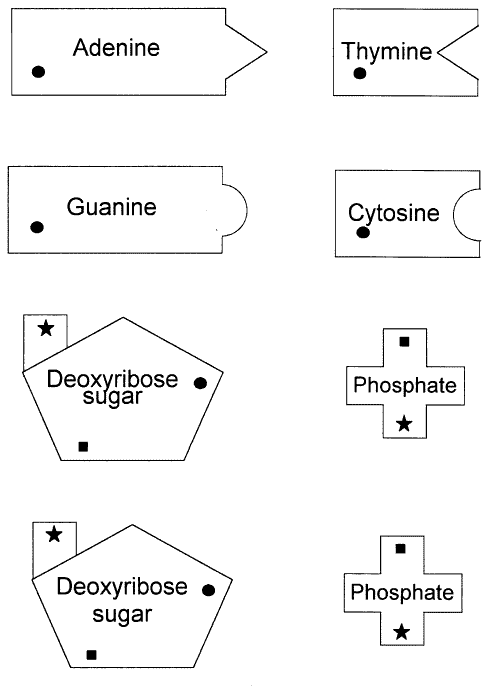
  1. Cut out all of the units needed to make the nucleotides from the handout provided.
  2. Color code the Nitrogenous bases, phosphorus, and deoxyribose sugar as follows —
    Adenine = red, Guanine = green, Thymine = yellow, Cytosine = blue, Phosphate = brown, and Deoxyribose = purple.
  3. Using the small squares and stars as guides, line up the bases, phosphates and sugars.
  4. Now glue the appropriate parts together forming nucleotides.
  5. Construct DNA model using the following sequence to form a row from top to bottom – cytosine (topmost), thymine, guanine, and adenine (bottommost).
  6. Let this arrangement represent the left half of your DNA molecule.
  7. Complete the right side of the ladder by adding the complementary bases. You will have to turn them upside down in order to make them fit.
  8. Your finished model should look like a ladder.
  9. To show replication, separate the left side from the right side, leaving a space of about 6-8 inches.
  10. Use the remaining nucleotides to complete the molecule using the left side as the base.
  11. Build a second DNA model by adding new nucleotides to the right half of the original piece of the molecule.
  12. Tape the nucleotides together to form 2 complete DNA ladders.

Questions

1. Of the 4 bases, which other base does adenine most closely resemble?

2. List the 4 different nucleotides.

3. Which 2 molecules of a nucleotide form the sides of a DNA ladder?

4. If 30% of a DNA molecule is Adenine, what percent is Cytosine?

5. What does the term replication mean?

6. What is another name for adenine and three phosphate molecules attached to it?


Effect of Solutions on Cells

 Effect of  Solutions on Cells

What happens when cells are place in different kinds of solutions

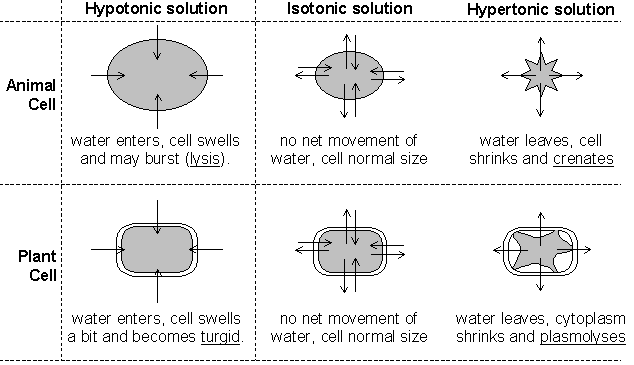
Plant cells placed in a hypertonic solution will undergo plasmolysis, a condition where the plasma membrane pulls away from the cell wall as the cell shrinks. The cell wall is rigid and does not shrink. 

   The Elodea cells  have been placed in a 10% NaCl solution. The contents of the cells have been reduced to the spherical structures shown.  


   Normal Elodea cells


Animal cells placed in a hypertonic solution will undergo crenation, a condition where the cell shrivels up as it loses water. Red blood cells in a hypotonic solution will swell and burst or lyse.


BACK