Mitosis PPT Questions

Cell Cycle and Mitosis
ppt Questions

Cell Cycle

1.Prokaryotic organisms include ___________, while plants and animals are ____________.

2. Describe prokaryotes.


3. How do bacteria asexually reproduce?

4. Name the 3 main steps of binary fission in bacteria.

    a.

    b.

     c.

5. Name a bacterial cell that reproduces by binary fission.

6. Describe eukaryotes.


7. How do eukaryotes asexually reproduce cells?

8. The stages in the growth and reproduction of a cell are called the __________ ___________.

9. List the 5 stages in the cell cycle.


10. What does G1 stage stand for?

11. Name two things that happen to a cell during G1?


12. What is the S stage of the cell cycle?

13. _________ instructions are copied in the S phase as ___________ are duplicated.

14. _______ stands for second growth stage.

15. G2 is the time between ____________ and ___________.

16. Cells continue to _________ during G2 and to make __________ that will be needed for mitosis or cell division.

17. Mitosis or cell division is known as the ________ stage.

18. How does a cell use its energy during the M phase?

19. Does a cell continue growing & making proteins in the M phase?

20. Mitosis is also called _______________ which means division of the ____________.

21. ____________ is called the resting stage and makes up the longest part of a cell’s life cycle.

22. What happens to cells during interphase?


23. Are chromosomes visible during interphase?

Mitosis

24. Name the 4 stages of mitosis.


25. Name 2 things that happen to a cell during prophase.

     a.

     b.

     c.

     d.

     e.

26. Can chromosomes be seen during prophase?

27. Sketch a eukaryotic chromosome and label the centromere and kinetochore fiber that attaches to it.


28. How many pairs of chromosomes are found in humans?

29. List 3 things that occur during metaphase.

     a.

     b.

     c.

30. Where are chromosomes located during metaphase of a cell?

31. What stage occurs after metaphase?

32. List 2 things that happen to cells during anaphase.

     a.

     b.

33. Sketch and label the mitotic spindle and attached chromosomes.


34. What is the last stage of mitosis?

35. Where are the two sets of chromosomes located at Telophase?

36. What two things reform during Telophase?

37. Chromosomes ___________ during Telophase so they are no longer visible.

38. In plants, what begins to form that will separate the two cells?

39. How are the two cells separated from each other in animals?


40. _____________ or division of the cytoplasm follows ___________, division of the nucleus, and forms ____________ daughter cells.

41. How do the two, new daughter cells compare to each other?


42. Label the following stages of mitosis.


Printable Copy

Mollusk & Annelid Study Guide B1

Mollusk & Annelid Study Guide

Be able to answer these questions:

  • Name the kingdom for mollusks & annelids.
  • What is the oldest part of a bivalves shell called?
  • What muscles open & close a bivalves shell?
  • What tissue surrounds & protects the soft body of mollusks?
  • What is the larval stage of mollusks called & describe it?
  • What structure enables a squid to move by jet propulsion?
  • What are the external segments of an earthworm’s body called?
  • Name the internal shell of a squid.
  • How do earthworms breathe?
  • Earthworms are hermaphrodites. What does this mean?
  • What type of symmetry do annelids & mollusks have?
  • What are the respiratory organs of aquatic mollusks & annelids called?
  • What are aortic arches & what organism has them?
  • What type of circulatory system do mollusks & annelids have?
  • What is the tongue-like structure called that snails use to scrap algae?
  • What is the “lip” of an earthworm called & how is it used?
  • Name the muscular organ used by mollusks for movement.
  • Name several examples of bivalve mollusks.
  • Give an example of a univalve mollusk.
  • Give an example of a marine, shelled cephalopod mollusk.
  • What is the area of a mollusk’s body called that contains most of the body organs?

Know the class for each of the following mollusks & annelids:

  • clams & scallops
  • snails & slugs
  • clam worms
  • chitons
  • squid & octopus
  • leeches
  • earthworms

Be able to label these internal parts of a clam:

  • heart
  • gills
  • anus
  • adductor muscles
  • incurrent siphon

Be able to recognize pictures of these mollusks & annelids:

  • clam
  • snail
  • lugworm
  • leech
  • earthworm
  • chiton
  • squid
  • octopus

Metric Measurement Lab


Metric Measurement Lab


Part A: Count your drops!


Take a guess – How many drops of water will it take to equal 1 milliliter? _____ drops

Follow the directions to find the number of drops in 1 milliliter of water, then answer the questions. You will need a small graduated cylinder (25 ml), a beaker of water, and an eyedropper for this section.  Remember to read the bottom of the meniscus when you are reading the volume of a liquid in a graduated cylinder.


  1. Fill a small graduated cylinder with 10 ml of water.
  2. Count the number of drops it takes to raise the water to 11 ml. Record the number in the chart.
  3. Leave the water in the graduated cylinder and count the number of drops it takes to raise the water to 12ml. Record the number in the chart.
  4. Leave the water in the graduated cylinder and count the number of drops it takes to raise the water to 13ml. Record the number in the chart.
  5. Calculate your average and round to the nearest tenth.


Picture of graduated cylinder


# of drops to 11 ml # of drops to 12 ml # of drops to 13 ml Average


Based on your average, how close were you to your guess?________

Based on your average, how many drops would it take to make 1 liter? _______

Part B: Water Displacement


Follow the directions to find the volume of three marbles using water displacement.

  1. Add 20 ml of water to a 100 ml graduated cylinder. Record this amount in the chart.
  2. Add three marbles to the cylinder and measure the volume. Record this amount in the chart.
  3. Find the difference between the two measurements and record in the chart. The difference between the two measurements will be the volume of the three marbles.
Volume of Water Before adding Marbles (ml) Volume of Water After Adding Marbles (ml) Difference in Volume (ml) Volume of 3 Marbles


Part C: Mass Mania


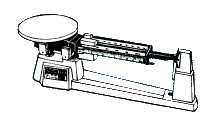
The gram is the standard unit of mass in the metric or SI system. The basic instrument used to measure mass is the mass balance.  Some mass measurements can be made using an electronic balance.


  1. Check to see that the Pointer is pointing to zero.
  2. If it is not, check to see that all the Riders (weights) are all the way to the left at the Zero mark.
  3. Adjust the balance by turning the Adjustment Screw slowly until it points to zero.
  4. Place your metric ruler on the pan and read & record the ruler’s mass.
  5. After resetting the balance to Zero, measure and record the mass of the empty 50-ml graduated cylinder and then the 3 marbles.
  6. Reset the balance to ZERO when all items have been massed.


Mass of Metric Ruler (g) Mass of Empty 50-ml graduated cylinder (g) Mass of 3 Marbles (g)


Part D: Volume by Formula


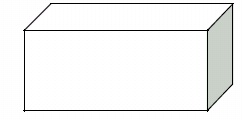
Use the formula to find the volume of the box. Measure to the nearest centimeter before calculating your answer.  If necessary, Round your answer to Two Decimal places.


Volume = length x width x height

__________ x __________ x __________ =________________cm3


Part E: Color Challenge


1. Obtain the following items from your teacher:

  • 3 beakers with colored water- 25 ml of each color (red, blue, and yellow)
  • 1 graduated cylinder (25 ml – 50 ml)
  • 1 eyedropper
  • 6 test tubes labeled A, B, C, D, E, and F

2. Perform each step outlined below using accurate measurements.

  1. Measure 17 ml of RED water from the beaker and pour into test tube A.
  2. Measure 21 ml of YELLOW water from the beaker and pour into test tube C
  3. Measure 22 ml of BLUE water from the beaker and pour into test tube E.
  4. Measure 5 ml of water from test tube A and pour it into test tube B.
  5. Measure 6 ml of water from test tube C and pour it into test tube D.
  6. Measure 8 ml of water from test tube E and pour it into test tube F.
  7. Measure 5 ml of water from test tube C and pour it into test tube B.
  8. Measure 2 ml of water from test tube A and pour it into test tube F.
  9. Measure 4 ml of water from test tube E and pour it into test tube D.

3. Complete the chart.

Test Tube Color Final Volume (ml)
A
B
C
D
E
F

Click HERE for Notebook Copy


Metric Measurement PPT Questions


Metric Measurement
ppt Questions

Metric System

1.When and by whom was the metric system developed?

2. The metric system is based on powers of ________.

3. Where is the metric system used?


4. The metric system is especially used by what group?

5. How is the metric system abbreviated & how did it get this abbreviation?


Metric Prefixes 

6. Regardless of the ________, the metric system uses the __________ prefixes.

7. Give 3 of the most common metric prefixes and their value.


8. One meter equals how many centimeters?         How many millimeters?

Length, Mass, and Volume

9. Define length.

10. What is the SI base unit for length?

11. _________ sticks or __________ rulers are used to determine length in the metric system.

12. Define mass.


13. If two object are the same size, will theyhave the same mass? Explain your answer.


14. What is the SI unit for mass?

15. What common object has approximately the mass of one gram?

16. How could you change the mass of an object?


17. A ___________ ___________ __________ is a scale used to measure metric masses.

18. Why will a triple beam balance give the same mass for an object no matter what planet it is on?


19. Define weight.


20. Explain why the weight of an object can change?


21. What is the SI unit for measuring weight?

22. What is gravity?


23. The force of gravity depends on what 2 things?


24. The greater the distance, gravity _________ so weight would be ____________.

25. The more mass an object has, the pull of gravity is _________ so the object will have ___________ weight.

26. How much less gravity does the moon have than the Earth?

27. If you had a mass of 36 kilograms on Earth, what would be your mass on the moon?

28. If you had a weight of 60 Newtons on Earth, what would be your weight on the moon?

29. What planet has 2.5 times more gravity than the Earth?

30. Would your mass be the same on Jupiter?    your weight?

31. Define volume.


32. How do you find the volume of a box?

33. The units for the volume of a box would be _________ centimeters.

34. Find the volume of a cube that is 3 cm on all sides.


35. What is the base unit for the volume of a liquid?

36. What scientific equipment is used to measure the volume of liquids?

37. Liquids make a curved upper surface when poured into graduated cylinders, so you must read the _____________ of the curve known as the ________________.

38. In the metric system, 1 cm3 equals __________________ of water having a mass of ________________.

Water Displacement and Density

39. ____________ ______________ is a method used to tell the volume of irregularly shaped objects.

40. If a rock causes the water level in a graduated cylinder to rise from 8.8 to 10 ml, what is the volume of the rock?

41. What is the mass of 25 ml of water? (Hint: look back at your answer to question #38.)

42. What is the mass of 1 liter of water?

43. Define density.


44. When finding the density of an object, the ___________ of an object measured in ___________ is divided by its _____________ measured in ______________ or ______________.

45. What are the units of measurement for density?

46. Sketch the density wheel that can be used to solve density problems.


47. If you know the mass and density, how can you determine the volume using the density wheel?


48. Find the density if the mass of an object is 24 g and the volume is 8 cm3.


49. Find the volume if the density is 3g/cm3 and the mass is 24 grams.


50. Find the mass if the density is 2g/cm3 and the volume is 8cm3 .


51. What is the density of 1 gram of water?


52. What is the volume of .5 kg of water?


53. In terms of density, why do some objects float?


54. Objects with a density less than __________ will float on top of water.

55. A toy boat has a density of 1.5 g/ml. Will the toy boat float?

56. What is true about objects that have a density equal to water?


57. How do fish and submarines that are denser than water float?


58. Why did the Titanic float before it hit the iceberg?


59. Why did the Titanic sink after hitting the iceberg?


Metric System

Metric System (SI)
Scientist use a single, standard system of measurement.  The official name of the measurement system is SYSTEME INTERNATIONAL d’UNITES (International System of Measurements) or SI.

The metric system is based on the number 10.

Main Units of Measurement
Length Volume Mass
meter (m) liter (l) gram (g)

Using the above values (meter, liter, & gram) as the base, their value can be increased or decreased by moving the decimal point to the right (lowers the value) or left (raises the value).

Metric Conversion Table

Kilo-
(k)
Base Unit
(m, l, g)
Centi-
(c)
Milli-
(m)
Micro-
(µ)
nano-
(n)
x 1000 meter, gram, liter 100 1000 1000 1000
1000 1 .01 .001 .000001 .000000001

Convert the following values by moving the decimal point the correct number of spaces and in the right direction .

1. 69.8 meters (m) =  ________________ centimeters (cm)

2. 152.97 milliliters (ml)  =  ________________ liters (l)

3. 42.67 liters (l) = _____________ milliliters (ml)

4. 299.32 kilometers (km) = ____________ nanometers (nm)

5. 26 grams (g) = _____________ kilograms (kg)

6. 123.43 centigrams (cg) = ______________ grams (g)

7. 75.2 liters (l)  = __________________milliliters (ml)

8. 456.3 grams (g) = ________________ micrograms µg

9. 4507.22 kilometers (km) = _______________millimeters (mm)

10. 0.00297456 kilograms (kg) = ___________ nanograms (ng)

BACK