Cell Study Guide Ch4 BI

Cell Study Guide

What type of cells did Hooke view when he discovered cells?
What are the smallest units of life called?
Which increases faster, the surface area or the volume of a cell?
What limits how large a cell can grow?
What do you call organisms that do not have a nucleus?
Give an example of a prokaryote.
Name several eukaryotic cells.
What type of cells have membrane-bound organelles?
Prokaryotes have a cell membrane and a ___________ around the outside.
What are cell membranes?
Give 2-3 functions of the cell membrane.
The cell membrane is selectively permeable. What does this mean?
If a cell is very active and needs more energy, what type of organelle will it need more of?
What organelle makes a cell’s ATP?
Proteins are made by what organelle?
What organelle is the packaging & export center of the cell?
What double membrane surrounds the nucleus?
Name the 3 main parts to all eukaryotic cells.
What canals connect the nuclear membrane with the cell membrane for the movement of materials?
In what organelle are chromosomes found?
Name 2 structures found in plant cells but not in animal cells.
Where does photosynthesis occur in a cell?
 In what organelles is the green pigment chlorophyll found?
  What is the purpose of large vacuoles in plant cells?
List the levels of organization in order from simplest to most complex starting with the cell.    
BACK


Cellular Respiration Study Guide BI


Cellular Respiration Study Guide
What type of organisms carry on photosynthesis?
What type of organisms carry on cellular respiration?
To get the most ATP from glucose, what type of respiration must follow glycolysis?
Does fermentation take place with oxygen?
Does oxidative respiration need oxygen?
Is glycolysis an efficient pathway for getting ATP (energy) from glucose? Explain.
Is oxidative respiration or aerobic respiration an efficient pathway fro getting ATP from glucose? Explain.
Is lactic acid fermentation aerobic or anaerobic?
When cells break down food, energy is temporarily stored in what molecule?
What energy molecule is essential for a cell to do any of its work?
What is the process called when organic compounds are broken down in the absence of oxygen?
What is the name of the process that breaks down food molecules in cells to release energy?
What gas is made during photosynthesis that is later used in cellular respiration?
What is the name of the process that splits glucose into pyruvate & releases some ATP?
What builds up in muscles when they are overworked and there is not enough oxygen present?
If lactic acid forms when glucose is broken down, this shows that there was not enough of what gas present?
What are the 2 main stages of cellular respiration called?
Citric acid forms during which part of cellular respiration?
Does glycolysis need oxygen?
What 2 energy carriers are formed during the Krebs cycle?
Is the Calvin cycle part of cellular respiration? Explain.
Is the energy carrier NADPH formed in cellular respiration? Explain.
Carbon dioxide, water, & ATP are formed during the _______ cycle and the ___________ chain.
Which produces more ATP — Krebs cycle & electron transport chain or glycolysis?
Water is formed at the end of _______________________.


Back


Cell Division Study Guide BI

Cell Division Study Guide

What molecule contains the information needed to direct all the activities of a cell?
Where in a cell are prokaryotic chromosomes found? eukaryotic chromosomes?
A human somatic cell contains how many homologous chromosomes?
How many chromosomes are in an human egg cell? sperm cell?
What is a karyotype?
Are gametes diploid or haploid?
Zygotes will have what chromosome number?
Does cell division in bacteria take place in the same way as it does in eukaryotes? Explain.
In what stage do cells spend most of their life cycle?
Is mitosis asexual or sexual reproduction?
A new nuclear envelope develops during cell division in what stage?
In what stage do chromatids separate from each other?
How does the number of chromosomes in newly divided cells compare with the number of chromosomes in the original cell?
During what type of cell division do haploid cells develop from diploid cells?
In order for DNA to fit into a cell, what must be done to compact it?
What is a centromere?
How many chromosomes are in a human skin cell? a human ovum?
Bacteria reproduce by a method known as _____________  ______________.
What is the shape of a bacterial chromosome?
Chromosomes are arranged along the equator of a cell during which stage of cell division?
Spindle fibers are made of ________________.
Be able to recognize sketches of the stages of mitosis.
What happens during cytokinesis in a plant cell?
Homologs separate during ________________.
BACK


Birds & Mammals Study Guide BI

Birds & Mammals Study Guide

What replaces teeth in modern birds?
How many chambers are there in a bird’s heart? a mammal’s heart?
Name 2 vertebrate groups that lay amniote eggs?
Did all fossilized birds have beaks? Explain.
Do most terrestrial vertebrates use internal or external fertilization?
Which mammal group carries its young in a pouch?
What mammal order lives entirely in water?
What characteristic of retile, bird, & mammal skin allows them to live on land?
Give several uses for hair or fur in mammals.
Name 2 main characteristics of all mammals.
What determines the type of teeth a mammal will have?
What group of mammals are egg layers?
What is the purpose of the placenta?
List several ways that birds are different from reptiles.
What were the earliest flying vertebrates?
From what group did birds probably arise?
Besides amniote eggs & living on land, name another way reptiles & birds are alike?
What group of mammals remain inside the mother until they are completely developed?
What mammal group has forelimbs modified into flippers?
What type of teeth are found in deer?
Name 2 sirenians.
What mammal group is born immature & finishes developing in the mother’s pouch?
In what order are dogs found?
Give 2 uses for the sounds that bats make? Can humans hear these sounds?
Name 2 marsupial mammals.
Echidnas & duck billed platypus are what type of mammals?
What are monotremes?
What are placental mammals?
Feathers are modified __________.
Describe the bones of birds.
What is the purpose of the crop in birds?
Birds excrete their nitrogenous waste as ____________.
Why is a bird’s respiration so efficient?
What are talons & what is their function?
Do all songbirds produce songs? Explain.
Where is the diaphragm located in mammals? What is its purpose?
Give the function of the syrinx in birds.
Reptiles called therapsids gave rise to what vertebrate group?
What type of teeth would carnivorous mammals have?
BACK


Biochemistry Study Guide


Biochemistry Study Guide


1. Molecules with a slightly negative end and a slightly positive end are called ___________________  _____________________________.

2. A monomer of protein is called an __________________  __________________.

3. An attractive force between like particles is called ___________________________.

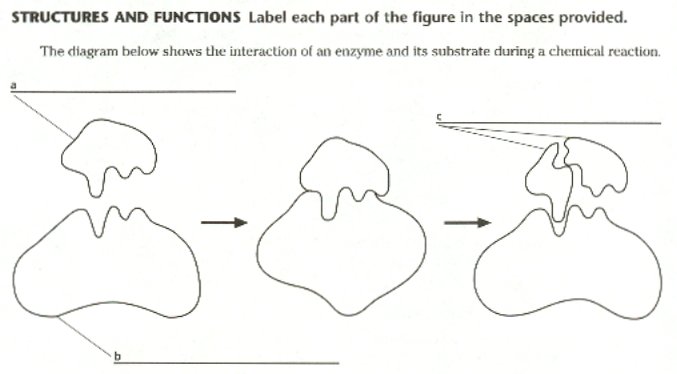
4. Organic molecules that catalyze reactions in living systems are ______________________.

5. The compound found in living things that supplies the energy in one of its chemical bonds directly to cells is ______________________.

6. Enzymes lower activation energy by___________ to the ____________________ and ______________________ bonds within the ________________________.

7. The monomers that make up nucleic acids are called __________________________.

8. The type of attraction that holds two water molecules together is called __________________________  __________________________.

9. The sharing of three pairs of electrons is called a ___________________  _____________.

10.  The structural building block that determines the characteristics of a compound is called the _____________________________  _______________________.

11.  Large carbon compounds are built from smaller molecules called ______________________________.

12.  What is the type of reaction that forms large molecules from smaller ones? _________________________________  _____________________________.

13.  What type of reaction breaks large molecules into smaller ones? _______________________

14.  What is the by product of a condensation reaction? __________________________

15.  The attractive force between unlike particles is called ____________________________.

16.  A compound that is stored as glycogen in animals and as a starch in plants is ____________________________________.

17.  Lipids are good energy storage molecules because they have many _________________-___________________ bonds.

18.  What are the components of many lipids? ________________________  ______________________

19.  What is the monomer of many polysaccharides? ______________________________

20.  What kind of reaction allows amino acids to become linked together? ________________________________  _____________________________.

21.  Nucleic acids function primarily to carry __________________________  ____________________ and direct _____________________  ______________________.

22. Tends not to react with water, “Water Fearing”  ________________________________

23. Attracted to water molecules, “Water Loving” _________________________________

24. Water is called a ___________________________  ___________________________.
DIRECTIONS: Read Chapter 3, Biochemistry, and Answer the questions below as completely and as thoroughly as possible. Answer the question in essay form (not outline form), using complete sentences. You may use diagrams or pictures to supplement your answers, but a diagram or picture alone without appropriate discussion is inadequate.

1. Describe the structure of a water molecule, and explain how the electrical charge is distributed over the molecule.

2. Describe the structure of amino acids and proteins.

3. What are the structural differences between monosaccharides, disaccharides, and polysaccharides?

4. What is capillarity? Include defining Adhesion and Cohesion.

5. How does a condensation reaction differ from a hydrolysis reaction?

6. Give Three reasons why water is an effective solvent.

7. What is an organic compound?

8. What property allows carbon compounds to exist in a number of forms?

9. The presence of four electrons in the outermost energy level of a carbon atom enables
carbon atoms to form what THREE Things.

10. Living things contain many different proteins of vastly different shapes and functions.
What determines the shape and thus the function of a particular protein?

11. How does the structure of a phospholipid, linear molecules with a polar end and a
nonpolar end, relate to their function in the cell membrane?